Examining Real Madrid's Tactical Tweaks Under Zinedine Zidane
Moods, vibes and sensations: Since Zinedine Zidane replaced Rafa Benitez as manager at Real Madrid, these are the areas in which change has been most notable.
Under the Frenchman, Madrid's stars have looked vibrant and unshackled in four games thus far, the driver of which has been the obvious rapport the team shares with Zidane. For Benitez, that never appeared to exist.
As such, the widely accepted themes of Zidane's management to date have been the impact of his aura and gravitas, as well as how his disposition appears to align neatly with the demands of his new job. But such a focus ignores the slight but significant tactical tweaks that have been evident under Zidane; Madrid's system, on close examination, looks different now than it did in late 2015.


Below, we'll examine those adjustments.
Midfield Clarity and Continuity
What Benitez was trying to achieve at Real Madrid was both abundantly clear and understandable. Having inherited a team with a skewed balance, the Madrileno attempted to craft a side of a different essence—a side of more control, added energy and greater power in midfield.
Such a shift proved difficult, however. Collectively, Madrid's players looked reluctant to fully embrace Benitez's ideas, seeing the manager tinker regularly as he searched for his ideal setup. Additionally, Benitez, amid questions over his style, at times looked caught between his own principles and the expectations of the president, fans and media.
Consequently, Madrid took on a confused identity in the final months of his tenure, and nowhere was that more evident than in midfield, where clarity seemed absent.
At times, we saw the "Carlo Ancelotti setup" with Toni Kroos at the base of the midfield; on other occasions, Casemiro took that role; on others, a fourth midfielder was introduced; sometimes Kroos had a deep-lying partner; on one occasion, the German played as a roaming No. 10; Isco and James Rodriguez didn't have consistent duties; and Luka Modric was one of the few constants.
The result was a midfield that didn't function, despite its immense talent:
"ESTA IMAGEN LO DICE TODO: pic.twitter.com/mDBNaBqEJi
— Madrid Sports (@MadridSports_) November 21, 2015"
Now, however, Madrid's midfield looks rather different.
Since taking over, Zidane has essentially reverted to the Ancelotti way, restoring Kroos as the deep-lying playmaker and flanking him with Modric and Isco in all four games thus far.
The continuity certainly appears to have helped—as has the clarity by returning to something more familiar—but also notable has been the slight shifts in the positioning of Modric and Isco.
Since Kroos' arrival, Modric has always been on the right side of the midfield three, but under Zidane the Croatian has been tucking in a little tighter and deeper. On the other side, Isco has been given the role of a left-sided connector, floating between the sort of hole occupied by a No. 10 and the large spaces that typically open up between Marcelo and Cristiano Ronaldo down the left (this is interconnected with other changes, too, as we'll examine below).
Admittedly, Madrid's effectiveness under Zidane has been helped by a gentle run of fixtures, but the subtle tweaks seen centrally have allowed the team's midfield to function considerably better than it did in the final months of 2015.
Definition Up Front
From the outset, Benitez's intention was clear: build around Gareth Bale ("Benitez's intention" might also translate to "president Florentino Perez's intention").
In the opening weeks of the season, the Welshman was awarded the sort of roaming, central role he craved, seeing Madrid's system drift from a 4-3-3 to a 4-2-3-1 and significantly alternating the dynamic of the attack.
Quickly, though, the whole setup became awkward. From the middle, Bale pushed forward; from the left, Cristiano Ronaldo pushed into the middle; between them, Karim Benzema was already there. As such, the three men often ended up occupying the same space, while the right-sided attackers, Isco and James, also tended to drift centrally, given that they're playmakers by trade.
What it meant was that Madrid's system became more of a 4-2-4, with little connection between the respective lines (as seen in the still frames above).
Now, however, the team's shape looks a lot more like this, with greater definition evident for each of the attacking positions:
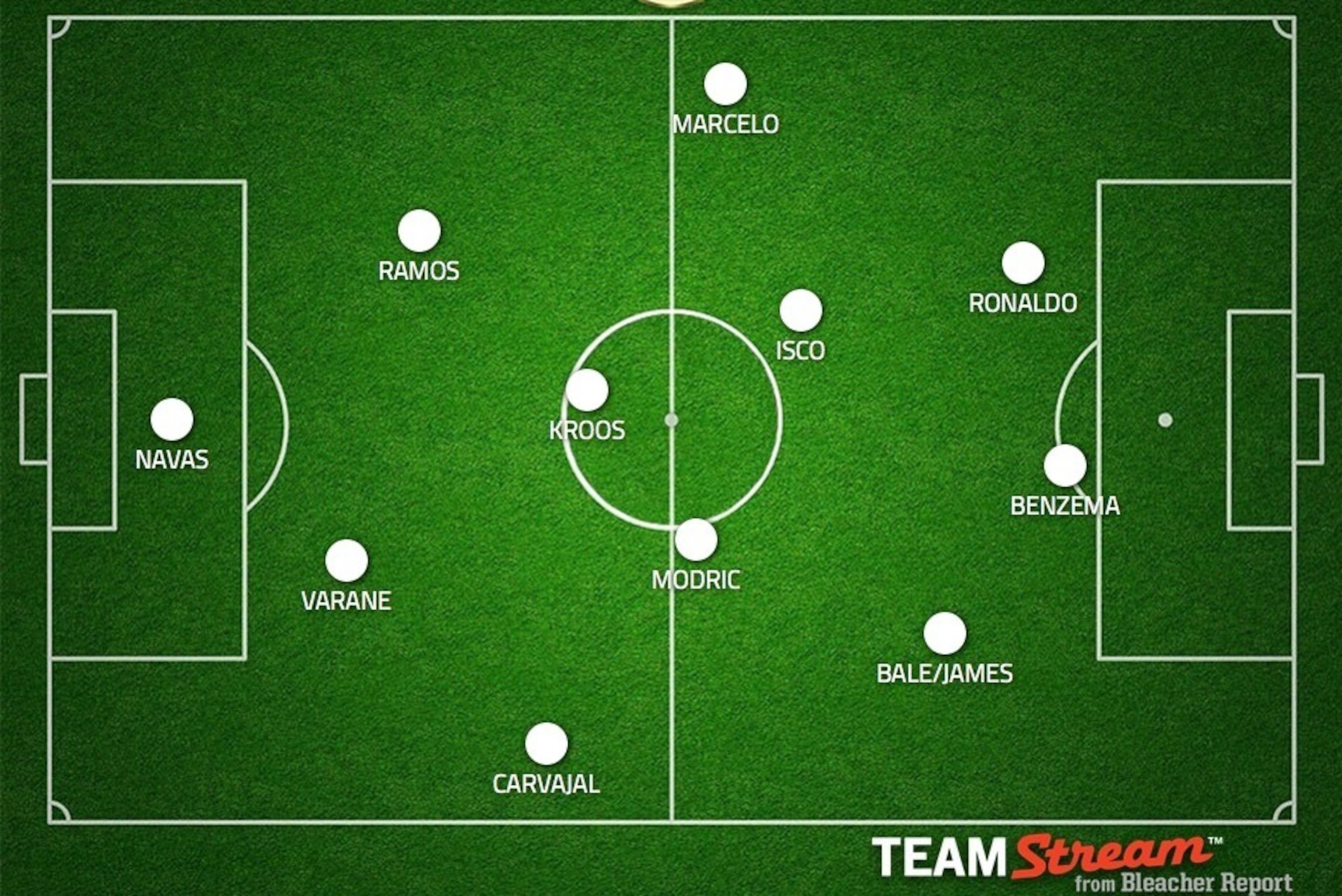
Indeed, with Bale—or, in his absence, James—restored to the right flank, Madrid's forwards no longer look as though they're competing with each other for space and prominence.
The lines are also connected by Isco, who in his left-sided role is able to come inside without depriving the team of width because of the added freedom given to Marcelo.
Freewheeling Marcelo
Marcelo has always been a left-back full of attacking instincts in his time at Madrid, but the team's shift under Zidane has allowed him more license to get forward than he had under Benitez.
One of the major differences seen in Real Madrid after Benitez replaced Ancelotti was the change in emphasis when it came to possession and ball control. Under the Italian, Los Blancos had grown increasingly technical and began drifting toward a more Barcelona-like method; when Benitez took over, he wanted the team to play faster and attack space, which at times meant absorbing pressure while looking to intercept the ball and break.
Thus, with a lesser dominance of possession, Madrid's full-backs weren't able to fly forward with the same regularity, knowing the team hadn't been set up to dictate terms exclusively.
Under Zidane, however, that's changed. Now prioritising ball control again with a playmaker-heavy midfield, Zidane's men have enjoyed 62.1, 63.8 and 65.5 percent of the possession in the last three games, according to WhoScored.com—a marked increase on their season average of 56.4 percent.
Consequently, Marcelo has essentially operated as a fifth midfielder from left-back—hence Marca's "fifth element" reference above—and against Espanyol had more touches in the opposition half than his own.
His permanent presence high up does two things: allow Isco to drift toward a No. 10 position in his role as connector and give Ronaldo the freedom to be a floating forward.
Again, how this setup fares against considerably stronger opposition will be interesting to see, but the tactical tweaks that have been evident under Zidane thus far have seen Real Madrid look much better from a systematic standpoint.

.jpg?w=2560 "Report: Darnold Could Miss 3-6 Weeks")

.jpg?w=2560 "Grading WWE NXT 🔠")