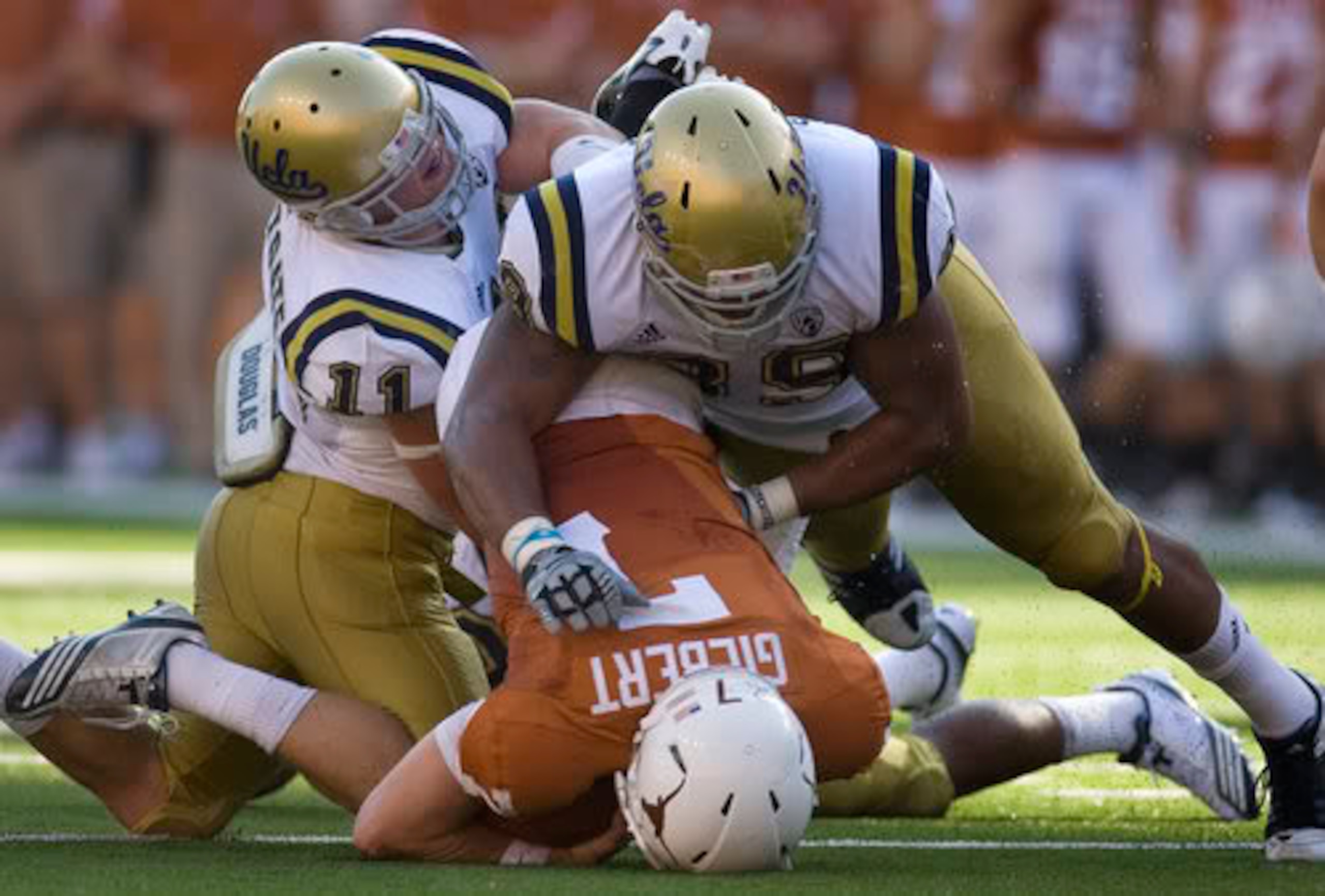

UCLA Football: Can the Bruins Ever Challenge USC Recruiting?
With USC dominating Los Angeles’ college football spotlight for the vast majority of its 123-year existence, UCLA fans often wonder if their team will ever be on par with the Trojans. Besides the occasional glorious upset, no Bruins fan should maintain with a straight face that their program belongs in the same class as Southern Cal from a performance standpoint.
UCLA football carries a somewhat rich tradition itself, having boasted names like the legendary Jackie Robinson, NFL Hall-of-Fame quarterback Troy Aikman, Hall of Fame-bound tackle Jonathan Ogden, three-time Super Bowl-champion linebacker Ken Norton Jr. and perennial Pro Bowler Maurice Jones-Drew, among others.
But when compared to the hundreds of former student athletes turned NFL veterans that hail from Heritage Hall, Bruins fans have every right to assume an inferiority complex about the program’s historic success compared to the prolific achievements of their arch nemesis.
UCLA has four former players in the Pro Football Hall of Fame, while USC has sent 11 Trojans to the hallowed sanctuary in Canton, Ohio.
USC has won 11 national championships while UCLA has won just one (1954).
The Bruins only have one Heisman Trophy winner to brag about (quarterback Gary Beban, 1967), while Southern Cal has had seven players accept the coveted award (six if you subtract 2005 winner Reggie Bush, who was forced to surrender his trophy).
Both Los Angeles-based programs have carved respective niches in the annals of college football, but when a top recruit wants to play in Los Angeles, he tends to lean towards the cardinal and gold.
Bruin Nation would love to lure the best talent away from USC, but what’s the best strategy in making this happen consistently?
This slideshow will discuss the various steps that need to take place in order for UCLA to challenge USC in recruiting. Having the right opportunity in place is the first step towards reversing the hegemony that has taken place for almost a century since the Bruins first assembled a football team in 1919.
Take Advantage During Down Period for ‘SC
1 of 4
The USC football program will be docked a total of 60 scholarships for the next two years, in addition to getting stripped of the 2005 BCS championship win over Oklahoma. It still faces suspension from the postseason until 2012, but the Trojans still managed to eke out yet another prodigious recruiting haul this February thanks to the NCAA appeals system.
Next year, expect the college football powers that be to come down hard on ‘SC, despite the fact that head coach Lane Kiffin generated another top-five recruiting class. That will likely keep the Men of Troy relevant in the Pac-12 and the national championship picture once they become bowl eligible again after this season concludes.
That said, a window of opportunity has opened for UCLA head coach Rick Neuheisel and his recruiting team because of the Trojans’ misfortune. Los Angeles remains a premier destination for student-athletes from all over the nation because of the temperate weather, cosmopolitan lifestyle and myriad professional opportunities the city affords.
The 2012 and 2013 seasons present UCLA football with chances to steal Southern Cal’s recruiting thunder. With dozens fewer scholarships to grant to incoming prep stars the next two seasons, Coach Neuheisel (or whoever is coaching the Bruins the next couple years if he is handed a pink slip after 2011) can corner the market on recruits interested in playing Division I football in Los Angeles.
Neuheisel may not have proven to be the savior to UCLA football in his first three seasons as Bruins head coach, but in light of USC’s issues, his lauded recruiting abilities should yield a stellar batch of prep stars akin to the top-eight 2010 class.
But if Neuheisel drops the ball in 2012 the way he did this past February (Bruins ranked 45th in FBS recruiting, according to Rivals), then he shouldn’t be expected to last beyond his five-year contract, which expires after next season.
If Neuheisel Doesn’t Last, Get a Coach Who Will Attract the Top Recruits
2 of 4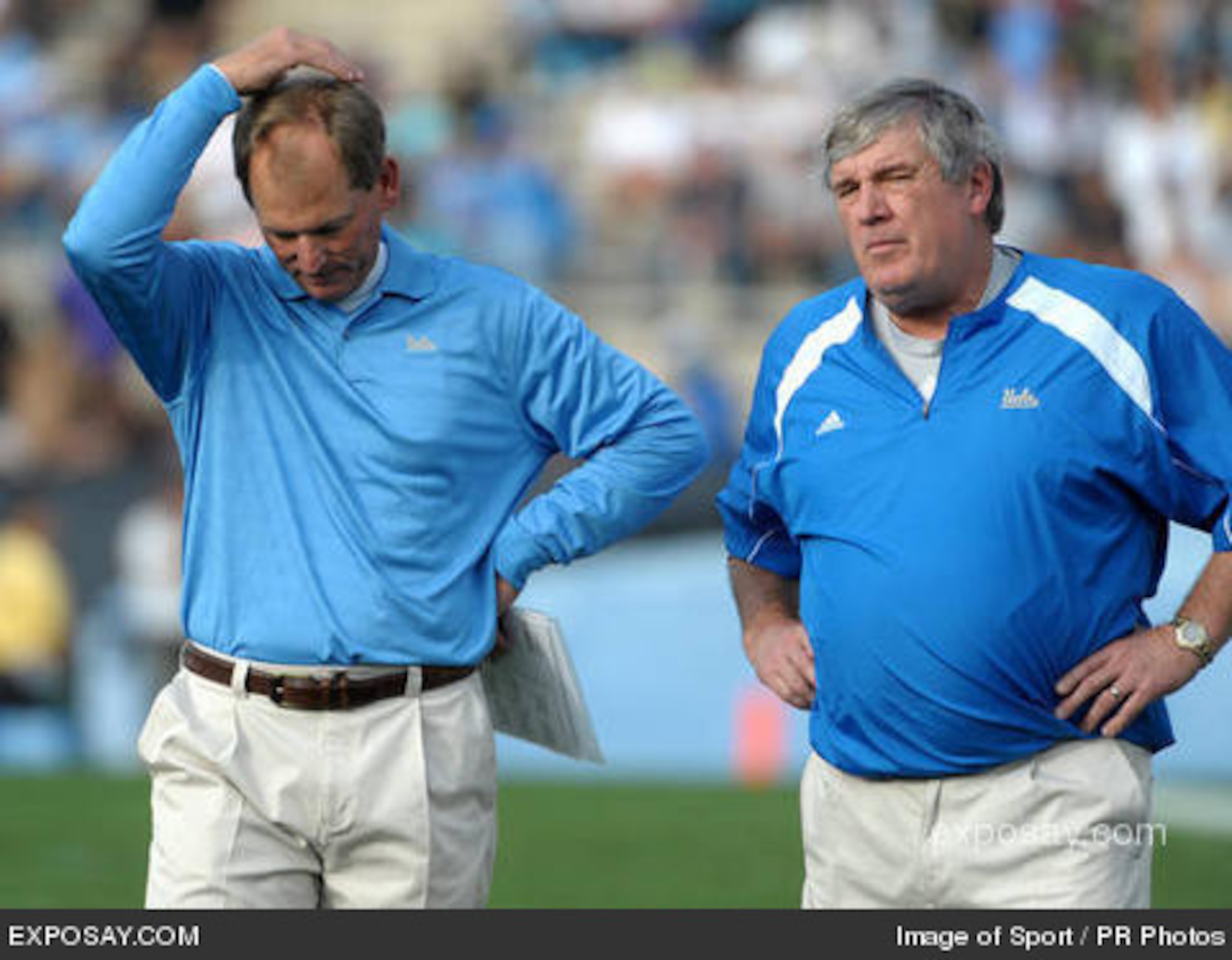
A universally acknowledged truth of college athletics recruiting is that players often attend a particular university to play for the coach who recruited them.
The football coach typically assumes certain duties which are commensurate with that of a parent: enforcing curfew, physical conditioning, promoting concentration, discipline, as well as numerous lessons in life and football.
Legendary NCAA football coaches like Penn State’s Joe Paterno or Texas’ Mack Brown inspire athletes from a young age, and help to shape their decisions and eventual collegiate destination.
Despite a solid, albeit unspectacular, 81-52 head coaching record in the NCAA that includes stints at Colorado and Washington, Neuheisel has a reputation for being a persuasive recruiter.
However, playing for Rick Neuheisel simply doesn’t carry the same cache to a prospective recruit as, say, playing for Nick Saban. Maybe the primary reason is that Neuheisel has just one BCS bowl win to his credit (when he coached No. 3 Washington to a Rose Bowl victory in 2000), and he doesn’t receive much national credibility since UCLA has struggled with a lackluster 15-22 record (8-19 in the Pac-10) in the three seasons under his watch.
Neuheisel’s contract pays him $1.25 million per year, modest by today's Division I standards. It’s difficult for a publicly-funded athletic department like that of UCLA to simply unload a dump truck full of money into the lap of the hottest head coaching prospect when athletic director Dan Guerrero must also consider the 13 other sports in which the school competes.
If Neuheisel gets the axe down the road, then the Bruins’ cadre of athletic boosters will need to tap the proverbial coffers to afford a football coach who elite prep stars will flock to play for.
Even in a troubled economy, college football coaches cost more than ever in 2011. Alabama’s Saban tops the list with a $6 million annual salary, but USC’s Lane Kiffin brings home a healthy $4 million per year despite a career record of just 15-11 as a college head coach.
Guerrero shouldn’t expect a Ferrari for the price of a Subaru. If UCLA is to ever rival USC in terms of long-term recruiting, it all starts with making a splash with an A-list head coaching hire. And given the higher costs of living in Southern California, $1.25 million per annum will only afford a modest amount of security.
The long-term profitability of a big-time coaching hire makes sense when factoring in the additional money coming in from Pac-12 expansion, increased ticket sales, revenue from the forthcoming conference television network and millions in potential revenue from a BCS bowl game. UCLA would be well-served to shell out added funds for a bigger name than Neuheisel despite his success as a Bruins player in the mid-1980s.
If his health wasn’t a concern, former Florida coach Urban Meyer would be a great hire to lead the Bruins if Neuheisel isn’t clad in powder-keg blue and gold a year or two from now. Meyer hasn’t made any recent overtures about a possible return to the sidelines, but he has come back from retirement before, and he’s only 46 years young.
But the two-time national champ is merely an example of someone who would lift the Bruins’ program from the doldrums of Pac-10 mediocrity and restore some buzz to football in Westwood.
Launch an Effective PR Campaign, but Don't Lead with Your Chin This Time
3 of 4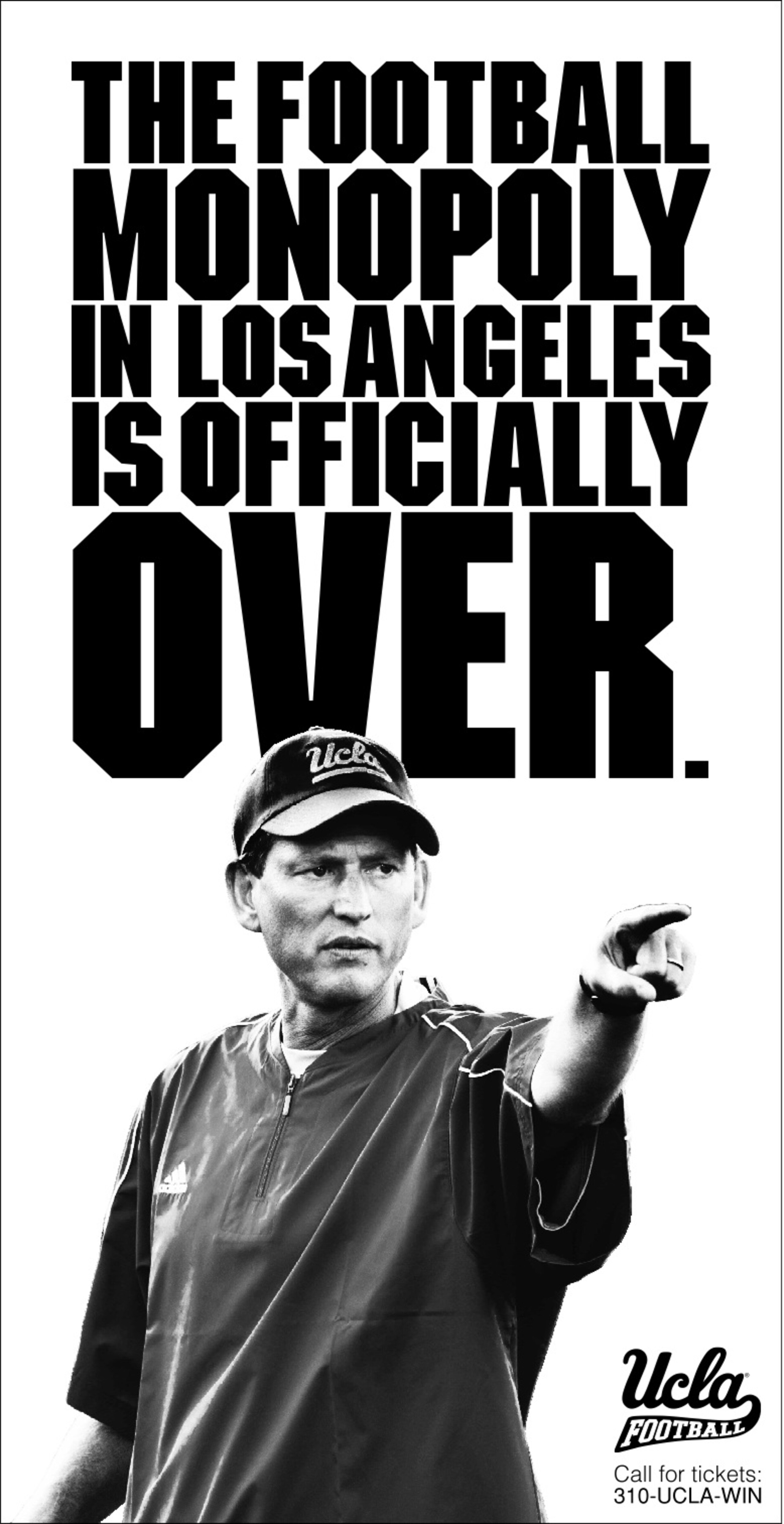
Speaking of buzz, Neuheisel deserves some credit for making an earnest attempt to draw a line in the sand with his infamous “Football Monopoly” comment when he returned to Westwood in 2008.
In hindsight, the resulting ridicule that UCLA’s program endured should have been expected. Even when USC football is half a decade removed from the Pete Carroll salad days, the team is still vastly superior in size, speed and overall athletic ability to their crosstown rivals.
UCLA isn’t terrible, but tradition-rich Trojans football has set the bar so high in Los Angeles that even a successful season, by UCLA’s standards, would be considered a downtrodden campaign at Heritage Hall.
Take 2010 as an example.
The bowl-game ban aside, USC finished with a record of 8-5. The last time the Men of Troy lost five or more games was former coach Pete Carroll’s first season in 2001, when the team posted a 6-6 record and lost in the Las Vegas Bowl. UCLA is traditionally content simply playing well enough to get invited to a postseason matchup. Different programs, different standards.
The culture of mediocrity surrounding UCLA football needs an overhaul. Winning is the best cure for a second-rate program, and incoming freshman quarterback Brett Hundley certainly has Bruin Nation brimming with hope for the future. But until games commence in the fall, something needs to transform the casual fans' opinions of Bruins pigskin between March and September.
Perhaps a more understated public relations campaign, something along the lines of “We Might Not Suck as Badly This Year as We Did in 2010,” might heighten awareness of the Bruins’ journey towards respectability. It would be doing it with an amusingly cheeky, self-deprecating tone while simultaneously educating the public about the Bruins plight as the red-headed stepchild of college football in L.A. Although Angelenos traditionally prefer a winner, most people can’t resist a scrappy underdog, either.
In all seriousness, the Bruins football PR team needs to mount a campaign that signals a potential changing of the guard. The Trojans will have dozens fewer scholarships to hand out to recruits over each of the next two years while the Bruins should be looking to capitalize on the NCAA sanctions as much as possible.
Theoretically, the Trojans’ talent is bound to subside, and UCLA can benefit from Southern Cal’s misfortune. Many high school stars want to come to ‘SC because the school is based in sunny Southern California. These same players can still reap the benefits of Los Angeles playing home games at the Rose Bowl in Pasadena as opposed to the Coliseum in Exposition Park.
Despite differing athletic budgets, the Bruins’ football facilities are every bit as state-of-the-art as the Trojans. A lucrative contract with athletic-apparel giant Adidas has afforded UCLA athletics top-tier equipment, although the Bruins do have fewer football coaches (11) on staff than USC (13).
Having been banned from the postseason until 2012, the Trojans are already suffering from past misdeeds. Once the recruiting fallout is realized several years down the road, we could actually witness much more parity between the two programs.
But innovation and creativity will be required to fool convince the public that UCLA football is for real when most of Bruin Nation isn’t even convinced this is the case.
_1.jpg?w=2560)
Try Not to Suck Anymore
4 of 4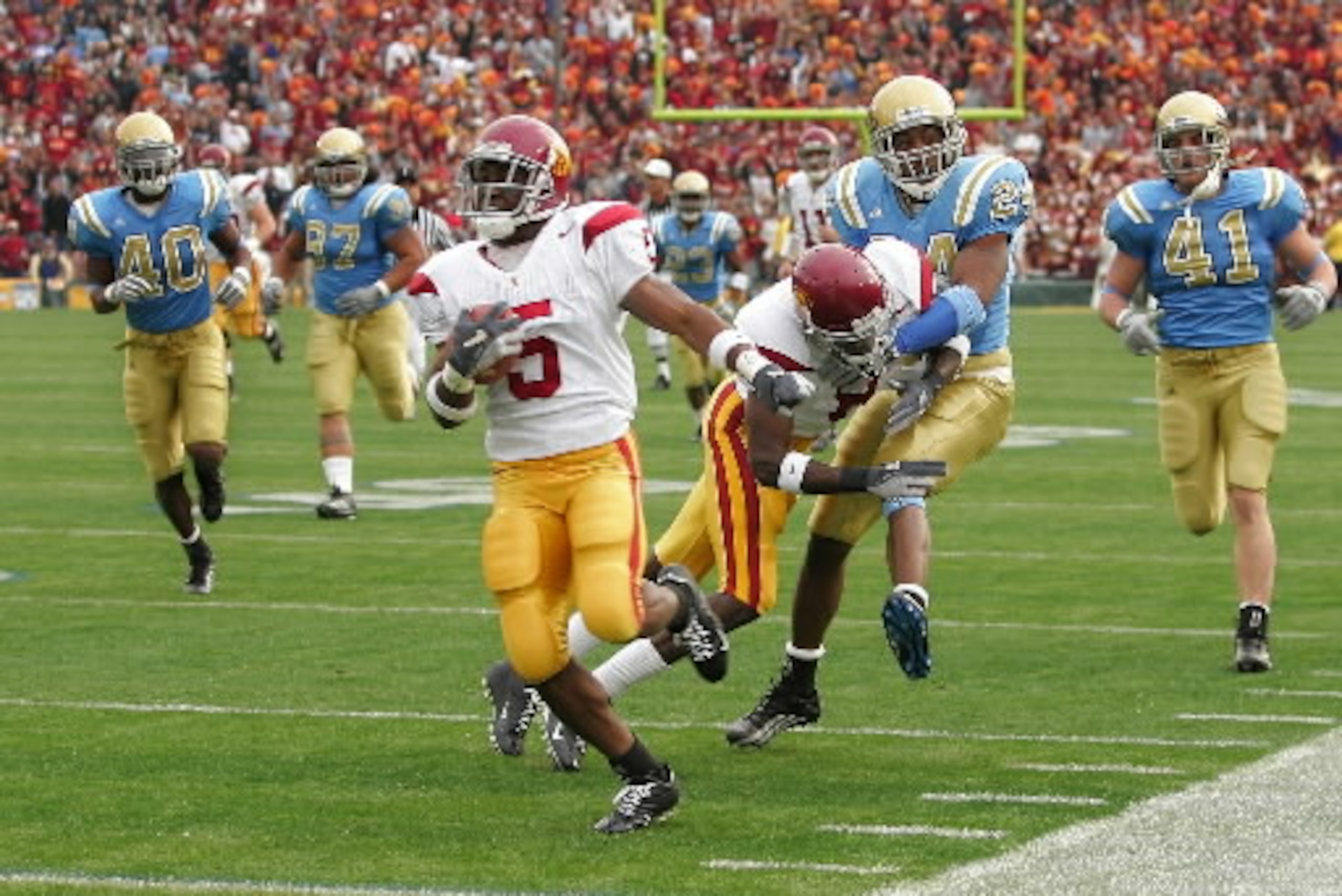
It’s no secret that L.A. sports fans love a winner. But columnists like the Los Angeles Times' controversial T.J. Simers butters his bread by routinely lambasting UCLA football as “a crummy team.”
Make no mistake, bigger things were expected from the Bruins in 2010 after Neuheisel brought a robust crop of recruits to Westwood the preceding February. A disappointing campaign smothered what momentum he had generated in his impressive recruiting efforts.
With uncertainty surrounding Neuheisel’s future in Westwood after multiple coaches were just given their walking papers, many prep stars were hesitant to sign with a middle-of-the-road program coached by someone who might not be around in two years.
If UCLA can at least get its winning percentage above .500 and get back to the postseason in 2011, then four things should happen:
1. Neuheisel will likely save his job and get his contract extended/renewed
2. The head coach’s job security will convince recruits that UCLA is a stable environment, which should improve the quality and quantity of recruiting
3. The Westwood bandwagon will continue to accumulate more fans, signifying that the Bruins are the team on the rise while the declining Trojans are so five years ago
4. The local media can go back to ripping on the Clippers as L.A.’s resident whipping team.
.png?w=2560)

.jpg?w=2560 "Chiefs, Steelers Eye WR Trades")
.jpg?w=2560 "Cowboys Handle Eagles on MNF 🤠")

.jpg?w=2560 "WWE Raw Live Grades 🔠")
.jpg?w=2560 "Jay-Z Headlining Super Bowl")