2011 NFL Draft: Taking Stock of Brandon Harris and the Canes' Prospects
Even though the Miami Hurricanes have been around a .500-team since Larry Coker's final season in 2006, their football program has still been sending players on to successful NFL careers.
Devin Hester is a game-changing return man and receiver, Greg Olsen is an emerging tight end and Jon Beason and Brandon Meriweather are both Pro Bowl defensive players.
Safety Kenny Phillips and tight end Jimmy Graham are both talented enough to get to Hawaii soon—as is Packers cornerback Sam Shields, although he was undrafted.
The wins may not be there, but when it comes to producing NFL-ready talent, "The U" is still the gold standard in college football.
This is, after all, the school that holds multiple records pertaining to the NFL Draft.
At least one Hurricane was selected in the first round every year from 1994 to 2008. This 14-year stretch is an NFL record.
The Canes had an astounding 19 first-round picks during a four-year period from 2001-2004.
The last of those drafts had six first-round Canes: Sean Taylor, Kellen Winslow II, Jon Vilma, D.J. Williams, Vernon Carey and Vince Wilfork.
This too is an NFL record, as the most first-round picks involving players from one school.
The Giants' selection of Kenny Phillips with the 31st and final pick of Round 1 in 2008 (New England had to give up theirs because of "Spygate") remains Miami's last first-round selection.
Cornerback Brandon Harris, defensive end Allen Bailey or wide receiver Leonard Hankerson could sneak into the late first-round and revive the trend this season.
After the jump, we'll take a look at where this year's Hurricanes might land.
Brandon Harris, CB
1 of 9A lot of mock drafts have Brandon Harris possibly going late in the first round to the Philadelphia Eagles.
With a sub-par 40-time at the combine (4.53 seconds), Harris may slip to the second round.
Harris has shut down top-flight receivers on multiple occasions during his college career. In late September, he held Pitt's Jon Baldwin to just three catches for 26 yards.
Brandon did get burned a couple of times by Michael Floyd in the Hurricanes' bowl game against Notre Dame, however.
But the Canes attempted to zone blitz the Notre Dame spread, so most of the blame for Floyd's big day falls on other Miami defensive backs.
Whatever team drafts Brandon Harris will find a talented, young (just a junior) corner with great ball skills and instincts.
He is a true cover corner with the ability to change direction on a dime to make plays on the ball.
Teams may be scared off by his straight-line speed, but there should be no doubting Harris' abilities as a football player.
Leonard Hankerson, WR
2 of 9After an impressive week of practices at the Senior Bowl, a productive game (five catches for 99 yards and one touchdown) and a surprisingly good combine, no one thinks Leonard Hankerson will drop past the second round.
Mel Kiper Jr. thinks he could go as high as the first. Based on what he did in college, it's not that surprising of a prediction.
Hankerson has been Miami's go-to target on offense for the past two seasons. His senior year was his best, as Hank hauled in 72 catches for 1,156 yards.
His 13 touchdowns broke Michael Irvin's school record for TD grabs in one season.
Hank has good size for a receiver. He isn't overly fast, but he has decent enough speed (4.43 at the combine).
Instead, he makes his living running clean routes, finding open space and making all the catches he can.
Hankerson isn't perfect—he has dropped a pass or two in big-game situations. But he is a hard-working and efficient receiver who isn't afraid to go over the middle.
Although he had a lot of long touchdown receptions in college, Hankerson seems like more of a possession receiver in the NFL.
In a class of receivers that is weak at the top but deep in the middle, Hank could slip into Round 1.
Even there, he's a real sleeper.
Allen Bailey, DE/DT
3 of 9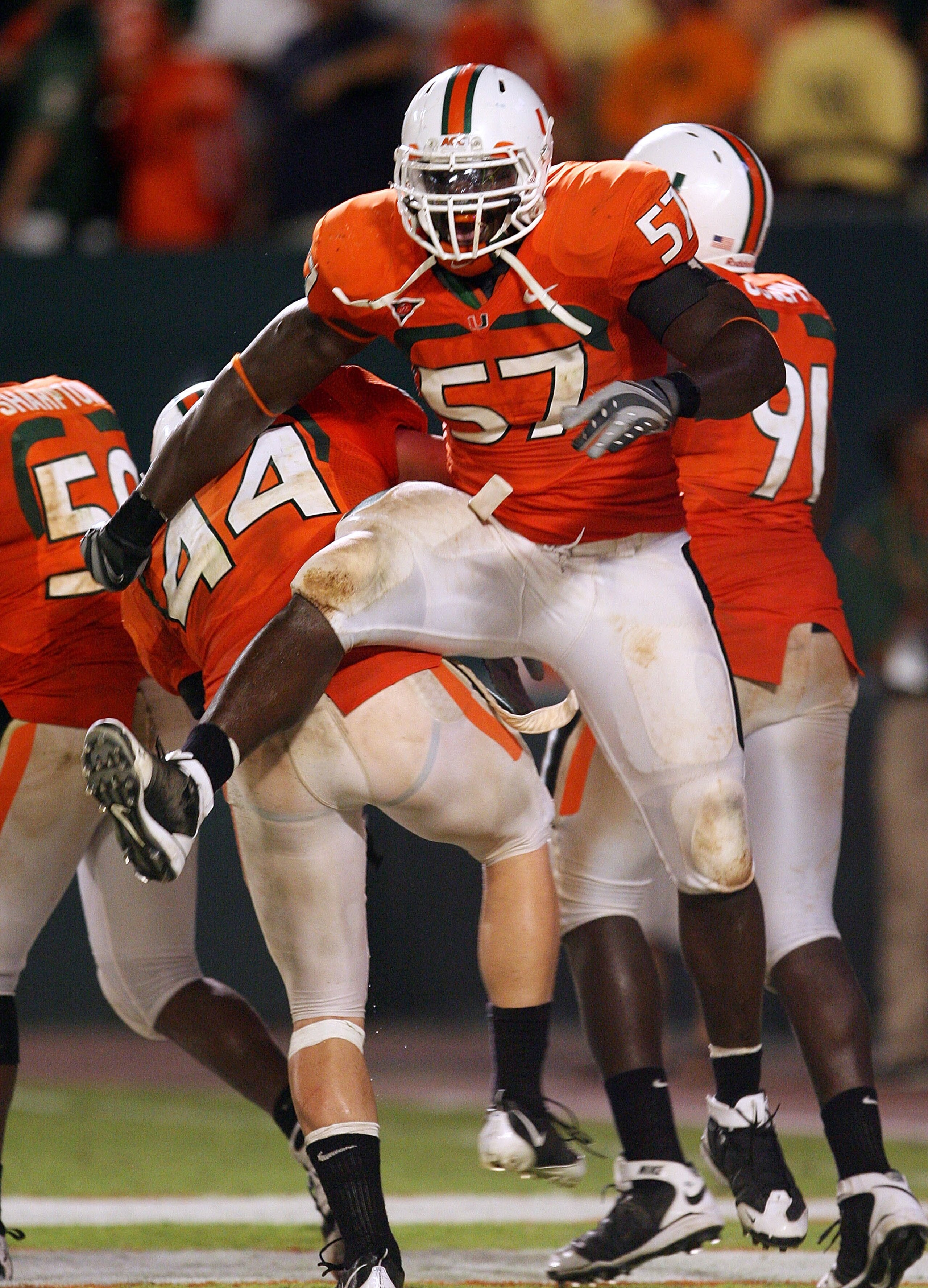
Allen Bailey is an imposing presence who could never consistently put it together on the field in college.
At 6'3", 285 pounds with almost no body fat, the strength to throw up 27 reps of the 225-pound bar and the speed to run a 4.77 40-yard dash, Bailey is a physical specimen.
But Allen Bailey never amassed more than seven sacks during any of his collegiate years. Part of that was due to the fact that he spent a lot of time moving between defensive end and defensive tackle.
In addition, Bailey would disappear against good teams. He seemed to dominate lesser offensive lineman physically—but that won't happen in the NFL.
I want to see Allen Bailey succeed, but he needs to show a better motor and better instincts against the run.
Bailey's body and versatility may get him into the first round; his lack of production might keep him in the second.

DeMarcus Van Dyke, CB
4 of 9
DeMarcus Van Dyke (DVD) did more for his draft status in less than five seconds at the NFL combine than he did in four years as a corner for the Hurricanes.
DVD posted a time of 4.28 seconds in the 40-yard dash, the fastest time of any player invited to the scouting convention. Based on this time alone, Van Dyke could go as high as the second or third round.
The fact that this has happened tells us two things.
First, Randy Shannon and his staff failed at talent evaluation. If you have a corner who can run that fast, there's no reason that you couldn't have developed him into a more complete player.
Secondly, NFL teams place way too much stock in combine numbers.
Van Dyke was a very bad college corner.
He wasn't strong enough to handle bigger receivers, nor did he have good enough ball skills or instincts to stay with faster receivers.
The fact that teams are considering taking him in the second round is absurd. Van Dyke lost his starting job—which he had held for four seasons—as a senior.
He was a completely unproductive college player.
Unless NFL coaches can really turn his game around and make him stronger, I doubt Van Dyke will do much at the next level.
Orlando Franklin, OL
5 of 9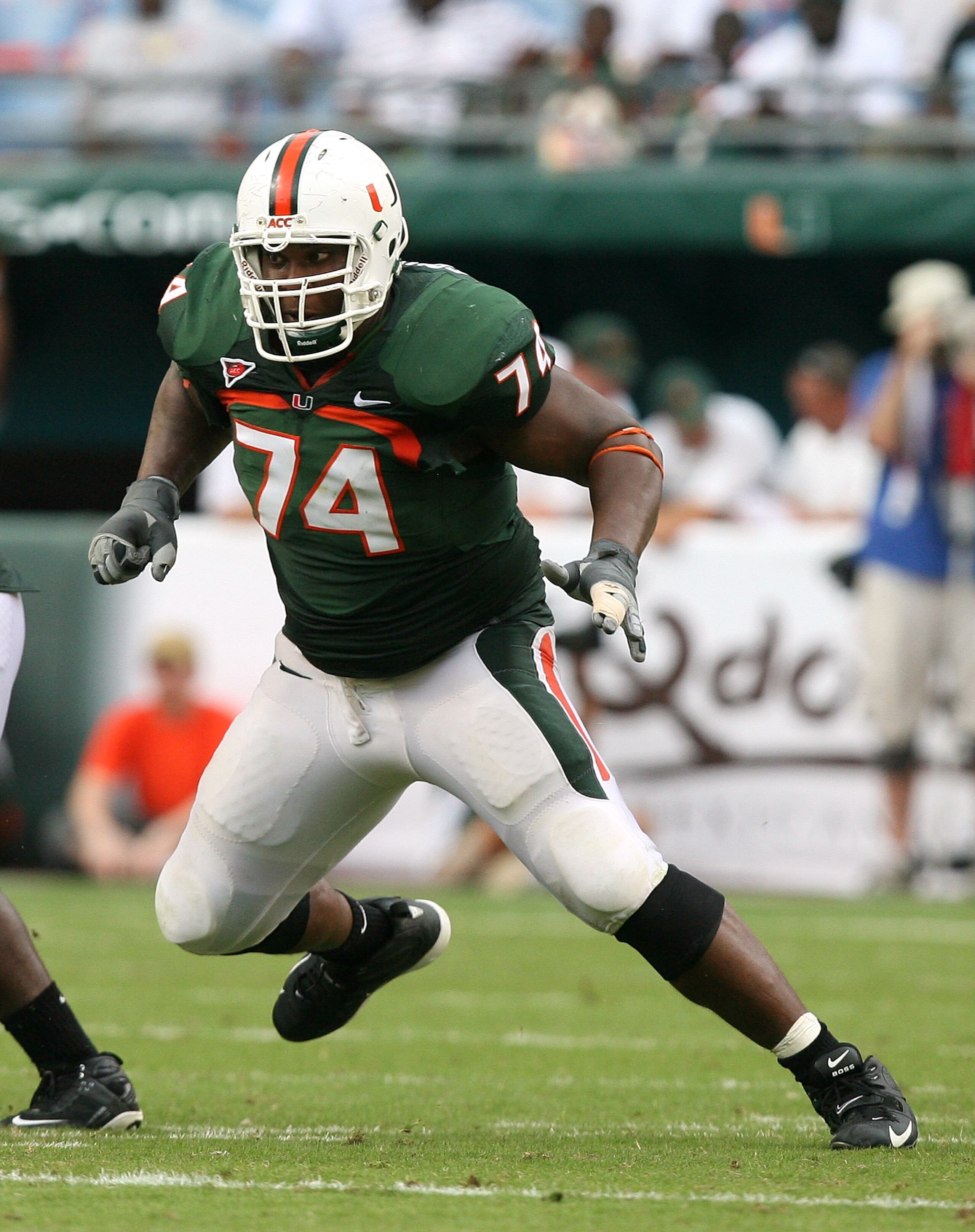
Orlando Franklin was much better during his junior year at guard than he was during his senior season at left tackle.
Had he stuck at his natural position, Franklin may have even been a first-round pick this year.
At 6'7" and 312 pounds, Franklin looks every bit the part of an NFL offensive guard. He gets good push in the running game, and he plays up to the level of his opponent.
While playing guard during his junior season, Franklin dominated several big-name defensive tackles. This list included last year's third overall pick, Gerald McCoy.
But concerns about his athleticism have led to doubts about Franklin's potential in the NFL.
With a ton of game experience and the ability to play multiple positions on the line, Franklin won't last past the third round.
He doesn't have a tremendous ceiling, but Orlando should be a reliable player for years to come—just like he was in college.
Colin McCarthy, LB
6 of 9
Colin McCarthy really helped himself at the NFL Combine. Mel Kiper Jr. thinks he can go as high as the third round.
The 6'2", 220-pound middle linebacker ran a 4.65 40-yard dash and put up 23 reps of the 225-pound bar. He also showed good lateral quickness with his time in the three-cone drill.
McCarthy is a good athlete and an experienced presence in the middle of the defense, but he's not the most reliable tackler. In fact, he's really bad in open space when he's one-on-one with a running back.
But his speed shows that he can at least participate in coverage in the NFL. He has the well-rounded abilities to be a solid starter for some team.
With a bad injury history and the type of skills that shouldn't age well, McCarthy might not have a very long career.
Graig Cooper, RB
7 of 9Cooper ran a 4.65 40-yard dash at the combine, but he is still barely a year removed from ACL surgery.
Speed was never his best attribute, however. Even before his knee surgery, Cooper excelled at exploding into the hole and picking up a handful of yards.
He rarely ran away from anybody.
I can't even calculate how many times Coop was tripped up by a flailing arm from the ground, causing a touchdown-saving tackle.
The combine numbers show that Cooper at least regained his horizontal quickness.
This skill helped him serve as an efficient running back and an effective return man who was more than willing to bang bodies.
Cooper has a thick frame. He's built like a six-foot fire hydrant and he doesn't go down easily from arm tackles.
He averaged 4.9 yards per carry over his college career, rushing for 2,263 yards on 461 attempts.
Graig Cooper was a former 5-star recruit who got injured at the worst possible time of his career. He should still be available around the fifth or sixth round.
A willing team could turn this still-recovering back into a reliable 1-B type runner.
Matt Bosher, K/P
8 of 9
Matt Bosher is not a kicker—he is a football player. Or at least that's what his teammates, including Jacory Harris, have said.
Of all the players leaving the Hurricanes program this season, few had careers as productive as Miami's specialist.
Bosher served as the punter for all four of his seasons and as the kicker for three. He has the skills to handle either discipline—or even both—in the NFL.
Bosher was voted as the All-ACC's second-team punter on two occasions. He was named the second-team kicker and the first-team kicker one time each as well.
But Bosher's best skill might be his tackling.
Ask any Miami Hurricanes fan and they'll tell you that their best special-teams tackler over the past four seasons was Bosher.
He runs down the field like a lunatic, ready to lay into whoever is holding his football.
Bosher received unnecessary roughness penalties on several occasions.
It is unlikely that Matt Bosher will be drafted, but because of his versatility and his willingness to hit, he may catch on somewhere.
That team's return man better watch out in practice.
Best of the Rest
9 of 9
Damien Berry, RB (pictured): The converted safety is a pure downhill runner who loves to absorb contact and grind out yards between the tackles.
Between his junior and senior years, Berry ran for 1,515 yards on 283 carries, good for a 5.3 YPC average with 13 touchdowns. He should make for a nice short yardage back in the NFL, but will likely go undrafted.
Richard Gordon, TE: Gordon is a big (6'3, 262 pounds) pass-catching tight end with enough speed to have returned kicks during his freshman year. Gordon is strong as well, but his inability to block well kept him off the field.
With the right coaching, he has enough natural talent to succeed.
Ryan Hill, DB: Like the recently departed Sam Shields, Hill failed at receiver for his first few years of college. Although he was a talented corner in high school, the Randy Shannon regime decided that his skills were best suited for offense.
In his limited return to defense, Hill showed good coverage and tackling abilities. If he has a good pro day, a team could take a chance on him late.
.png?w=2560)
.png?w=2560)




.jpg?w=2560 "Latest Peyton-Colts Rumors")