


Few NBA discussions are as garbled by inexactness as the search for the next dose of breakout stars.
How do we define "breakout?" How do we interpret "star?" Do age and experience cutoffs matter? How are they determined? Who died and made me Keeper of Breakout Star criteria?
All of these are fair questions, and they remain without clear answers. Subjectivity is bound to creep into every breakout-star scavenger hunt. And you know what? That's fine.
Cobbling together criteria at all, as arbitrary as it may seem, at least lends itself to an air of uniformity. For our purposes, that will mean limiting the breakout-star prowl to players who are entering their age-24-or-younger seasons, have no more than four years experience (including 2021-22) and have yet to receive an All-Star nod.
Following this set of guidelines does a nice job juggling the predictive element of our exercise while largely containing the number of "Well, duh" candidates. Even if every inclusion is obviously on the star track, their ultimate arrival remains a point of debate. For each player, we are effectively saying "This dude will begin gaining traction in All-Star conversations next season, even if they're not actually selected to the exhibition."
De'Aron Fox, who is entering his fifth year at age 24, is the only potentially deserving candidate who gets the default boot. But he just wrapped up a season in which he averaged 25.2 points and 7.2 assists while honing his step-back jumper and calm-but-also-the-storm pace of play. His breakout is more complete than ongoing.
This space is reserved for those with higher-variance outcomes, less-established sample sizes and more question marks. Opportunity also factors into this equation. Some, for example, will have RJ Barrett slotted into one of these five spots. But the New York Knicks revamped their offensive pecking order in such a way that his growth and volume will be capped relative to last season. Players projected to have greater influence over their team's mode of operations curry favor ahead of options like him.
LaMelo Ball, Charlotte Hornets
1 of 5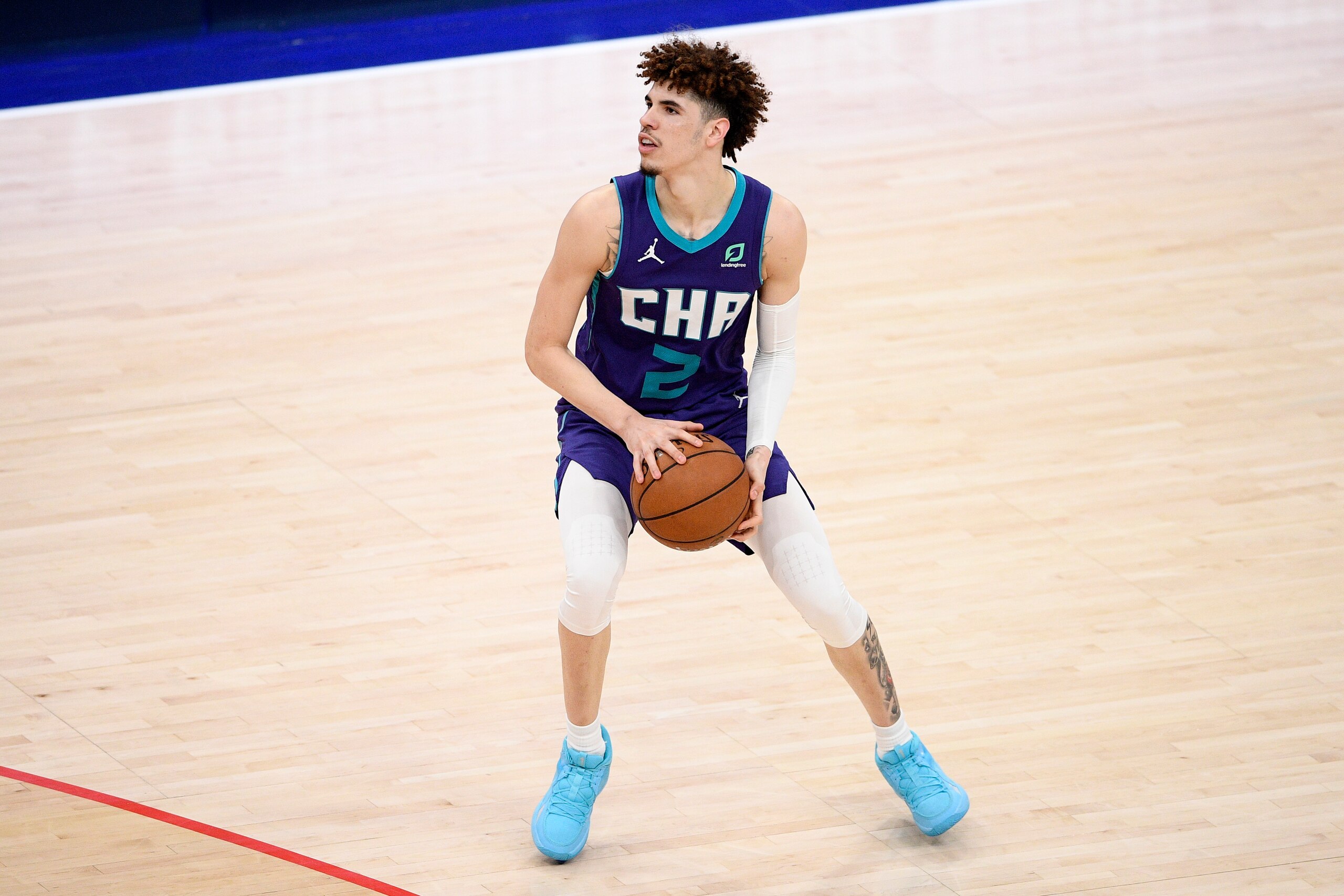
LaMelo Ball's dalliance with stardom began almost immediately as a rookie. He turned the Charlotte Hornets into League Pass darlings with brain-bending passes, and his flash was not without substance. Charlotte's offense performed better for the year with him on the floor, and his on-ball creativity, ungoverned and unguardable, has outfitted the team with a roadmap to contention.
Finding a genuine North Star is the most difficult part of any rebuild, retooling, renovation or whatever organizations prefer to call it. LaMelo has given the Hornets theirs. That much is a given, even after a rookie year interrupted by onset bench duty and a fractured right wrist.
From the moment LaMelo earned a starting gig through the end of the season, he averaged 18.1 points, 6.2 assists and 1.7 steals while shooting 37.9 percent from deep on nearly six attempts per game. His playmaking garnered most of the acclaim, though.
There isn't a pass he can't make, a teammate he can't see, an angle he won't work or a risk he won't take. His is the type of vision best left unbounded. Mistakes are part of the experience, and to preach restraint is to place limits on a player wired to operate outside them.
Somewhat lost in the sensory overload of every LaMelo assist was the polish and poise with which he can score. He needs to get better at finishing around the rim, but he displayed operable touch from just about everywhere else.
After entering Charlotte's starting lineup, he downed 48.6 percent of his floaters and dabbled in step-back threes (5-of-12). His clip on off-the-dribble triples waxed and waned, but those are part of his armory. Just as importantly, he drained 44.1 percent of his spot-up threes from Feb. 1 onward, routinely dispelling the notion that he needed to have a monopoly over the offense's usage.
That LaMelo beat out Anthony Edwards and Tyrese Haliburton for Rookie of the Year despite missing almost one-third of the season says it all. His was not a victory unearned. The LaMelo experience was a consensus revelation. Just imagine what it'll be like unobstructed by injury or an out-of-the-gate backup role.
Anthony Edwards, Minnesota Timberwolves
2 of 5
Anthony Edwards' rookie year was an acid trip. He went from having one of the most divisive seasons imaginable to entrenching himself as one of the league's brightest young stars.
Shifts in his efficiency can be found at various points of the season, but the transition is most stark when looking at his pre- and post-All-Star-break numbers:
- Pre-All-Star break (36 games): 29.1 minutes, 14.9 points, 2.5 assists, 25.6 usage rate, 46.6 true shooting percentage
- Post-All-Star break (36 games): 35.2 minutes, 23.8 points, 3.4 assists, 28.3 usage rate, 56.7 true shooting percentage
Hovering around a true shooting percentage of 57 isn't otherworldly efficiency, but it's a monstrous leap from where Edwards began the season, and it came amid a climb in usage.
His shot selection can still be nauseating, but more so than any other rookie, he was bestowed an offensive license without restriction from the jump. That he spent half the season downing 38.7 percent of his pull-up threes and converting 52.4 percent of his looks on drives—all while getting to the foul line at an enviable rate—is patently big-time.
Edwards will wedge his way into the fringe-star discussion if his end-of-the-year performance holds serve. Building on top of that initial ascent will demand better decision-making out of the pick-and-roll and a stronger defensive presence.
Edwards showed some flashes as a facilitator last year, but nothing overly complicated. There were a lot of dimes dropped out of chaos. His defense at once left a ton to be desired and hope for more. He weeded out some serial ball-watching and apathetic stances, but he needs to get back in transition at faster than nonchalant speed and take fewer gambles when helping from the strong side.
The Minnesota Timberwolves will give Edwards every chance to broaden his impact. Their offensive reliance on him has arguably only increased, even after the acquisition of Patrick Beverley, and he'll get plenty of defensive reps on the wings. Any progress he makes as a go-to youngster on a team pining for a co-star will go a long way toward accelerating his star trajectory.
Shai Gilgeous-Alexander, Oklahoma City Thunder
3 of 5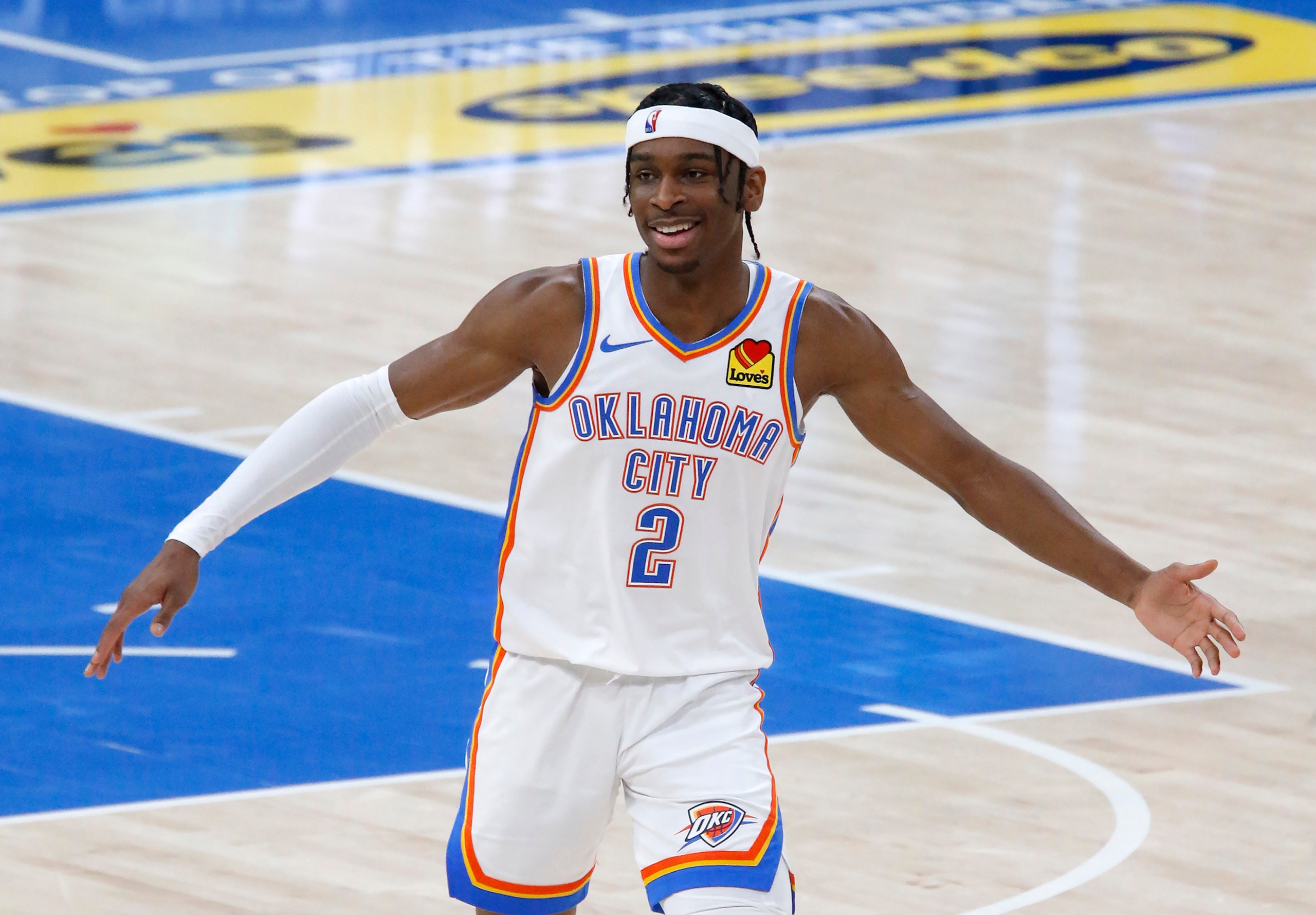
Shai Gilgeous-Alexander might have already graduated from this list had he appeared in more than 35 games last season. Plantar fasciitis in his right foot cropped up after the All-Star break, but it would've been awfully difficult to include him had he snagged Most Improved Player honors.
He was having that kind of season.
Most wondered how Gilgeous-Alexander would respond when given control over an offense without a safety net. Secondary playmakers galore dotted him during his rookie season with the Los Angeles Clippers, and he had Chris Paul by his side through his sophomore go-round on the Oklahoma City Thunder. Some semblance of a drop-off was almost expected. Going from part of a committee to an all-everything had to include a steep learning curve.
Or maybe not.
Assuming the reins of Oklahoma City's offense looked good on Gilgeous-Alexander. Changes in pace and desultory-yet-deliberate body mechanics culminated in total defensive manipulation. His feel within the two-man game and for passing out of traffic also noticeably improved, giving him the tools necessary to take unalterable control over both his team and its opponent.
Stephen Curry and Kevin Durant are the only other players last season who averaged over 20 points and five assists while shooting as well on twos (54.7 percent) and threes (41.8 percent). SGA sustained this production despite more than 87 percent of his made baskets going unassisted—the highest mark among the 439 players to appear in at least 20 games.
That is absolutely, positively, unequivocally bonkers. And it helped turn SGA into a max-extension formality. Party-crashing the All-Star conversation, if not the All-NBA discourse, is the natural next step.



Ja Morant, Memphis Grizzlies
4 of 5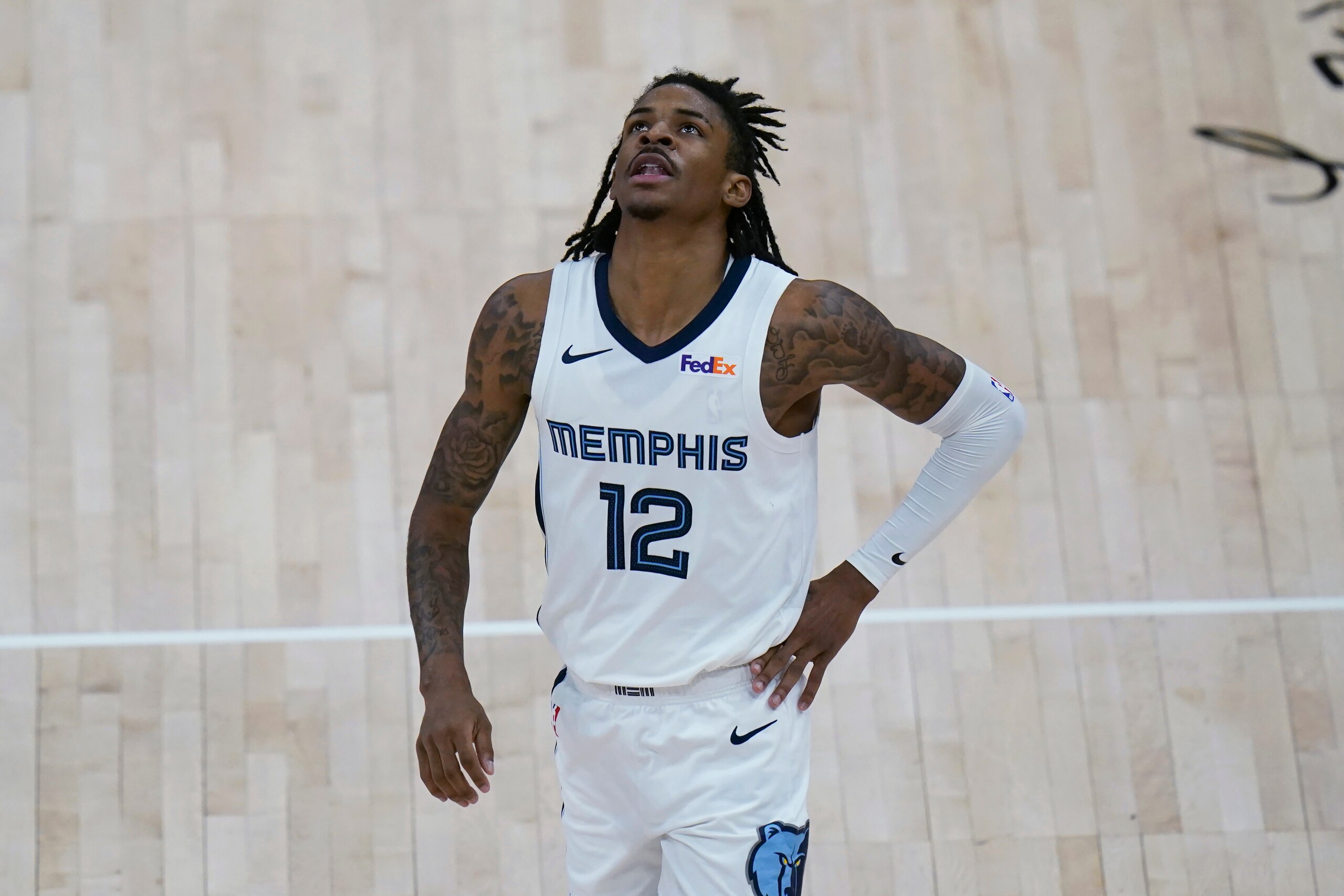
Ja Morant's sophomore numbers suggest a regression from his rookie year. Really, it was more like a season of lateral adjustments.
Though Morant's efficiency from downtown and inside the arc dipped, his offensive mystique has hardly faded. His meld of playmaking and explosiveness verges on unprecedented. He is a threat to do anything imaginable, and even that which can't be fathomed, whenever he leaves his feet. He views 7-footers around the basket as personal hurdles, can disarm defenses with his floater and has 360-degree vision.
Slight downswings in his two-point shot-making aren't the least bit concerning. He was often working within cramped spaces. His efficiency should spike as the Memphis Grizzlies open up the floor around him.
Three-point shooting remains his swing skill, though getting better at keeping opposing guards in front of him when defending the pick-and-roll is a close second. He found nylon on 38.1 percent of his triples over his final 27 regular-season games, but defenses will remain content to go under him until he consistently knocks down outside looks off the dribble with more urgency.
So early into Morant's career (he just turned 22 on Aug. 10), this all qualifies as nitpicking. He has been saddled with the livelihood of an entire offense, without much secondary shot creation to streamline his responsibility. Memphis is actually fortunate that he hasn't endured more wild offensive swings.
To this point, Morant has effectively balanced the job description of No. 1 scorer and floor general. His progress may have slowed last season—he missed some time with a sprained left ankle—but his career arc hasn't changed. He's traveling the path toward superstardom, and his arrival is still seemingly a matter of when rather than if.
Michael Porter Jr., Denver Nuggets
5 of 5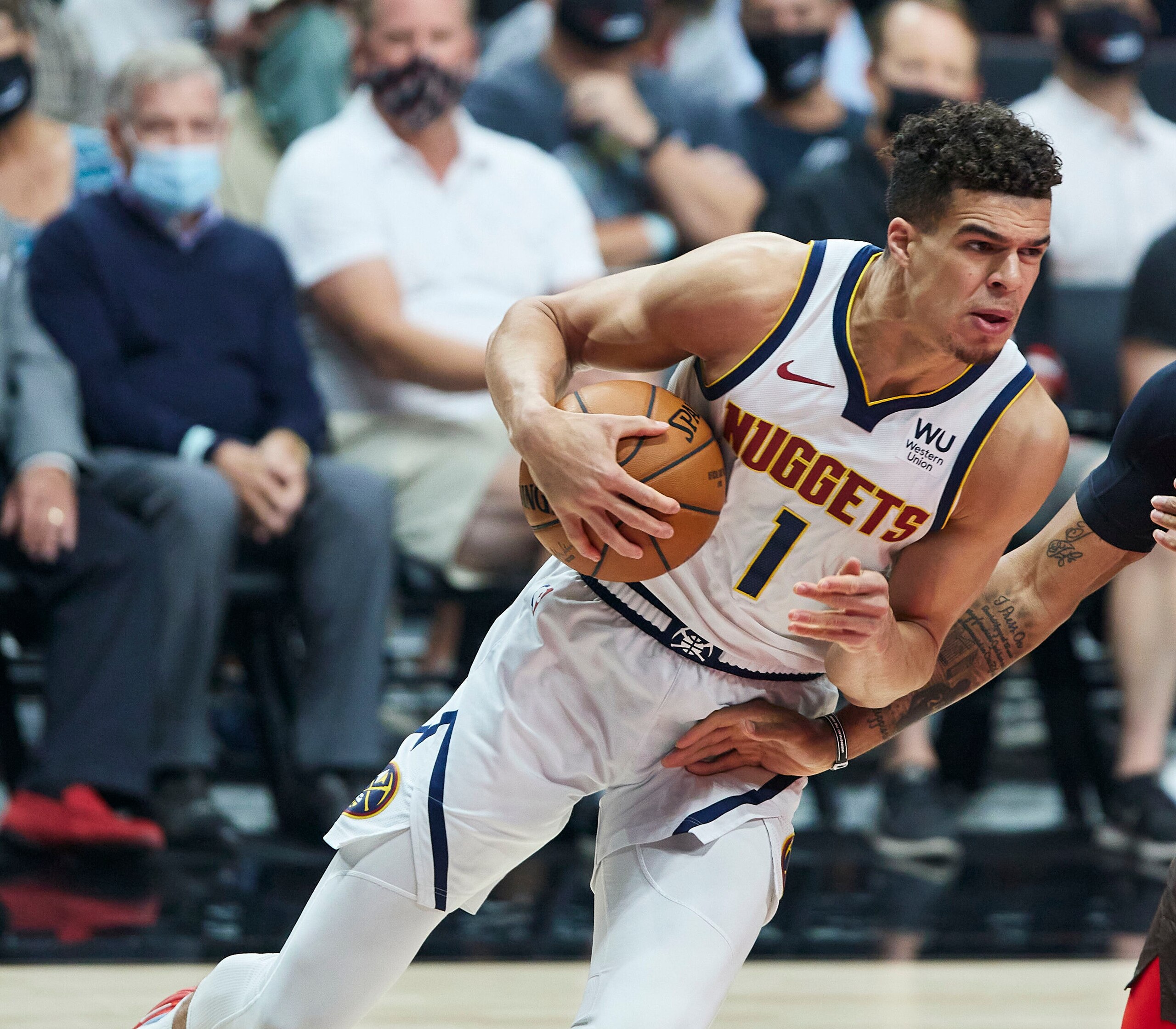
Michael Porter Jr.'s star ascent was deemed a given long before now. He finished his sophomore season averaging 19.0 points while hitting a ridiculous 62.8 percent of his twos and 44.5 percent of his threes, displaying a brand of shot-making best described as unstoppable.
Skeptics, insofar as they actually exist, might harp on the simplicity inherent of his third-option status behind Nikola Jokic and Jamal Murray. And that definitely buoyed his efficiency. But his secondary role was also his sacrifice. Learning to thrive as a cutter and lights-out shooter actually increased his dynamism, rendering him capable of doing more while seamlessly fitting into an ecosystem that required him to do less.
Porter's capacity to handle more is no longer theoretical, either. Murray's torn left ACL foisted the sophomore into a more prominent role. Porter responded by averaging 23.5 points while converting 63.4 percent of his twos and 48.9 percent of his threes. Most of his baskets continued to come off assists, but his frontcourt touches exploded after Murray's injury, and he used more time and dribbles per possession than beforehand, too.
Sustaining that output in the postseason wasn't as easy. Yet MPJ still averaged 17.4 points on 56.5 percent two-point shooting and a 39.7 percent three-point clip through 10 playoff games, all while providing glimpses into the extent of his on-ball bandwidth.
That same opportunity awaits MPJ next season with Murray recovering from his torn left ACL. And while much attention will be paid to his self-creation, passing and defense—he's muuuch better as the helper now—the long-term state of his back looms as the lone roadblock that can prevent his bona fide stardom.
Unless otherwise noted, stats courtesy of NBA.com, Basketball Reference, Stathead or Cleaning the Glass. Salary information via Basketball Insiders and Spotrac.
Dan Favale covers the NBA for Bleacher Report. Follow him on Twitter (@danfavale), and listen to his Hardwood Knocks podcast, co-hosted by NBA Math's Adam Fromal.

.jpg?w=2560 "Raiders Could Start Mendoza")

.jpg?w=2560 "Rodgers Iced Out on Plane 💎")
.jpg?w=2560 "🚨 Week 8 AP Top 25 Poll")
.jpg?w=2560 "Packers Safety Slams Refs 🤬")
