


It's time for us to have the awkward conversation. You know, the one where we choose which NBA household names belong on Regression Watch entering next season.
This exercise always rubs people the wrong way. That's fair. But this is a worthwhile discussion.
Plus, if you really think about it, inclusion amounts to a compliment. And it definitely, in most cases, isn't meant to be a grim reaper. We've merely picked stars and studs who would benefit from readjusted expectations.
Everything was factored into the decision-making process: age, injury history, team fit, this season's performance, etc. Certain players are already on the downswing, but their reputation precedes them. Some have enjoyed a terrific 2018-19, but their efforts figure to be noticeably unsustainable over the longer haul. Others don't fall under either umbrella, but they're getting older and find themselves in less prominent situations.
We did not single out players so far into their decline that they'll continue incremental regression. Nor did we include players enjoying career years who aren't yet in danger of exiting their prime. Paul George probably won't again rival the best version of Kevin Durant the Oklahoma City Thunder ever had—if he does, oh my God—but vacating the MVP discussion wouldn't equate to a meaningful backslide.
These players were picked based on the odds that their potential declines could be both substantial and permanent. We also rolled with an All-Star-lineup-style field by splitting up our spots between two backcourt and three frontcourt options. Welcome to Regression Watch 2019-20.
Backcourt: Chris Paul, Houston Rockets
1 of 5
Age at Start of 2019-20: 34
2018-19 Per-Game Stats: 16.1 points, 4.4 rebounds, 8.2 assists, 2.0 steals, 56.6 true shooting percentage
Advanced Metrics: 19.5 player efficiency rating (PER), 60.96 total points added (TPA), 4.03 real plus-minus (RPM)
Contract Status: Three years, $124.1 million remaining (2021-22 player option)
Chris Paul's decline is already underway, which shouldn't come as a shock. Hamstring issues have dogged him since last season, and undersized point guards in their mid-30s aren't supposed to party-crash the top-10 discussion.
Except, Paul did inject himself into the top-10 field last season, just like the season before that, and the one before that, and the one—well, you get the point. He has played at such a high level for so long that his first drop-off actually has come as a quasi-shocker.
This isn't to say Paul is finished. He's not even close to fully washed. He has perked up a bit since returning from his strained left hamstring. He's shooting 61.1 percent inside five feet, up from 53.8 percent to start the year, and his defense remains unnavigable for opponents when he's totally engaged. Ask Kemba Walker.
Setting the world on fire in spurts is fine for most, but Paul is held to a different standard. Every shift, however seemingly minor, matters at his age. He isn't cooking bigs on switches like he did last season and cedes more control of the offense to James Harden without actually making his job easier.
Just over 85 percent of Paul's buckets are going unassisted—right in line with last year's mark (85.6) but still ridiculously high. His reliance on pull-up three-pointers has increased since joining the Houston Rockets, a progression that hardly portends a smooth aging process. Check out his splits on these shots over the past six seasons:
- 2013-14: 33.6 percent (60.7 percent of total 3PAs)
- 2014-15: 37.7 percent (61.8 percent of total 3PAs)
- 2015-16: 33.3 percent (68.4 percent of total 3PAs)
- 2016-17: 38.7 percent (70.4 percent of total 3PAs)
- 2017-18: 38.1 percent (81.9 percent of total 3PAs)
- 2018-19: 33.5 percent (79.7 percent of total 3PAs)
Pull-up threes are more common than ever, and no one should pretend to be an expert in the devolution of megastars. (Related: This includes me.) But if this is the type of from-scratch burden the Rockets are going to have Paul shoulder in 2019-20, they should brace themselves for a more unflattering result.
Backcourt: Derrick Rose, Minnesota Timberwolves
2 of 5
Age at Start of 2019-20: 31
2018-19 Per-Game Stats: 18.2 points, 2.8 rebounds, 4.5 assists, 0.6 steals, 55.8 true shooting percentage
Advanced Metrics: 19.5 PER, minus-8.08 TPA, minus-1.07 RPM
Contract Status: Unrestricted free agent this summer (Early Bird)
Derrick Rose hangers-on will interpret this as a personal affront. There will be some variation of "You blogpeople are so biased! Watch the game, h8er! D-Rose is life!" in my mentions.
Let's be clear: Derrick Rose is having a fantastic individual season. He's shooting and scoring like a star. Stephen Curry and Kyrie Irving are the only other players clearing 20 points and five assists per 36 minutes while hitting more than 38 percent of their three-point attempts.
It is not a stretch to say this might be the best offensive version of Rose. He's not playing as many minutes as he did during his superstar days, but he's finally leveraging both long-range volume and efficiency. Attacking the rim is easier than ever, and not just because he spends time carving up second units.
That doesn't mean the party is going to last. It most likely won't.
For one, we don't even know where Rose will be playing next season. The Timberwolves have his Early Bird rights, but reinvesting in him doesn't make much sense unless they think this core can be a problem in the Western Conference. Any change of scenery threatens to harsh Rose's 2018-19 vibes.
Pretending he's no longer an injury risk doesn't fly, either. He's battled ankle problems all year, and while he's on track to cross the 65-game threshold for the first time since 2015-16, he hasn't made 70 appearances since 2010-11, his MVP season. (He played in 39 games during the 2011-12 lockout campaign.) That matters.
Mostly, though, accepting this iteration of Rose as the new normal means buying into his three-point progression. That's hard to do. He never put down more than 34 percent of his threes before this season. Now, at age 30, he's shooting 38.3 percent from beyond the arc overall and canning nearly 40 percent of his pull-up triples.
Paired with the rest of his question marks, this late-career reversal is enough for us to view Rose's 2018-19 performance in uncertain terms.
Frontcourt: Danilo Gallinari, Los Angeles Clippers
3 of 5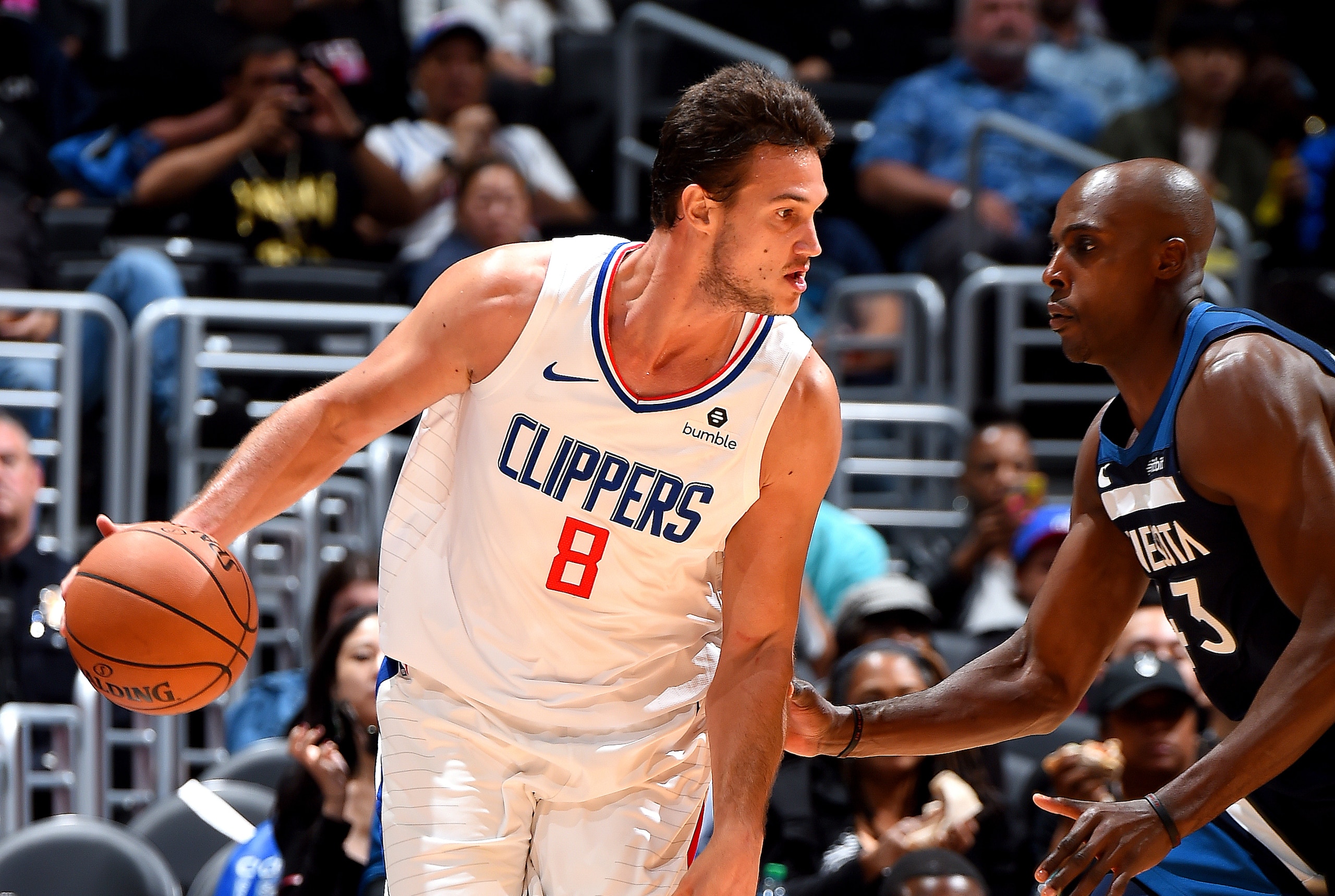
Age at Start of 2019-20: 31
2018-19 Per-Game Stats: 18.8 points, 5.9 rebounds, 2.4 assists, 0.7 steals, 0.4 blocks, 62.2 true shooting percentage
Contract Status: One year, $22.6 million remaining
Multiply ugh by ugh squared, and you will successfully encapsulate how I feel about slotting in Danilo Gallinari. He is playing spectacular basketball this season—perhaps a little too spectacular. As HoopsHype's Bryan Kalbrosky wrote:
"Overall only a dozen players in the West have averaged more points per game from jump shots. He has averaged 1.01 points per possession (85th percentile) off the dribble this season, which displays his fantastic skill set to create his own shot as well.
"His resume might scream sharpshooter, though he is capable of doing much more than that. Gallinari has been impressive when asked to run the offense as the primary ball-handler in the pick-and-roll. Including passes, he ranks in the 96th percentile among all players in the league on PnRs."
Gallinari's marriage of efficiency and volume does not just stand out relative to this season. It holds historical significance.
There have been 98 instances in which a player eclipsed 20 points, five three-point attempts and five free-throw attempts per 36 minutes. Gallinari's true shooting percentage this season ranks 10th within that group.
This is, objectively, absurd—so much so it would be foolish to expect this onslaught to continue.
Gallinari is among the NBA's biggest (active) injury risks. He's reached 70 appearances (or its equivalent) just twice in his career. He has the chance to hit that mile marker for the first time since 2012-13, but it'll be close. He missed 10 games between late January and early February with back problems.
Also not to be forgotten: The Los Angeles Clippers' roster is fluid. Gallinari could take a backseat to Kawhi Leonard or another star next year, or he could be moved to facilitate the arrival of two max free agents.



Frontcourt: LaMarcus Aldridge, San Antonio Spurs
4 of 5
Age at Start of 2019-20: 34
2018-19 Per-Game Stats: 20.8 points, 8.8 rebounds, 2.5 assists, 0.5 steals, 1.3 blocks, 56.7 true shooting percentage
Contract Status: Two years, $50 million remaining ($7 million partial guarantee for 2020-21)
LaMarcus Aldridge almost avoided this nod. The prospect of his regression feels Al Horfordian—like he will be capable of doing more, but the San Antonio Spurs' setup won't demand it.
And maybe that's part of the equation. Aldridge's usage has dipped from last season following DeMar DeRozan's arrival. That remains a welcomed drop-off. Aldridge played like a one-man hub in 2017-18 while Kawhi Leonard rehabbed his quad injury.
Additional slippage might be on the way, though. Dejounte Murray is going to have more influence over the offense when he returns from a torn right ACL, and Derrick White's sophomore efforts are begging for role expansion.
That all benefits Aldridge on some level. More than 60 percent of his shots are still coming as contested looks, and most of his made baskets continue to go unassisted. Neither is a deviation from his career norm, but the infusion of extra ball-handling and table-setting should make his job easier.
But simplification always has an opportunity cost. Aldridge has basically scored at a career clip per 36 minutes over the past two seasons. The presumption should not be that this persists. Even if his efficiency remains intact (possible!), his usage is set to fall and, equally important, he turns 34 in July. San Antonio will only monitor his minutes more hawkishly from here.
Aldridge's decline, should it come, may not be as pronounced compared to his peers. But as the only included player who made this year's All-Star roster, whatever regression he might incur means a whole lot more.
Frontcourt: Marc Gasol, Toronto Raptors
5 of 5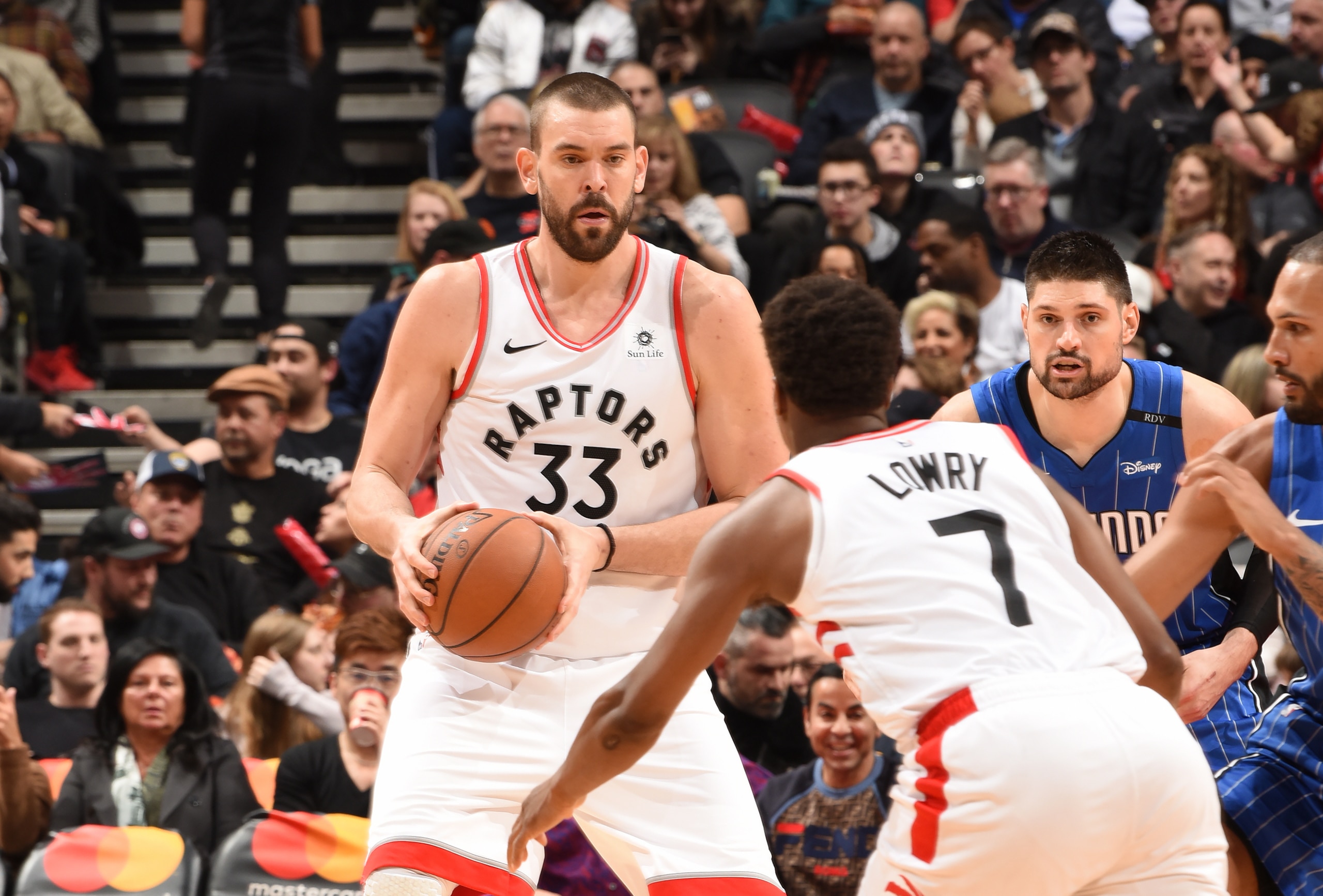
Age at Start of 2019-20: 34
2018-19 Per-Game Stats: 15.1 points, 8.3 rebounds, 4.6 assists, 1.1 steals, 1.2 blocks, 53.8 true shooting percentage
Advanced Metrics: 17.2 PER, 110.96 TPA, 3.08 RPM
Contract Status: $25.6 million player option for 2019-20
Marc Gasol is, quite literally, just what the Toronto Raptors ordered.
"He probably brings to this team something which they never had," assistant coach Sergio Scariolo told CBS Sports' James Herbert. "A type of player who never was in this team. He basically is a great passer, somebody who sees the next play a split-second before most of the opponents. And most of the teammates as well. Most of the coaches, sometimes."
Gasol is living up to that hype. Toronto's offense has mostly stalled this season whenever Kyle Lowry and Kawhi Leonard catch a breather, but his vision gives new life to the second unit. He's averaging more assists per 36 minutes than he did with the Memphis Grizzlies, and the Raptors are pumping in over 112 points per 100 possessions when he's on the court without one of their other two stars, according to Cleaning the Glass.
This is all great news in the short term. Gasol's outlook beyond this season is more confusing.
Next year will be his age-35 season, and he already showed signs of wear and tear in Memphis. He's knocking in shots at a nice clip since joining Toronto, but his overall efficiency has been on the comedown since the beginning of December.
Remove his age and previously slumping offense from the table, and general uncertainty still creeps its way into the picture.
Will he pick up his player option? Will the Raptors re-sign him if he doesn't, assuming Leonard stays? Will they continue to view him as a second-unit anchor—he has started one game in Toronto—who seldom crosses the 25-minute threshold?
Where might Gasol end up if he leaves or gets traded? Does he retain the mobility to stay on the floor in postseason crunch-time situations? Is he even suited for a larger role at this point?
Whatever becomes of Gasol next year, however effective he might remain, we've probably seen the last of his heyday.
Unless otherwise noted, stats courtesy of NBA.com or Basketball Reference and accurate leading into games on March 1. Salary and cap-hold information via Basketball Insiders and RealGM.
Dan Favale covers the NBA for Bleacher Report. Follow him on Twitter (@danfavale) and listen to his Hardwood Knocks podcast, co-hosted by SLC Dunk's Andrew Bailey.



.jpg?w=2560 "Jonathan Taylor Landing Spots 📍")


