Here, in the infancy of the 2018-19 NBA season, it's a little tougher to figure which teams need to shuffle the deck.
The league hasn't stratified yet. The haves are hard to distinguish from the have-nots when we don't yet know who's on the playoff bubble, who's one deal away or who has to tear everything down to the studs.
Nobody is guaranteed to tank in the West, and while the East has a handful of purposeful losers, it's too soon to know which club will position itself as a leader in the annual race to the bottom. What's more, nobody knows how teams will react to tweaked lottery odds that marginally disincentivize losing.
To come up with candidates, we'll have to look at the bigger picture, highlighting teams with unaddressed needs and asset pools that don't make sense. Alternatively, maybe there's an organization with a vocal, unapologetic star who's looking for a way out. You know, maybe one who did everything but pull the fire alarm in a profoundly disruptive practice tirade designed to force a deal.
That's an extreme example, and there are other situations where some shuffling makes sense. Even in October, it's never too early to think about swinging a deal.
Minnesota Timberwolves
1 of 5
It's hard to pinpoint the exact moment when the Minnesota Timberwolves should have traded Jimmy Butler, but that's only because there are so many options.
Was it nearly a year ago, when Butler lit into his teammates for a lack of effort?
Was it after the Houston Rockets bounced Minnesota from the playoffs in five games, at which point Butler again lamented the lack of fight he perceived in his fellow Wolves? Or was it after Game 5 of that first-round series when Butler didn't fly back to Minnesota with the rest of the club?
Hey! Maybe it was in June or July, when rumblings surfaced about Butler's dissatisfaction with Karl-Anthony Towns and Andrew Wiggins. Or perhaps it could have been when Butler turned down a $110 million extension offer (which was the right financial move on his part...probably).
At the very least, it should have been when Butler met with Tom Thibodeau in September to formally request a trade. And if that didn't do it, Butler's seemingly premeditated practice sabotage and the wildly convenient national interview that immediately followed should have.
All that, and more, wasn't enough to convince the Wolves they should cut bait. All that, and Minnesota is still apparently content to let this mess fester and further erode whatever chemistry and sense of order remains in the organization.
Don't worry, though. Wolves owner Glen Taylor has an understanding with Butler, who'll play hard until the team can trade him. If we know anything about operations in Minnesota, it's that when Taylor gets some face time, everything works out great. I mean, Taylor gave Andrew Wiggins a ridiculous max deal, but only after looking the 2014 No. 1 overall pick in the eye and determining Wiggins was serious about improving.
It has been trade season in Minnesota for a long time. It's too bad the Wolves are the last ones to take it seriously.
Sacramento Kings
2 of 5
The Sacramento Kings have been a laggard in the NBA's broad embrace of small, wing-heavy lineups and increased three-point shooting. Part of that has to fall on Dave Joerger, who in two seasons as head coach hasn't fashioned the Kings into anything approaching a modern team.
Last year, they ranked last in pace and 28th in three-point attempts per game. That's with speedster De'Aaron Fox at the controls for much of the season. In preseason play, Sacramento attempted just 1.2 more triples per game but ranked an encouraging 11th in pace.
It appears Joerger is trying to do the smart thing, but he's also hampered by a roster that isn't built for modern ball. A frontcourt rotation that features six players—Willie Cauley-Stein, Marvin Bagley III, Harry Giles III, Skal Labissiere, Kosta Koufos and Zach Randolph—who should only play center in today's game hamstrings a coach.
Sacramento has messed around with extra-large lineups, once trotting out Bagley, Labissiere, Giles and Cauley-Stein together in preseason play. That unit, and several of the Kings' less ridiculous two-big combos, isn't tenable with the way the game is played.
Giles and Bagley together? Sure, that's worth a look, if only to see which of the two might develop the ability to defend stretch 4s or wings. But beyond that, the Kings can't expect success or, more importantly, meaningful development from their bevy of young bigs when they're put in those positions.
Cauley-Stein is headed for restricted free agency, and it's hard to imagine the Kings will devote much to retaining him next summer. There have to be teams that see the 2015 No. 6 overall pick as a reclamation project, one they can cleanse of the Sacramento stink if given the chance. If the Kings can't move him, they should go down the front line and see what their assets are worth.
Only Bagley and Giles should be off the block.
New Orleans Pelicans
3 of 5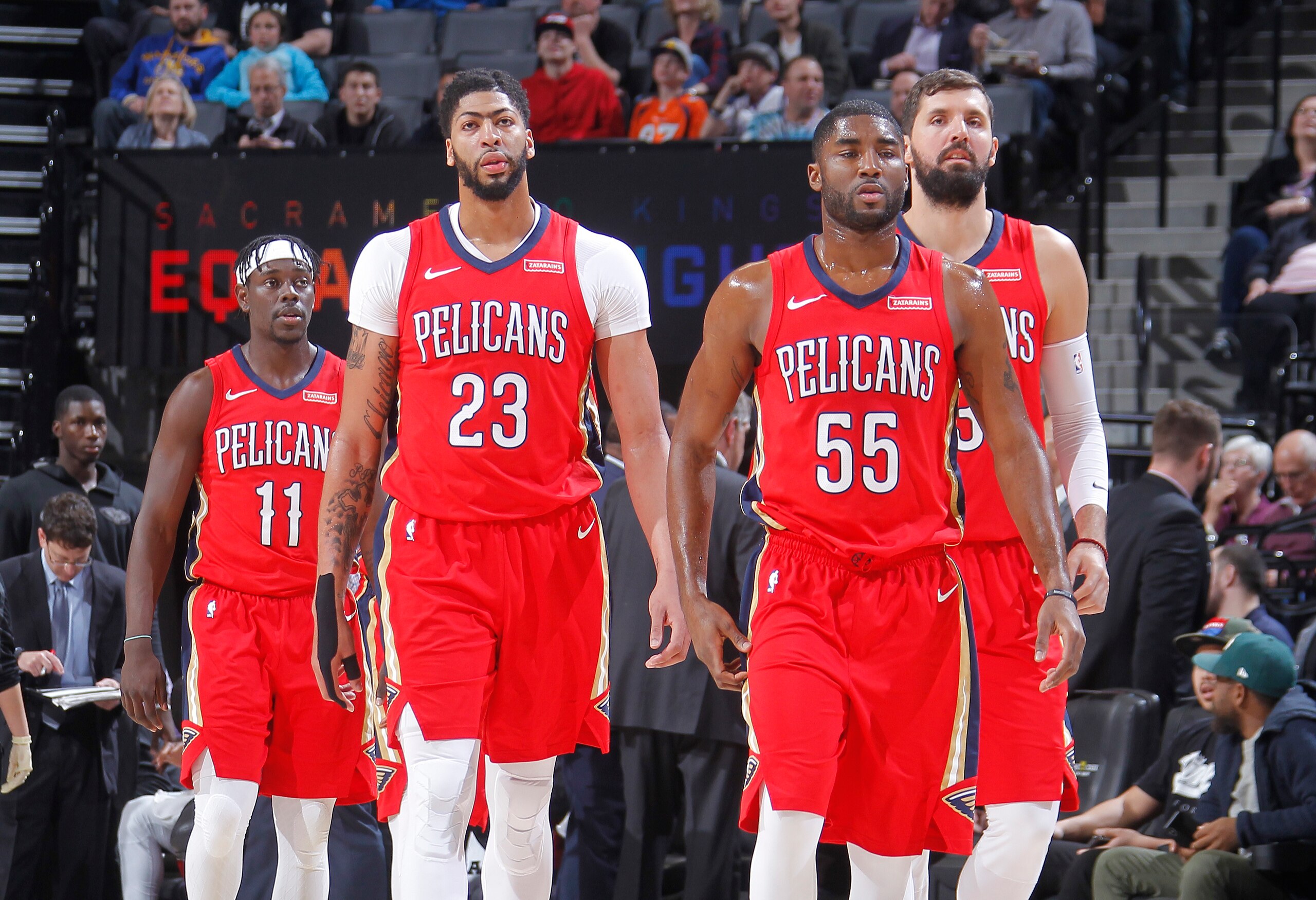
Maybe the New Orleans Pelicans' failure to find the big wing necessary for postseason success doesn't rise to the level of criminal franchise mismanagement (those guys are hard to find because everyone wants them), but it's disappointing.
Wesley Johnson, acquired Monday from the Los Angeles Clippers for Alexis Ajinca, is an improvement. But he's a career 33.7 percent three-point shooter whose defensive contributions have been, at best, inconsistent since he came into the league in 2010. The Pels need to do better.
When you've got Anthony Davis, the hardest part of roster construction is solved: The transcendent star, a prerequisite for serious contention, is in place. You've got options around that star, of course. But one of the nonnegotiable elements of team success lately has been a wing player capable of at least slowing the superstar wing opponents sure to pop up in postseason play. Nobody stops LeBron James, Kevin Durant or James Harden, but any team that's serious about trying needs the right personnel.
New Orleans doesn't have that guy.
Solomon Hill made some theoretical sense in that role when he signed a four-year, $48 million deal in 2016, but a changing league meant Hill was suddenly best deployed as a 4. He has also been injured and broadly ineffective since signing.
The Pels haven't done any better in the intervening two years, and it's telling that they'll begin the season by starting three smallish guards—Jrue Holiday, Elfrid Payton and E'Twaun Moore, all 6'4"—or give retread Darius Miller another look at the 3. Nikola Mirotic could see minutes there, too, but he's a power forward by design and can't be expected to wrangle a wing star on D.
New Orleans' plight becomes more urgent the closer Davis gets to his 2020 free agency (player option). Fail to complement him with the right personnel, and he might conclude the Pelicans aren't the franchise that gives him the best chance to win big.
A playoff berth is likely either way, but if New Orleans wants to keep Davis happy by at least threatening a second-round opponent, it had better scour the trade market for a natural small forward.

Atlanta Hawks
4 of 5
The New York Knicks, Phoenix Suns, Sacramento Kings and Chicago Bulls might all be worse than the very obviously rebuilding Atlanta Hawks. But none of those franchises have been as transparent in their efforts to collect young talent and assets at the expense of short-term gains.
So while every team outside the playoff picture should scrutinize its roster to find movable veteran pieces that might return something more valuable in the long term, Atlanta seems likeliest to take decisive action.
Kent Bazemore, Dewayne Dedmon, Jeremy Lin and opening-night starter Vince Carter should all play elsewhere at some point this season. All four can contribute to a winner, and only Bazemore's deal, which has a $19.3 million player option next season, runs beyond 2018-19. These guys shouldn't be tough to move, and the Hawks ought to be incentivized to shop them.
Perhaps there's concern about Dedmon's ankle. Maybe Bazemore needs to prove his 39.4 percent conversion rate from deep wasn't a fluke. Lin and Carter might be buyout candidates.
Nonetheless, Atlanta is bottoming out and trusting in an approach that feels awfully similar to The Process. Head coach Lloyd Pierce is a branch off Philadelphia 76ers head coach Brett Brown's tree, and he lived through the most conspicuous rebuild in recent memory with the Sixers. If his hiring didn't signal Atlanta's willingness to undertake a deliberate, "no shortcuts" reconstruction, I'm not sure what would have.
As such, the Hawks should gauge the market for everything that isn't nailed down and/or under age 24. For their purposes, 2022 second-rounders are worth more than veteran rotation players.
Phoenix Suns
5 of 5
If the Phoenix Suns have grossly misjudged where they are in their rebuilding trajectory, it's too late; they're adding vets and acting as if victories are the goal in 2018-19.
Trevor Ariza and Ryan Anderson aren't in Phoenix to facilitate losing. They can both play, and even though the Suns have the option to deal or buy them out before the end of the year, maybe that won't happen if this commitment to improvement lingers. Based on Phoenix's signing of Jamal Crawford, that commitment shows no signs of wavering.
Unfortunately for the Suns, while Ariza and Anderson have recently demonstrated the ability to contribute to a winner, Crawford hasn't done anything of the sort for years. Long one of the league's worst defenders, Crawford masks the fact that he's been a damaging offensive player for a while with his ability to create bad shots.
Example: Last year, the league average for effective field-goal percentage was 52.1 percent. Crawford, theoretically a helpful offensive weapon, was at 48.5 percent. In 2017-18, the league average was 51.4 percent. Crawford was at 47.9 percent.
Maybe there's value in bailing your team out of a late shot-clock situation with a contested pull-up off the dribble. Desperate times and all that. But that's Crawford's go-to move. Efficiency has never been his friend.
So if he's the vet Phoenix wants to utilize at its barren point guard spot—even against second units—well, this feels like a waste of resources.
Either let Elie Okobo or De'Anthony Melton play alongside Devin Booker and take copious lumps along the way, or find someone who'll make teammates better while playing a style conducive to winning. The Suns have young pieces to deal if they're serious about getting help. Trusting Crawford, 38 and years removed from his time as a positive force on the floor, won't cut it.
Stats courtesy of NBA.com and Basketball Reference unless otherwise indicated. Accurate through games played Wednesday, Oct. 17.

.jpg?w=2560 "Jonathan Taylor Landing Spots")
.jpg?w=2560 "NFL House in Paris Closes for Protests (AP)")

.jpg?w=2560 "Trevon Diggs Cut by Seahawks")