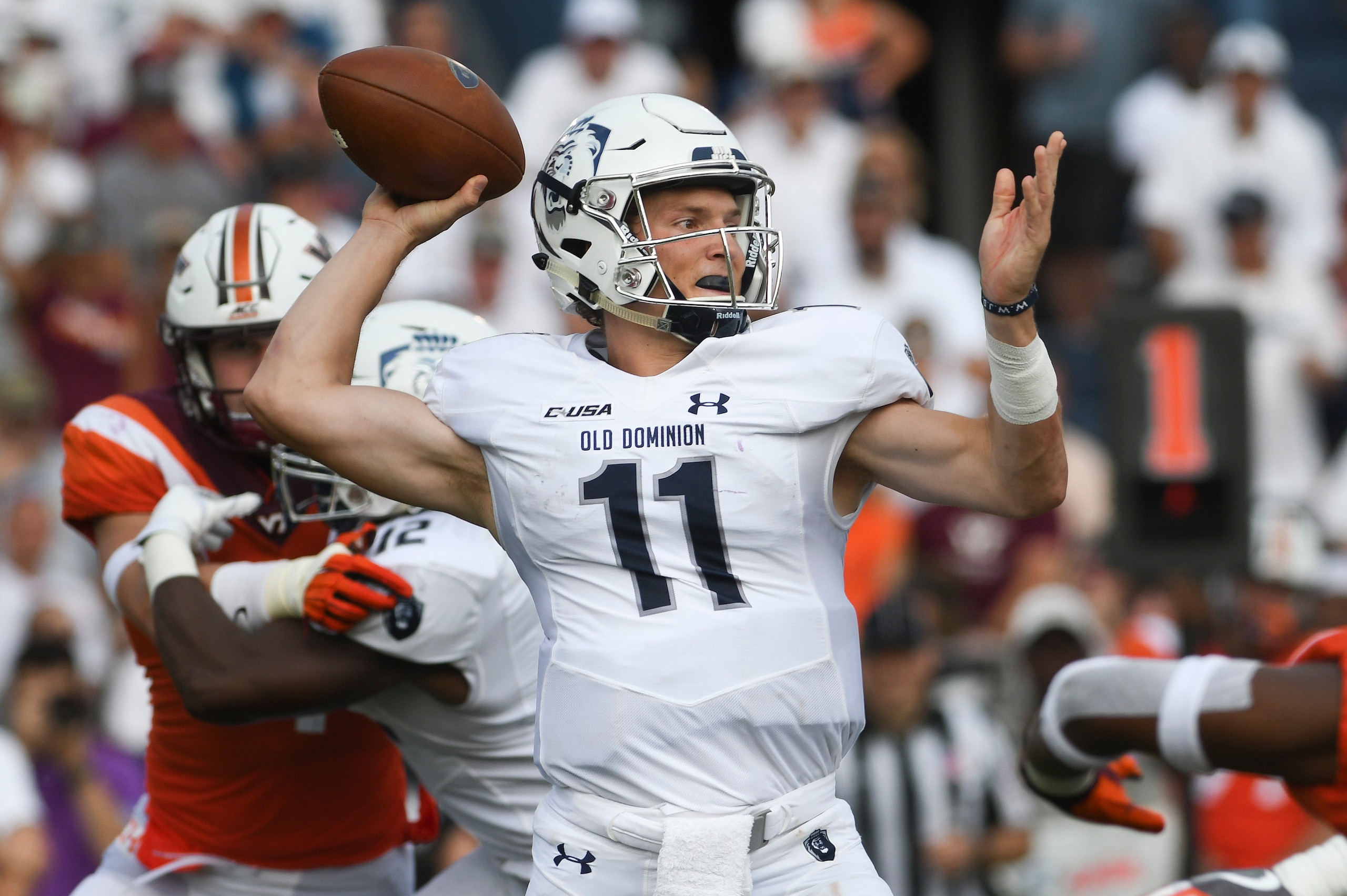


Old Dominion's Blake LaRussa threw for more yards (495) than any other player in Week 4, handing Virginia Tech both its first loss of the season and the Bleacher Report award for the biggest disaster of the season.
The Hokies were one of five ranked teams to suffer losses to unranked teams on Saturday, but teams in the top half of the rankings were able to avoid that plague. It ended up being one of those weird, glorious days in college football when it felt like everyone lost, but everyone in the Top 12 came away with a W.
They weren't all pretty, though. Stanford needed multiple lucky bounces to pull off a miraculous comeback against Oregon, and Oklahoma had to go to overtime to survive Army's clock-draining tactics.
Both of those close calls feature prominently in our Week 4 CFB awards, along with an incredible statement win in the SEC, a backdoor cover for the ages, a true freshman who is already on pace to break career passing records, a brilliant QB switch by Notre Dame and much more.
Before we dive in, though, one quick note on an award you won't find here. We normally declare a "Heisman Stud of the Week" and/or a "Heisman Dud of the Week." However, each of the four early favorites for the stiff-arm trophy played so well in Week 4 that we devoted an entire column to their collective efforts. Rather than recycle that analysis, here's the link to the four Heisman studs of the week for your supplementary reading.
The Most Absurd Backdoor Cover of the Week
1 of 16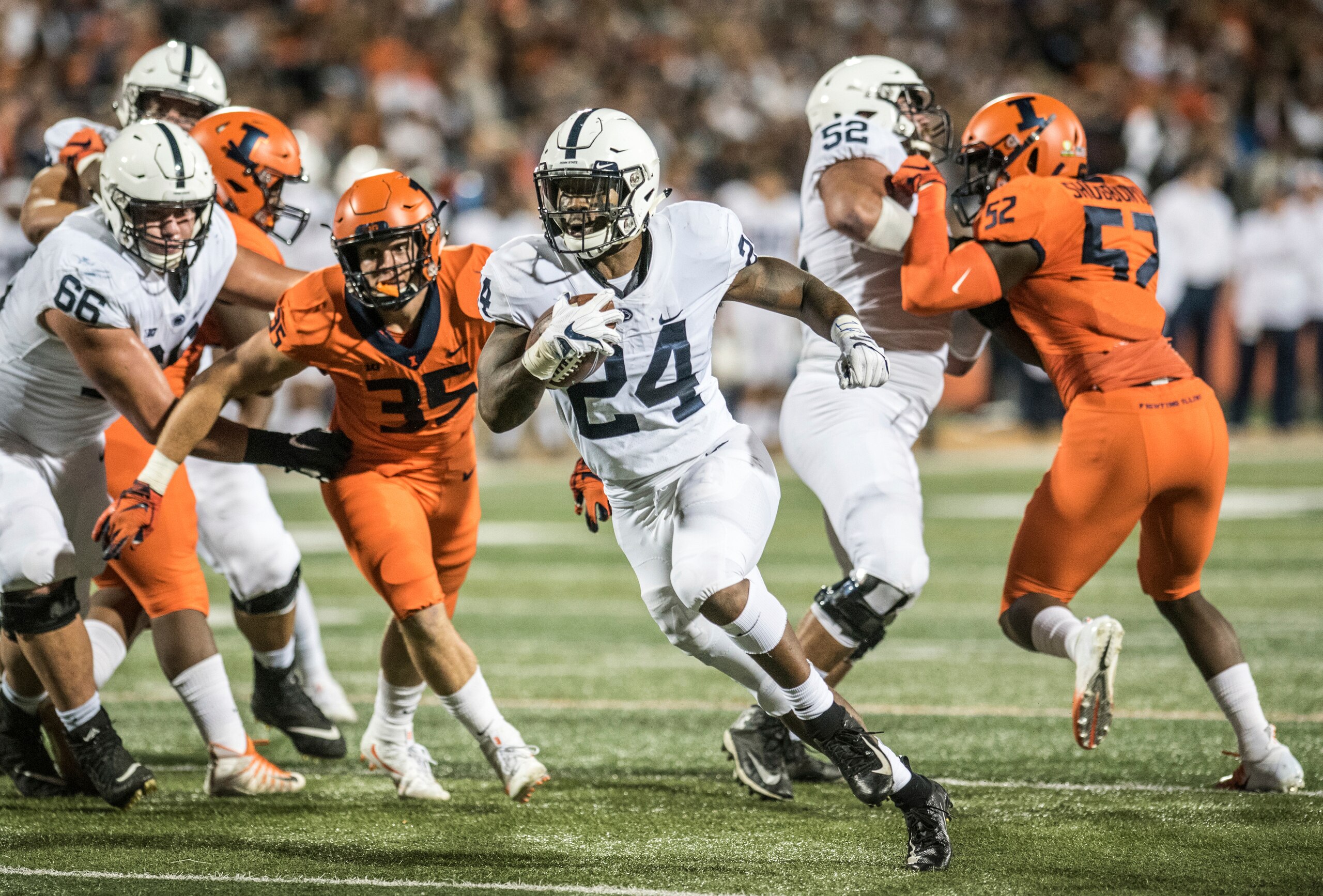
Penn State junior running back Miles Sanders probably deserves his own award for Friday night excellence. The 2016 5-star recruit gashed the Illinois defense for 200 rushing yards and three touchdowns, averaging 9.1 yards per carry. (He also threw a TD pass to QB Trace McSorley on a trick play; however, it was overturned because of an ineligible receiver downfield.)
Sanders did it all in just three quarters, recording his last official touch with two minutes left in the third.
But it was Penn State's fourth quarter, sans-Sanders onslaught that had fans losing their minds.
The 10th-ranked Nittany Lions were supposed to cruise to victory over the Illini. Per OddsShark, Sanders and Co. were 27-point favorites, despite playing on the road on a Friday night in their first conference game of the year—not to mention the trap-game potential with next week's game against Ohio State looming large in the distance.
It was perhaps because of that combination of factors (and lackluster defense) that Penn State was trailing 24-21 early in the third quarter and only leading 28-24 at the start of the fourth.
Forget about covering in a comfortable win. The Nittany Lions were in full-blown survival mode.
Or so it seemed.
For you see, Penn State is a second-half offensive juggernaut. It had serious problems on defense in the fourth quarter in the scare against Appalachian State back in Week 1, but it has scored at least 35 points after the intermission in all four games this season.
Coming into this game against Illinois, the Nittany Lions had scored touchdowns on 14 of their 21 possessions in the second half or overtime, excluding end-of-regulation kneels and one punt returned for a score. And they went 6-of-6 against the Illini, scoring five fourth-quarter touchdowns while only running 12 plays.
As previously mentioned, Sanders didn't gain a yard in the fourth quarter, and Trace McSorley's last pass attempt came with more than 14 minutes remaining. But despite rolling with a second-team offense of Sean Clifford, Ricky Slade and Mac Hippenhammer (what a name!), the Nittany Lions could not be stopped en route to a 63-24 rout—covering the spread with room to spare.
Incredibly, this is Penn State's third consecutive game that has ended with a run of at least 42 unanswered points. The Nittany Lions scored the final 44 points against Pittsburgh in Week 2 and put up 42 straight last week against Kent State. Never ever give up on the spread when these guys are playing.
The Unlikeliest Comeback of the Week
2 of 16
Speaking of unbelievable backdoor covers, Stanford -3 at Oregon should've never had a chance.
With four minutes remaining in the third quarter, Oregon's impending win over Stanford was as good as signed, sealed, delivered.
The Ducks were up 24-7 and had the ball on the Stanford 1 in a 1st-and-goal situation. To that point, they had gained at least 40 yards on all six of their possessions, while Stanford only had one drive of more than 30 yards. Justin Herbert and Co. were just inches away from taking a 24-point lead and cruising to a season-defining victory.
ESPN's win probability chart gave the Ducks a 99.0 percent chance of victory at that time.
And then all hell broke loose.
Cyrus Habibi-Likio fumbled on first down. Oregon got it back, but then on third down, the snap sailed over Herbert's head for Stanford's Joey Alfieri to scoop it up and run 80 yards for a touchdown. It should've been 31-7, but just like that, it was 24-14.
After an Oregon three-and-out followed by a three-play touchdown drive for Stanford, the Cardinal were right back in it.
Still, the Ducks had a golden opportunity to put the game away. Leading 31-28 with the ball and less than three minutes remaining, they were just a couple first downs away from victory. After Herbert got them two first downs, all they really needed to do was kneel the clock away. Worst-case scenario, they punt the ball out of bounds with fewer than 10 seconds remaining.
Again, the win probability chart gave the Ducks a 98.7 percent chance to come away with a huge W.
But for some inexplicable reason, Oregon continued running actual plays and fighting for extra yards, resulting in a CJ Verdell fumble that Stanford recovered. The Cardinal went 46 yards in 46 seconds, sending the game to overtime with a field goal. Once there, a Colby Parkinson touchdown reception was the final piece of the most improbable comeback win.
The Statement Win of the Week
3 of 16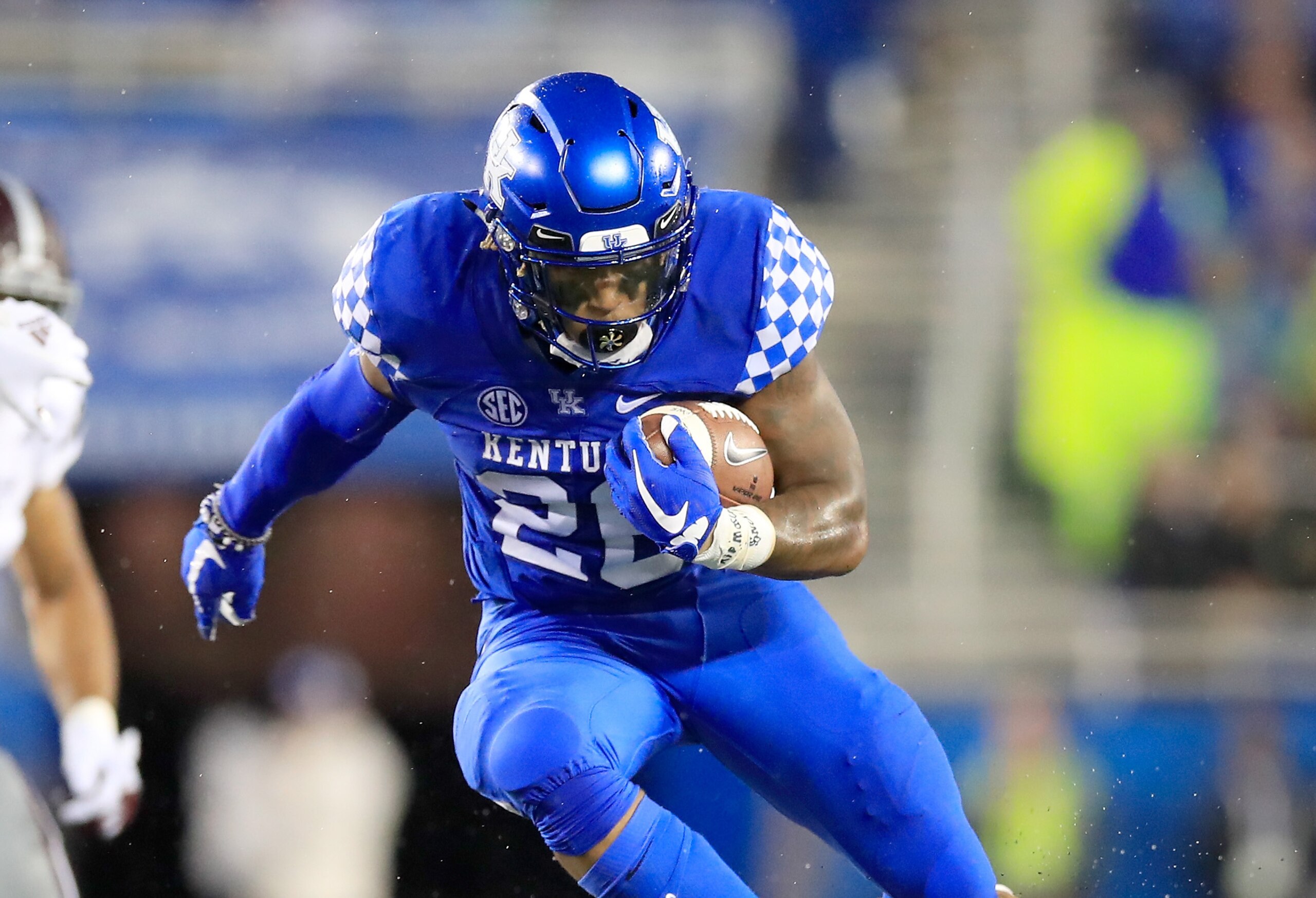
So you thought Kentucky was just a basketball school, did you?
The Wildcats already had a program-altering road win over Florida back in Week 2, and they dismantled yet another ranked conference foe in a 28-7 victory over No. 14 Mississippi State.
September isn't even over yet, but Kentucky has already knocked off multiple ranked opponents in the same season for first time since 2007—the only time in the past 33 years the Wildcats were an AP Top 25 team.
As long as we're talking about ancient history, one must go all the way back to 1993 to find the last time they finished a season ranked better than 35th in scoring defense. But out of seemingly nowhere, the Wildcats have one of the best defenses in the nation. They are tied for seventh in scoring defense with a mark of 13.3 points allowed per game. They're also 11th in total defense, allowing a stingy 279.5 yards per game.
Compare that to just last year, when they ranked eighth in scoring defense and 12th in total defense...in the SEC.
Kentucky limited Mississippi State's high-octane offense to a meager 201 yards and seven points. The Bulldogs had averaged at least 8.1 yards per play in each of their first three games, but they finished at 3.4 against Kentucky with only one drive that went for more than 25 yards.
And while Kentucky's defense was in shutdown mode, Benny Snell Jr. was doing his best Barry Sanders impression.
It was supposed to be a tough day for Snell. Mississippi State's defense had allowed just 26 total points and two touchdowns in its first three games, and it was particularly adept at stopping the run. Those first three opponents averaged a combined 2.5 yards per carry and did not find the end zone.
Snell had 6.6 yards per tote and scored not one, not two, not three, but four times.
With a Heisman candidate at running back and a defense that is eating opponents alive, Kentucky is looking like the top challenger to Georgia in the SEC East. The Nov. 3 showdown between the Wildcats and the Bulldogs (in Lexington) just might be one of the best games of the 2018 season.
.jpg?w=2560 "AP Poll Top Five Week 9")
.jpg?w=2560)
The Complete and Utter Disaster of the Year
4 of 16
Three weeks ago, Virginia Tech played a Monday night road game against No. 19 Florida State, forcing five turnovers while allowing only three points. Despite losing just about every defensive starter from last season, it appeared the Hokies were going to be just fine in that department—and quite possibly the biggest challenger to Clemson in the ACC.
If you happen to find that team, please contact the authorities in Blacksburg, Virginia, because they went missing on the cross-state drive to Norfolk for the Week 4 game against Old Dominion.
The Monarchs entered the game 0-3 and were prominent in the debate about the worst FBS team in the country, because we're not talking about close losses to quality opponents. They were against Charlotte, Florida International and Liberty—the latter in blowout fashion. Tom Fornelli of CBS Sports had Old Dominion at No. 4 in his "Bottom 25 Rankings," and The Athletic's Chris Vannini ranked ODU 128th out of the 130 FBS teams.
The Monarchs were a 28.5-point underdog, and rightly so.
Somehow, that team—playing a backup quarterback, no less—scored seven offensive touchdowns in a 49-35 win over Virginia Tech.
Blake LaRussa threw for 495 yards and four scores. He also rushed in another one. Jeremy Cox averaged 6.5 yards per carry en route to 130 yards and two touchdowns. Two different Monarchs receivers had nine receptions and more than 140 yards each.
It looked as though Old Dominion was the 13th-ranked team making mincemeat of an opponent that had given up 52 points to Liberty.
Yes, Virginia Tech lost QB Josh Jackson to an ankle injury early in the fourth quarter, but that doesn't explain why the defense allowed touchdown drives of at least 65 yards on five of ODU's final six possessions.
As was the case with Wisconsin's loss to BYU last week, this disaster technically doesn't affect Virginia Tech's chances of winning the ACC, but it is quite challenging to imagine that happening.
The Second-Biggest Letdown of the Week
5 of 16
Boston College should send a thank you note to Virginia Tech for suffering the most embarrassing loss of the season and making us all forget how miserably the Eagles played against Purdue.
Prior to Saturday, it had been a great run for Boston College.
Last Thursday's 41-34 road win over Wake Forest gave the Eagles their first 3-0 start since 2007. A few days later, they appeared in the AP Top 25 for the first time since November 2008. And throughout the week, many members of the national media made note of the fact that BC QB Anthony Brown was leading the country in passer efficiency rating.
The Eagles were quickly emerging as a threat to at least shake things up in the ACC, given their remaining games against Clemson, Miami and Virginia Tech.
But they laid a big fat egg in West Lafayette in a 30-13 loss to previously winless Purdue.
Brown can go ahead and kiss that passer efficiency rating lead goodbye after this performance. He completed 13 of his 27 pass attempts for just 96 yards, one touchdown and four interceptions. All four picks came in the span of five possessions. During that stretch, Brown had more passes caught by Purdue defenders (four) than by his own receivers (three).
It wasn't just Brown, though. Nothing was working for Boston College. AJ Dillon had his worst performance in nearly a full calendar year, rushing 19 times for 59 yards (3.1 YPC). Meanwhile, X-factor Jeff Smith—who entered the game averaging 16.5 yards per touch—was limited to two carries for six yards.
Prior to a pair of meaningless drives late in the fourth quarter, the Eagles had just 98 yards of total offense—against a team that allowed 608 yards against Missouri last week, no less.
This nonconference letdown won't impact Boston College's chances to make a run at the ACC championship, but it made the Eagles feel like less of a threat to upset the apple cart.
The Dual-Threat Performance of the Week
6 of 16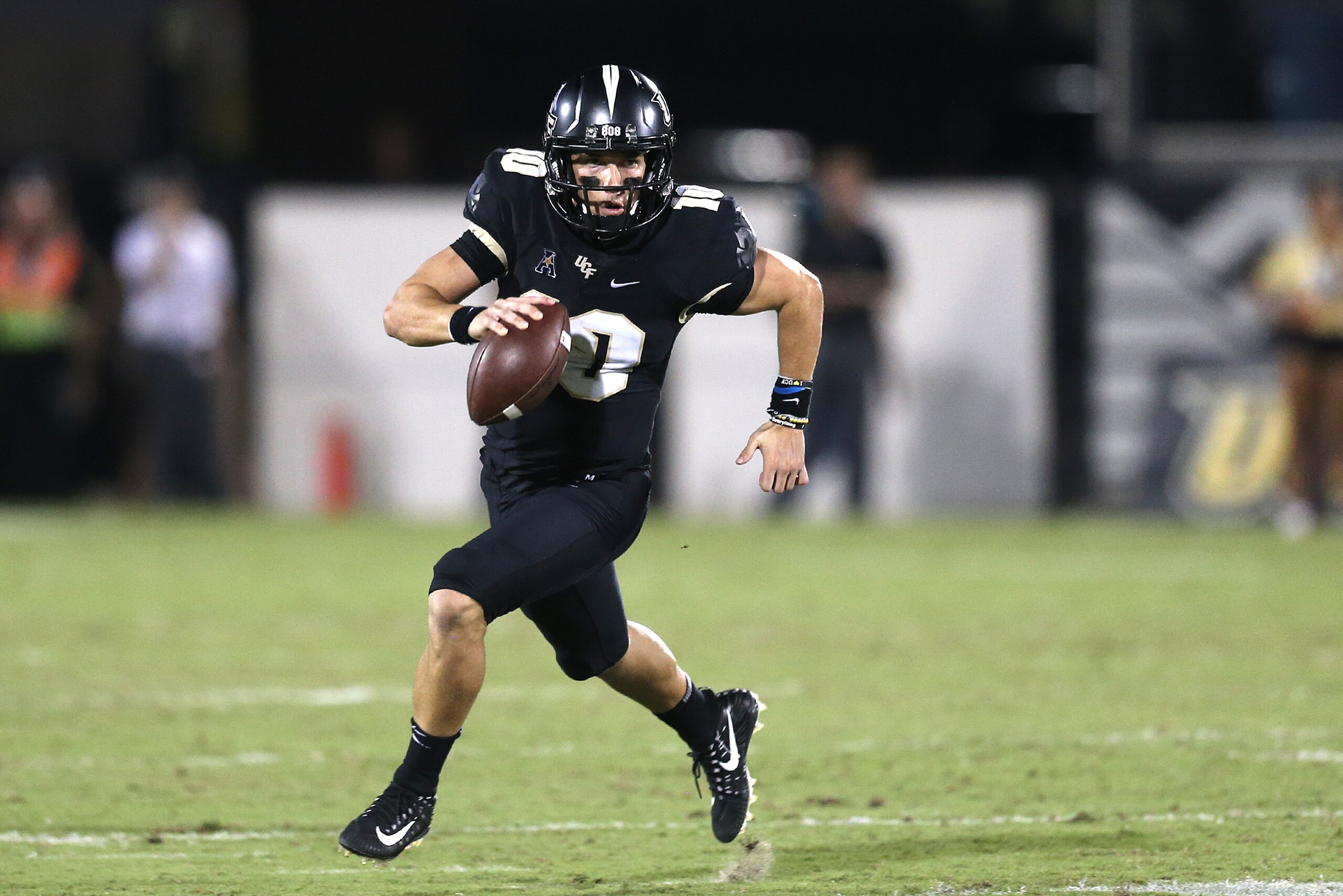
It's hardly uncommon to see McKenzie Milton doing damage with both his arm and his legs.
Over the final three games of last season—including the Peach Bowl win over Auburn—Milton averaged 369.7 passing yards with 3.7 touchdowns, as well as 80.0 rushing yards and 1.0 touchdowns. Those aren't quite Johnny Manziel or Lamar Jackson rushing numbers, but his dual-threat nature is what makes him one of the top 10 or so candidates to win the Heisman.
And against Florida Atlantic's poor excuse for a defense, Milton had another field day.
Similar to Penn State's Miles Sanders, Milton did the vast majority of his work in the first three quarters. Over the final 18 minutes of UCF's 56-36 win over FAU, he completed just two of his five pass attempts for 19 yards and rushed for a meager seven yards.
The Knights didn't need him anymore at that point, though, because he had already thrown three touchdowns and rushed in three more.
Big plays were few and far between for UCF. It didn't have a single rush of more than 14 yards, and a 39-yard first-quarter reception by Gabriel Davis was the only pass play that went for more than 23. But Milton was surgical in his evisceration of the Owls, leading the Knights on six touchdown drives of at least 50 yards.
Per Sports Reference, Milton became just the sixth player since 2000 to amass at least 300 passing yards, 75 rushing yards and three touchdowns both through the air and on the ground in a winning effort. The other five were Manziel, Jackson, Tajh Boyd, Dak Prescott and John Wolford, so this performance put him in rather elite company.
The Best QB Switch of the Week
7 of 16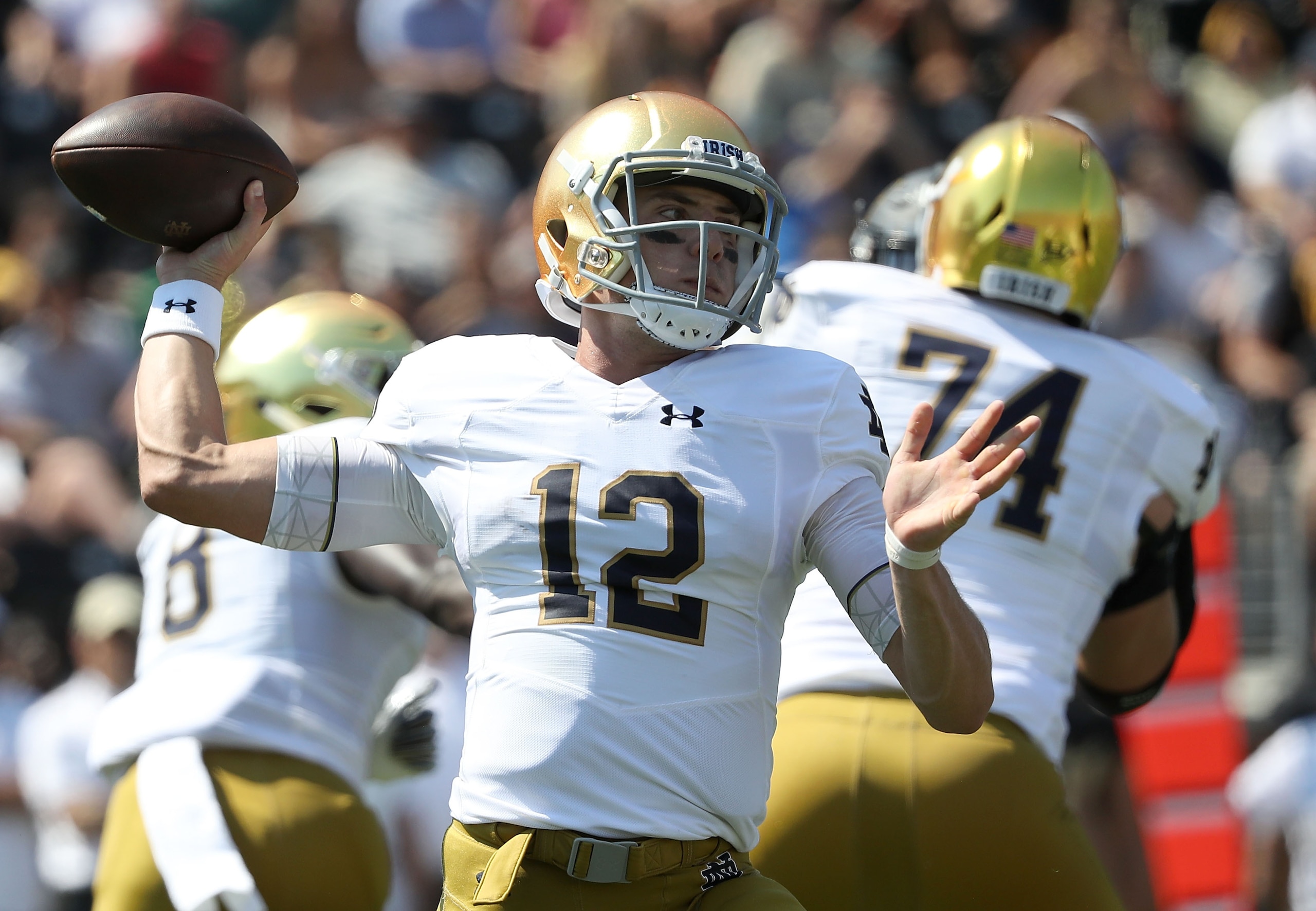
You've no doubt heard a lot about quarterback debates for the past several months. Clemson is still trying to figure out whether Kelly Bryant or Trevor Lawrence is the answer. Meanwhile, Nick Saban keeps saying Tua Tagovailoa and Jalen Hurts will both get snaps, even though it's clear to the rest of the world who won that contest in Tuscaloosa.
But did Notre Dame just become a serious threat to reach the College Football Playoff by switching from Brandon Wimbush to Ian Book?
Ranked No. 8 in the AP poll heading into Week 4, the Fighting Irish were obviously already somewhere in that conversation. However, anemic offense in nail-biting home wins over Ball State and Vanderbilt left Notre Dame well behind the likes of Alabama, Clemson, Georgia, Ohio State and Oklahoma on the list of teams who seem capable of going 12-0.
Wimbush was largely to blame for the inability to move the ball. The dual-threat QB was much more of a no-threat factor, averaging 2.8 yards per carry and completing just 55.3 percent of pass attempts with four interceptions. After three games, he had only thrown for one touchdown and rushed for one other. It clearly wasn't working.
Thus, Brian Kelly made the last-minute decision—at any rate, it wasn't announced until moments before kickoff—to hand the reins to Book. And early returns against Wake Forest were fantastic.
The first three drives were uninspiring, resulting in one punt, one fumble, one turnover on downs and zero points. But things escalated in a hurry from there, as Notre Dame scored touchdowns on eight of its next nine possessions—six of them on drives of at least 70 yards.
Book scored five touchdowns (two passing, three rushing) in Notre Dame's 56-27 victory over the Demon Deacons, accounting for 368 total yards between his running and throwing.
We'll be curious to see where Wimbush fits in moving forward. Perhaps the type of role Braxton Miller had as a senior at Ohio State would work well. But it looks like Book will be the man at QB for Notre Dame's season-defining stretch against Stanford and Virginia Tech in the next two weeks.
The Emerging Group of Five Contender of the Week
8 of 16
Rutgers has become a doormat.
After consecutive road losses to Ohio State and Kansas by margins of 49 and 41 points, respectively, the Scarlet Knights came back to Piscataway to get their teeth kicked in by Buffalo. The Bulls cruised to a 42-13 win, beating a power-conference opponent for the first time since—wouldn't you know it?—a 34-11 road win over Rutgers in September 2002.
But rather than heaping more, well-deserved insults onto Rutgers, let's show some love to a Buffalo team that might be better than it has ever been.
In 28 tries, Buffalo has never won more than eight games in a season, but it's already halfway there after victories over Delaware State, Temple, Eastern Michigan and now Rutgers. Led by legitimate NFL prospects QB Tyree Jackson and WR Anthony Johnson, the Bulls have an offense that could make one heck of a run through the Mid-American Conference.
That dynamic duo connected twice for 101 yards against Rutgers, but it's much more than just that twosome. In fact, the Bulls have rushed for at least 150 yards and scored at least 35 points in all four games—something they only did twice in the entire 2017 campaign.
And against Rutgers, the defense was the big story. Buffalo didn't force a single turnover, but it held Rutgers to 3.8 yards per play and clamped down in a big way on third down. The Scarlet Knights converted just two of 18 third downs and went three-and-out nine times.
It's probably still too early to start entertaining the thought of a perfect season. Next week's home game against Army will be a challenge, as will road tilts with Toledo and Ohio. But it's not impossible. And given the early losses by Florida Atlantic and Boise State, Buffalo may well be the non-AAC Group of Five team with the best odds of sneaking into a New Year's Six bowl.
The Rushing Phenom of the Week
9 of 16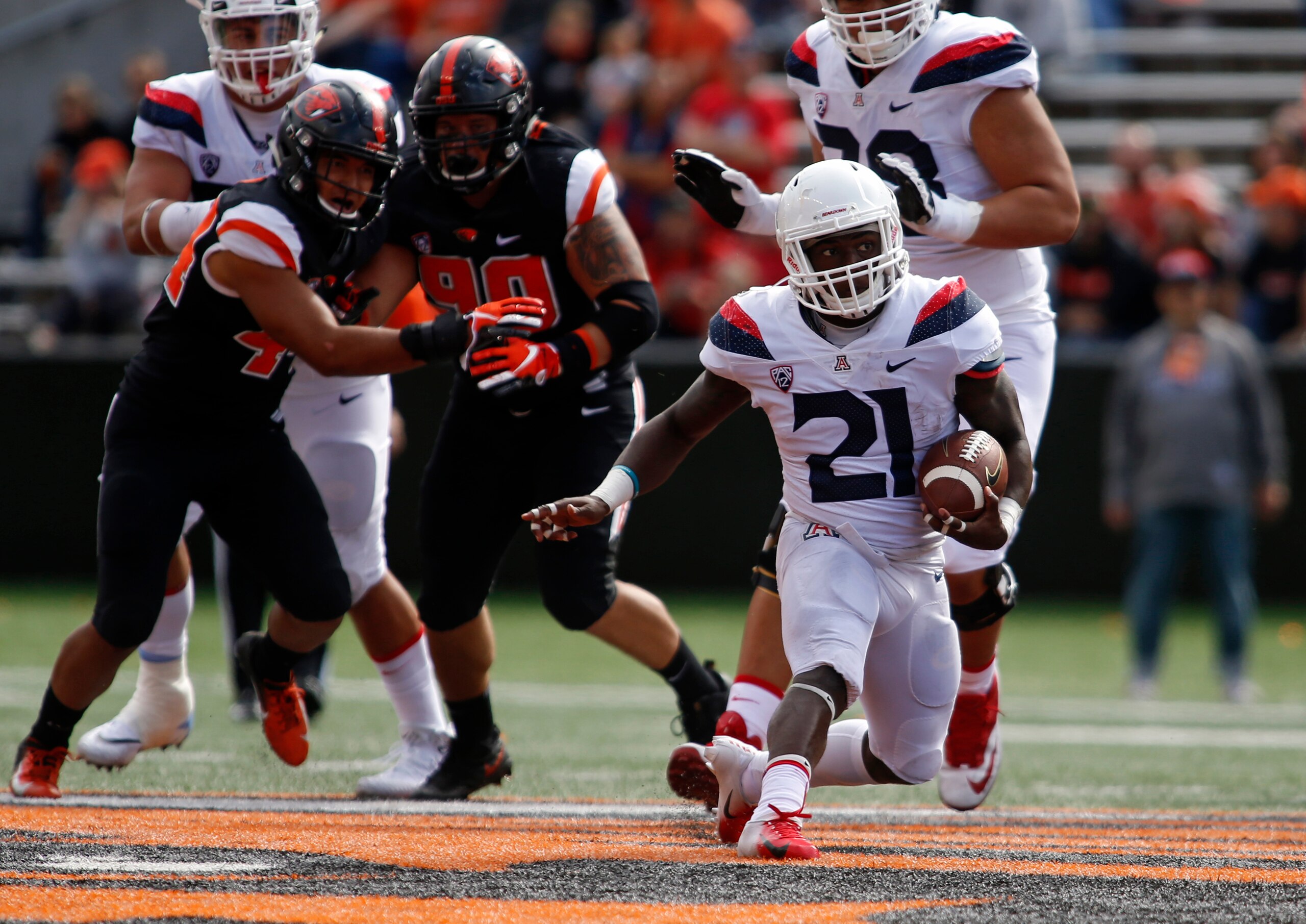
Running wild against Oregon State has become the norm in recent years. The Beavers have allowed at least 200 rushing yards per game in each of the past three seasons, and they are well on their way to extending that streak to four years.
This week's beneficiary of that Swiss cheesy front seven was Arizona.
The Wildcats ran 51 times for 442 yards and three touchdowns as a team—even though Khalil Tate had minus-nine yards on four carries. It wasn't quite the 534-yard, seven-TD shellacking they put on the Beavers last year, but this was still enough for a 35-14 road win in conference play.
The singular star was J.J. Taylor, who carried the ball 27 times for 284 yards and a pair of touchdowns. His previous career highs were 19 carries and 168 yards, both coming back in 2016. He left both of those marks in the dust in this one. Not only that, but he more than doubled his rushing total for this season, as he had amassed just 193 yards in his first three games.
Taylor got the Wildcats party started with a 40-yard touchdown early in the first quarter, and he added a just-for-good-measure 62-yard TD late in the fourth.
Per Sports Reference, it's just the third time since 2000 that an Arizona player rushed for at least 240 yards in a single game. (However, Taylor finished nowhere near Kadeem Carey's mark of 366 yards and five touchdowns in 2012.)
This was also the best individual rushing performance in 2018, surpassing Wisconsin's Jonathan Taylor, who ran for 253 yards against New Mexico in Week 2.
The Most Depressing First-Half Drive Chart of the Month
10 of 16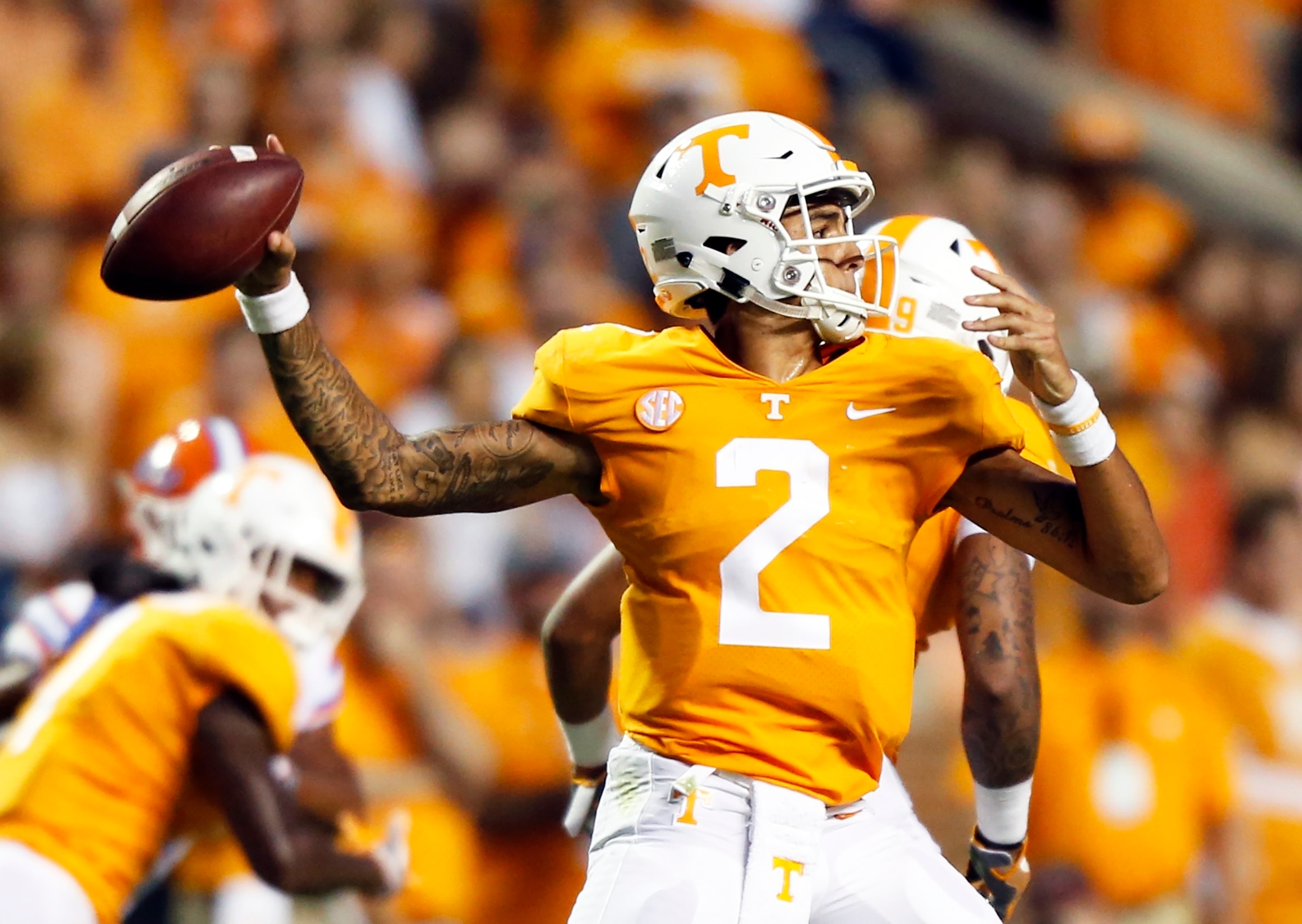
It has been a pretty brutal two years for Tennessee fans, but the Volunteers may have hit a new on-the-field low during the 47-21 home loss to Florida.
Jarrett Guarantano committed turnovers on each of Tennessee's first two possessions. The first was a strip-sack, setting Florida up just outside the red zone for a quick TD. The second was an interception returned to the Tennessee 7 for yet another easy Gators score.
After a turnover on downs followed by a short field goal, Tim Jordan got stuffed several yards behind the line of scrimmage for a safety. And the Volunteers finished out the half with a pair of fumbles that nullified drives of 76 and 44 yards.
Just for good measure, Tennessee also fumbled the opening kickoff in the second half.
If you add it all up, that's eight possessions without a single touchdown or punt, which has to be some sort of a record. The Vols lost four fumbles, threw an interception, failed on a fourth-down attempt, took a safety and kicked one field goal (on a 19-yard drive). After less than 31 minutes, they were down 33-3.
And if you were thinking, "Well, maybe things will improve in the next few weeks," think again. Tennessee plays at Georgia this coming Saturday and then draws Auburn and Alabama right after a bye week.
The turnover-bonanza-turned-26-point-home-loss to Florida just might be the highlight of this four-game stretch.
The Clock-Consuming Performance of the Year
11 of 16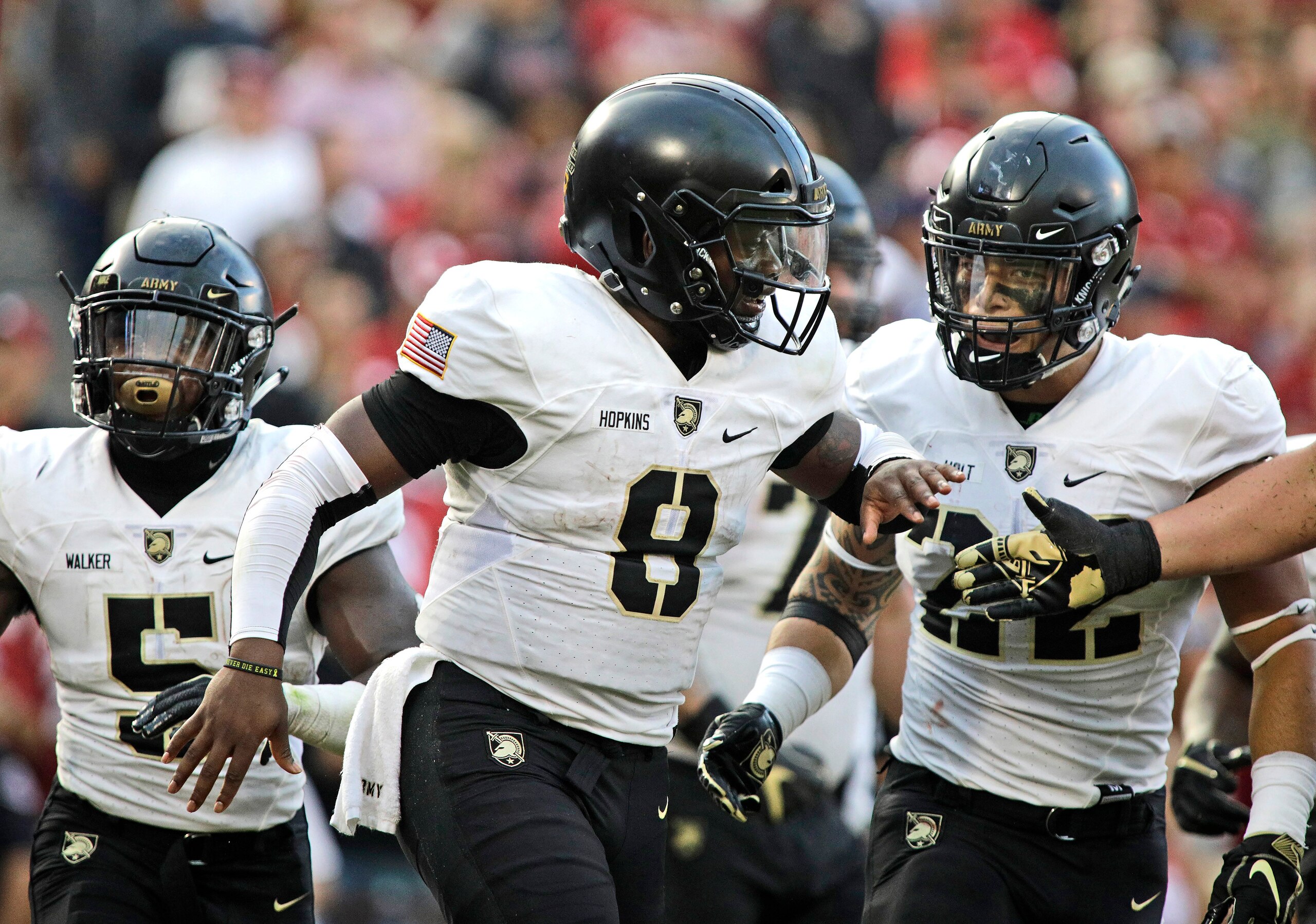
Nobody bleeds clock quite like Army, and combining that with Oklahoma's quick-strike offense was like watching the tortoise and the hare.
After three weeks, the Black Knights led the nation in average time of possession by a margin of more than two minutes. They were at 39 minutes and 38 seconds per game, while No. 2 Rice was sitting at 37 minutes and 30 seconds.
But against the Sooners, Army held the ball for 44 minutes and 41 seconds.
On Army's first possession, it ran 16 plays (all rushes) for 75 yards and ate 9:31 off the clock en route to a touchdown.
The Black Knights had so much fun with that drive they decided to do it again. The second possession also lasted 16 plays and 75 yards. The only differences were that they did attempt (and convert) one pass and this drive "only" lasted 8:54.
Oklahoma's first three drives (all touchdowns) only took seven minutes and 10 seconds.
The real gems didn't come until the second half, though.
Army tied up the game late in the third quarter on a 19-play, 85-yard, 10:47 touchdown drive. And after a goal-line stand on Oklahoma's next possession, the Black Knights chewed 10 more minutes off the clock on a 17-play, 65-yard drive.
Unfortunately for the underdogs, that drive ended in an interception, and Oklahoma would win the game 28-21 in overtime.
Still, what an incredible performance by the triple-option offense. Army almost had twice as many rushing attempts (78) as Oklahoma had offensive plays (40).
The Misleading Box Score of the Week
12 of 16
Arkansas outgained No. 9 Auburn by a margin of 290-225. The Razorbacks also won the time of possession battle by roughly five minutes. Each team managed just 13 first downs, as Auburn averaged a woeful 2.5 yards per carry. Arkansas did commit two turnovers while Auburn had none, but the Tigers only scored three points off those turnovers.
Given all that information, you'd probably assume it was a close game, right?
You'd be wrong.
Auburn won 34-3.
What in the world?
Special teams made a world of difference for Auburn.
Ryan Davis had a 48-yard punt return and a 36-yarder. Each one set up the Tigers inside the Arkansas 30 for easy points. They also blocked one punt and returned it to the Arkansas 9, setting up another touchdown. And the one time the Razorbacks put points on the board, the Tigers immediately got them back and then some, as Noah Igbinoghene had a 96-yard kickoff return for a touchdown.
Auburn scored six times, but only one of those drives went more than 27 yards. The Tigers only had one offensive play of more than 15 yards, but they still won with room to spare.
Turns out it's rather easy to beat a bad team when playing with a short field on a regular basis.
The True Freshman Performance of the Week
13 of 16
With a tip of the cap to Purdue's Rondale Moore—who had at least eight receptions for 100 yards and a touchdown for the third time in four games—we have to declare Texas Tech QB Alan Bowman the true freshman of the week.
One week after torching Houston for 605 yards and five touchdowns, Bowman had a more-modest-but-still-incredible 397 passing yards and two touchdowns in Texas Tech's surprising road win over No. 15 Oklahoma State.
The Cowboys defense had been looking fierce in the first three weeks, but Bowman had almost no difficulty moving the ball against them. He led the Red Raiders on eight drives of at least 59 yards.
One of those drives ended in an interception in the end zone and another stalled out with a missed field goal, but the other six produced points in the 41-17 win.
It wasn't all Bowman, of course. Demarcus Felton, SaRodorick Thompson and Ta'Zhawn Henry combined for 38 carries, 252 rushing yards and three touchdowns. But the Red Raiders called upon Bowman's arm 46 times in victory.
It's way, way too early to extrapolate like this, but let's do it anyway.
Bowman is averaging 389.25 passing yards per game. If he stays healthy and keeps the job for the next three-and-a-half years, that's 18,684 yards, assuming no bowl games. That isn't to say the Red Raiders have no hope of a bowl in the next four years. It's just a baseline. If they can make it to two bowl games, that bumps his projected total up to 19,462.5 yards.
In case you haven't figured out where this is going yet, the career leader in FBS passing yards is Case Keenum at 19,217.
I'm not saying. I'm just saying.
The Point-a-Palooza
14 of 16
In most weeks, this title for highest-scoring game comes down to the difference of a missed field goal or a garbage-time touchdown. But Nevada and Toledo cruised to the Point-a-Palooza pedestal, combining for 107 points while no other game surpassed 92.
To get to all those points, there were 12 plays in this game that went for at least 25 yards. (Actually, it's 13 if you include Diontae Johnson's 98-yard kick return for a touchdown.) Only one of those plays—Toa Taua's 66-yard rushing touchdown—gained more than 38 yards, though, as this was a steady onslaught of medium strikes rather than a series of home run plays.
Though Nevada ended up on the wrong end of the scoreboard, the Wolf Pack scored 44 points while out-gaining Toledo by 122 yards. Taua rushed for 170 yards and three touchdowns, and Ty Gangi threw for 320 yards and one score.
They weren't enough to overcome Mitchell Guadagni, who would be a strong candidate for Group of Five player of the year if not for UCF's McKenzie Milton.
Toledo's dual-threat QB threw for four touchdowns, rushed for two more and had a combined total of 342 yards. Guadagni got out to a slow start in this one, partially because two of Toledo's first three touchdowns came on the aforementioned kick return and the recovery of a blocked punt, but he got red-hot in the second and third quarters.
Incredibly, the final points in this game were scored with 7:26 remaining, as they weren't exactly racing the clock to reach the century mark.
The "So About That Hot Seat Nonsense..." Game of the Week
15 of 16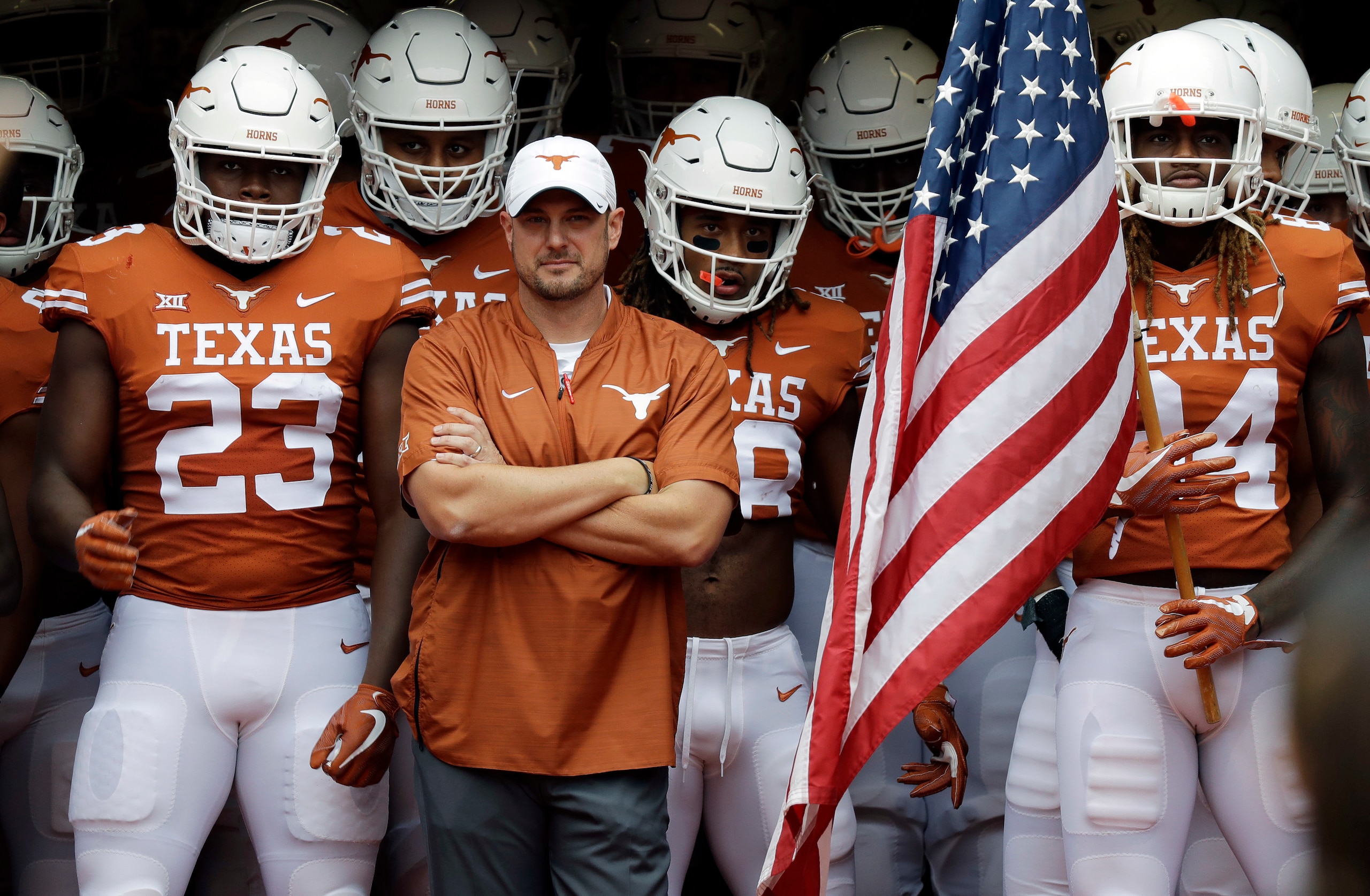
For the first 41 minutes of TCU vs. Texas, it seemed as though the Longhorns were going to blow a golden opportunity.
The first two turnovers that they forced produced neither points nor first downs. Two of their three longest drives—a six-play, 51-yard possession to start the game and a 14-play, 69-yard drive in the third quarter—ended in missed field goals. Despite quality defense, they trailed 16-10.
Suddenly, the offense sprang to life.
Sam Ehlinger completed each of his final six pass attempts for 98 yards and a pair of touchdowns. In between those 30-plus-yard scores by Collin Johnson and Lil'Jordan Humphrey, Ehlinger also rushed in a touchdown set up by a Caden Sterns interception.
Just like that, they scored 21 unanswered points for a 31-16 win over No. 17 TCU.
Three weeks removed from a season-opening loss to Maryland that had many screaming for Tom Herman's head, Texas has reeled off back-to-back wins by multiple-TD margins over ranked opponents. (USC didn't deserve to be ranked last week, but that's neither here nor there.)
By knocking off TCU while Texas Tech stomped Oklahoma State, Texas is now arguably the third-best team in the Big 12. And the Longhorns will get to face the top two teams (Oklahoma and West Virginia) in Texas, so they'll at least have a good chance in those games.
Could Herman go from the hot seat to the Big 12 champion in a span of three months?
The Biggest Bounce-Back Performance
16 of 16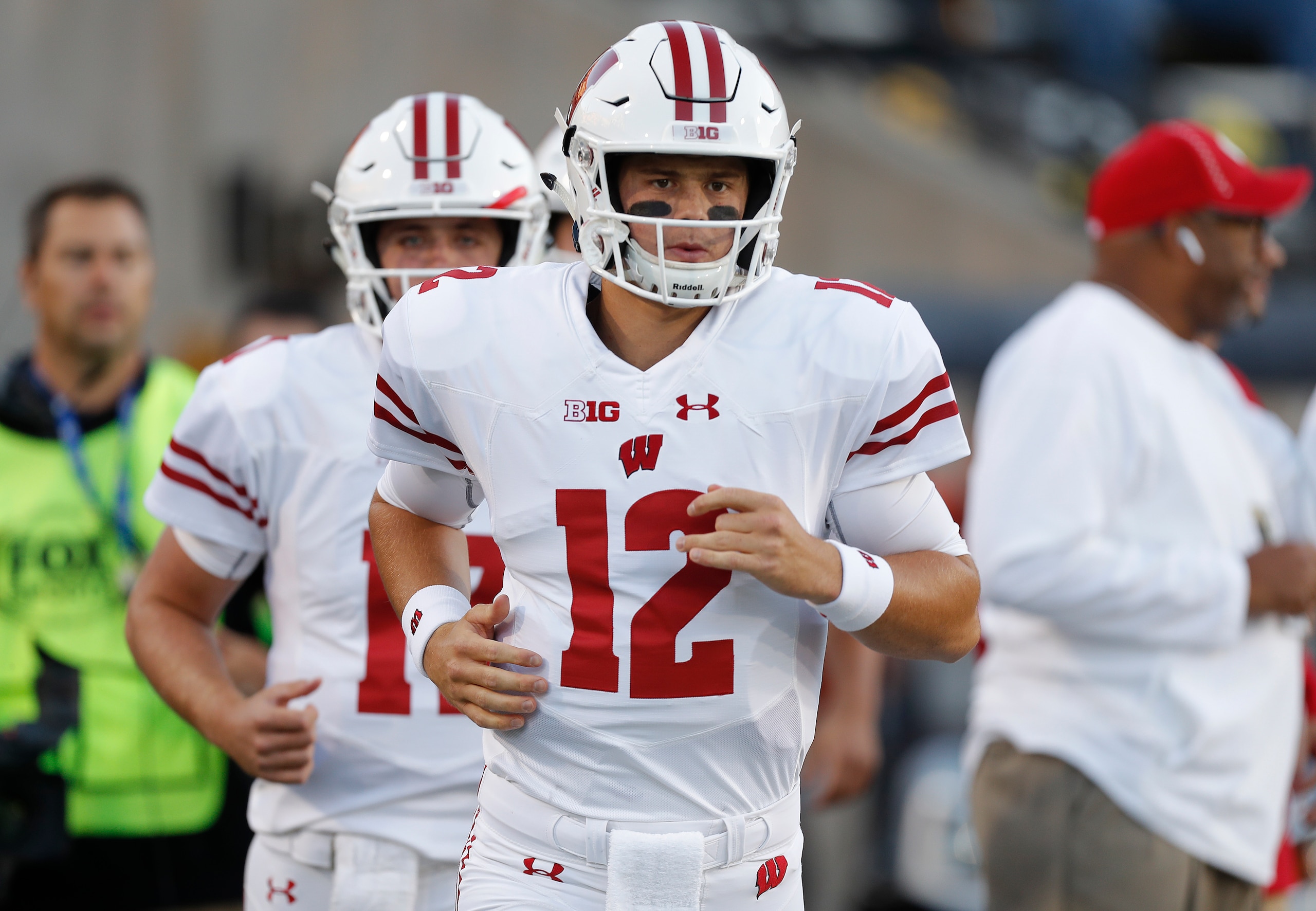
Last week's loss to BYU reduced Wisconsin's shot at the College Football Playoff from reasonable to minimal at best. And the Badgers had no time to lick their wounds, because a Week 4 road game against Iowa could have bumped them out of the conversation altogether.
Jonathan Taylor wasn't any more effective in this game (113 rushing yards) than he was last week (117).
Fortunately for Wisconsin, QB Alex Hornibrook had his best game of the season—and arguably the best of his career, given the opponent and the circumstances.
Hornibrook entered the night with just three touchdowns and two interceptions on the year, and his 63.2 completion percentage left something to be desired. None of those touchdowns came in the loss to BYU, even though he threw the ball 28 times.
Against Iowa, though, the lefty was lethal. He finished 17-of-22 for 205 yards and three touchdowns on the road against one of the best defenses in the nation.
And he was calm, cool and collected under pressure in the game-winning drive. Trailing by three with less than six minutes remaining, Hornibrook and Co. got the ball back on their own 12. The QB completed all five of his pass attempts on the drive for 67 yards, including the 17-yard touchdown to A.J. Taylor to finish it off.
Hornibrook also guided the Badgers on a 95-yard TD drive in the first half that included a pair of passes for third-down conversions. And when they recovered a fumble at the Iowa 10, He found Danny Davis III for a touchdown on 3rd-and-goal from the 12.
Wisconsin did do one thing without Hornibrook, though. Alex Ingold tacked on a rushing touchdown for the final score of 28-17 after Iowa quarterback Nate Stanley threw an interception.
If the Badgers can play like that on the road against Michigan and Penn State, there's still hope.
Kerry Miller covers college football and men's college basketball for Bleacher Report. You can follow him on Twitter, @kerrancejames.



.jpg?w=2560 "Raiders Could Start Mendoza")


.jpg?w=2560 "Rodgers Iced Out on Plane 💎")

.jpg?w=2560 "Packers Safety Slams Refs 🤬")