
Building the 2018 All-NBA Playoff Team So Far
These NBA stars have been the best playoff performers so far.
And refreshingly, that's all that matters.
There's something liberating about leaving behind the persistent regular-season concern of sustainability. The 82-game grind necessitated a long analytical view. No great single-game performance or hot month could ever exist peacefully; it had to be subjected to questions about whether it would last. Whether it was merely the anomalous result of a small sample that would correct itself over time.
Here, in the playoffs, it's all about what a player does—not whether he'll keep doing it.
It's a cleaner way to think about the game, less complicated and, somehow, seemingly purer.
Based on their numbers and overall impacts, these guys are dominating the postseason.
1st Team Guard: Jrue Holiday, New Orleans Pelicans
1 of 10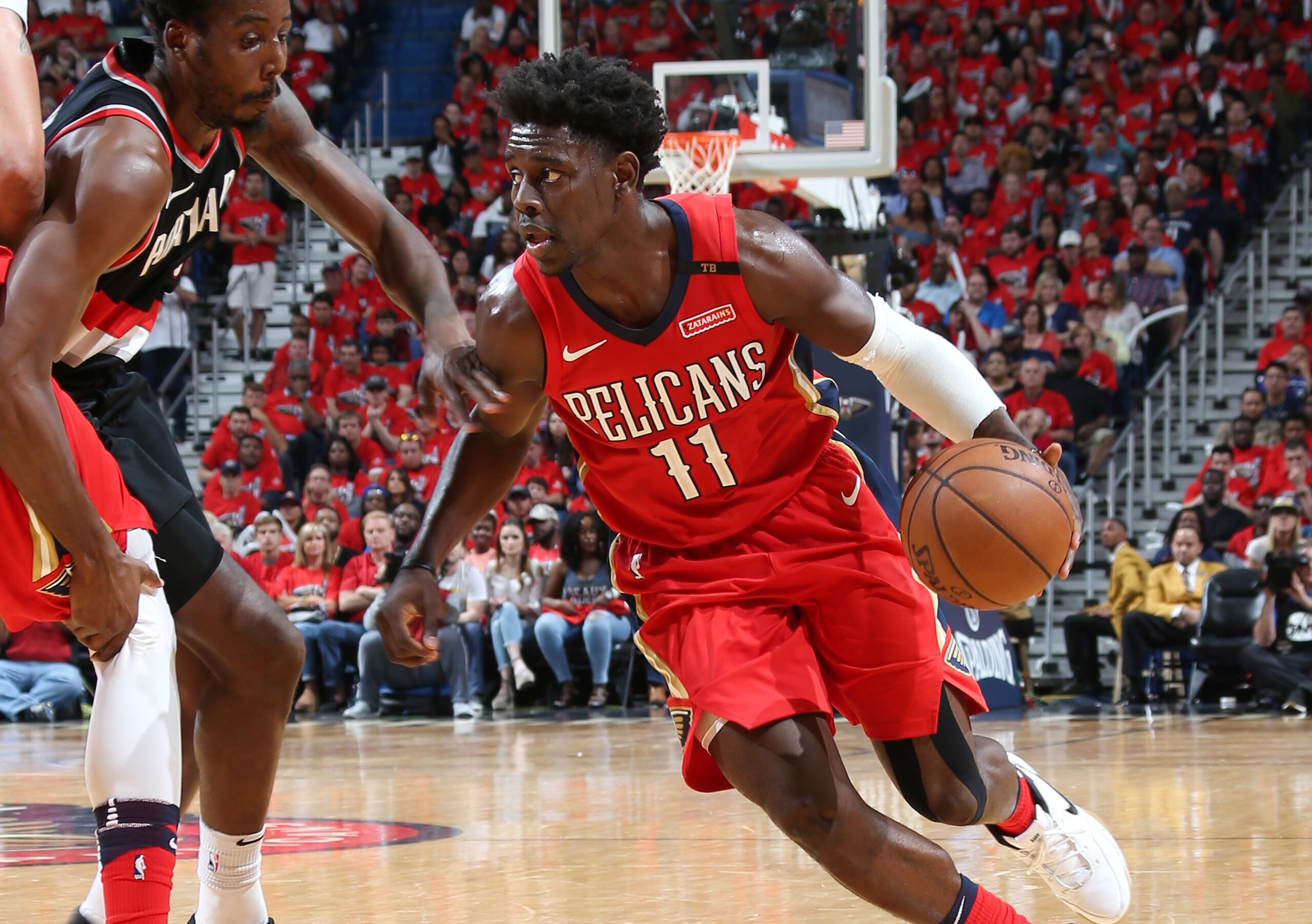
Jrue Holiday outplayed Damian Lillard and CJ McCollum in the New Orleans Pelicans' first-round sweep of the Portland Trail Blazers, coming alive in his first healthy postseason since 2012 to average 27.8 points, 6.5 assists and 4.0 rebounds while hitting 56.8 percent of his shots from the field.
He made game-changing steals and blocks, produced one of the leading early playoff memes by shame-pointing at Jusuf Nurkic and generally played better two-way basketball than any guard in the league.
He did all that while adopting a previously hidden brashness, much to the delight of his teammates.
"I don’t have no idea know where it came from," Anthony Davis told Scott Kushner of the New Orleans Advocate. "Talking smack to the fans—I've never seen it. I love it. If he can keep getting 40 for us, I'll get him mad every game. I love it."
This is normally where you'd have to wonder whether this elevated version of Holiday will stick around. Thankfully, that's not a concern for our purposes. We get to just appreciate what he's done to this point: play the best all-around basketball of his career.
1st Team Guard: James Harden, Houston Rockets
2 of 10
Don't get too caught up in the narrative that James Harden struggled in the first round.
Sure, he laid an egg in Game 2 against the Minnesota Timberwolves, scoring just 12 points on 2-of-18 shooting. But even with that stinker of an effort included, the surefire MVP still averaged 29.0 points and 7.4 assists with a 56.3 true shooting percentage.
If not for his brilliant effort in Game 1—in which he put a faltering Houston Rockets offense on his back and carried it home behind an array of impossible step-back triples—the Minnesota Timberwolves would have logged a series-opening upset. Harden finished that contest with 44 points, hitting 15 of his 26 shots and handing out eight assists.
For the series, a ridiculous 84.8 percent of his makes were unassisted.
Houston was the best team all season, but it cruised to a 4-1 series win in the first round because Harden did it on his own when he had to.
1st Team Forward: LeBron James, Cleveland Cavaliers
3 of 10
It is so, so difficult to be surprised by anything LeBron James does anymore, but it's still remarkably easy to find oneself in awe. The sensation comes from watching the GOAT (yeah, I said it) illustrate again and again and again the ways he can carry a team like no one else.
Consider the Cavs' three-point win in Game 2. To eke out that meager margin, all James had to do was go for 46 points, 12 rebounds and five assists on 70.8 percent shooting. In playoff history, only Elvin Hayes had ever accumulated those numbers in a single game. And James got his totals in eight fewer minutes than Hayes did when he pulled off the trick in 1970.
If that doesn't do it for you, take a gander at another three-point win in Game 5. James produced 44 points (on 58.3 percent shooting), 10 rebounds and eight assists in that one, making all 15 of his foul shots and drilling the buzzer-beating game-winner. Another unparalleled achievement.
All James had to do for his Cavs to avoid a four- or five-game series loss to a good-but-not-great Indiana Pacers team was rewrite the history books on a nightly basis. And on Sunday, he officially staved off a Game 7 elimination with a 45-point, nine-rebound, seven-assist performance while shooting 64 percent and collecting four steals along the way.
He's the best we've ever seen. There's no discussion.


1st Team Forward: Giannis Antetokounmpo
4 of 10
Even though Giannis Antetokounmpo's Milwaukee Bucks got bounced in the first round by a Boston Celtics team missing Kyrie Irving, he still earns a first-team spot.
The guy did what he could.
With averages of 25.7 points, 9.6 rebounds and 6.3 assists on 57.0 percent shooting, Antetokounmpo logged 40 minutes a night and faced Boston's full defensive attention. Hamstrung by a nonsensical offensive scheme that turned every half-court possession into a slog and forced to carry the load on both ends, Antetokounmpo performed as well as anyone could have under the circumstances.
You can't put any of the blame for Milwaukee's loss on Giannis. He was his typical brilliant self. It was the rest of the Bucks—from the front office to the rest of the roster—that failed him.
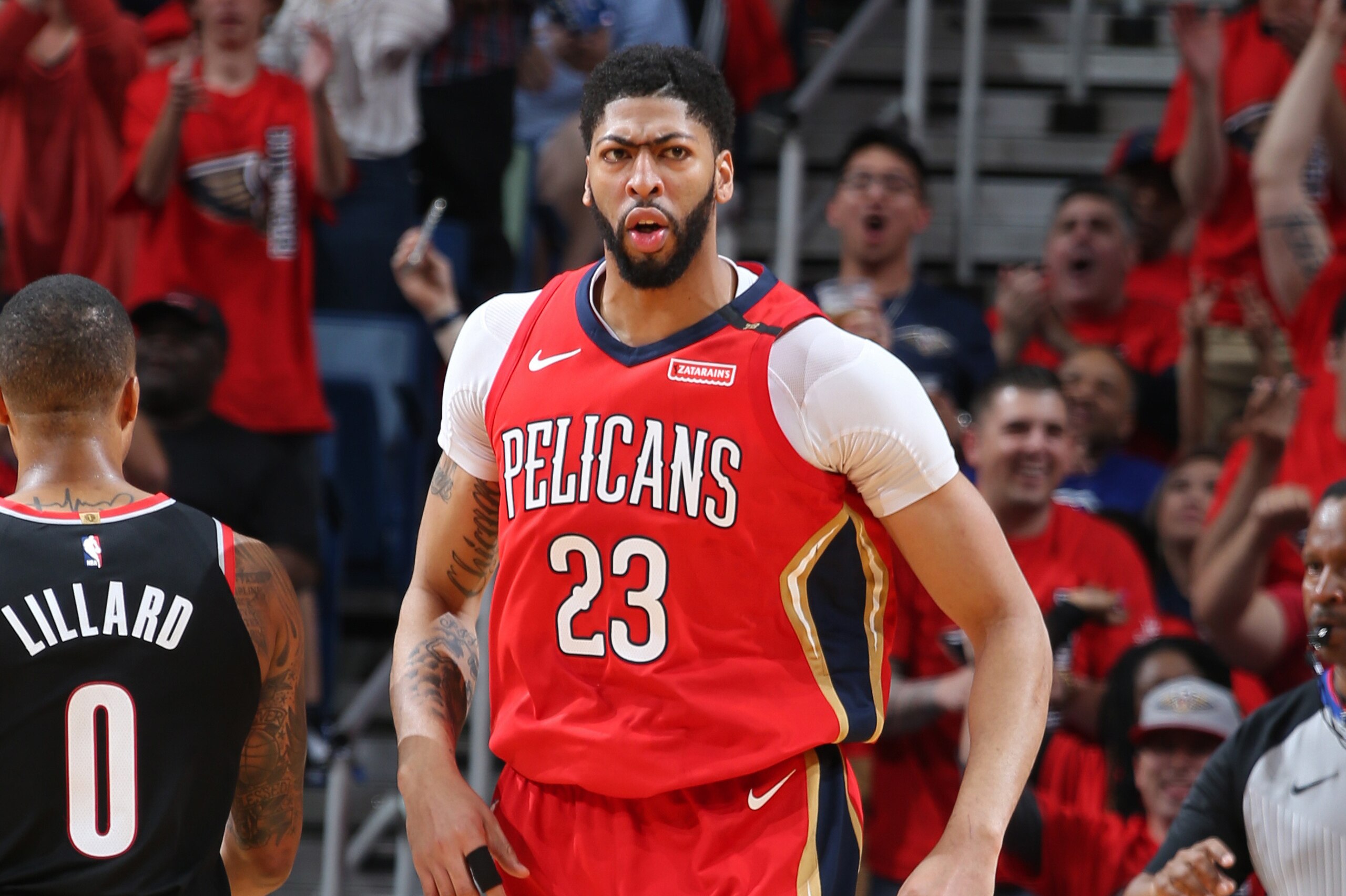
1st Team Center: Anthony Davis, New Orleans Pelicans
5 of 10
Did any other centers have a 47-point performance in a closeout first-round game?
Or average 33.0 points and 11.8 rebounds while shooting 57.6 percent from the field?
Or post 2.8 blocks per game in a (mild) upset sweep?
Or prompt a quote like this from Golden State Warriors assistant general manager Kirk Lacob?
"Now he's figured out how he can dictate as a defensive player what you’re going to do on offense," Lacob told Marcus Thompson II of The Athletic. "It's mental. That's all it is. Some guys never figure it out. But it's really scary when dudes with 7'5" wingspans figure it out."
No? Nobody else? Cool. That makes this one easy.
2nd Team Guard: Russell Westbrook, Oklahoma City Thunder
6 of 10
Russell Westbrook's third quarter in Game 5 gets him onto the second team, because when dealing in the necessarily small-sample environment of the postseason, swinging a single contest is huge.
His 20 points during a 32-7 third-quarter run erased a 25-point deficit and prevented the Utah Jazz from logging a five-game series win. Overall, Westbrook put up 45 in the contest, outscoring the entire Jazz team by five points over the final 20 minutes.
He fired off too many ill-advised shots, particularly late in OKC's Game 6 loss, in which he attempted a whopping 43 field goals in all. At 39.8 percent from the field, Westbrook ranked 20th out of 21 players who took at least 15 shots per game in the first round. Inaccurate shooting and ball-hoggery aside, Westbrook was still a sight to behold.
There's just something to be said for the entertainment value of a mindset as singular as his. And from a physical stamina standpoint, I'm not sure anyone else in the league could have sustained Westbrook's level of intensity over such a vast number of high-usage minutes. He didn't rest once in the second half of Game 5.
Maybe Westbrook's style of play contributed to Oklahoma City's elimination, but his prolific production (29.3 points, 12.0 rebounds and 7.5 assists) at least warrants a second-team nod.
2nd Team Guard: Donovan Mitchell, Utah Jazz
7 of 10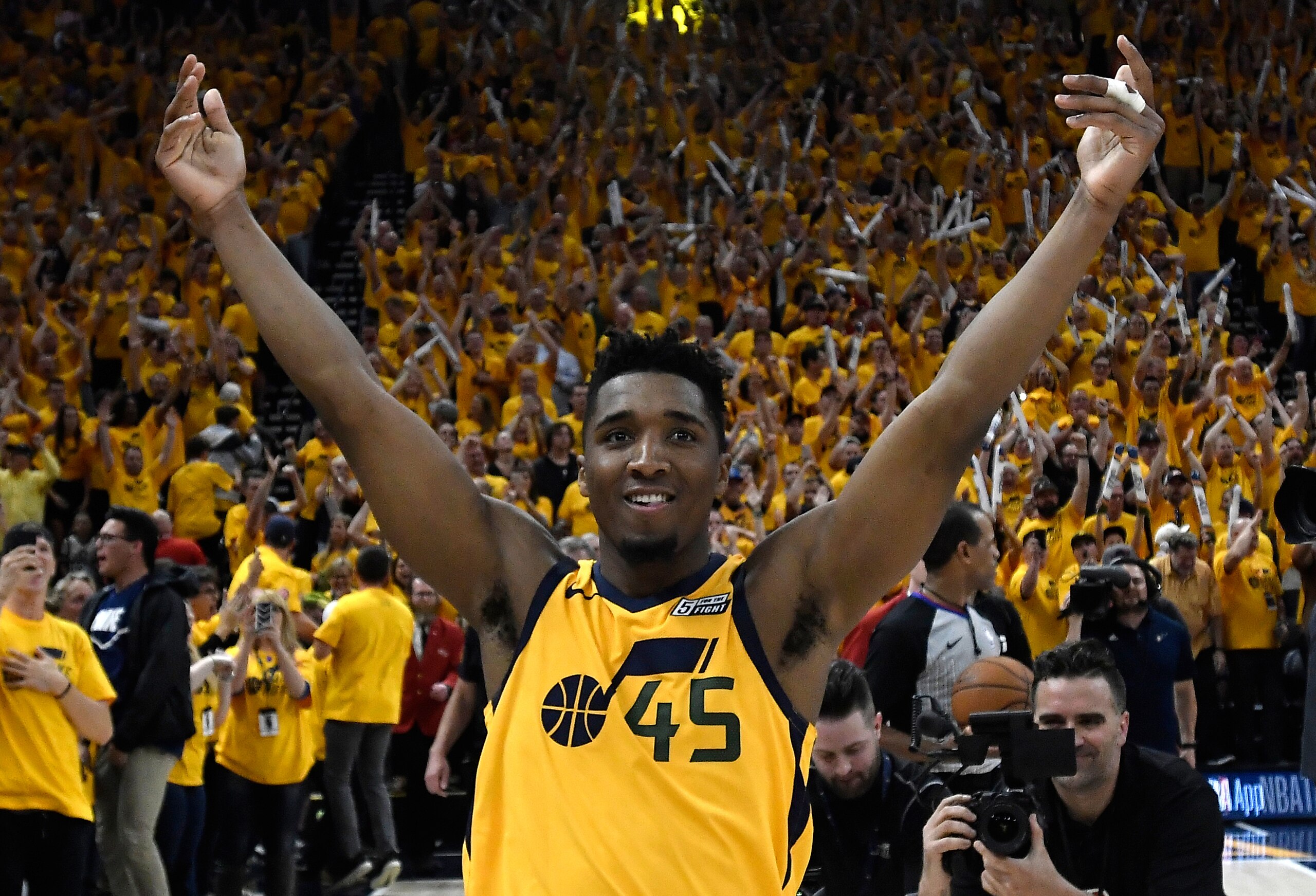
Donovan Mitchell's 38 points in the Utah Jazz's Game 6, series-clinching victory on Friday were the most by a rookie in the playoffs since 1987, and if not for the 22 points he scored in the third quarter alone, Utah might very well have had to go back to Oklahoma City for a nerve-wracking Game 7.
Perhaps we've grown accustomed to Mitchell's clever scoop shots, daredevil pull-up threes and cyclone spins into the lane. But we simply can't let the fact that he's been so excellent all season obscure what he's done in his first playoff action.
Mitchell, a rookie, stared down reigning MVP Russell Westbrook—and outplayed him.
Sorry if you're persuaded by volume stats and triple-doubles, but efficiency matters. And so does a willingness to play in a manner that does not marginalize one's teammates.
Compared to Russ, Mitchell shot it better from the field, from deep and from the foul line, and he turned the ball over less than half as frequently. So, sure, Westbrook's counting stats look incredible. And it's undeniable that he won OKC Game 5 on his own. But Mitchell managed to dominate without sucking the agency out of his supporting players.
Joe Ingles made impacts on both ends, Rudy Gobert did his thing (excluding him from this team hurts), Ricky Rubio played some of the best ball of his life, and Derrick Favors swung games with his scoring and rebounding. Alec Burks vaulted into the rotation for an injured Rubio in Game 6 and felt empowered enough to fire away immediately.
You might say that merely indicates Mitchell's supporting cast was better, but for my money it was indicative of the difference between selfish and unselfish stardom.
Mitchell—with first-round averages of 28.5 points, 7.2 rebounds and 2.7 assists—was remarkable. Westbrook was also statistically brilliant but got his numbers in a way that put his teammates in the back seat. In Utah, when Mitchell shines, everybody else rides shotgun.
2nd Team Forward: Ben Simmons, Philadelphia 76ers
8 of 10
Ben Simmons is only the sixth rookie to record a postseason triple-double (and the first since Magic Johnson did it in 1980, 16 years before Simmons was born), and he led his rapidly ascending Philadelphia 76ers to a five-game series win over the Miami Heat.
He made impacts on both ends, producing an offensive rating that improved by 2.2 points per 100 possessions when he was on the floor. The defensive difference was even bigger; Philadelphia held the Heat to 3.9 fewer points per 100 possessions when Simmons played.
"You knew from the first time you saw him in summer league that he was special," a vanquished Dwyane Wade told Jessica Camerato of NBC Philadelphia. "I think the thing that was impressive about him all year is he just continued to get better and better and better. To the point where it's like that guy in Cleveland—doesn't have bad games. The imprint that [Simmons and James] put on the game is more than just scoring. [Simmons] does so much."
That he did all that while making just six of his 27 field goals outside the restricted area speaks to the way Simmons forces the game to be played on his terms. There's no forcing him to beat you with jumpers. There's no schematic way to exploit his weaknesses. When given a cushion and dared to shoot, Simmons either surveys the floor and finds the open man or sucks up the space at a dead run and physically overwhelms defenders in his path.
Several postseason participants broke through as stars in 2017-18, but Simmons, occupying a critical role for his team, is elevating his game even higher.
2nd Team Forward: Kevin Durant, Golden State Warriors
9 of 10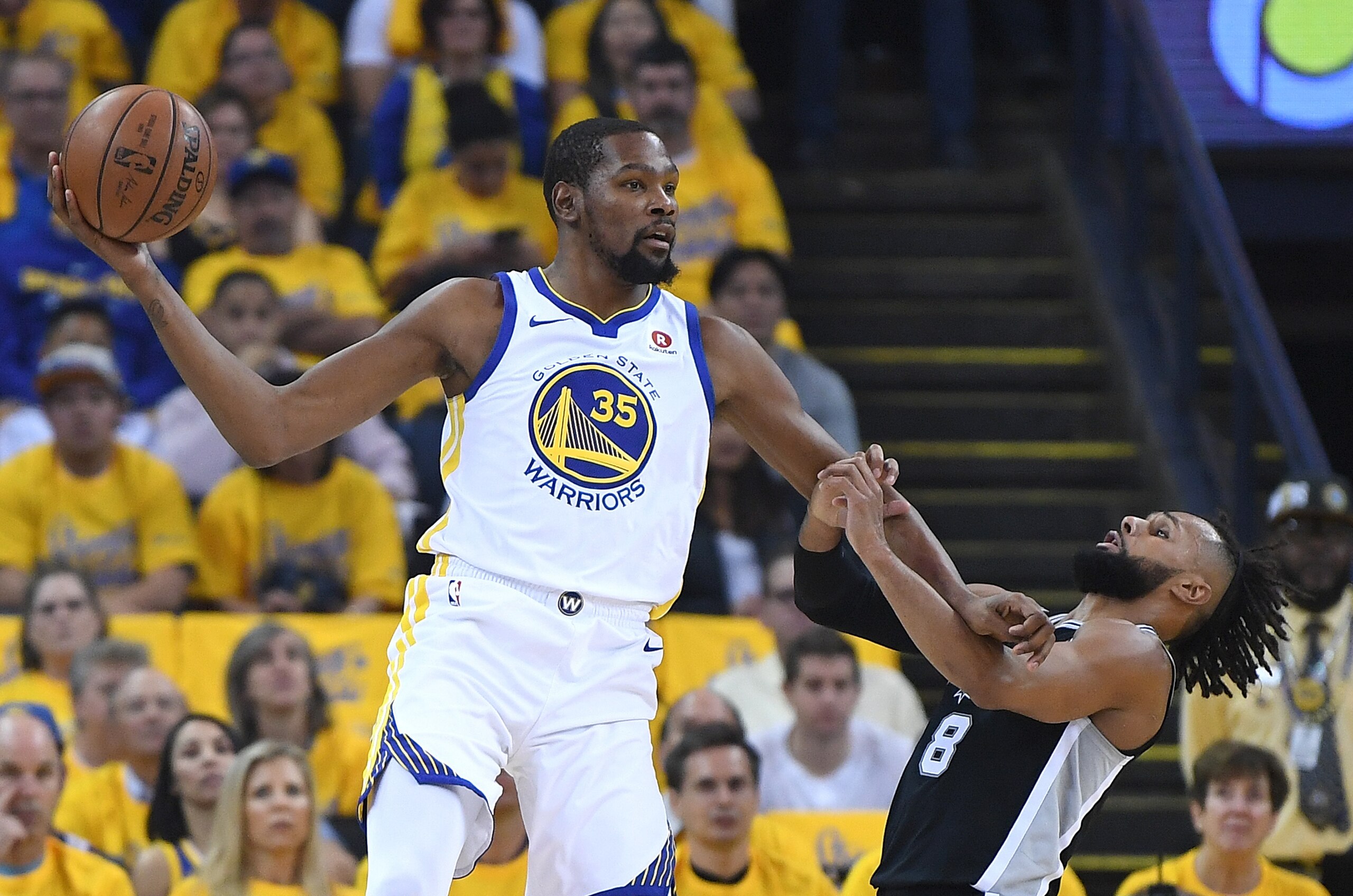
The Golden State Warriors outscored the San Antonio Spurs by 16.3 points per 100 possessions with Kevin Durant on the floor during their first-round series. That figure nearly doubled the Rockets' league-leading plus-8.5 net rating from the regular season.
Yet when KD sat, Golden State got outscored by 7.3 points per 100 possessions. That's a massive 23.6-point swing, and it says almost everything you need to know about how much the Dubs depended on Durant with Stephen Curry unavailable.
Durant's ability to generate reasonably efficient shots at will props up a Warriors offense that struggles to create great spacing without Steph. Set a high screen, generate a switch, and suddenly you have Durant at the elbow towering over a helpless smaller defender. Early in the series against San Antonio, Patty Mills found himself in that unenviable position several times.
Leave a like-sized defender on him in space, and prepare for a blow-by drive.
Two-point jumpers are out of style, but Durant is good at them. During the regular season, 38.6 percent of Durant's shots came from 10-23 feet. He converted them at a 49 percent clip, and he's been even more accurate from those ranges during the playoffs. As safety nets go, it's hard to beat Durant in the mid-range.
Golden State's title chances depend on Curry's healthy return, but the Warriors can stay competitive with just about anyone as long as Durant has it going.
2nd Team Center: Clint Capela
10 of 10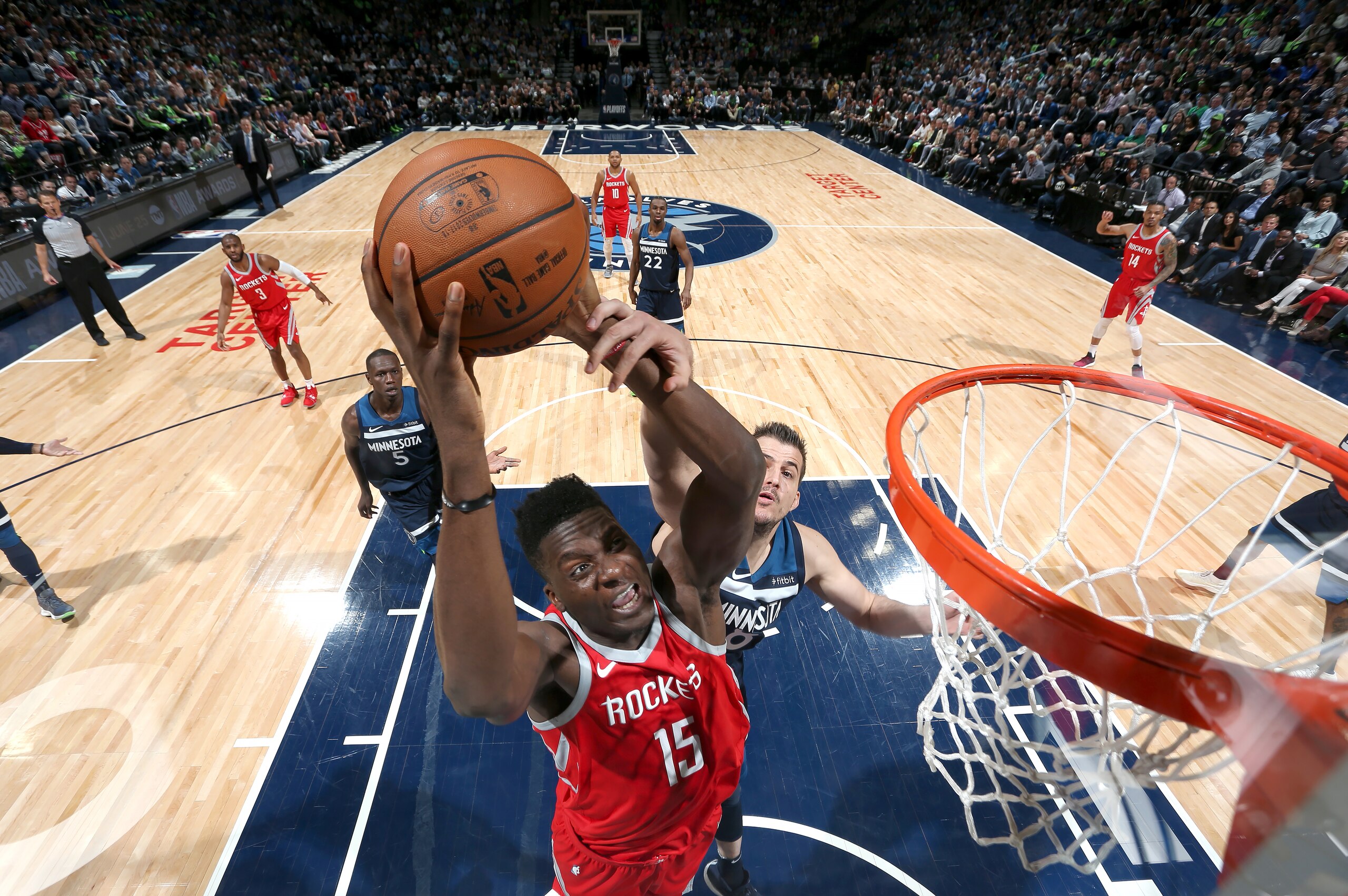
The worst thing you can say about Clint Capela is that he's *only* a superstar in his limited role. Because all he has to do is defend in space, rebound, roll to the rim and block shots while opponents pay all their attention to James Harden and the imminent barrage of threes, he has it easy.
Except...Capela's skills actively enable Harden and the rest of the Rockets to be great. His rim runs draw in defenders, and opponents can't pay full attention to stopping Harden from scoring on drives when they know Capela's lurking for a lob.
Defensively, Houston's switch-heavy scheme doesn't work nearly as well if Capela can't hold his own against guards.
So in reality, Capela contributes to Houston's excellence as much as he benefits from it. He put up 15.8 points and 14.2 rebounds in the first round, hitting 67.3 percent of his shots.
Joel Embiid played only three first-round games, so he lacks the volume for real consideration here. Capela matched Rudy Gobert's blocks per game while averaging more points, rebounds and assists in the first round. Note, too, that Capela got his numbers while defending a more dangerous offensive weapon (Karl-Anthony Towns) than Gobert (Steven Adams).
Stats courtesy of Basketball Reference, Cleaning the Glass or NBA.com unless otherwise specified.

.jpg?w=2560 "Grading WWE Raw 🔠")

.jpg?w=2560 "Bijan's INSANE 1st Half 🤩")
.jpg?w=2560 "Viral Rams Coach Vid 🖕")
.jpg?w=2560 "Injury-stricken Seahawks signing veteran RB")

.jpg?w=2560 "2 NFL Officials Suspended")