


It turns out Gotham's Dark Knight may have some fight left in him after all.
When Matt Harvey made his 2017 debut for the New York Mets against the Atlanta Braves last Thursday, only Matt Kemp walked away unimpressed. He got to Harvey for a pair of home runs.
Everyone else, however, was treated to a dominant effort that was at once reminiscent of vintage Harvey and a tease of an entirely new Harvey.
TOP NEWS

Brewers Complete Comeback In Game 2

World Series Game 2 Takeaways 🍿

Next MLB Players to Sign $200M Contracts 💰
The 28-year-old spearheaded a 6-2 Mets victory at Citi Field with six and two-thirds innings of two-run ball. He allowed only three hits, walked none and struck out four. All with only 77 pitches.
The occasion marked a complete 180 from what life was like for Harvey last year.
Even before his season ended in July when he went under the knife to address thoracic outlet syndrome, 2016 was a nightmare for the right-hander. After entering the year with an ace-like 2.53 career ERA, he pitched to a decidedly un-ace-like 4.86 ERA in 17 starts.
In all, Harvey looked nothing like the guy who was the National League's starting pitcher in the 2013 All-Star Game and who had returned from Tommy John surgery to dominate throughout 2015. The boo birds let him know about it at one point.
"I remember getting booed off the field last year," he said Thursday, according to Anthony DiComo of MLB.com. "So flipping that switch a little bit, and keeping moving forward, was exciting."
Your humble narrator is obligated to remind everyone of the caveats of this particular scenario. It's only one start. And one April start at that. And against a pedestrian Braves lineup to boot. There's a limit to how much anyone can get excited about Harvey's triumphant return.
But since it was indeed a triumphant return, it's worth diving into it for clues about how Harvey means to reclaim his status as an ace.
It doesn't look like he'll do it by blowing hitters away like he used to. One thing that signaled something was wrong with Harvey last season was a dip in his velocity. Courtesy of Brooks Baseball, here's a graph that shows the downward trend is continuing:
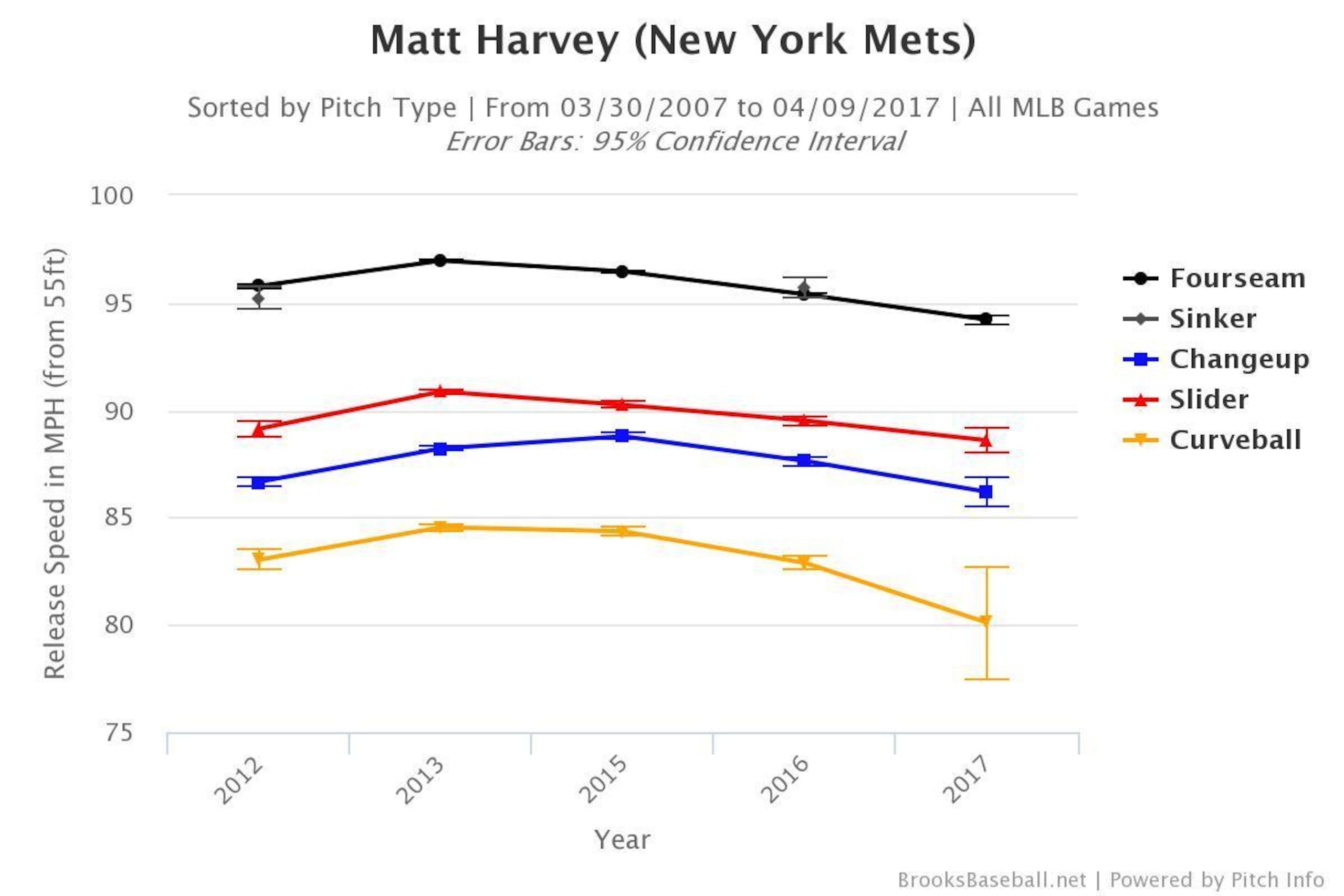
When he was at his peak in 2013, Harvey was releasing his fastball at an average of 97 miles per hour. His average dipped to 95.4 mph last year and opened at 94.2 mph this year. He could add a few ticks as the season goes along, but his fastball going full retro seems unlikely.
The silver lining is that the fastball he has now is still pretty good. But with less velocity comes a smaller margin for error. The pressure's on Harvey to find ways to get around that.
However, this is something he's been keenly aware of since at least spring training.
"Obviously I'm not looking to throw 100 mph again, or 97 even," Harvey said in mid-March, per DiComo. "My job is to get people out, no matter what I'm throwing."
Based on his 2017 debut, Harvey's answer to no longer having an elite fastball is to not throw it as often.
That's true not just in general, but also from a sequencing perspective. Per Baseball Savant, Harvey threw a smaller percentage of fastballs overall and a smaller percentage of first-pitch fastballs against Atlanta:
| 2012 | 69.0% | 70.2% |
| 2013 | 56.8% | 68.5% |
| 2015 | 58.9% | 67.9% |
| 2016 | 58.6% | 66.7% |
| 2017 | 48.1% | 63.6% |
So began Harvey's transformation from a power pitcher into more of a finesse pitcher.
He pitched backwards and ultimately relied on his hard slider and fading changeup for the bulk of his pitches. He threw 38 of those, compared to just 36 fastballs. With the movements and speeds of Harvey's pitches changing so frequently, it's no wonder Braves hitters couldn't get comfortable.
The danger of an approach like this is straying into junk-baller territory.
Think of somebody like James Shields. He's responded to his velocity loss by rarely throwing the ball in the strike zone. Lo and behold, he now walks a ton of guys and gets annihilated when he does go in the zone. He needs hitters to chase bad pitches to be effective—and even then he's not that good.
For now, though, Harvey doesn't appear in danger of straying into junk-baller territory.
The goose egg he hung in the walk column against the Braves isn't misleading. He was extremely aggressive within the strike zone. So much so, in fact, that the early leaderboard for strike-zone percentage at FanGraphs looked like this on Sunday:
- Stephen Strasburg: 62.4%
- Matt Harvey: 62.3%
- Wei-Yin Chen: 61.6%
- Jaime Garcia: 60.5%
Of the four pitchers listed here, Harvey's the only one who's hit the zone with over 60 percent of his pitches despite throwing under 50 percent fastballs.
There aren't many comps for a fastball-light, strike-heavy approach like that. Perhaps the best is Bronson Arroyo in 2013. That may not sound flattering, but he had a 3.79 ERA in 202 innings that year. And that was without a fastball even remotely like the one Harvey still has in his arsenal.
As such, there's really no way the Braves could have been prepared for the Harvey they saw. He may have dominated like his old self, but he did it because he's recognized he can no longer pitch like his old self.
And in doing so, he didn't just impress Mets fans and Internet baseball writers.
"It was an encouraging start," wrote one scout in a text message to ESPN's Jerry Crasnick. "[Harvey] was very economical with his pitches. His stuff will continue to creep back as the season and the weather heats up. It was impressive. He really 'pitched' tonight."
It bears repeating that one good start doesn't put Harvey safely out of the woods. It's a long season, and the big questions arguably have more to do with his durability than his performance.
But if his first start is a blueprint for the rest, it's already possible to see how he's going to be an ace again.
Data courtesy of Baseball-Reference.com, FanGraphs, Brooks Baseball and Baseball Savant.




.jpg?w=2560 "Jonathan Taylor Landing Spots 📍")
.jpg?w=2560 "Mahomes Asked OT to Leave Meeting")



