Best and Worst Moves New York Giants Can Make This Offseason
There will be plenty of decisions that New York Giants general manager Jerry Reese and the rest of the front office will have to make in the coming weeks as they reshape the team's roster.
This slideshow looks at some of the potential decisions Reese and company are likely to come across and whether it's really in the best interest of the club to make the move or go in a different direction.
A Good Move: Target a Veteran Offensive Tackle
1 of 8
It's a bad year to need a veteran offensive tackle given the lack of choices expected to hit the market combined with the thin crop in this year's draft class.
Yet the Giants, who last year tried to add to this position group, find themselves in the same position once again, the need exacerbated by the seeds of doubt left tackle Ereck Flowers planted because of his erratic play in his second season.
The Giants must come up with an offensive tackle, especially if they decide to move on from John Jerry and Marshall Newhouse, two veterans who initially were signed to provide depth at guard and tackle, and Will Beatty, the team's one-time starting left tackle.
If all those players depart via free agency, the Giants will be left with Flowers, Justin Pugh and Bobby Hart as their only options at offensive tackle. Pugh, of course, has been working at left guard, a position that the team probably doesn't want to change.
Signing a veteran offensive tackle such as Riley Reiff of the Lions would be the way to go for a couple reasons.
First, Reiff probably won't draw the type of contract Cincinnati Bengals offensive tackle Andrew Whitworth, who is coming off a one-year, $9 million contract, is likely to draw.
That would help the Giants—who have about half of the cap space they had last year—to focus on keeping as much of their starting defensive unit together.
Second, because Reiff can play both left and right tackle, his presence will allow the coaching staff to mix and match different offensive-line combinations as they search for the right group to ensure that quarterback Eli Manning's iron-man streak continues.
A Bad Move: Not Clearing More Salary Cap Space
2 of 8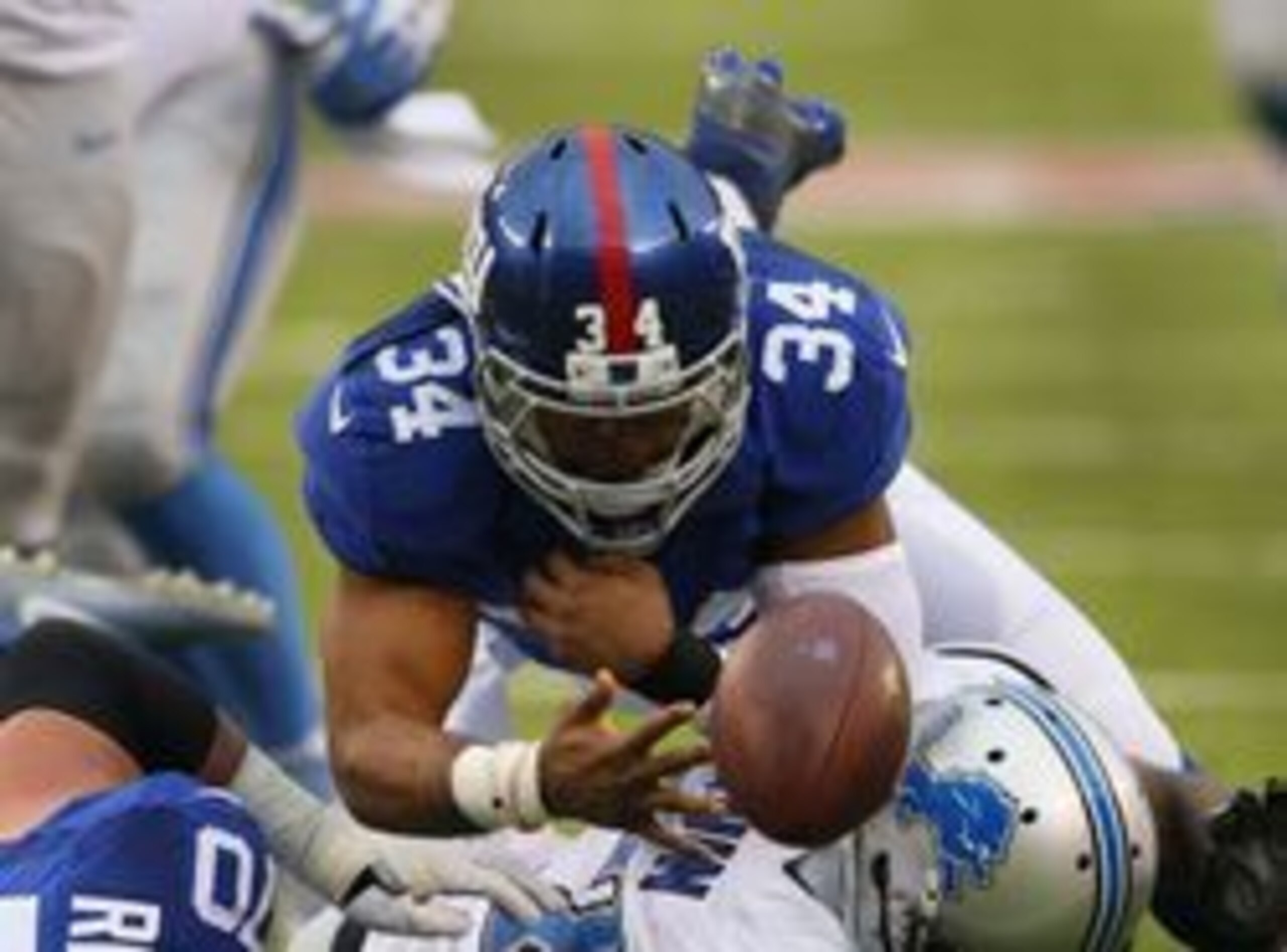
After spending what amounted to $30.1 million in first-year contract money to add defensive end Olivier Vernon, defensive tackle Damon Harrison, cornerback Janoris Jenkins and linebacker Keenan Robinson, the Giants have to decide whether to keep as much of the band together or wave goodbye to key members such as defensive end Jason Pierre-Paul, defensive tackle Johnathan Hankins and Robinson.
It would make sense to keep the band together; the problem is the Giants had upward of $60 million in cap space last year whereas this year, even after releasing receiver Victor Cruz and running back Rashad Jennings, Over the Cap projects the Giants to have $31,536,686 of cap space. That's roughly the same figure they spent on those first-year cap figures for the key additions on defense last year.
Simply put, the Giants need to create more cap space; if they don't, they run the risk of not having enough money to accomplish what they need to get done this offseason in free agency.
There are a couple of places where they can potentially look to trim some fat off the salary cap.
The first is linebacker J.T. Thomas.
That Thomas wasn't part of the same transaction group as Cruz and Jennings was a bit of a surprise considering he's been injured the bulk of his time as a Giant and lost his starting weak-side linebacker job to Jonathan Casillas last summer.
Thomas' $4 million cap figure just so happens to be the highest among the Giants linebackers, which makes zero sense if he's not going to have a starting role in 2017.
Even if the Giants are keeping Thomas around in the event they lose Robinson to free agency, his cap figure, which includes a $2.975 million base salary, needs to be reworked.
Running back Shane Vereen is another player with a bloated cap figure for 2017, that being $4,916,668, which grossly passes the other running backs on the roster.
Besides the fact that Vereen is coming off an injury-filled 2016 season, his $3.15 million base salary is rather high for a role player, who—since signing with the Giants in 2015—hasn't played in more than 450 offensive snaps in each of the last two seasons, per Pro Football Focus.
Between Thomas and Vereen, the Giants might be able to clear another $3 million to $5 million in cap space at a time where every bit is going to help in their upcoming free-agent negotiations.
A Good Move: Not Adding a Veteran Receiver
3 of 8
When the Giants released Victor Cruz, many people believed that at some point, they'd add a taller, veteran receiver to replace the leadership he brought to the receivers' room.
Upon closer inspection, that might not be the best use of limited cap resources for two reasons.
First, if Odell Beckham Jr. and Sterling Shepard are projected to be the team's No. 1 and No. 2 receivers respectively, the two guys who are likely to see the bulk of the targets, it makes sense to continue developing Tavarres King (that potential tall receiver the Giants are believed to covet) and Roger Lewis as a potential No. 3 receiver who can line up on the outside.
If you think back to 2011, that's exactly what the Giants did with a little-known receiver by the name of Cruz, who, like King, lit things up in the preseason in his first year, only to disappear from the regular-season landscape.
The difference this time around is that King stayed on the roster despite not being much of a contributor on special teams. By the end of the year, he was siphoning snaps away from Cruz.
The other reason the Giants might want to pass on signing a veteran receiver is the draft. This year's draft class is loaded with tall receivers, with NFL Draft Scout projecting as many as 16 receivers as potential first-, second- or third-round picks.
The only way it would make sense for the Giants to add a veteran is if they can get someone on a minimum salary benefit contract, which, as defined by Article 27, Section 2a-b of the NFL Collective Bargaining Agreement is a one-year contract with a Paragraph 5 (base) salary commensurate with the veteran's number of accrued experience and a maximum amount of $80,000 in additional compensation (e.g. signing bonus).
Such contracts would only count for a maximum of $695,000 against the salary cap, regardless of the player's actual contract value.
.jpg?w=2560 "Cardinals Giants Football")
.jpg?w=2560 "Titans Giants Football")
.jpg?w=2560 "Dolphins Bills Football")
A Bad Move: Using the Franchise Tag on DE Jason Pierre-Paul
4 of 8
The 2017 NFL salary cap hasn't yet been finalized, but that hasn't stopped teams from planning around what Over the Cap projects will be a $168 million figure.
With that estimated figure comes the costs involved for the franchise and transition tags, the former of interest to the Giants as they plan a strategy involving defensive end Jason Pierre-Paul. Per Albert Breer of MMQB, the projected 2017 franchise tag for defensive ends is $17 million.
That's a hefty chunk of change for a team that is currently projected to have to $31,536,686 of cap space to devote to one player.
The Giants have until March 1 to decide whether to tag Pierre-Paul. It would be surprising if they take that route.
First, Pierre-Paul told reporters the day after the Giants were eliminated by the Packers in the postseason that he's not interested in signing another one-year deal as he's done the last two seasons.
"I've done proved it," he said, regarding his value. "There's not a guy like me doing it with 7.5 fingers. I played great this year. If it's here, I would love to be here. This is all I know. To be in a different jersey, it would feel awkward, but it is what it is.”
But if the Giants, whom NFL.com's Mike Garafolo reported are hoping to strike a new deal with Pierre-Paul before the start of free agency, can't get it done, they can always use the franchise tag to buy time.
Except they shouldn't use the tag for two reasons. One, the use of the tag would leave the Giants with around $14.5 million in cap space based on a $168 million cap.
Of that $14.5 million, the Giants still need to put aside money for their draft class (about $5,504,087, per Over the Cap) and somehow find a way to sign an offensive tackle, while potentially re-signing defensive tackle Johnathan Hankins and linebacker Keenan Robinson.
In other words, using the franchise tag on Pierre-Paul would put a chokehold on the Giants' cap space that they probably can't afford given the other needs to be addressed.
Pierre-Paul might appear to have the leverage on the surface. Considering the 2017 draft class is loaded with edge rushers, if, as SNY's Ralph Vacchiano reported, his goal is to get a similar deal to what Olivier Vernon received last year, he might end up falling short of that objective.
A Good Move: Acquiring Eli Manning's Successor
5 of 8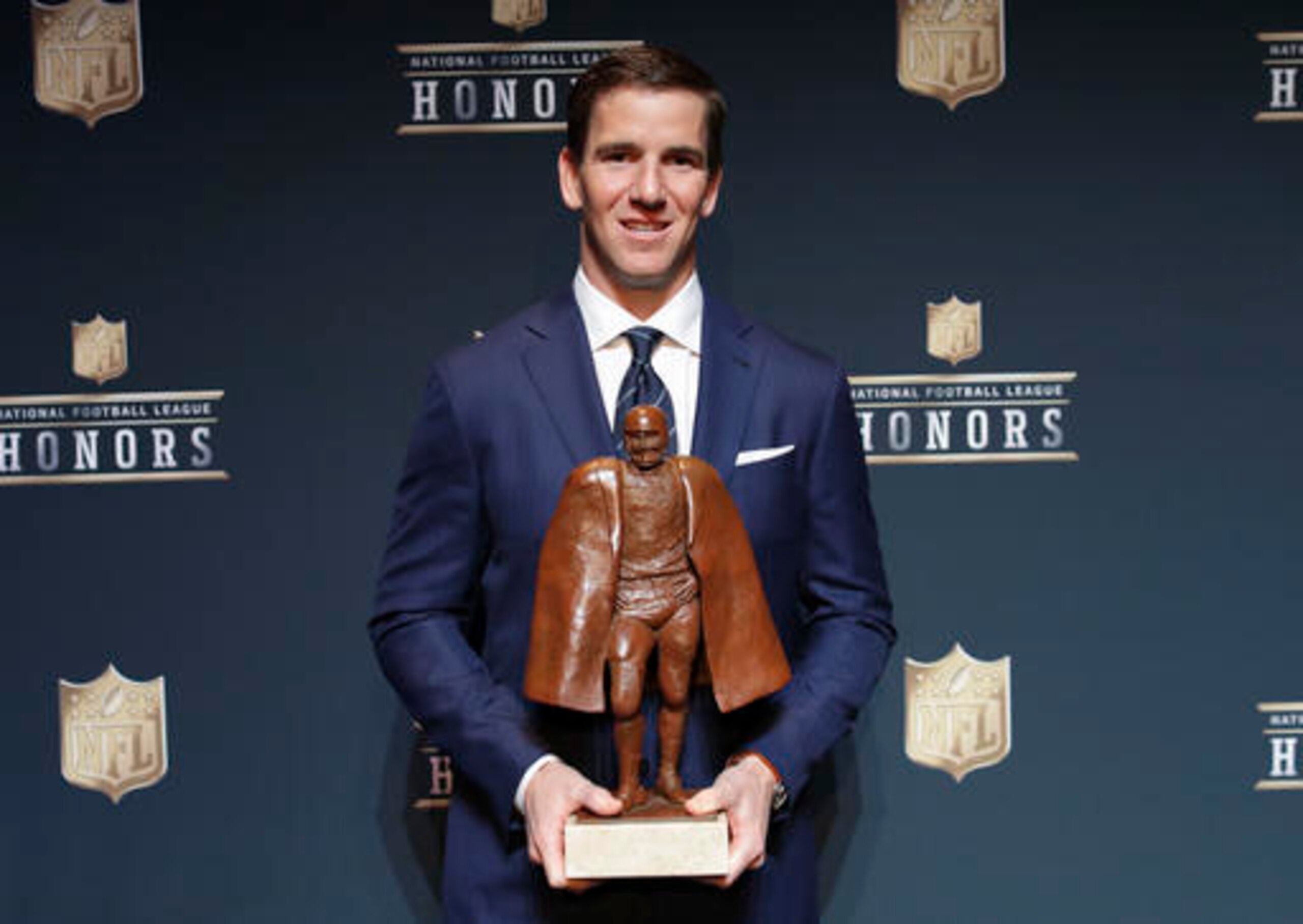
All good things must come to an end. Yes, that also includes the long-time tenure of the Giants' very own iron man, quarterback Eli Manning.
Just not yet, according to Newsday's Bob Glauber (h/t Pro Football Talk) who believes the team thinks the 36-year-old has "two or three years" of football left.
That doesn't mean that the Giants should continue to put off the inevitable. It can take a couple of seasons for a rookie to really gain a feel for the offense, something that any Giants rookie quarterback drafted is going to have a hard time doing given that Manning’s iron-man streak.
The problem is that this year's quarterbacks class won't be confused anytime soon with the 2004 class which produced Manning, Pittsburgh's Ben Roethlisberger and the Chargers' Philip Rivers.
With that said, the Giants cannot put off the inevitable, especially considering backups Ryan Nassib and Josh Johnson are both set to hit free agency.
Getting a young prospect on board now will give that player time to learn the finer points of the pro game from Manning as well as the numerous intangibles that have enabled the veteran to have staying power.
A Bad Move: Signing Justin Pugh to a Long-Term Deal This Year
6 of 8
No, that's not a typo in the headline. And no, this isn't a matter of my believing that left guard Justin Pugh shouldn't be a long-term member of the Giants.
The reason why I think it would be a bad more to lock him up long-term right now (those two words are the key to this slide), is because of the economics involved.
Per Spotrac, the Giants will have an estimated $34.44 million of cap space once the Top 51 rule kicks in March 9.
Of that $34.44 million, Over the Cap estimates the Giants needing $5,504,087 for their 2017 rookie class. Deduct that amount from the $34.44 million and that leaves the Giants with a sneeze under $29 million to tie up in their own free agents as well as any newcomers they might be targeting.
Short of the Giants clearing more cap money, discussed earlier in this slideshow, that's not a lot of money to get everything done that they need to do.
Defensive end Jason Pierre-Paul, defensive tackle Johnathan Hankins and Keenan Robinson are three guys on defense the Giants are believed to want back.
If the research by ESPN's Jordan Raanan is on target and Hankins receives a deal similar to that of Linval Joseph ($6.25 million per year) and Pierre-Paul receives a deal in the neighborhood of $15 million per year, those two deals alone could sop up $21.25 million of the available cap space, leaving approximately $7.75 million to add a veteran offensive tackle and fill in some other potential needs such as a running back and/or wide receiver.
Pugh's 2017 cap figure of $8.821 million actually puts him among the highest average-per-year earners at left guard, per Over the Cap.
Pugh is going to get a nice payday down the line. However, it makes more sense from a financial standpoint to give him that in 2018.
A Good Move: Picking Up Odell Beckham Jr.'s Option Year
7 of 8
There shouldn't even be a question about picking up Odell Beckham Jr.'s option year, a decision the Giants have to make this year.
Besides the obvious, that Beckham is a key cornerstone in the offense, picking up his option year for 2018 buys the Giants another year to work out a long-term deal with their star receiver.
Spotrac's glance into the future shows that some of the big free-agent decisions the Giants will have to make in 2018 include left guard Justin Pugh (assuming he's not locked up this year), center Weston Richburg and strong-side linebacker Devon Kennard.
By removing Beckham from that list, the Giants, who probably won't have a lot of salary-cap space to carry over into 2018 given the needs staring them in the face in 2017, stand a better than average chance of getting those three key players back on second contracts.
As for Beckham, even if the Giants don't manage to lock him up long term right away, they will be able to buy at least two more years on him with the franchise tag.
A Bad Move: Ben McAdoo Continuing as the Play-Caller
8 of 8
When head coach Ben McAdoo spoke to the media for the final time before jumping into the offseason, he made it known that "everything was on the table" as far as the evaluation and fixing of an offense that grossly underperformed despite having mostly the same personnel as it did in 2015 when it shot to top-10 status in scoring, average yards per game and passing.
Among those items up for discussion is McAdoo's role as a play-caller, a role that has fans and media split over the wisdom of a head coach taking on both roles.
McAdoo might very well retain the play-calling duties, especially if general manager Jerry Reese gives him a windfall of talent on offense as he did for Steve Spagnuolo on defense.
Regardless, McAdoo just might be better off handing over the play-calling to an assistant coach because in the three years he's called the plays, there have been some recurring issues that have shown little progress of being fixed.
The most glaring issue is on third-down. Last year, the Giants converted 35.62 percent of their third-down attempts, 28th in the league. That was a drop from the 37.79 conversion percentage they logged in 2015 (22nd) and an even bigger fall from the 42.98 percent in 2014, McAdoo's first year as the play-caller.
Another glaring issue is in the red zone. In 2014, the Giants converted 59.02 percent of their red-zone trips en route to scoring 23.8 points per game. That figure tumbled to 44.44 percent in 2015, before rising just slightly to 47.37 percent in 2016.
Now that McAdoo has gone through his "rookie season" as a head coach, he might find things easier to juggle moving forward.
Then again, given the number of fires a head coach has to put out daily, it is hard to reconcile how he can balance overseeing the entire team while also putting in the necessary hours to craft the ideal game and the various in-game adjustments plan on a weekly basis.
Unless otherwise noted, all advanced analytics are from Pro Football Focus.
Patricia Traina covers the New York Giants for the Journal Inquirer and Sports Xchange. All quotes and information were obtained firsthand unless otherwise sourced.
.jpg?w=2560 "Hill Injury Update Football")