
Ranking the Best Moments in NBA All-Star Game History
Moments make the NBA All-Star Game. The 2017 edition should be no exception.
The extensive shade traded between Kevin Durant and Russell Westbrook figures to draw plenty of eyeballs. So should Isaiah Thomas' exploits in the fourth quarter, along with a potential in-game dunk-off featuring first-timers Giannis Antetokounmpo and DeAndre Jordan.
And you know LeBron James will be watching his minutes after leading the league in average playing time through the 2016-17 season so far.
But will anything from this year's festivities in New Orleans register among the most memorable moments in All-Star history? That depends on how crowded the existing list is.
For our purposes, the crop to consider was so deep that Tracy McGrady's self-oop, Glen Rice's record scoring quarter and Rolando Blackman's shooting with confidence all missed the cut. What was left were 10 unforgettable moments, chosen and ranked according to lasting impact on our collective basketball psyche.
10. Shaq Attacks the Admiral
1 of 10The 1996 All-Star Game offered an eye-opening preview of the prodigious power shift that would grip the NBA later that summer.
The night had the makings of a memorable evening for the San Antonio Spurs. After all, they played host to the game at the Alamodome, with David Robinson, the reigning MVP, and Sean Elliott shining on the West's bench.
But Shaquille O'Neal had other ideas. Rather than kowtow to the Admiral on his home turf, O'Neal, then suiting up for the East, put the league's pre-eminent big man on a poster.
Michael Jordan, in his first All-Star Game since coming out of his baseball retirement, took home MVP honors for scoring 20 points in the East's 129-118 win. But it was O'Neal—with his 25 points, 10 rebounds, two blocks and one facial on Robinson—who stole the show.
Five months later, he portended an end to The Admiral's reign over the conference when Shaq left the Orlando Magic for the Los Angeles Lakers in free agency.
9. Kobe and Shaq Bury the Hatchet to Share MVP Honors
2 of 10
By the time the All-Star Game landed in Phoenix during 2009, four-and-a-half seasons—and whole lakes-worth of water—had passed under the crumbled bridge between Shaquille O'Neal and Kobe Bryant. The former had earned his fourth ring (then with the Miami Heat) in 2006 before getting traded to the Phoenix Suns in 2008. The latter would bring home his own later that year.
Thus, when the once-dynamic (and dust-up-prone) duo for the Los Angeles Lakers teamed up one last time, some brilliant basketball was bound to follow. Bryant logged game highs in points (27) and steals (four). O'Neal chipped in 17 points, five rebounds and three assists in just 11 minutes off the bench to boost the West to a 146-119 annihilation of the East. For their efforts, the former teammates shared MVP honors.
"It felt like old times," O'Neal said, per ESPN. "I miss those times."
Bryant, though, wasn't quite so sentimental.
"We are not going to go back to the room and watch 'Steel Magnolias' or something like that, you know what I'm saying, crying, all that stuff," he said, per ESPN. "We had a good time. That's all."
Still, for one night only, fans were treated to a flashback of one of the greatest pairs the NBA has ever seen—and in O'Neal's final All-Star appearance, no less.
8. 1983: Marvin Gaye Puts His Stamp on 'The Star-Spangled Banner'
3 of 10Music has long played a pivotal part in All-Star Weekend. This year's edition in New Orleans will be no different, with The Roots set to open the game Sunday, John Legend headlining halftime and scores of bands due to fill the Crescent City's streets with song and dance throughout.
Of all the pageant's memorable musical moments, though, none can compare to Marvin Gaye's iconic rendition of "The Star-Spangled Banner" in 1983. Rather than stick to the traditional script—an a capella rendition or one backed by horns and drums—Gaye came out with a simple synthesizer track backing his silky smooth vocals on a rearranged rhythm.
"I just never heard anything so good," Kiki Vandeweghe, an All-Star for the Denver Nuggets that year, told Grantland's Pete Croatto.
"It was just a moment in time that I don't think anybody is ever going to forget. Being so close to him when he was singing it you could hear the voice unamplified. Wow, it was something. You get those moments in your life that you're never going to forget. I don't remember half the stuff that went on in the game, but I'll tell you what: I remember that."
The East would go on to win, 132-123, but the night belonged to Gaye, who was shot and killed by his father the following year.



7. 1962: Wilt the Stilt Sets the Standard
4 of 10If not for Gregg Popovich's swarming defense to end the 2016 All-Star Game in Toronto, Paul George might've snared the event's all-time scoring record. Instead, the Indiana Pacers swingman finished with 41 points—just shy of Wilt Chamberlain's 42 points in 1962—despite finishing on the losing side of the West's 196-173 victory.
"They weren't trying to let me break that record," George said during a postgame interview with TNT, per ESPN. "I was unaware, though. I shot the three when I could have got a layup. If I had known that [I was close to the record], I would have dunked."
Back in Chamberlain's day, there was no three-point shot—not that he needed one. He dominated inside instead, hitting 17-of-23 from the field and grabbing 24 rebounds.
Chamberlain's efforts were far from enough to keep the East afloat. The West dominated, 150-130, behind Bob Pettit's MVP performance: 25 points and an All-Star-record 27 rebounds.
That both marks still stand is a testament to how the sport has shifted further outward, in favor of guards and wings. But while Chamberlain's point total has been challenged, the fact that it meant enough, 54 years later, to inspire a targeted defensive tactic from Pop says all you need to know about how hallowed it still is.
6. 1972: Mr. Clutch Rescues the West
5 of 10Rarely do NBA players have career years in their 30s.
Jerry West had put together plenty of banner seasons during his 20s, but it wasn't until he turned 33 that he managed to frost his cake-worthy career. His Los Angeles Lakers started that season on an NBA-record 33-game winning streak and ended it with their first title since leaving Minneapolis—and the only one of West's amazing career.
In between, Mr. Clutch strengthened his claim to his all-timer of a nickname during the 1972 All-Star Game and on the Lakers' home floor at the Forum in Inglewood. West was named MVP in part for tallying 13 points, six rebounds and five assists, but largely for the 20-foot pull-up jumper he hit to beat the buzzer and give the Western Conference a 112-110 win.
As it happens, that game-winner came against Walt Frazier, whom West would see again when the Lakers met the New York Knicks during the NBA Finals. After dropping Game 1 by 22 points, L.A. would go on to win four in a row, with Wilt Chamberlain—not West—taking home Finals MVP honors.
5. 2001: The Answer's MVP Preview
6 of 10Speaking of iconic years, few NBA players have put together complete campaigns like the one Allen Iverson authored in 2000-01. That season, he earned his second scoring title (31.1 points per game), was named regular-season MVP and carried the Philadelphia 76ers to 56 regular-season wins and an Eastern Conference crown.
The Answer's role as David in a league filled with Goliaths came into sharper focus than ever during the All-Star Game in Washington, D.C. Iverson's scrappy Eastern Conference squad could hardly hold a candle to the big, bad West, which jumped out to an 11-0 lead during the first quarter and led by 21 with nine minutes to go in the fourth.
But A.I. would not be denied. Nor would he let his teammates take it easy, even in a "meaningless" exhibition. He scored 15 of his game-high 25 points during those final nine minutes to lead the East all the way back before Stephon Marbury sealed the 111-110 win with a pair of threes in the final 53 seconds.
"Everybody was saying we couldn't win because of our size. It's not about size. It's about the size of your heart," Iverson said, per the Associated Press. "Coming into the fourth quarter, we were all sitting on the sidelines saying 'Why not us? Why can't we be the ones to come back from a 19-point deficit (after three quarters) in an All-Star Game?"
That effort made Iverson the clear-cut All-Star MVP—in the backyard of Georgetown, his alma mater—during what would be the defining season of his Hall of Fame career.
4. 2003: MJ Fades Away
7 of 10In the bigger picture, the 2003 All-Star Game wasn't the most glorious one for Michael Jordan. He wasn't voted in as a starter, and though Vince Carter was kind enough to cede his spot in the East's first five, His Airness didn't exactly deliver.
He shot 9-of-27 from the field for 20 points during a 155-145 loss to the West.
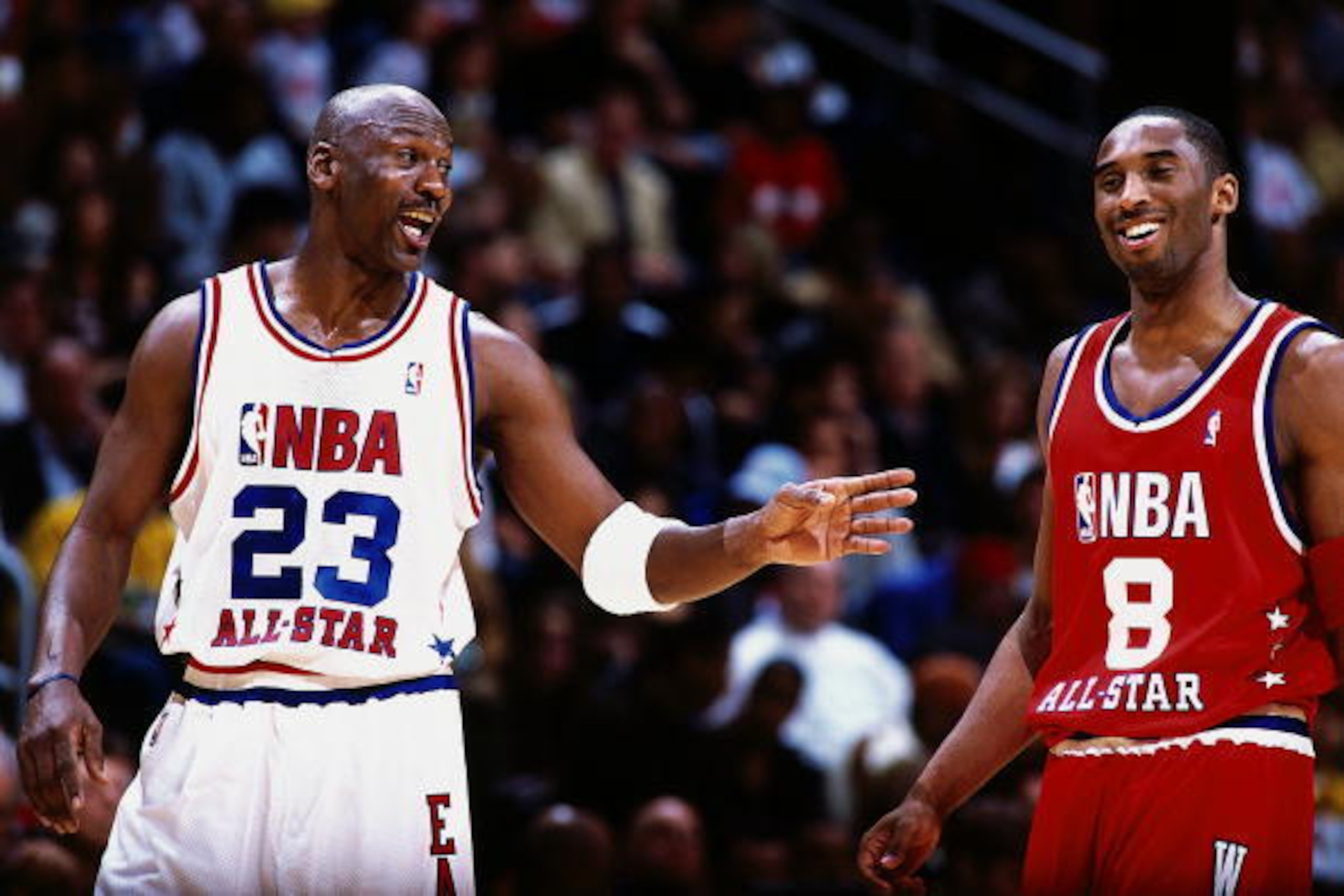
Despite all that, MJ nearly went down as both the hero and the G.O.A.T. in his final All-Star appearance. With overtime coming to a close, he rose for a patented baseline fadeaway jumper to put the East up two with four seconds left.
Jordan would've had the last word if not for—you guessed it!—Kobe Bryant. His Airness' closest stylistic heir drew a foul on a three-point try at the other end, hit two of three free throws and helped the West fend off the East in the second extra period.
Kevin Garnett came out as the game's MVP, but for one shining moment, Jordan looked like he might ride off into the sunset with his fourth such trophy. Instead, he had to settle for a mantle stacked with five regular-season MVPs, six Finals MVPs, six championship rings, plus scores of other awards and honors earned throughout arguably the most distinguished career in basketball history.
3. 1988: His Airness Rules the Windy City
8 of 10All-Star Weekend in 1988 was all Michael Jordan, all the time—and for good reason. The Chicago Bulls hosted the Windy City festivities, with Jordan in the midst of arguably his greatest individual season.
That year, he led the league in scoring (35 points per game), steals (3.2 per game) and minutes (40.4) en route to the first of his five MVP trophies and his only Defensive Player of the Year Award.
The midseason weekend at Chicago Stadium served as Jordan's coming-out party. On Saturday, he outdueled Dominique Wilkins in the Slam Dunk Contest by flying from the free-throw line not once but twice. The next night, they teamed up to lead the East to a 138-133 win over the West.
But while Wilkins did well to score 29 points in 30 minutes, it was Jordan who took center stage. He scored 40 points—two shy of the single-game All-Star record—with eight rebounds, three assists, four steals and four blocks in a performance that was not only MVP-worthy but also one of the greatest ever seen in the midseason showcase.
"I wanted to make sure Michael had the most butter on his bread," Detroit Pistons guard and Chicago native Isiah Thomas said, who earned eight of his 15 assists on dishes to Jordan, per the New York Daily News.
Thomas' Pistons got the best of Jordan's Bulls in that year's playoffs, though the era of His Airness was coming.
2. 1964: All-Stars Almost Walk Out
9 of 10NBA players might not be the multimillionaire moguls they are today without the brave efforts of 20 legends back in 1964. That year's All-Star Game in Boston was scheduled to run in prime time on ABC—a watershed moment for the still-fledgling league.
Except, there almost weren't any players to put on a show. Prior to the game, on a snowy Tuesday night in January, Boston Celtics legend Tommy Heinsohn—then the president of the National Basketball Players Association—convinced the rest of the players to boycott the event if the league's nine owners didn't agree to recognize and negotiate with the union.
"The players were controlled by the owners," Jerry West, who was slated to suit up for the Western Conference that night, told the Los Angeles Times' Mike Bresnahan in 2011. "All of us felt like we were slaves in the sense we had no rights. No one made anything then. You had to work in the summer. It was the stone ages of basketball."
The owners implored the players to reconsider their strike before angrily demanding they leave the locker rooms and head to the court.
With game time quickly approaching, and ABC's executives threatening to nix the broadcast, league commissioner J. Walter Kennedy capitulated to the players' demands, which included a pension plan, improved working conditions, a friendlier schedule and the ability to have the union collectively bargain contract details with the owners.
That was enough to pry the players out of hiding, just in time for the start of a contest that would end in a 111-107 win for the East. In truth, the real victors were all those who would pass in and out of the NBA during the five-plus decades since.
They've come to profit handsomely from a game and a league that has become such a boon for players in large part due to the power its labor force has come to wield.
1. 1992: Magic's Kingdom
10 of 10In November 1991, Magic Johnson told the world he would be retiring after contracting HIV.
The world, however, voted in Johnson as an All-Star starter for the West anyway, even though he stepped aside before the 1991-92 season began.
Not that he needed the practice. He was the star of the show from tip to buzzer, pacing the Western Conference in points (25) and assists (nine) to a 153-113 win in Orlando. Before the game, Isiah Thomas, one of Johnson's closest friends off the floor and most bitter rivals on it, led the other All-Stars in a line of embraces for the Los Angeles Lakers legend, showing the world that Magic's virus couldn't and wouldn't come between them.
"Words mean a lot," Johnson said, per NBA.com, "but it's feelings that count most. Ours is a game of compassion. I'll never forget those hugs and high-fives."
With the outcome already in hand, Johnson repaid the favor by guarding Thomas and Michael Jordan on consecutive possessions, in between setting up Dan Majerle for a layup and draining a three of his own.
Naturally, Johnson was named All-Star MVP. But for those struck by the AIDS epidemic, his show of strength and grace on such a big stage meant so much more.
Josh Martin covers the NBA for Bleacher Report. Follow him on Twitter, Instagram and Facebook, and listen to his Hollywood Hoops podcast with B/R Lakers lead writer Eric Pincus.

.jpg?w=2560 "NFL investigating 2 referees for separate viral exchanges")

.jpg?w=2560 "Report: Chiefs Contact Hill's Agent")
.jpg?w=2560 "OBJ Calls Out Giants After Release")
.jpg?w=2560 "Tyreek makes another cryptic post amid Chiefs rumors")
.jpg?w=2560 "Greenlaw Talks Payton Exchange")