

Quarter-Season Grades for Each Golden State Warriors Player
The 2016-17 Golden State Warriors look every bit the part of NBA steamroller.
Their league-best marks—too numerous to list in totality—include the following: .840 win percentage, plus-11.9 net efficiency rating, 118 points averaged per game, 49.8 field-goal percentage and plus-12 average margin of victory. They have 14 double-digit wins and only four total losses.
How have the new-look Dubs climbed this high this quickly?
The ingredient list includes everything from head coach Steve Kerr's egalitarian approach to general manager Bob Myers' mastery, but it draws heavily from the fact this roster is historically loaded.
All 15 individual parts have combined to make this an on-court colossus, but the degree of impact wildly varies. With Golden State having turned the first corner on its 82-game trek, we have enough data to assess each player's quarter-campaign.
The players are presented in ascending order of importance, based on both subjective (eye test, value, performance vs. expectations) and objective (traditional and advanced statistics) evaluations.
15-11. Deep Reserves
1 of 7
15. Damian Jones, C
The scouting report on rookie Damian Jones reads like a Warriors fan's wish list: size (7'0", 245 lbs), explosiveness, even a smattering of spacing. But so far, the 30th overall pick has only tantalized Dub Nation in their dreams. His body of work consists of a single scoreless nine-minute appearance, thanks to a torn pectoral muscle suffered 12 days before the draft.
Grade: Incomplete
14. Anderson Varejao, C
The Warriors liked Anderson Varejao enough to reward him with a one-year deal for the veteran's minimum. But that adoration stops short of giving the 34-year-old actual floor time (49 minutes over seven games), so his on-court contributions could be described as minimal. There are probably worse insurance policies out there, but it's telling that he's been unable to crack an inconsistent center rotation.
Grade: D+
13. James Michael McAdoo, PF
James Michael McAdoo was once pegged as a potential lottery talent, but that feels like a lifetime ago. Undrafted out of North Carolina, the third-year forward bides his time doing custodial work during lopsided games. He has suited up just 11 times this season with the average margin of victory in those contests being a whopping 22.4 points.
His physical tools look intriguing, but he's doomed by the lack of a discernible offensive identity.
Grade: D-
12. JaVale McGee, C
The unlikely owner of Golden State's third-highest on-court offensive efficiency, JaVale McGee has been a high-flying testament to the importance of vertical spacing. His above-the-rim game gives this group something unique. But that was expected, as were the on-court blunders and defensive misadventures.
Grade: C
11. Kevon Looney, PF
Two hip surgeries all but exhausted Kevon Looney's rookie season, so this feels like his first NBA test. He's not acing anything, but he looks to be ahead of the curve for carving a niche on this star-studded roster. Credit his buy-in of the rim-running and rebounding roles pressed upon him, which has denied him the chance to showcase his perimeter skills but also made him a valuable support piece.
"What I like about him is he doesn't try to do too much," Kerr said, per Connor Letourneau of the San Francisco Chronicle. "He's smart, and he knows where to be."
Looney's activity on the glass—6.8 defensive rebounds per 36 minutes, best among the second-teamers—pays obvious benefits for the league's worst club in defensive rebounding percentage (73.8). It would be nice to see what else he can do offensively, but that's not a priority with this roster.
Grade: C+
10-6. Supporting Cast
2 of 7
10. David West, PF
There are many things David West is not anymore—young, dynamic, intimidating at the rim. But he's still savvy, skilled and statistically relevant. He's on pace to set new career highs in assists (5.6), blocks (2.0) and steals (1.8) per 36 minutes, plus post his second-highest field-goal percentage (52.5). His weaknesses restrict him to just 11 minutes per night, but he's been better than expected when he sees the floor.
Grade: C+
9. Patrick McCaw, SG
It hasn't been easy keeping Patrick McCaw out of the picture. A sprained ankle threatened his rotation spot, but he reclaimed it upon healing. Neither the star-studded perimeter starters nor the sturdier-than-expected reserve wings have denied the 38th selection regular minutes since.
"You can tell what Kerr likes about him," Tim Kawakami of the San Jose Mercury News wrote, "McCaw doesn’t ever look flustered, can handle the ball, he can use his 6'7" frame to create offensive angles when he drives, also is perfect in the Warriors' switching defense and can hit a shot or two."
McCaw is far from perfect: He has the worst on-court defensive rating and the only negative net rating among Warriors regulars. But he's a second-round rookie, acquired for only cash considerations, who's logging the ninth-most minutes on an NBA superpower.
Grade: B
8. Ian Clark, SG
Ian Clark has already transitioned from afterthought to pivotal piece.
After shooting just 41.4 percent overall and 35.2 percent outside his first three seasons, he's skyrocketed those accuracy rates to 50 and 39.2, respectively. He's also tallying more than twice as many assists as turnovers, holding the team's fifth-highest points-per-36-minutes average (17) and slicing seven percentage points off his opponents' field-goal percentage.
Grade: B+
7. Shaun Livingston, PG
The Warriors' wealth of talent is encapsulated in Shaun Livingston's meager 17.4 minutes per night. A walking mismatch, the 6'7" point guard is hitting a mind-numbing 59.3 percent from the field and 47.7 percent of his pull-up jumpers (third among guards with 25-plus attempts).
That said, he's never been less needed and sports personal lows in usage percentage (11.8), assist percentage (12.8) and player efficiency rating (9.9).
Grade: C+
6. Zaza Pachulia, C
The smartest move Zaza Pachulia has made during his Warriors tenure is separating from his predecessor.
"I'm not comparing myself to Andrew [Bogut]," Pachulia said, per Letourneau. "I came here to provide my presence. That's all I can do."
Pachulia can't match Bogut as a paint protector or lob finisher. But the Dubs knew they were getting someone different, and Pachulia has mostly exceeded that type of expectation. His field-goal percentage is a new best (50), and he's outpacing his career per-36-minute rates in rebounds (11.3, up from 10.0), assists (4.9, 2.1), steals (1.7, 1.2) and blocks (1.0, 0.6).
Grade: B
5. Andre Iguodala, SF
3 of 7
It only feels slightly hyperbolic to say Andre Iguodala can do no wrong.
He's a basketball magician in more ways than one, lulling observers to sleep with seemingly forgettable per-game marks of 5.8 points, 3.6 assists, 3.4 rebounds and 24.8 minutes. Then the contest closes and everyone sees him in his full plus/minus glory.
When he plays, the Dubs dominate to the tune of plus-15.3 points per 100 possessions.
"He gets it," Kerr said, per Letourneau. "He's just so smart, and he just calms us down offensively. We just see him make one smart play after another."
Therein lies the rest of Iguodala's superhuman abilities: He has a cat-like knack for staying on his feet and under control. To wit, he paces all players with an absurd ratio of 5.67 assists to one turnover. The gap between him and second place (1.5) is wider than the one separating Nos. 2 and 14.
But the results aren't nearly as sweet when he searches for his own shot (career-low 5.8 points per game with a 52.6 true shooting percentage). And his typically lights-out defense has been uncharacteristically generous so far (plus-1.9 defensive field-goal differential). Whether the 32-year-old is pacing himself or losing a half-step may not be clear until later in the year, but either way he remains valuable.
Grade: B



4. Klay Thompson, SG
4 of 7
It wasn't braggadocio, just simple prognostication when Klay Thompson told The Vertical's Shams Charania this summer, "I'm not sacrificing [expletive], because my game isn't changing."
The arrival of Kevin Durant has done nothing to slow Thompson's ascent. In fact, the All-Star shooting guard is averaging career highs in field-goal attempts (17.4), makes (8.2) and percentage (47.2). He owns the season's highest point total—a 60-point dissection of the Indiana Pacers in less than 30 minutes—and should push his scoring average to new heights once his three-point percentage hits its normal level.
"I've seen it all from him," Stephen Curry said, per Bay Area News Group's Anthony Slater. "When he gets it going, he takes a heat-check turnaround three from the corner, heavily contested and it goes in? Unbelievable."
Believe this—Thompson is within striking distance of his first 50/40/90 slash line. His off-the-dribble arsenal grows by the game, and his inside-the-arc shooting has never been more accurate.
Could his stat sheet touch more categories? Sure. Is he locking up opposing scorers like usual? The numbers say not quite.
But he's a foundational piece of an historic attack. His gravitational pull on defenders simplifies the game for his teammates, and if he's not given enough attention, he can strike at ludicrous speed. He gets knocked a bit for being a specialist, but he's exceptional at what he does.
Grade: B+
3. Draymond Green, PF
5 of 7
There isn't an obvious weakness on Draymond Green's stat line. His well-rounded arsenal—he's one of only two players who are averaging at least 10 points, eight rebounds and six assists—makes him a nightly triple-double threat. His defense is elite.
But Golden State's talent-soaked roster forces opposing clubs to nitpick with their game plans. So Green's decent-not-great shooting touch becomes the area they try to exploit.
"They want Draymond to shoot the three because he's better as a passer, facilitator and initiator of the offense," Durant said, per Letourneau. "But when he's knocking down the three-pointer, it opens the floor for everybody."
Even when Green isn't hitting outside, he's elevating those around him. He has the NBA's seventh-best plus/minus (plus-226), the eighth-most points created by assists (16.7 per game) and one of only two lines with at least eight boards, two steals and one block per game.
But his shooting has dipped across the board, hence the make-Draymond-beat-us strategy.
Grade: A-
2. Stephen Curry, PG
6 of 7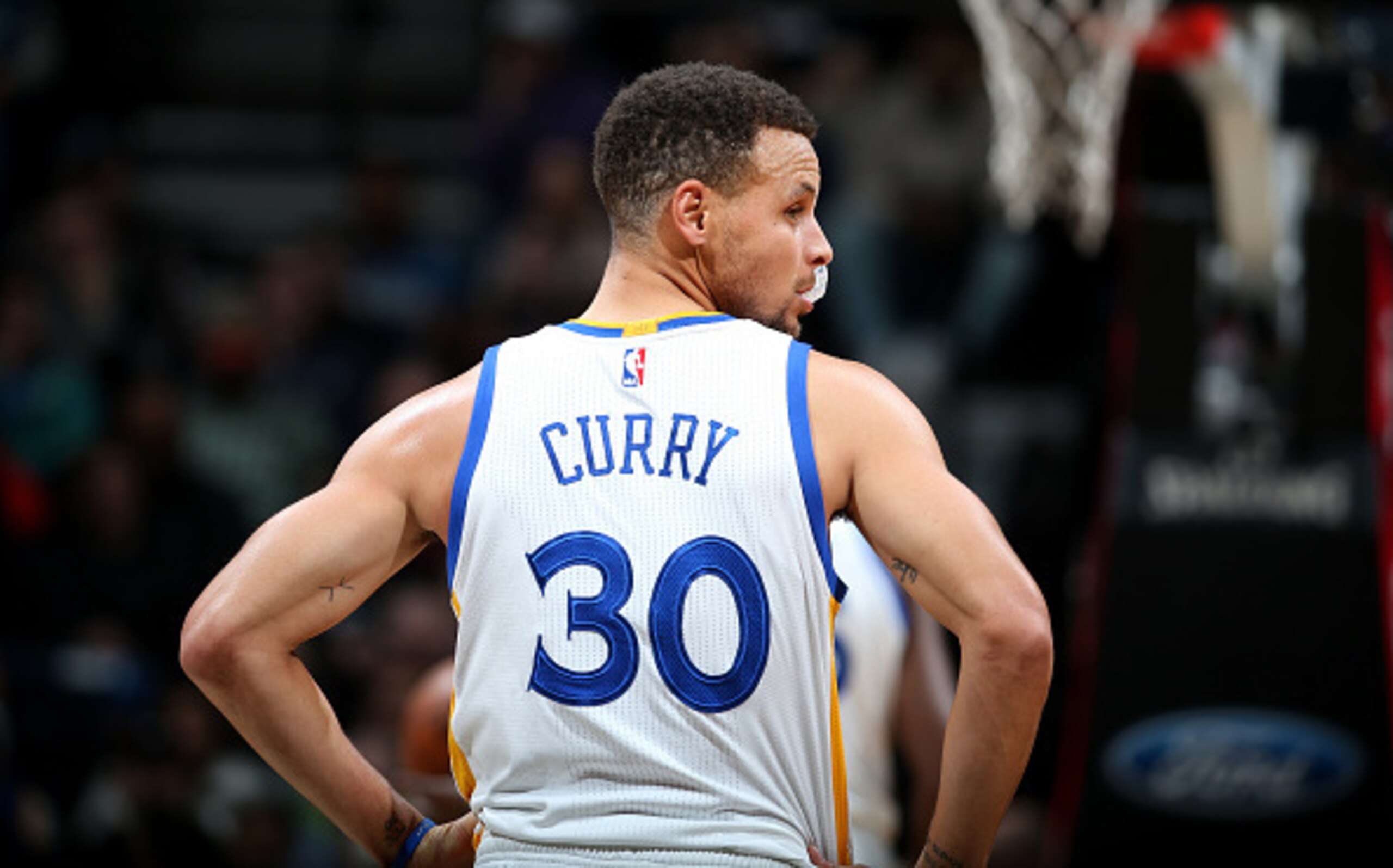
It's strange seeing Curry—owner of the last two MVP awards—sitting anywhere other than the head of the table. But sacrificing that seat was part of his sales pitch to Durant in free agency.
"Curry told Durant...that he could care less about who is the face of the franchise, who gets the most recognition or who sells the most shoes," a source told The Undefeated's Marc J. Spears. "The two-time NBA MVP also told Durant that if Durant won the MVP award again, he would be in the front row of the press conference clapping for him."
If Curry is cool putting himself in the 1A slot, then so are we. But it feels ridiculous given what he brings on a nightly basis.
He's the clubhouse leader in made triples (3.8 per game) and one of only seven players with top-20 rankings in both points (25.4, 10th) and assists (5.8, 18th). He has generated the fifth-most win shares (4.3) and holds the 11th spot in PER (25.5). His 6.71 offensive real plus-minus trails only that of fantasy juggernauts Russell Westbrook and James Harden, via ESPN.com.
In other words, 1A Curry is still on the league's short list of superstars. But his field-goal (48.1) and three-point (39.5) percentages aren't quite where they could be, so he's trailing his MVP pace in both quality and quantity.
Grade: A
1. Kevin Durant, SF
7 of 7
Durant has never averaged fewer than the 16.8 shots he's launching this season. That fits with conventional thinking that his Bay Area migration would come at the expense of individual dominance.
And yet the former MVP has arguably never looked better. The Dubs have discovered a new level of efficiency in the 50/40/90 club member, while he is simultaneously supplementing his scoring with lockdown defense and better board work.
"He's 6'12" or whatever, and he can do everything," Warriors assistant coach Bruce Fraser told ESPN.com's Marc Stein. "It's not fair."
Durant hasn't had to sacrifice much. Despite the drop-off in opportunities, this is only his fourth-lowest scoring average (25.8 points per game). He has the clean looks this offense generates and a career-best 53.6 field-goal percentage to thank for that.
And he's compensated for anything he's given up with a new sharpness to his other skills: He's never averaged more rebounds (8.4) or blocks (1.6). His assist-to-turnover ratio is a personal best (2.19). His steals match his career high (1.4), and his PER trails only the mark set during his MVP campaign (28.4). His matchups are shooting 4.8 percentage points worse against him than they do on average.
He's been even better than anticipated, which didn't seem possible with the resume he brought over. The only thing denying him an A-plus is the real—and equally terrifying—chance he may continue to improve as he gets deeper into his Warriors tenure.
Grade: A
Unless otherwise noted, statistics accurate through Monday, Dec. 12, and used courtesy of NBA.com and Basketball-Reference.com.
Zach Buckley covers the NBA for Bleacher Report. Follow him on Twitter @ZachBuckleyNBA.

.jpg?w=2560 "NFL investigating 2 referees for separate viral exchanges")

.jpg?w=2560 "Report: Chiefs Contact Hill's Agent")
.jpg?w=2560 "OBJ Calls Out Giants After Release")
.jpg?w=2560 "Tyreek makes another cryptic post amid Chiefs rumors")

.jpg?w=2560 "Greenlaw Talks Payton Exchange")