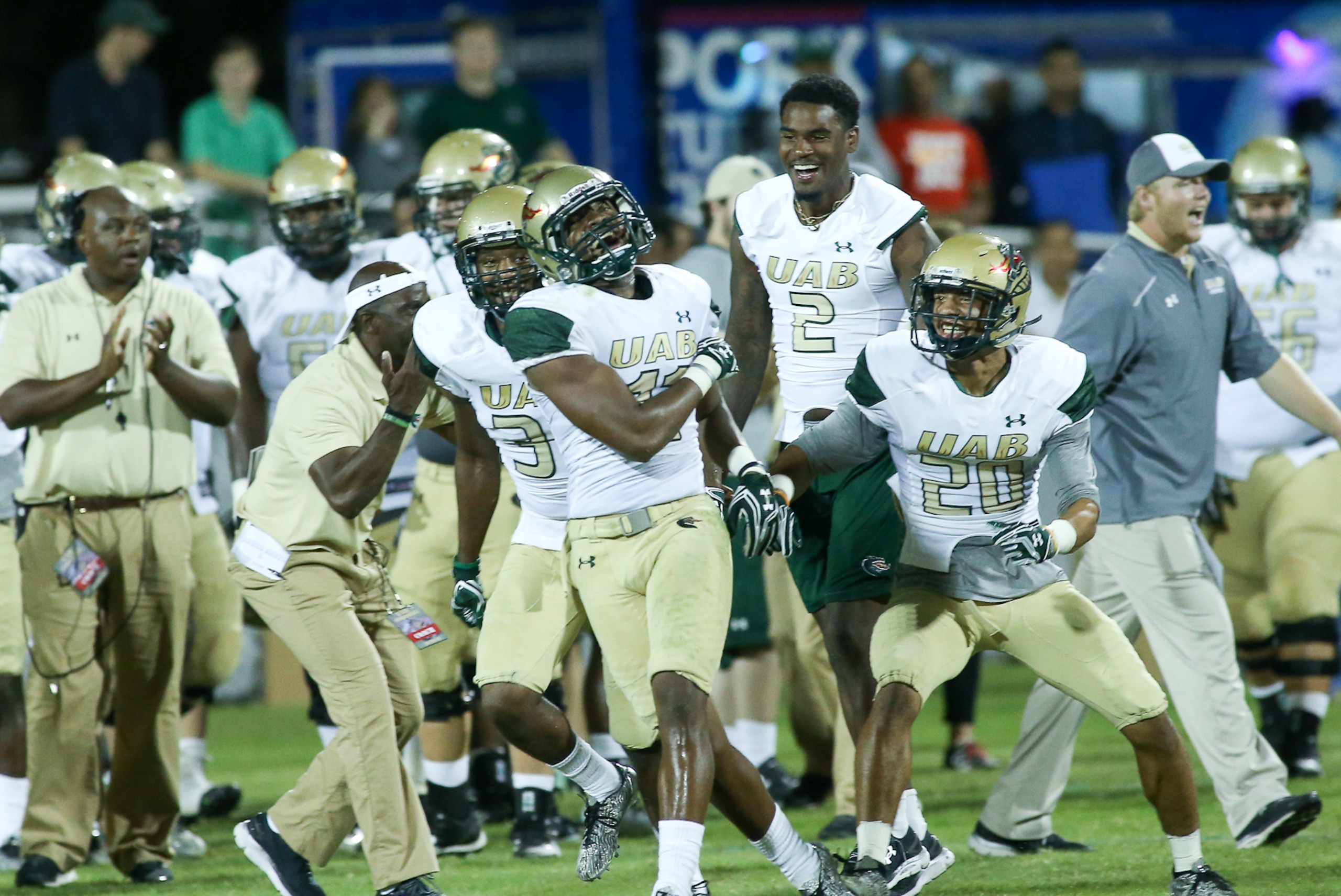

The Dragon Awakens: UAB Football Nears the End of Its Time in Football Limbo
BIRMINGHAM, Ala. — Inside an inconspicuous brick building in the heart of football country, a countdown is ongoing. A small forest-green sign near the entrance suspends from the wall, illuminating dancing red numbers.
0 days, 4 hours, 12 minutes, 54 seconds ... 53 ... 52 ... 51 ...
"Blazer Football Countdown" is etched across the top. It emits no sounds. It lists no opponents. It garners no crowd.
TOP NEWS

🚨 Week 5 AP Top 25 Poll
Colorado State DC gets fired mid-game during blowout loss
Massive Shakeup in CFB Top 25 List 🔢
It simply counts down the hours, minutes and seconds until the University of Alabama-Birmingham football team will play its most important game of the season. Its only game.
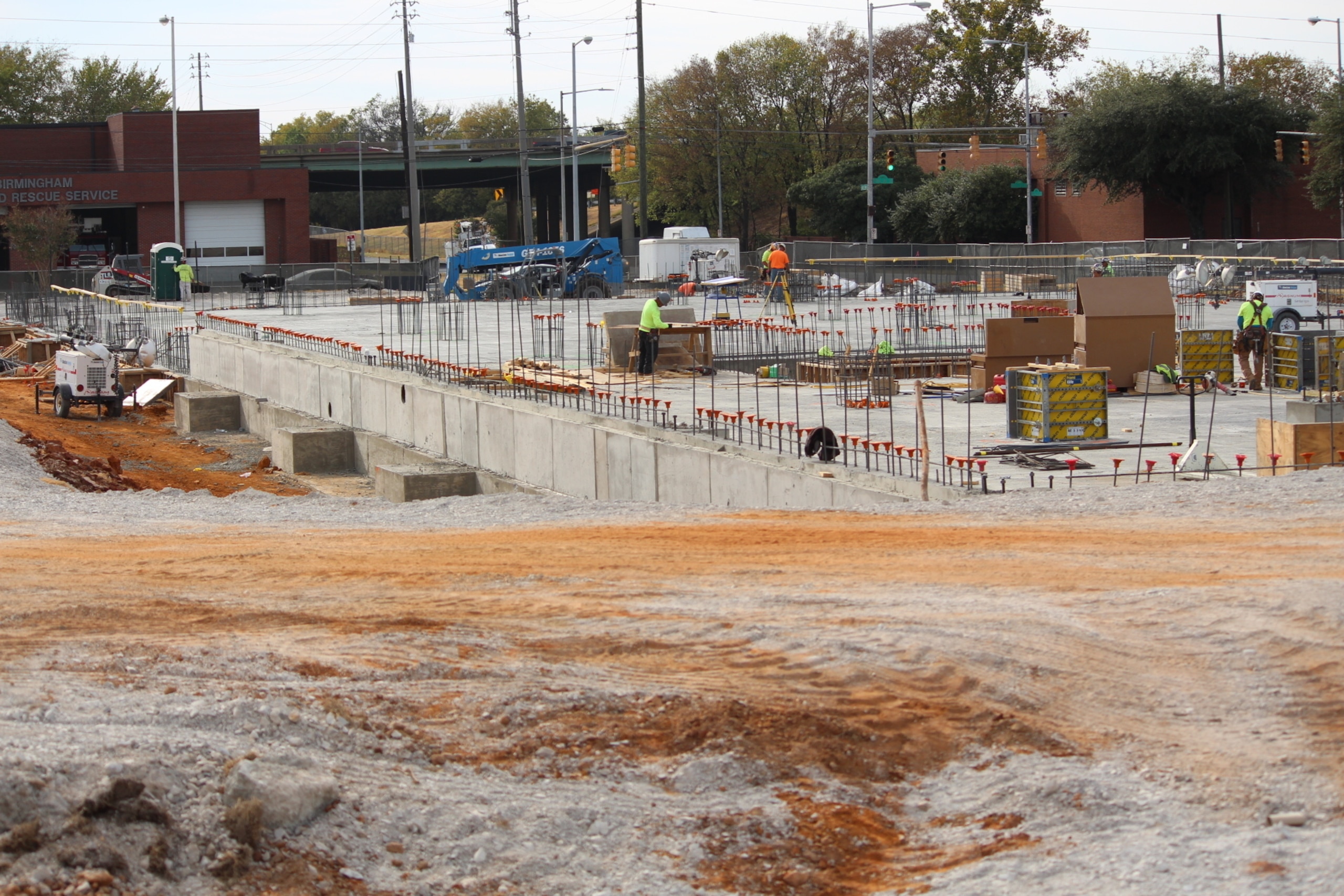
Not long from now, this cramped headquarters will be leveled and replaced with something more luxurious, something it can grow into.
For now, it serves as UAB's football operations building, and on this Thursday afternoon in the middle of October, it is bursting with energy.
Coaches carry smiles, full plates and foam cups of lemonade through the hallways. Dreamland Bar-B-Que, a Birmingham essential, is catering the occasion. For as much as these people have gone through over the past few years, none of it shows today.
Such emotions were absent two years ago, the day university President Ray Watts told a room full of angry, confused and emotional UAB players and coaches the program was shutting down for financial reasons.
A team on the verge of finally breaking through following a 6-6 season closed its doors in December 2014.
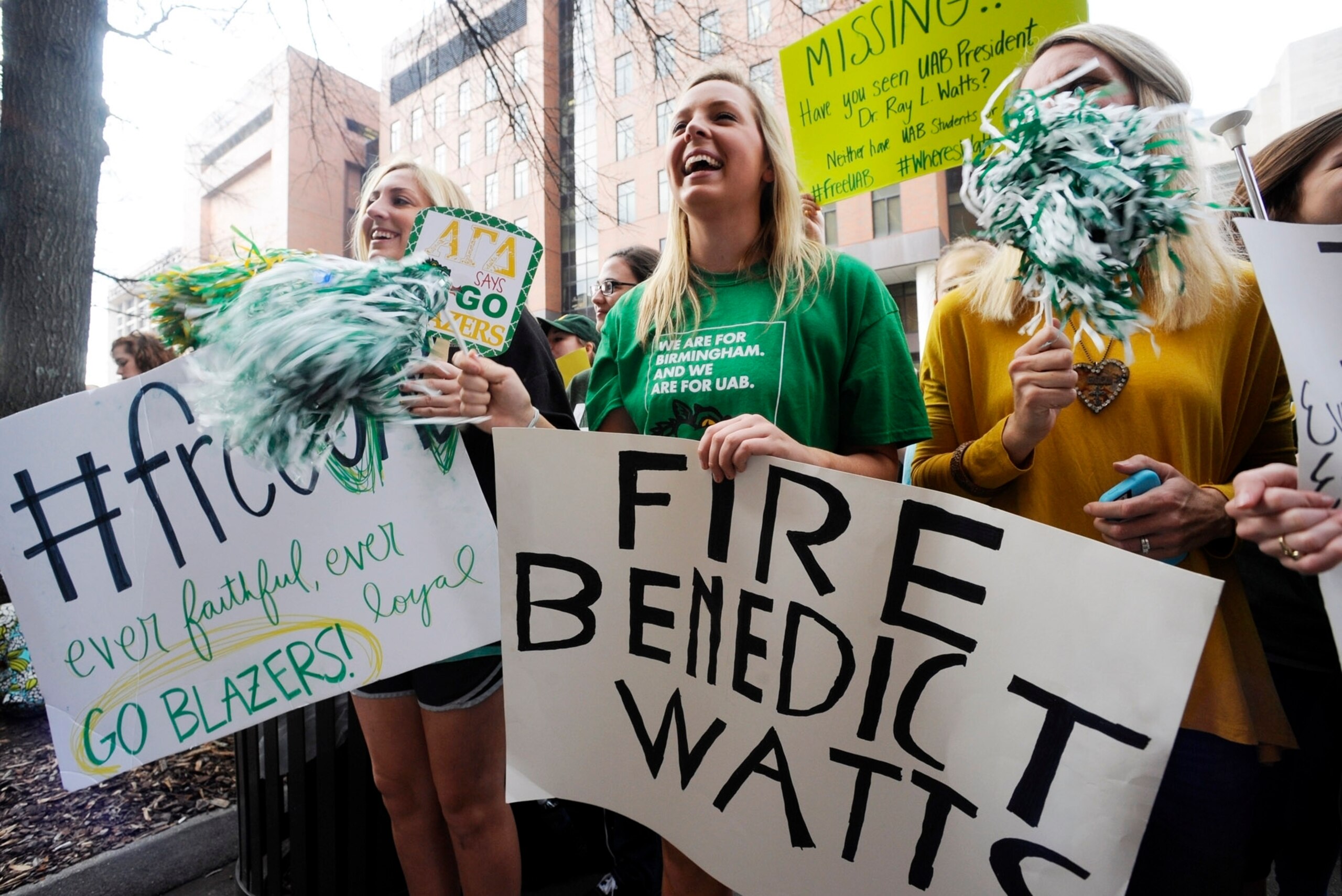
"My mother passed away when I was 19, so I don't want to compare it to a death," UAB head coach Bill Clark says. "But this was close to a death."
"It was shock and disbelief," linebacker Shaq Jones adds. "This was somebody playing an April Fools' joke in the middle of December. But when it actually happened and it set in, it was crippling."
Six months later, following a groundswell of local and national support—coupled with the financial commitments to support the program—UAB football was brought back to life.
On September 2, 2017, the Blazers will play football in anger again. While the program was disassembled in a few minutes, putting it back together would take years.
All but 20 or so players left the school—the "culture" group, as Clark calls them. Some left to play at other universities. Others gave up football entirely. Those who stayed essentially had their eligibility frozen by the NCAA.
Clark and his staff have spent 18 months piecing it back together. They helped raise funds. They logged countless hours recruiting, trying to ensure they had a full roster. And then, finally, they started coaching again.
With the first game still more than nine months away, UAB has endured a season unlike any in recent college football history: no schedule, no games, no opponents.
"It's really hard to explain what it's been like," defensive coordinator David Reeves says. "It has been unorthodox, very strange and all those things. You don't realize the reward of playing a game on Saturday and what a release that is."
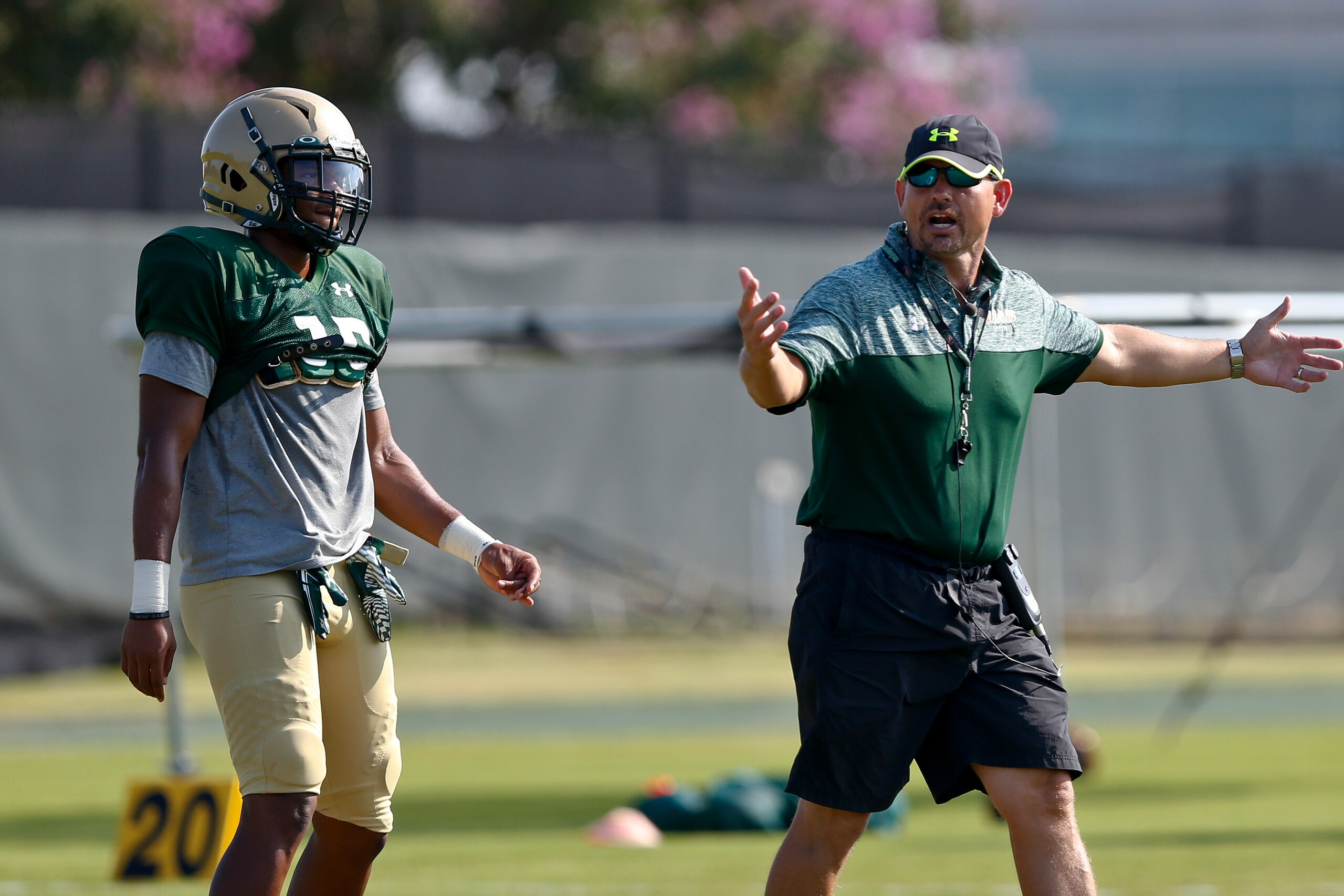
Behind the scenes, however, football is happening. Practices are being conducted. Film is being dissected. Depth charts are rounding out. Perfect strangers are coming together for a cause they believe in.
It has all led up to this Thursday in October, zero days, four hours, nine minutes and 15 seconds before UAB takes on UAB in the Green and Gold scrimmage.
It will have the feeling of an actual game, which is by design. The band will play during timeouts. The cheerleaders will cheer. There will be fans and fireworks.
"We're gonna win tonight, I guess," Clark says with a smile from his office chair. "We can't lose."
0 days, 3 hours, 22 minutes, 11 seconds ...
Clark's office is a time machine—a glimpse into the football future.
Blueprints of the new facilities, new practice fields and other enhancements UAB has planned are scattered throughout. He is part architect and part football coach these days, although coaching is slowly winning the tug of war.
"I think early on it was harder than I thought it would be," he says. "It was so much fundraising and business to get to the football. Now, it's been better than I thought. It's surreal. Everything we said would happen, it's happened.”
Wearing a bright pink golf shirt, khakis and engaging blue eyes, Clark slips out of his office and onto the practice field that will soon be dug up and replaced with a state-of-the-art turf field.
To his left, construction workers are standing in a small hole that is in the early stages of being filled. By next season, this hole will be the new football operations headquarters. These days, the anthems of UAB's practices are the sounds of earth being dug up and steel hitting steel.
Back in the spring, before the future was being erected right in plain sight, the football team came back to the field. Spring practice marked the return of football, although this return was by no means seamless.
"First day of practice looked great," Clark says. "Then on day three, it hit. We only had 57 players. We were worried about someone getting hurt."
Given the timing, the vast majority of UAB's recruiting class—a group composed almost entirely of junior college players—was still months away from arriving on campus.
This group, which was the second-highest-rated class in Conference USA, according to Scout.com, served an even greater purpose than the talent added. These were the bodies Clark needed to fill out a full roster—or at least come close.
While the team waited for their arrival, spring had to be different. Players and coaches desperately wanted to do more—it had already been too long—but the staff resisted the urge.
Contact was limited. Practices were altered. With the freedom to finally play football, they eased into it.
Any player with an injury that required attention had it addressed. According to Clark, more than 10 players underwent surgeries with hopes of being completely healthy for spring practice.
Spring of 2017, that is. This is not a normal football timeline.
In the summer, the remaining players arrived to fill out the roster. While fall practice was still a mystery of sorts, the Blazers finally had a nearly full team to work with.
0 days, 1 hour, 35 minutes, 43 seconds ...
The forecast for tonight's game is worsening by the hour. Contingency plans are being discussed in the instance of bad weather, which is becoming increasingly likely.
Coaches and administrators spend the afternoon monitoring the situation on their cell phones. While concerned, they remain hopeful.
In a way, this entire year has been one elaborate, calculated contingency.
"It was really tough early on," Clark says. "Every day, it's gotten better."
While unusual, this situation is not completely unfamiliar to Clark. In 2008, he joined South Alabama a year before the program began playing games.
Serving as the defensive coordinator, he witnessed firsthand what it was like to start from scratch, albeit under more controlled parameters.
He saw what was necessary to build a team both physically and emotionally. While there is no guide for such a project, Clark came in with more experience than most.
The difference will come later: the expectations.
South Alabama began its existence by playing prep schools in 2009. UAB will play Florida next fall. The city, having watched this team come alive, is anxious for something more than a doormat.
"We're working 80 hours now, and it'll turn into 110 later," Clark says. "I still feel like I’m leaving too early."

Clark says he thought early on that everything should be as close to normal as possible, but he came to the conclusion the team should not practice every day.
He wanted to engage the players but not burn them out, to get them acclimated to a football timeline but be open and honest about the situation at hand.
"That means we're going to give great effort for three days, because we're not practicing those other days," Clark told his team. "It's a luxury, and it's not going to be that way next year."
One of those three days is Saturday. Beyond refamiliarizing players with game day, this decision carried further significance. Back when Clark was at South Alabama, he received advice from Bobby Wilder, his friend and the head coach at Old Dominion.
"I would make sure I was doing something on Saturday," Wilder told Clark. "That way, you know what they were doing Friday night."
On Saturday mornings, the staff meets at 7 a.m. The players meet at 8.
By 9, they're practicing at Legion Field.
Two hours later, after going through an assortment of game-like situations, the players head home. The coaches then spend the rest of the day recruiting and watching football.
They note plays and formations that jump out. They look for details that can be incorporated into their playbook. The process has become more casual and ritualistic than anything else, but it is a part of what they do.
During the week, the staff goes back to the basics. One of the benefits of not having to prepare for an opponent is that the focus can be purely internal.
The Blazers have spent the past few months on the details. They have worked on tackling. They have become masters of their own playbook. They have worked on bettering themselves.
"We have had a luxury of being in spring football mode for an extended period," defensive coordinator Reeves says. "It's one of my favorite times of the year because it's a chance to slow down and really teach.
"I love practice. I think practice is everything. So for me, I've kind of been to Disney World for a few months. But the players probably disagree with that. To go from August until now without a game is a real mental stretch."
0 days, 0 hours, 35 minutes, 53 seconds ...
Darious Williams was working a shift at Ace Hardware the day he found out UAB football was coming back. He'd left school and returned home to the Jacksonville area.
A co-worker alerted him to the news. Because the former walk-on couldn’t have his phone while he worked, he waited until his shift was done to learn more.
When Williams clocked out, he had an avalanche of missed calls and text messages from players and coaches waiting for him. Everyone wanted him back.
"I loved it, but I didn't think of how big this could impact me," Williams says. "When it was stripped away, it really hurt. It humbled me and made me love the game and my teammates more."
Shaq Jones had a similar reaction. When the program was pulled, Jones visited other schools. He listened to their pitches. He felt the pressure from coaches wanting him to commit earlier than he was ready to do so.
"I thought about whether I wanted to play football or not. I lost the passion for it," he says. "UAB was family, and I had grown so close to the players and coaches. Leaving it was kind of like leaving life behind, and I didn't want to do that."
Williams and Jones are centerpieces of what UAB is trying to accomplish. They are the connective tissue between the program's past and future.
As the players started practicing again, one of the first orders of business was for the roster to mesh. With so many new players arriving from so many different places, there was awkwardness that needed to be addressed.
"No more cliques; no more people on their own," Williams says. "It's more like a family, like we want it to be."
Typically, teams bond through turmoil. The losses, the disappointment, the injuries and the struggles of a normal football season are bad in the moment, but they can also bring players together. The Blazers had to coalesce without the benefit of going through these unforeseen, raw emotions together.
"My expectation going in was that we might not take it as serious," Williams says. "But the outcome has surprised me. We got on the same page. It's right around the corner. We can blink, and we're right on the same path as everybody else."
"Our mindset is that we're playing today," Jones says. "There is no next year. Every day is a game day for us. We approach every practice with the mindset that we have to get better. Because if we don't, we'll be a complete disappointment."
The daily routine isn’t always the same, but the people are.
Since spring, UAB players have only hit UAB players. One practice after the next, the same linemen have gone up against the same linemen. The same wide receivers have gone up against the same defensive backs.
When they’ve tackled, the same bodies have collided into one another repeatedly without any break in the sequence. "It's amazing they don't hate each other," Clark jokes.
Like the coaches, players often gather after practice on Saturday to watch football.
They root on former teammates who decided to leave after the shutdown. They check in on future opponents to see what they can expect next year.
They dream of what it will be like when September 2, 2017, finally arrives. They think about a time when they will no longer be bystanders.
"Sometimes I just sit at home and think about what that first game is going to feel like," Jones says. "You have these big games, but just imagine that game."
0 days, 0 hours, 0 minutes, 0 seconds ...
The countdown clock is alone, displaying nothing but zeroes in an empty building.
Across the street, the stands at BBVA Compass Field—UAB's soccer stadium, which has been repurposed for the evening—start to fill. Goal posts on wheels are placed on each end of the field. Music blares over speakers as more people pour in.
The dark clouds that threatened the night pass by without a drop of rain. By the time the football team emerges from beneath a giant, inflatable dragon, the wind has calmed. It is an immaculate evening for football.
Clark has ditched the pink shirt for the green UAB polo he'll sport on game days next season. He's added a headset and lost his smile.
As the players go through their stretching routines, Clark and the staff survey the field. There's a nervous energy 15 minutes before kickoff—the kind of nervous energy one wouldn't expect from a scrimmage.
The atmosphere is intimate, and the limited seating is now at capacity. Others without seats line the chain-link fence that surrounds the field. Altogether, a few thousand people have decided to watch UAB play UAB.

Clark stands 15 yards behind the offense on each series as the game begins. From the first snap on, he doesn't hold back. He yells. He corrects. He compliments. He provides feedback when he feels he has to.
His voice carries over the commotion of the night and the sound of teammates smashing into one another with purpose.
There is also a shocking amount of speed and size being put to use for a team that was asked to start over. The play is by no means perfect, although it is far crisper than it should be at this point in the process.
"At the end of the day, we have to win," Clark says. "That's the life that we live, and I feel that already. That's what's waking me up. There's always more to do. It's the only way I know how to do it."
Big hits are acknowledged with even bigger reactions. Entire sidelines react to touchdowns in coordinated celebration. Coaches wear the excitement and disappointment on their faces after each down, as do the players. It matters a great deal to them. This much is clear.
As the game ends, fireworks are launched into the night. Players and coaches smile and embrace one another again.
The team gathers around Clark in the middle of the field as he delivers one final message. Only a few practices remain before they're done for the fall.
Once his last word is heard, the team members migrate toward the band. Together, as the sky is still peppered with flames, they sing the UAB fight song.
None of this will have a place in any box score or record book. It will be long forgotten when the countdown ends and their football lives can return to normal—when September 2 finally arrives.
But in the moment, it feels quite real.
_0.png?w=2560)
.jpg?w=2560 "OBJ Calls Out Giants After Release")

.jpg?w=2560 "Rap: Lions, LaPorta End Contract Talks")

.jpg?w=2560 "Report: Baker May Miss Up to 6 Weeks")