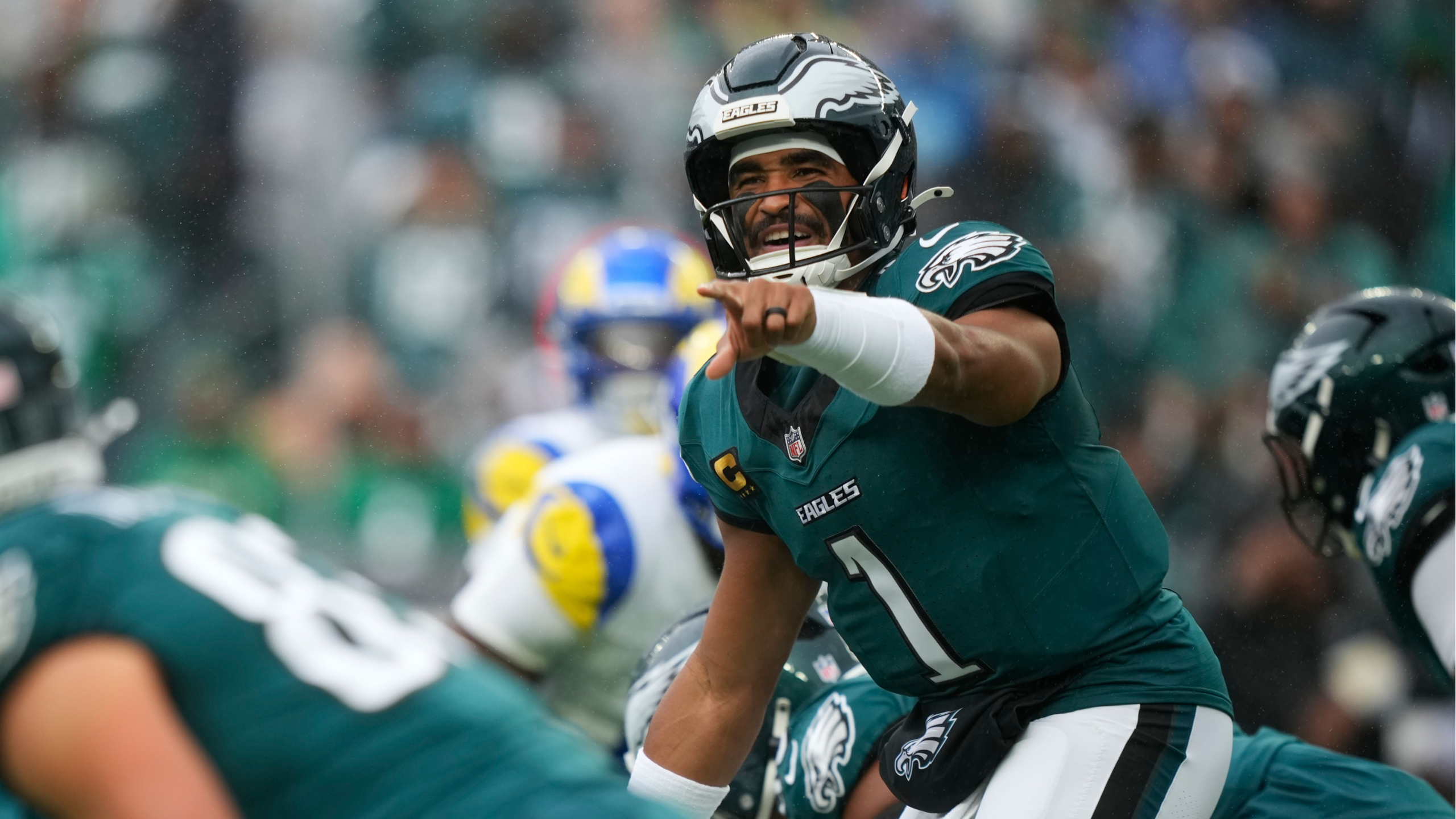
A Match Made in the Bayou: Why Danny Etling Needs LSU as Much It Needs Him
The words "football," "savior" and "Indiana" don't often go together unless someone makes some sort of reference to that school in South Bend.
It's not a state LSU has often looked to for players, either. In the football program's long history, there have been only three lettermen from Indiana—interestingly, one of them was a quarterback who won a national championship, Matt Mauck.
Mauck grew up a little south of where Danny Etling did in Terre Haute, on the western edge near the Illinois border. It's a region much more known for Larry Bird on the Indiana hardwood. In fact, comedian Steve Martin once called it "Nowhere, USA."


_0.png?w=2560)
Yet here Etling is at the unlikeliest of places, Baton Rouge, ahead of LSU's key matchup with conference rival Auburn, where he could key not only the No. 18 Tigers' chances of getting back in the College Football Playoff chase but possibly affect head coach Les Miles' future. After successfully earning the victory in his first start with the Tigers, the transfer from Purdue is now the hope of a torn-up community that's been through a lot lately.
"We were very pleased," Miles said about Etling's addition to the Tigers during the Southeastern Conference's coaches' teleconference Wednesday morning. "More so now."
This could be it for both of them if this doesn't work out, but during Saturday's 23-20 home victory against Mississippi State, some optimism returned after a bleak start to the season that led to starting quarterback Brandon Harris' benching.
Etling's numbers weren't overly spectacular—19-of-30 for 215 yards, one touchdown and 23 yards on the ground—but no one expected them to be.
Perhaps the number everyone should have been focused on was "zero." That's how many interceptions and sacks the Bulldogs defense recorded.
"Danny Etling has done a great job moving the ball around and doing the things we asked him to do," Miles said during his weekly Monday press conference. "Seven players caught passes, three wide receivers, two fullbacks, two tight ends. Really scored 23 points in the first—in the first stanza—and should this offense come to play for 60 minutes, we would be happy about it."
Etling was also efficient, showed poise and didn't seem to force too many passes. With star running back Leonard Fournette returning after missing the previous game with an ankle injury, the offense kept the chains moving.
| Quarter | C-A | Yards |
| 1st | 6-10 | 81 |
| 2nd | 8-10 | 91 |
| 3rd | 2-4 | 7 |
| 4th | 3-6 | 36 |
| Total | 19-30 | 215 |
That is, it did in the first half.
If there was a downside to Etling's performance, it's that the LSU offense got worse as the game progressed, with 282 total yards in the first half and 110 in its scoreless second half. Plus, he could have easily had a couple of passes picked off.
Granted, a fumble lost and another on fourth down, bad field position and a rotating offensive line due to numerous injuries didn't help, but LSU's inability to kill the clock left the door open for Mississippi State's comeback from being down 23-6 in the fourth quarter.
"It was definitely frustrating to watch the film," Etling said Monday, per the Times-Picayune's Ron Higgins. "I thought we had a good game plan. That second half we sort of shot ourselves in the foot. That's kind of what we felt after the game. I think it's something we can definitely improve upon."
The interceptions, in particular, are something to watch because they were part of his downfall at Purdue.
The short version of that is Etling lost his job to the guy who lost his job to the guy who was the quarterback during Purdue's 2-10 season last year.
David Blough, who is just a sophomore this season, ended up being the last man standing for the Boilermakers. The quarterback in middle of that turbulent stretch was Austin Appleby, who transferred to Florida and will start Saturday against Tennessee.
"I'm happy for those two guys," Purdue head coach Darrell Hazell said during the Big Ten coaches' teleconference Tuesday. "It's a proud moment for the Boilermakers."
That's one way to look at it. Another is that while most college programs are trying to prepare their quarterbacks to maybe play at the next level, at Purdue that apparently means the Southeastern Conference.
"It's an unusual set of circumstances, certainly," Miles said. "We're kind of glad that we have our Purdue guy."
According to Miles, Cam Cameron was the link to landing Etling as a transfer after he had been benched for a younger player and decided to leave Purdue.
Not only was LSU's offensive coordinator an Indiana guy, having played both football for Lee Corso and basketball for Bob Knight with the Hoosiers before a knee injury ended both careers, but Cameron and Etling went to the same high school, South Vigo, and their families know each other.
"We watched his Purdue tape, and you could recognize that he could throw the football, and you could recognize that he was handling all the various situations that his team was going through—and felt like with Cam we could bring him on," Miles said. "He had all the characteristics of a quarterback that we like to consider for our starter."
If that means being an effective game manager, Etling could help get LSU back on track in a big way, if for no other reason than he should make things easier on Fournette. After all, Fournette came close to breaking two long touchdown runs and still finished with 174 total yards against the Bulldogs.
Harris couldn't do that during the season opener against Wisconsin at Lambeau Field (a 16-14 loss), when it became painfully obvious LSU had to have better play at the quarterback position in order to challenge for the SEC West title.
| Name | Rating | C-A-I | Pct. | Yards (Avg.) | TDs |
| Danny Etling, 2016 | 127.4 | 25-44-1 | 56.8 | 315 (157.5) | 2 |
| Brandon Harris, 2016 | 95.9 | 13-25-2 | 52.0 | 139 (69.5) | 1 |
| Etling at Purdue | 110.9 | 238-429-12 | 55.5 | 2,490 (11.9) | 16 |
| Harris, 2015 | 130.6 | 149-277-6 | 53.8 | 2,165 (180.4) | 13 |
Now comes the hard part for Etling: Not doing the same things that didn't work at Purdue, which led to numerous sacks and interceptions. He was a what-you-see-is-what-you-get quarterback who didn't intimidate anyone in the Big Ten. He had 88 carries for minus-104 yards for the Boilermakers, due to sacks, and 12 interceptions compared to 16 touchdown throws.
It also won't take SEC opponents long to scheme against him because his sample size isn't just relief work against Jacksonville State—it's 15 games. Plus, his lone win as a starter at LSU came at home against the team many expect to finish last in the SEC West.
So while Mississippi State discovered he can run a little and buy his receivers some more time to get open, which in turn allows LSU to be a little less conservative with the play-calling, opponents will be better prepared to counter him beginning Saturday at Auburn.
That's also when we might be getting some answers to the other questions still surrounding Etling. Will he be able to lead the Tigers back from a significant deficit? Can he handle that physical pounding that comes with playing in the SEC? When things aren't going well, will he do better this time around?
Miles is banking that he can, although at this point, the coach has no choice (barring a remarkable turnaround by Harris). He also has a roster loaded with talent and returning starters at nearly every other position, who should bring out the best in Etling.
The flip side is Etling is getting his second/last chance as well. Instead of possibly riding the bench in West Lafayette permanently, he now has the chance to play at an SEC school on a national stage, in the thick of the College Football Playoff chase. In many ways, it's a match of opportunity on both sides.
"Maybe I wasn't ready when I first played," Etling told Ross Dellenger of the Advocate after the 34-13 win over Jacksonville State.
"I was a young kid at Purdue. I've grown up a lot in the last year, and I've been on both ends of the spectrum. It's never fun. This position, it's one of criticism. It's one that's going to bring a lot of attention as well. Obviously, you take it with a grain of salt and keep rolling."
| Year | Name | Rating | C-A-I | Yards (Avg.) | TDs | Record |
| 2005 | JaMarcus Russell | 136.6 | 188-311-9 | 2,443 (203.6) | 15 | 11-2 |
| 2006 | JaMarcus Russell | 167.0 | 232-342-8 | 3,129 (240.7) | 28 | 11-2 |
| 2007 | Matt Flynn | 125.8 | 202-359-11 | 2,407 (200.6) | 21 | 12-2 |
| 2008 | Jarrett Lee | 116.9 | 143-269-16 | 1,873 (170.3) | 14 | 8-5 |
| 2009 | Jordan Jefferson | 137.2 | 182-296-7 | 2,166 (180.5) | 17 | 9-4 |
| 2010 | Jordan Jefferson | 114.7 | 118-209-10 | 1,411 (108.5) | 7 | 11-2 |
| 2011 | Jarrett Lee | 152.0 | 104-167-3 | 1,306 (100.5) | 14 | 13-1 |
| 2012 | Zach Mettenberger | 128.3 | 207-352-7 | 2,609 (200.7) | 12 | 10-3 |
| 2013 | Zach Mettenberger | 171.4 | 192-296-8 | 3,082 (256.8) | 22 | 10-3 |
| 2014 | Anthony Jennings | 118.3 | 111-227-7 | 1,611 (123.9) | 11 | 8-5 |
| 2015 | Brandon Harris | 130.6 | 149-277-6 | 2,165 (180.4) | 13 | 9-3 |
That's what this team needs: Someone who can get the offense rolling and not necessarily a quarterback who will go out and try to win games with his arm. Historically, they're not mutually exclusive, especially at a place such as LSU.
Quotes were obtained firsthand unless otherwise noted.
Christopher Walsh is a lead SEC college football writer. Follow Christopher on Twitter @WritingWalsh.

.jpg?w=2560 "NFL investigating 2 referees for separate viral exchanges")
.jpg?w=2560 "Report: Chiefs Contact Hill's Agent")
.jpg?w=2560 "OBJ Calls Out Giants 😳")
.jpg?w=2560 "Tyreek makes another cryptic post amid Chiefs rumors")