In Mastering the Use of Force, Stephen Curry Bests LeBron James at His Own Game
CLEVELAND — Stephen Curry had won the NBA MVP before.
What he won for the first time this season was the Magic Johnson Award, which honors "the player who best combines excellence on the basketball court with cooperation and dignity in dealing with the media and the public," from the Professional Basketball Writers Association.
That means Curry didn't just play great; he was great at explaining to the world what it was like to play so great.
TOP NEWS

Pic of LeBron's Helicopter Commute 🚁

Duren Calls Out 'False' Rumors
NBA Trade Idea to Give Warriors Alternative All-Star Upgrade
And even when he lapsed late Friday night into some cliches, it was actually notable what he was saying:
"Answered the bell..."
"Just tried to attack..."
"Took their first punch..."
That Curry had physicality still on his mind was no coincidence, because the Golden State Warriors are now on the cusp of another NBA title as a result of not being as "soft" in their 108-97 NBA Finals Game 4 victory as their coach called them after their Game 3 loss.
Curry, in particular, responded to the physical play that is the crux of the Cleveland Cavaliers' plan to stop him—and did stop him in Game 3.
On the flip side, the opposing superstar—LeBron James—failed Friday to win at the physical game that should be his advantage every night...and now his team is in trouble.
No team in 32 previous tries has ever come back from a 3-1 NBA Finals deficit, and two of the potentially final three games are in Oakland.
Of course, Curry and James have completely different perspectives on physicality in the game. Shortly after referring to James as a "freight train," Warriors head coach Steve Kerr said about Curry: "He doesn't have the size and strength to dominate a game physically, so he has to dominate with his skill."
But it's the job of both Curry and James as team leaders to figure out how to make physical play work for them in whatever way they can.

James settled for some jumpers Friday night, and he didn't push his big body nearly as far as he could. He complained after the game about getting just four foul shots, but there were countless times he veered away or passed the ball when a Golden State defender cropped up in his path in the paint.
Why not crash in there and make the referees call something? Get a couple of charges just to understand what is going to be over the line instead of not crossing it.
James even acknowledged afterward he is OK with "attack turnovers" he incurs. He doesn't have to do all the scoring, but he has to flex the force he has at his disposal to make the game easier for what is an inferior team.
As it was, James had aggressiveness left in the tank despite playing 45-and-a-half minutes. He got into a 15-second, in-game tussle with Draymond Green with fewer than three minutes remaining. In the final minute, James gave Curry three hard blows in a take-a-foul situation, and when Curry complained to the referees about no whistle, James took vocal exception to the little guy not being man enough to take it.
Truth is, Curry's team won because he dealt with the physicality better than James did.
Curry missed his first shot in Game 3, begged for a foul call that didn't come and never got on track while having to play through contact.
It gnawed at him more than he let on, because bias against him for lack of strength is a longstanding sore spot.
But he was better prepared for all the grabs and pushes and shoves at both ends in Game 4. Iman Shumpert tried to defend Curry on one play by simply lowering his shoulder to body-check Curry off his route. When no whistle came, Curry just kept bouncing off and keeping after it.
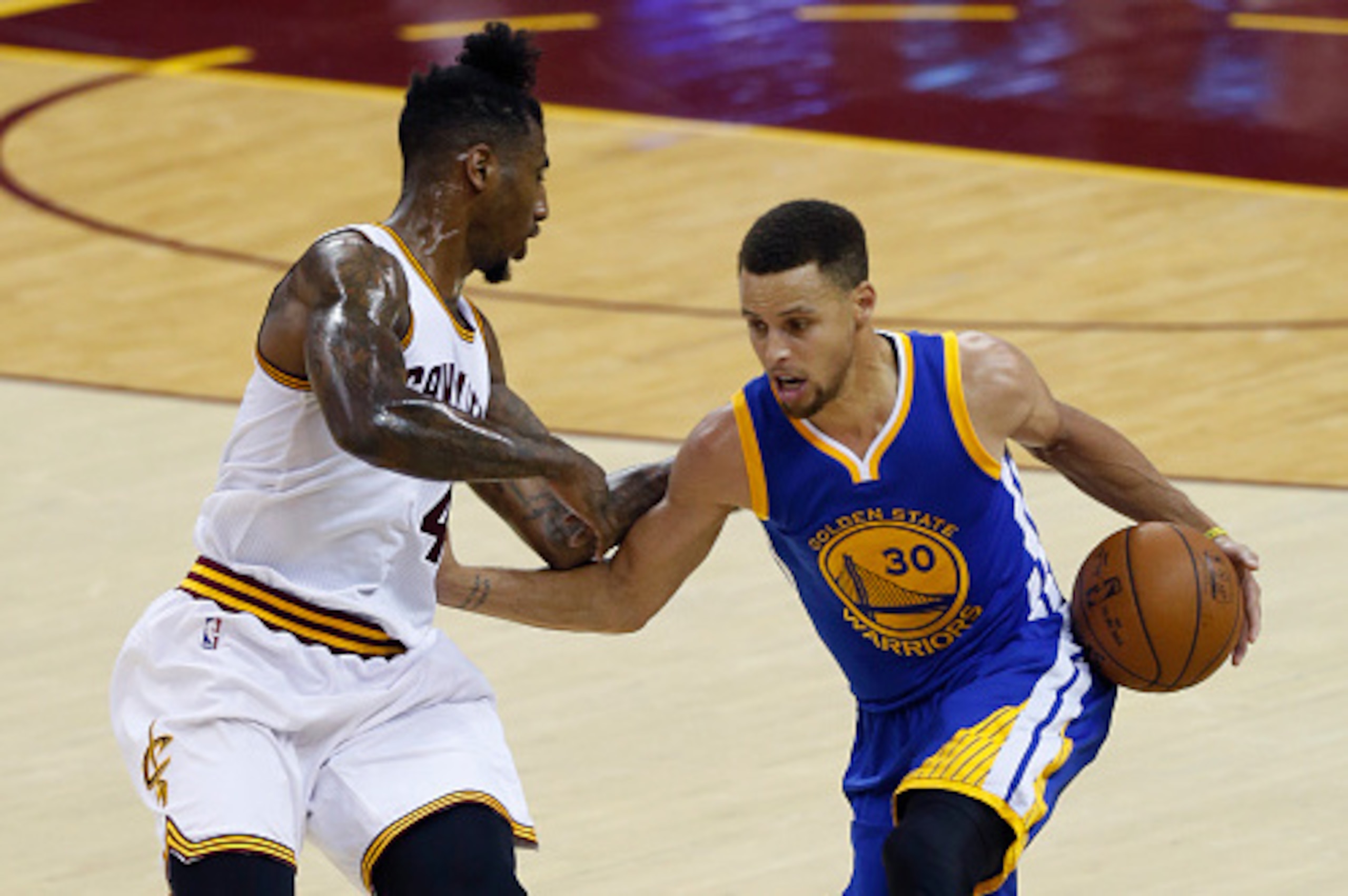
He needed help, for sure. Curry acknowledged how his teammates' improved screens, side-to-side ball movement and shot-making shifted some bodies away from him so he could get better shots.
But he also knew he had brought an aggressive response to position himself to use his skill. He made Cleveland pay for continuing to overplay at the arc, probing inside toward bigger bodies and passing for several key buckets to set up his outside shot later.
It was a huge victory for him and little guys everywhere, because the NBA playoffs are not a world they dominate.
Chris Paul, Steve Nash, John Stockton...they don't have rings in large part because they get marginalized in playoff series when bigger defenders or double-team traps or determined coaching strategies prevent them from executing those nifty, tricky, skillful things they've mastered.
That's just how Curry has looked at times in this series—taken out of his game. It's defensible to be a decoy if his team can win that way, as the Warriors did twice at home to start the Finals.
But Curry had to figure something out to take Game 4 on the road, and he shook off some hurried, shaky moments early to find his way.
In one such circumstance, in the second quarter, Curry went up too timidly on a shot inside and missed. Teammate Klay Thompson went over afterward and gave Curry a punch to re-emphasize the need to be assertive.
"I'm proud of the way he competed," Thompson said afterward. "And everyone else fed off that."

Curry might wind up with the Bill Russell NBA Finals MVP Award as his next first-time trophy despite being held to fewer than 20 points in each of the first three games of this series—the first time he has ever had such a poor playoff scoring stretch.
Yet he scored 38 in Game 4 and is now averaging 21.5 points per game for the series (on 43.8 percent field-goal shooting)—far more than Thompson (15.3 points on 40.4 percent shooting) or Green (14.8 on 41.7).
If Curry finishes strong in Game 5 Monday and winds up Finals MVP, it won't just be another piece of hardware to go with his regular-season MVP and the Magic Johnson honor.
Curry is listed at 190 pounds.
Tony Parker in 2007 is the only player lighter than 200 pounds to be named Finals MVP in the past 25 years.
Parker's memorable 2007 was James' first time in the NBA Finals, and Cleveland was swept largely because when San Antonio Spurs head coach Gregg Popovich packed the paint against him, James didn't know how to utilize his power.
It's James' seventh trip to the Finals. He should know better by now.
Kevin Ding is an NBA senior writer for Bleacher Report. Follow him on Twitter @KevinDing.



.jpg?w=2560 "NFL investigating 2 referees for separate viral exchanges")
.jpg?w=2560 "Report: Chiefs Contact Hill's Agent")
.jpg?w=2560 "OBJ Calls Out Giants 😳")
.jpg?w=2560 "Tyreek makes another cryptic post amid Chiefs rumors")