Denver Broncos' Full Position Breakdown and Depth Chart Analysis at Running Back
The Denver Broncos are going to have a different look on offense this year, but it’s one that is going to be familiar to Broncos fans. Broncos head coach Gary Kubiak didn’t get to fully implement his offense last year with quarterback Peyton Manning running the show. Instead, the Broncos used a hybrid system that was part Kubiak and part Manning.
This year, the real Kubiak system will be in place for the Broncos.
Earlier this offseason, the Broncos decided to match the Miami Dolphins' offer for restricted-free-agent running back C.J. Anderson. He stays with the team with a larger bank account and a larger role than ever before.
TOP NEWS

K9's Blunt Postgame Quote 😑
Rodgers Calls Out Owners After Paris Game
.jpg?w=2560 "LA Premiere of \"Chad Powers\"")
Latest Peyton-Colts Rumors
Anderson has intriguing upside as the team’s starter. After two years of being among the league’s leaders in all-purpose yards over the final two months of the regular season, Anderson needs to show that he can produce for a full season.
Behind Anderson, the Broncos have an interesting competition at the position. There is a mixture of veterans, practice-squad-level players and one talented rookie all vying to create a pecking order of backup running backs.
Here is the full position breakdown and depth chart analysis of the running backs on the Broncos roster.
Starter: C.J. Anderson
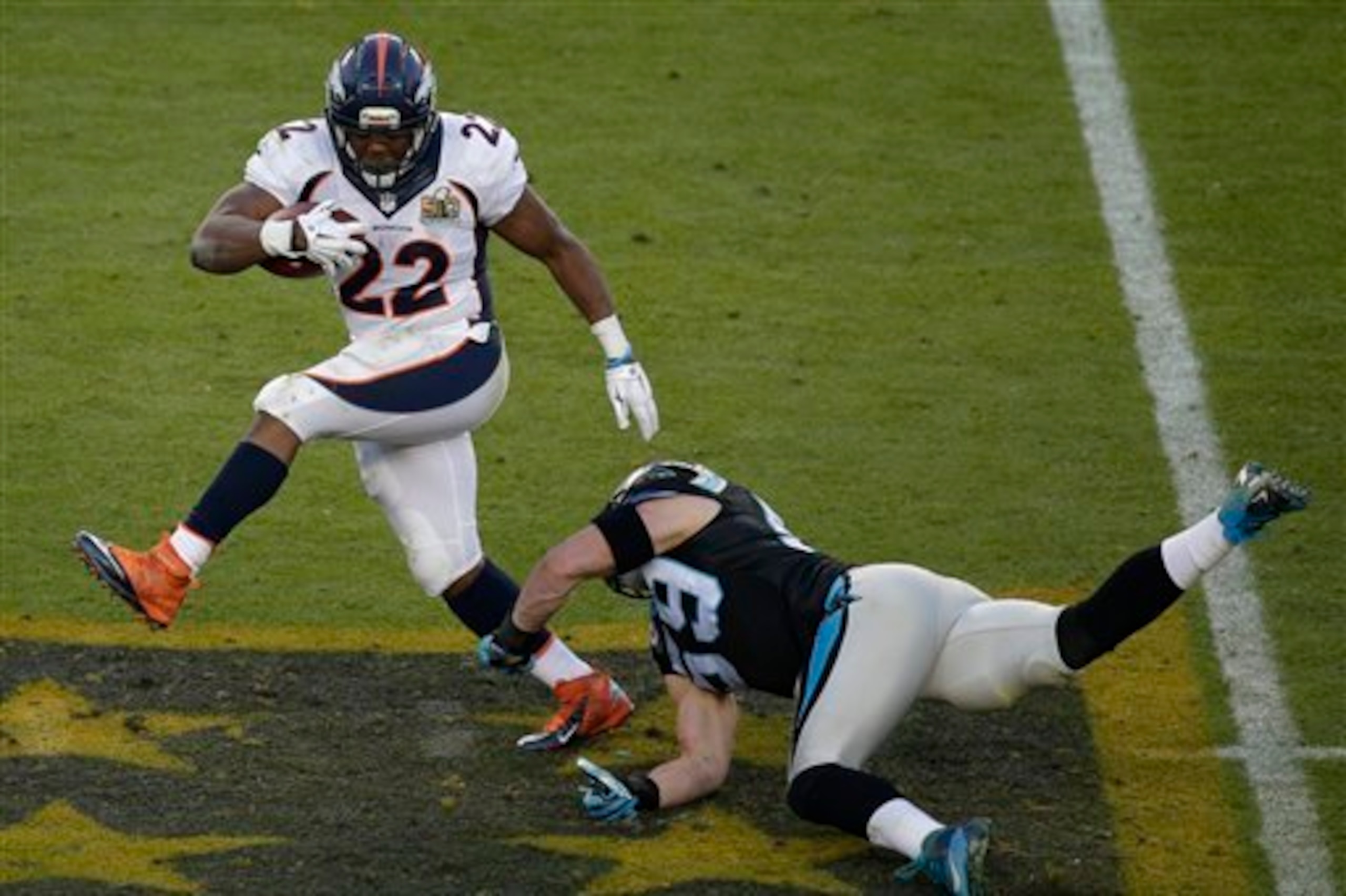
The Broncos picked up Anderson as an undrafted free agent after the 2013 NFL draft. This was the same draft where they selected Wisconsin running back Montee Ball in the second round. There were 22 backs selected in that draft class, and that’s the reason why Anderson wears the No. 22 for the Broncos. While Ball is out of the league, Anderson is a Super Bowl champion.
Anderson is a powerful back who can lead the way for the Broncos. He finished 2015 ranked fourth in rush-yards-after-contact average (2.22 yards). He doesn’t need a ton of space to work with, and it doesn’t take Anderson long to build up power between the tackles.
Even though he’s not known for his speed, Anderson is more agile than some think. He’s capable of making defenders miss in tight quarters and can change speed quickly without losing much speed. He led the NFL in rushing yards during the postseason, and in each playoff game Anderson had a carry of 30 yards or more.
This year in the true Kubiak system, Anderson could have sustained success as the team’s starter. Anderson smiled as he said, “This system is perfect for me.”
He’s excited to stay in Denver, and Anderson is more than ready to prove the doubters wrong. Anderson has heard people proclaim he can’t produce for a whole season, and he’s heard national media members and NFL analysts proclaim he’s not even the best back on the roster.
The naysayers only energize the veteran back. He’s shown up to OTAs this offseason in the best shape of his life. Gone are the days of him “ramping up” toward the regular season, Anderson is ready to go right now.
The Broncos worked diligently to upgrade their offensive line this offseason. Adding offensive tackles Russell Okung and Donald Stephenson should do just that. With a better blocking scheme up front and a quarterback that is able to draw away the back-side defender, Anderson should see better rushing lanes and clear cutback lanes in front of him in 2016.
Primary Backup: Devontae Booker

The team found a tremendous value in the 2016 NFL draft when Utah running back Devontae Booker fell to them in the fourth round. A meniscus injury that required two surgeries is part of the reason why Booker fell in the draft.
Booker does a lot of things similar to the way that Anderson does.
Like Anderson, Booker is a powerful runner between the tackles. He’s not afraid to run inside, and Booker rarely goes down on first contact. He has the ability to wear down a defense and get stronger as the game goes on.
The rookie may have been the best receiving back in this draft class. Over the last two years, Booker snared 80 passes for the Utes. He will naturally look passes into his hands and can make defenders miss after the catch.
Pass-protection ability is an important asset for any rookie running back, and Booker is no different. He’ll have to prove that he can protect the passer if he wants to win the primary backup job behind Anderson.
Booker got everyone talking with some interesting comments from the NFLPA rookie symposium earlier this month, per the league's official Twitter account:
"Not your average 4th-round pick...
— NFL (@NFL) May 20, 2016 "
Devontae Booker has big plans in Denver. pic.twitter.com/7exsmBi88w
Anderson is not bothered by the rookie’s comments.
“To be honest, him carrying pads or him not carrying pads, it doesn’t matter as long as he comes to work," Anderson said. "If he comes to work, he’ll get the respect.”
Some think Booker is going to cut into Anderson’s playing time, but that may not be the case. The language of the NFL is money, and Anderson’s $5 million bonus paid earlier this year says the team will give him as much as he can possibly handle. Think of Booker as more of a three-down-back-in-waiting for the Broncos.
Competition for Final Spots: Juwan Thompson, Kapri Bibbs, Ronnie Hillman
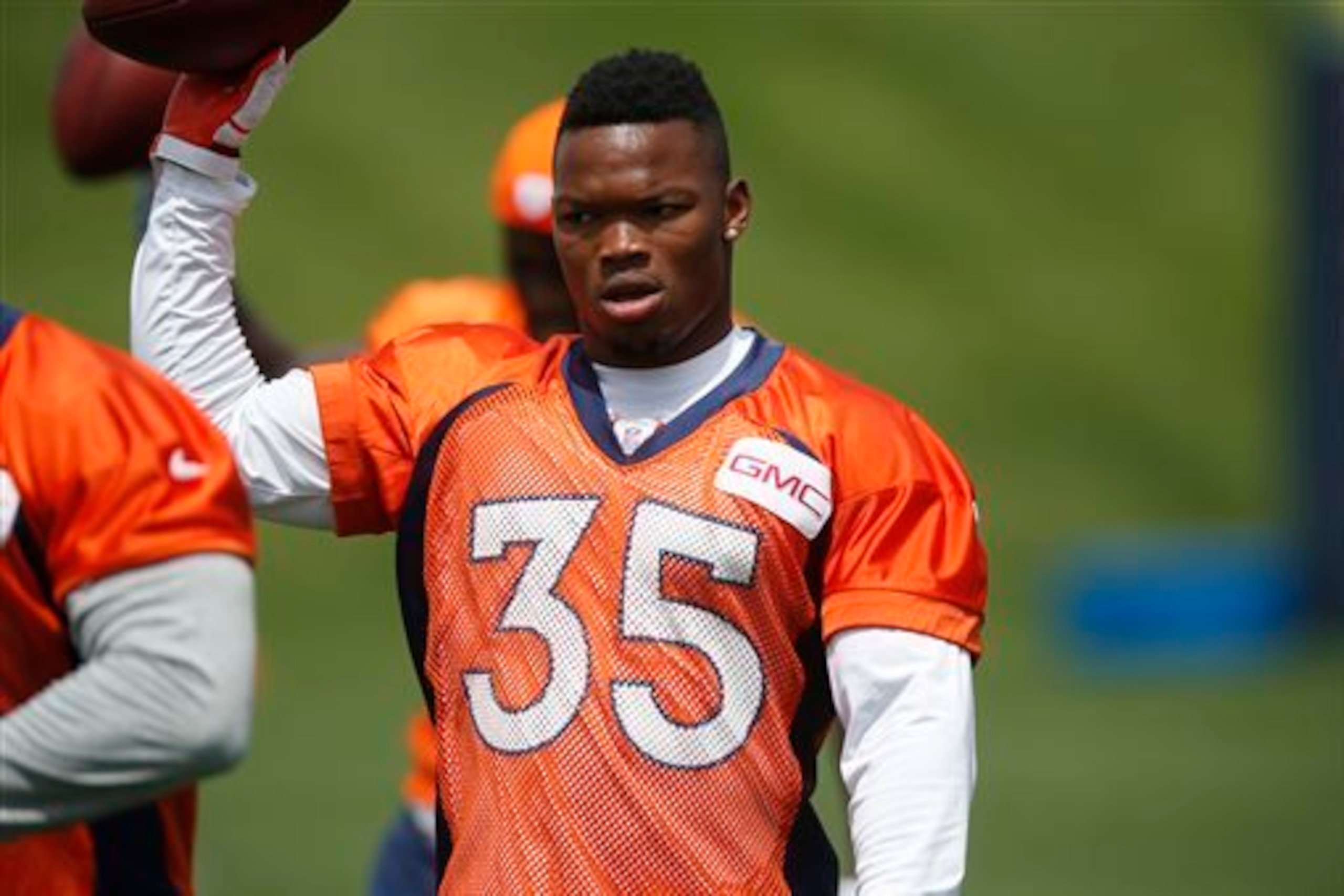
There is going to be a numbers crunch at certain positions when the Broncos are making up their 53-man roster. One of those positions that could get squeezed is running back.
Not only will the number of tight ends kept on the final roster impact how many backs are retained, but the Broncos may actually have a fullback (2016 sixth-round pick Andy Janovich) take up a valuable roster spot in 2016. The addition of a fullback may mean the Broncos only keep three running backs, and at most they would likely only keep four running backs.
At the top of the list could be veteran Ronnie Hillman. He was an unrestricted free agent this offseason, but he didn’t generate much (if any) interest on the open market. The Broncos decided to bring back their leading rusher from 2015 on a one-year deal where he carries a $2 million cap hit with $500,000 in dead money.
Next up is power back Juwan Thompson. He’s not creative as a runner, but he is swift when he builds a head of steam and tough to bring down. Thompson is a favorite of the coaching staff—both at the running back position and on special teams. This offseason, Thompson has been getting snaps in practice at both running back and fullback.
A sleeper at the position could be Kapri Bibbs. Undrafted out of Colorado State in 2014, Bibbs has spent two years on the Broncos practice squad. He’s a natural runner with a proven nose for the end zone. In practice, Bibbs has shown good hands as a receiver out of the backfield. This offseason, Bibbs has shown up with a stronger physique than in previous years.
Offensive coordinator Rick Dennison is excited about Bibbs’ potential.
“I think we’ve always thought he has some great run skills. He’s pretty natural with the ball. He caught the ball well. It’s just figuring the whole thing out.” Dennison concluded, “He just looks like he knows what’s going on a little bit better.”
Behind Bibbs there is veteran Cyrus Gray. He’s a decent all-purpose back, but Gray has to be considered a long shot for the 53-man roster.
Summary
In 2015, the Broncos were undefeated when they gave Anderson 14 or more carries. In 2016, we may see Anderson get an average between 20 and 25 carries per game. This heavy workload was previewed last year in Super Bowl 50 when Anderson had 24 carries for 90 yards and a touchdown against a tough Carolina Panthers defense.
In that game, Anderson was given the freedom to control his workload. As he continued to hammer on the Panthers defense, Anderson would sometimes look over to the sidelines and give the coaching staff a “thumbs up” to show he wanted to stay in. Anderson did stay in for most of the game, only allowing Hillman to get on the field for five carries.
Expect Anderson to keep giving the “thumbs up” in 2016.
Their main backup running back should be Booker, as he does things like Anderson does. So long as the rookie proves that he can protect the quarterback, a primary reserve role should be there for him.
Bibbs has a new look, but like Booker, he needs to prove himself in pass protection. If Bibbs struggles in that area of his game (again), then the team could easily turn to Thompson.
Being able to line up at both running back and fullback is a great benefit for Thompson, and so is his outstanding ability on special teams.
Hillman is different from any back on the roster at this time, and he’s proved that he can make big plays with a tiny crease. However, he’s not a lock to make the final roster due to the competition he’ll be facing.
The Broncos are built to win on defense. In order to better set up their defense by keeping them fresh, the Broncos will lean heavily on the rushing attack in 2016. That means a lot of Anderson—just like in the Super Bowl. The Kubiak system is capable of creating an incredibly strong rushing attack, and that should once again be the case this season.
All quotes and injury/practice observations obtained firsthand. Record/statistical information provided via the Broncos' media department unless otherwise noted.
Contract and salary-cap information provided by Spotrac. Transaction history provided by Pro Sports Transactions.
.jpg?w=2560)


.jpg?w=2560 "Landing Spots for Trade Candidates 📍")