Who's to Blame for the Chicago Blackhawks' Early Exit from 2016 NHL Playoffs?
On Monday night, the defending Stanley Cup champion Chicago Blackhawks became the seventh team eliminated from the 2016 Stanley Cup playoffs, after a 3-2 loss to the St. Louis Blues in Game 7 of their first-round series.
The Blackhawks have won three Stanley Cups in the past six years but have never won back-to-back championships in their franchise's entire 90-year history. In fact, no team has repeated as Stanley Cup champion since the Detroit Red Wings nearly 20 years ago, back in 1997 and 1998. Perhaps a Stanley Cup run simply takes too big of a toll on the now tightly budgeted teams of the salary-cap era.
Chicago gave it a good fight, rebounding from a 3-1 deficit in the series to force Game 7 and then tying the deciding game heading into the third period.
Digging deeper, here's who's at fault for the abrupt end to the Blackhawks' 2015-16 season.
Stan Bowman
1 of 6
Don't get me wrong—on balance, vice president and general manager Stan Bowman has done a tremendous job of icing a top-level lineup in the salary-cap era. He has three Stanley Cup rings to show for his efforts.
But looking at this year alone, Bowman needs to answer for some misfires that didn't work out as well as Blackhawks fans might have hoped.
The optimists in the crowd will point to Artemi Panarin—an out-of-the-blue acquisition who led all NHL rookies in scoring and showed delicious grit against the Blues in the playoffs despite his small stature.
Panarin hit a bunch of bonuses in his first NHL season—a good problem for the team to have—and the 24-year-old is signed through 2016-17, at which time he'll be a restricted free agent. That's all positive.
But Bowman didn't make out as well as usual with the rest of his personnel moves this season.
Under the gun to trade Patrick Sharp, he had to throw in defensive prospect Stephen Johns in order to complete a deal with the Dallas Stars during the offseason. The players he acquired, Trevor Daley and Ryan Garbutt, were both moved midseason—but they're still playing this spring, in Pittsburgh and Anaheim, respectively.
Meanwhile, the spoils of those trades—Rob Scuderi, then Christian Ehrhoff, for Daley and Jiri Sekac (later lost on waivers) for Garbutt—are all long gone or, in Ehrhoff's case, healthy-scratched throughout the playoffs.
In 2015, Chicago milked maximum potential out of trade-deadline acquisitions like Antoine Vermette and Andrew Desjardins. This year, Andrew Ladd, Dale Weise and Tomas Fleischmann couldn't replicate the same magic.
Losing that first-round pick and young scorer Marko Dano in exchange for two months of Ladd's services now looks like a very high price for Bowman to have paid.
Percentage of Blame: 30 percent
Andrew Shaw
2 of 6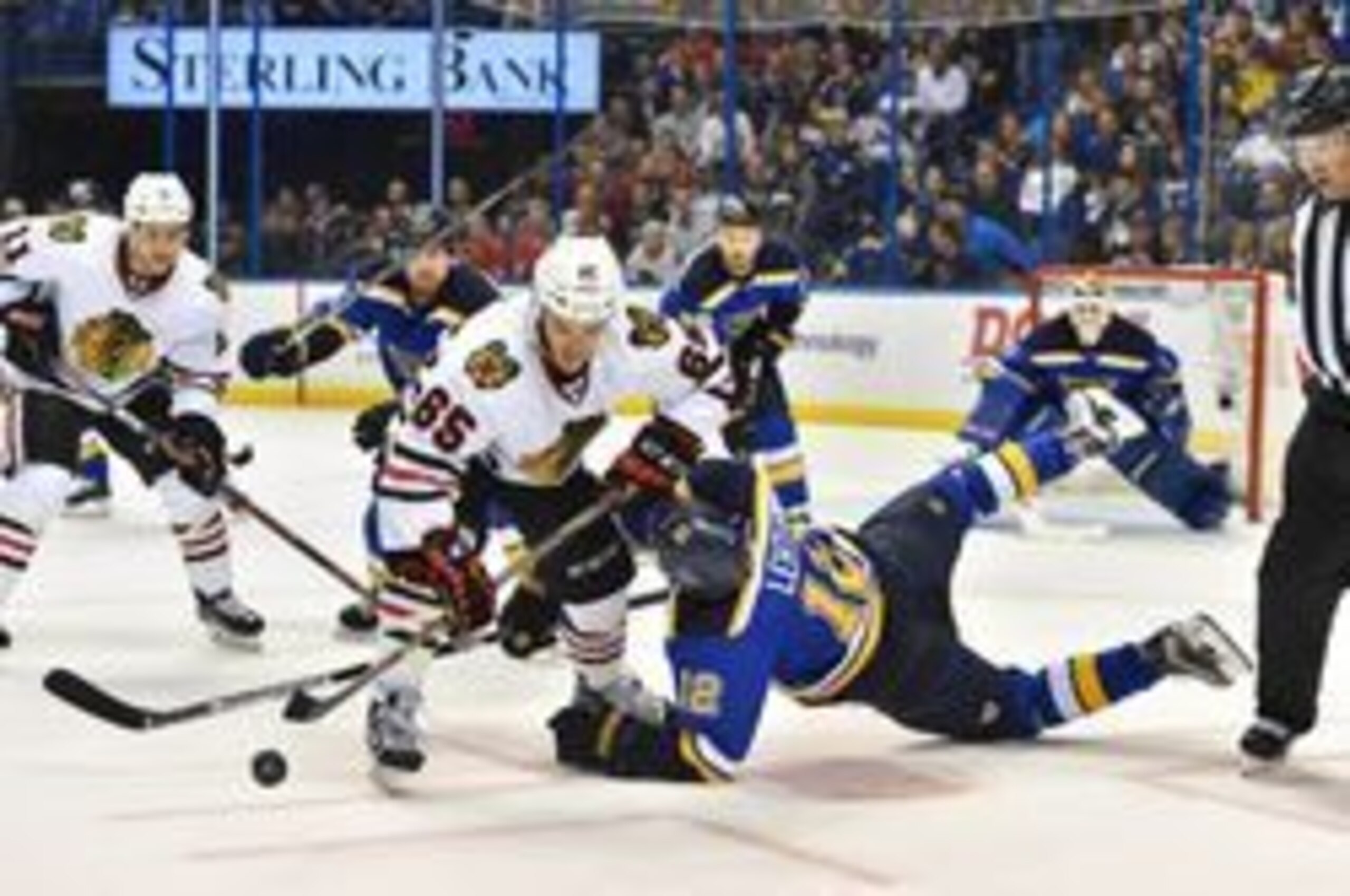
Andrew Shaw caused an unneeded distraction for his team when his temper-tantrum late in Game 4 earned him a one-game suspension for using a homophobic slur.
From a hockey standpoint, Shaw's bigger error was getting whistled for the penalty that sparked his outrage in the first place.
With just two minutes, four seconds to play in the third period of Game 4 and the Blackhawks trailing by one game in the series and one goal in the game, Shaw basically derailed any chance for his team to even the series when he took the interference penalty on Jay Bouwmeester, then lost his mind.
It wasn't a good look for 24-year-old Shaw. He's known for being a feisty competitor and has a chance to cash in big on his next contract as a restricted free agent—although he might not be able to stay with cash-strapped Chicago.
In the moment, Shaw let his emotions get the better of him. Even more importantly, he may have spoiled his team's best chance to level that game and, potentially, the series. The penalty itself, rather than Shaw's reaction, may have been the beginning of the end for Chicago in the 2016 playoffs.
Percentage of Blame: 25 percent
Jonathan Toews
3 of 6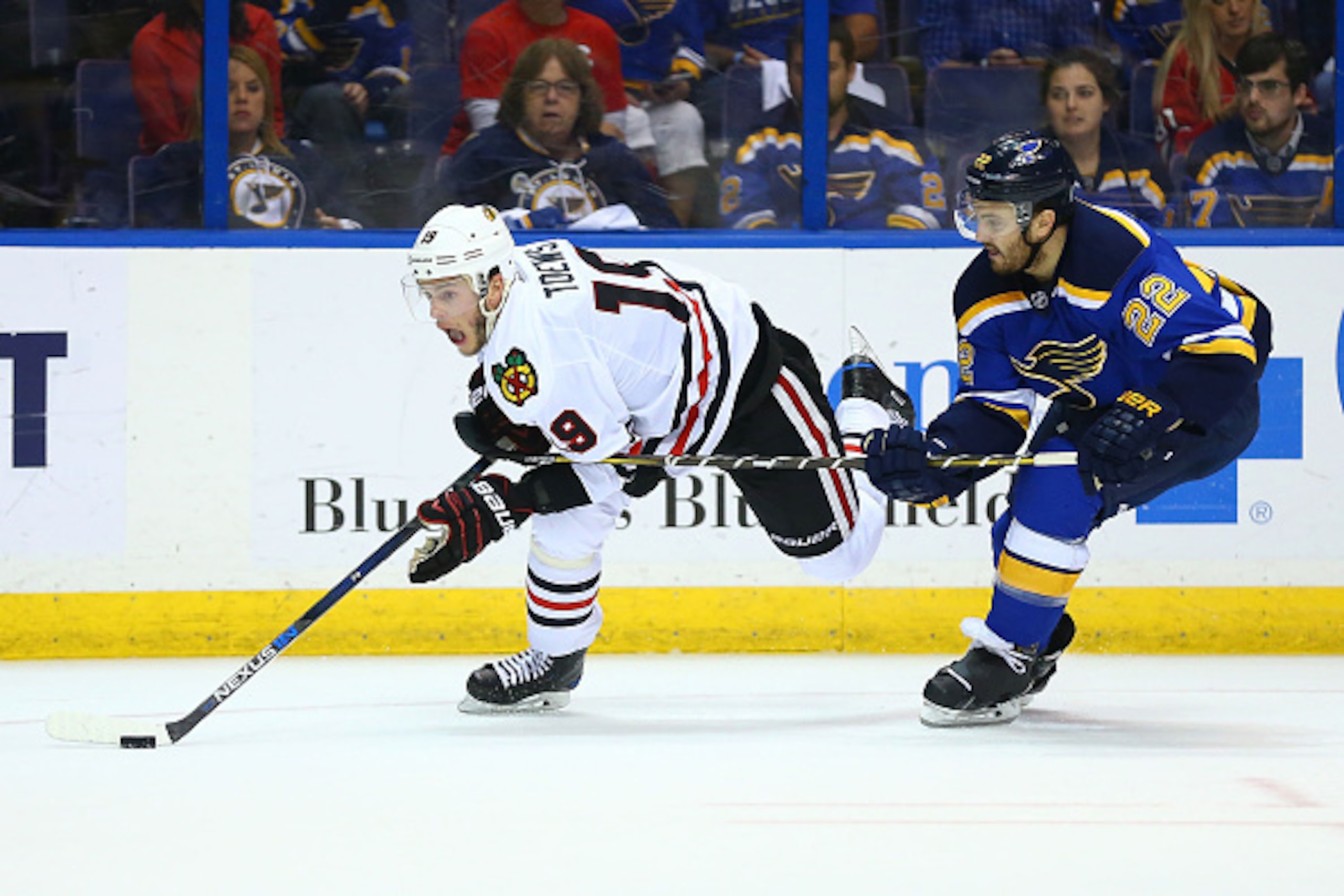
Captain Serious wasn't terrible against St. Louis. He picked up six assists in seven games, recorded a plus-two, delivered his usual stellar 58.8 win rate in the faceoff circle and averaged a huge-for-a-forward 22:41 per game.
But in the first year of his new contact with the big $10.5 million cap hit, Jonathan Toews slipped offensively in the regular season, to just 58 points, then failed to deliver the signature playoff moment that we've come to expect from him over the past six years.
Even Patrick Kane can brag about that spine-tingling double-overtime wraparound that kept the Hawks alive in Game 5. For the first time in his pro career, Toews didn't score in the playoffs this year.
On Monday, Toews couldn't deliver the equivalent of the late game-saver that tied the Hawks' seventh game of their first-round series against the Vancouver Canucks back in 2011.
Chicago ultimately lost that series. Have they also lost the clutch play of Jonathan Toews going forward?
Percentage of Blame: 15 percent

Joel Quenneville
4 of 6
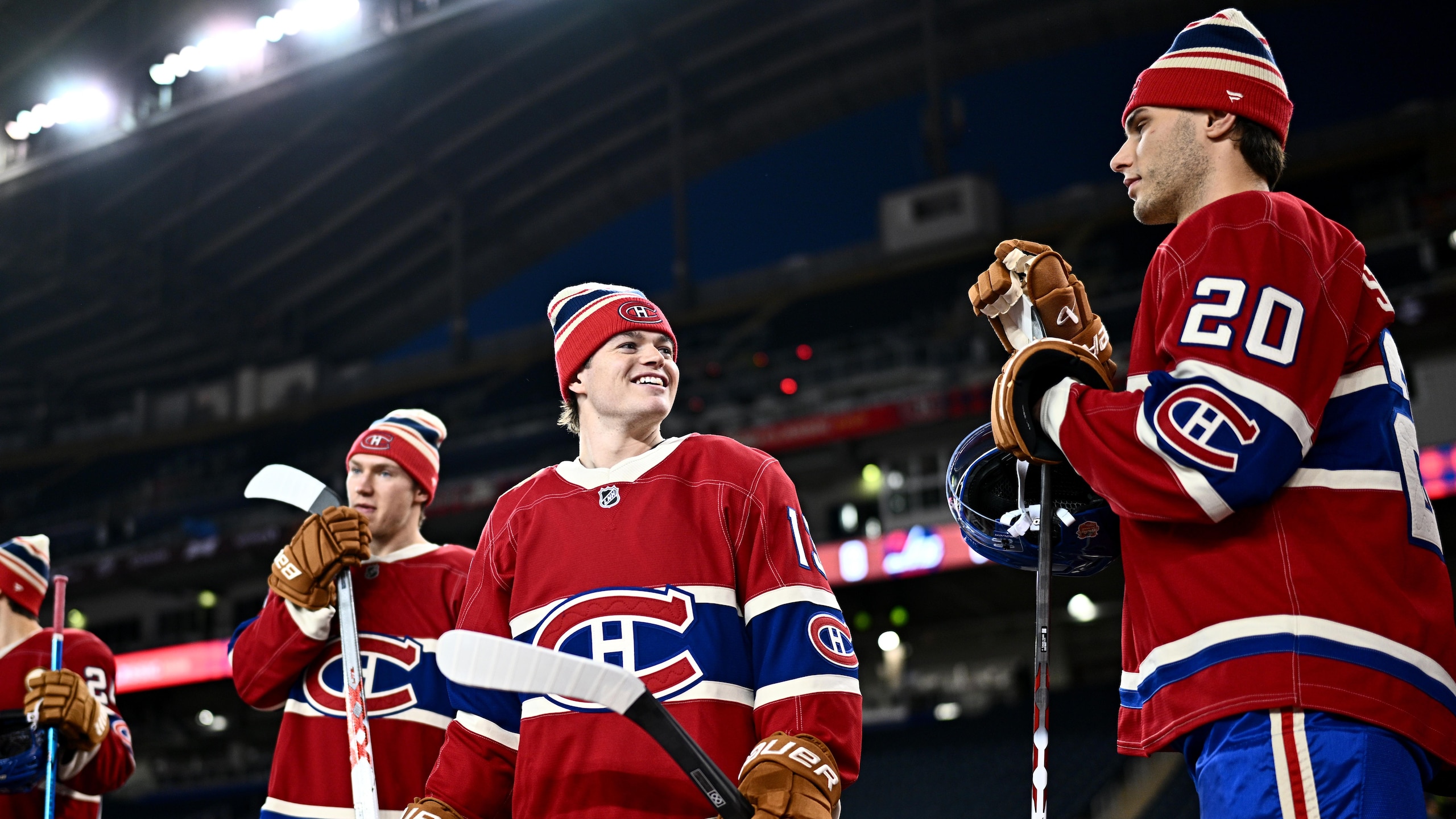
During his long NHL coaching career and particularly his eight years behind the bench in Chicago, Joel Quenneville has proved to be a savvy taskmaster who can match lines with the best of them and get the most out of his players when the chips are down.
This season, Quenneville's magic didn't work as well as usual. The Panarin-Anisimov-Kane line proved to be genius in the regular season, but beyond that, Coach Q wasn't able to successfully integrate any new acquisitions into his lineup.
With the core group getting smaller and smaller after every passing year, Quenneville relied too much on those veterans against St. Louis, without providing a strong enough supporting cast to get his team into the second round.
At the end of Chicago's playoffs, Duncan Keith ranked second among all players with an average of 31:57 of playoff ice time, while Brent Seabrook was 10th at 27:09. Jonathan Toews' 22:41 per game was by far the highest ask of his career. The same is true for Patrick Kane's 24:04.
Quenneville's core players have always been workhorses, but it was clear against St. Louis that he didn't trust his support staff enough to let his big guns shine.
Overworking his stars might have cost Quenneville and his players the series against the Blues.
Percentage of Blame: 15 percent
Troy Brouwer
5 of 6
Isn't it ironic that the Blues player who scored the winning goal and broke the playoff curse for his team is a former Blackhawk—one who earned a Stanley Cup ring in Chicago as a 24-year-old back in 2010?
Troy Brouwer was an early victim of the Blackhawks' salary-cap issues. As a restricted free agent at the end of the 2010-11 season per General Fanager, the former seventh-round draft pick was traded to the Washington Capitals for a first-rounder.
Brouwer's cap hit climbed from $1.025 million to $3.666 million during his four years in Washington as he became known as a physical heart-and-soul forward.
Anyone who questioned the Blues' decision to trade a sniper like T.J. Oshie for the grinding Brouwer last summer is now left to eat their words after his third-period garbage goal proved to be the series winner that finally advanced the Blues past the Hawks, into the second round.
Percentage of Blame: 10 percent
Bryan Bickell
6 of 6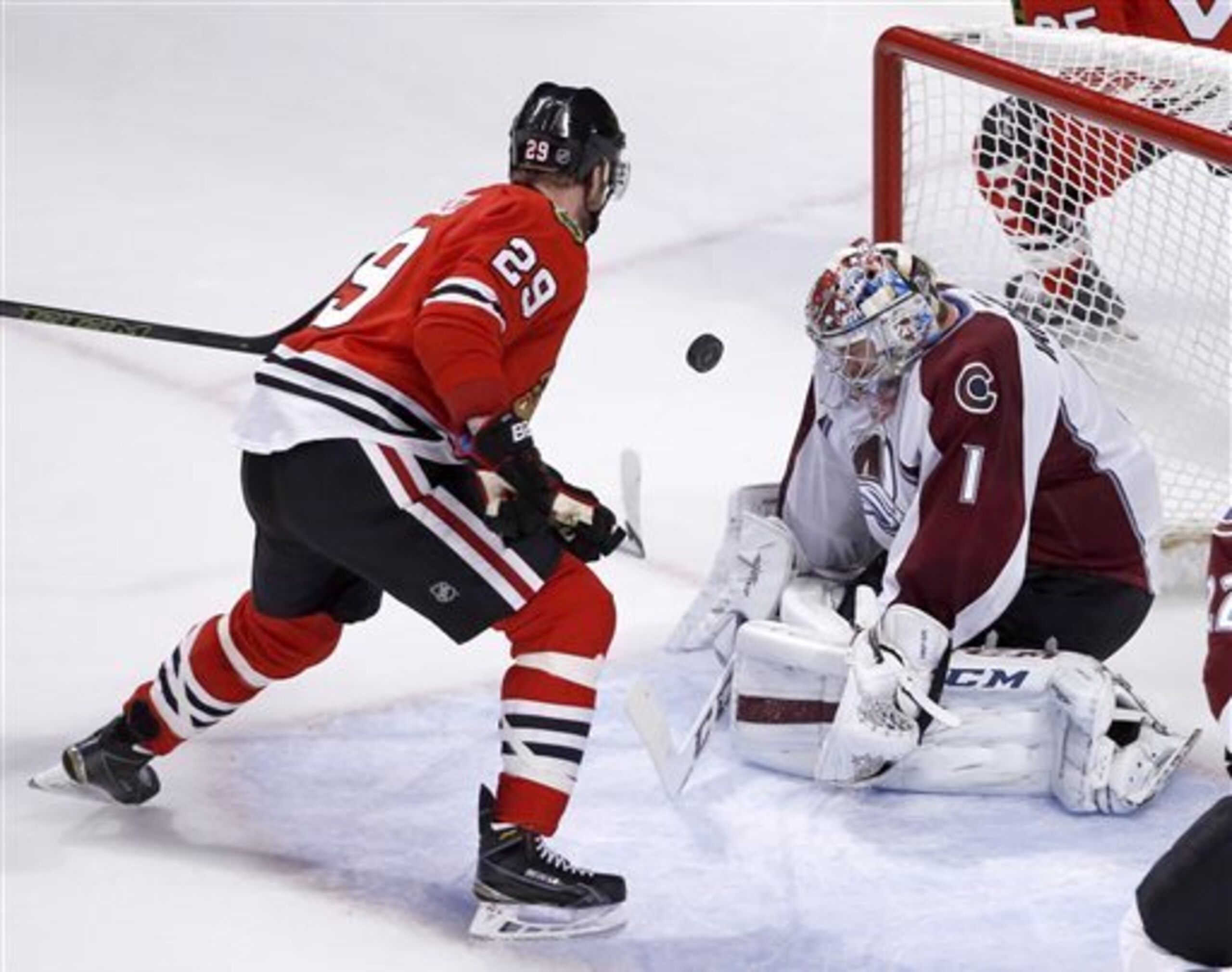
Bryan Bickell's 17 points and two game-winning goals were a huge part of the Chicago Blackhawks' 2013 Stanley Cup run, but his momentary surge of awesomeness has cost the team in a huge way in subsequent years.
As a result of his impressive performance—and with unrestricted free agency on the horizon—Bickell was signed to a four-year contract with a cap hit of $4 million a season after that 2013 Cup win, according to General Fanager.
Unfortunately for both the player and his team, Bickell's on-ice performance quickly fell off a cliff, leading to stints in the AHL this season.
Like his Blackhawks teammates, Bickell's season ended with a first-round playoff loss—but with the Rockford Ice Hogs. Meanwhile, Stan Bowman is left to ponder what might have been if he'd been able to reassign Bickell's $4 million in cap space—and how he might be able to make it disappear next year.
Percentage of Blame: 5 percent
All stats courtesy of NHL.com.
.jpg?w=2560 "NHL Trade Grades Connor Hellebuyck")


.jpg?w=2560 "Latest Peyton-Colts Rumors")