Why DT Damon Harrison Is the New York Giants' Biggest Free-Agent Signing
The New York Giants’ big Day 1 free-agency splash certainly sent shock waves around the NFL, given what Mark Maske of the Washington Post reported is $114 million in guaranteed money handed out to a group consisting of defensive ends Olivier Vernon and Jason Pierre-Paul, defensive tackle Damon Harrison and cornerback Janoris Jenkins.
Of all those moves, however, there is none bigger than Harrison—and not just because of his 6’4”, 350-pound body, which ties for heaviest player on the Giants roster with fellow defensive tackle Montori Hughes.
Just how much does Harrison, who wasn’t even invited to the NFL combine back in 2012 when he declared for the draft, according to NFL writer Dave-Te’ Thomas, bring to the Giants?
TOP NEWS

Stephen A. Apologizes After Lane Johnson Comments
Ravens Trade for Eagles Pro Bowl OL 🚨
.jpg?w=2560 "Cowboys Texans Football")
Dak to Stroud: Get Some Wins 💯
Run Defender Extraordinaire
Last season, the Giants' run defense allowed 121.4 rushing yards per game, which put them 24th in the NFL. The New York Jets, Harrison’s former team, finished as the league’s second-best run defense at 83.4 rushing yards allowed per game.
According to Football Outsiders, the Giants allowed an average of 4.05 yards per rush through the center-guard gap—22nd in the league.

What went wrong for the Giants? According to Pro Football Focus, other than Johnathan Hankins, whose season ended early due to a pectoral muscle tear, no other defensive tackle on the roster had a positive run grade.
To add further perspective to that, only Hankins and Jay Bromley, the latter of whom saw his snaps increase once injuries took away Hankins and Markus Kuhn, finished with double-digit stops for zero or negative yards, and neither of them finished with a run-stop percentage higher than 8.3.
Harrison, meanwhile, finished with 49 stops and an 18.1 run-stop percentage—that’s one less run stop than all the Giants' defensive interior linemen combined.
The other thing that went wrong for the Giants? Per Football Outsiders, they allowed a whopping 5.37 yards per rush off the left end, which would have been against the right defensive end (Pierre-Paul’s spot).
In reviewing some of that film of the run defense, the problem was all too often the right defensive end—Kerry Wynn, George Selvie and others who tried to fill in for Pierre-Paul often got caught up in the wash.
Let’s take a look at a play in the Jets' season opener against Cleveland in which Harrison chases down running back Isaiah Crowell for a three-yard loss.
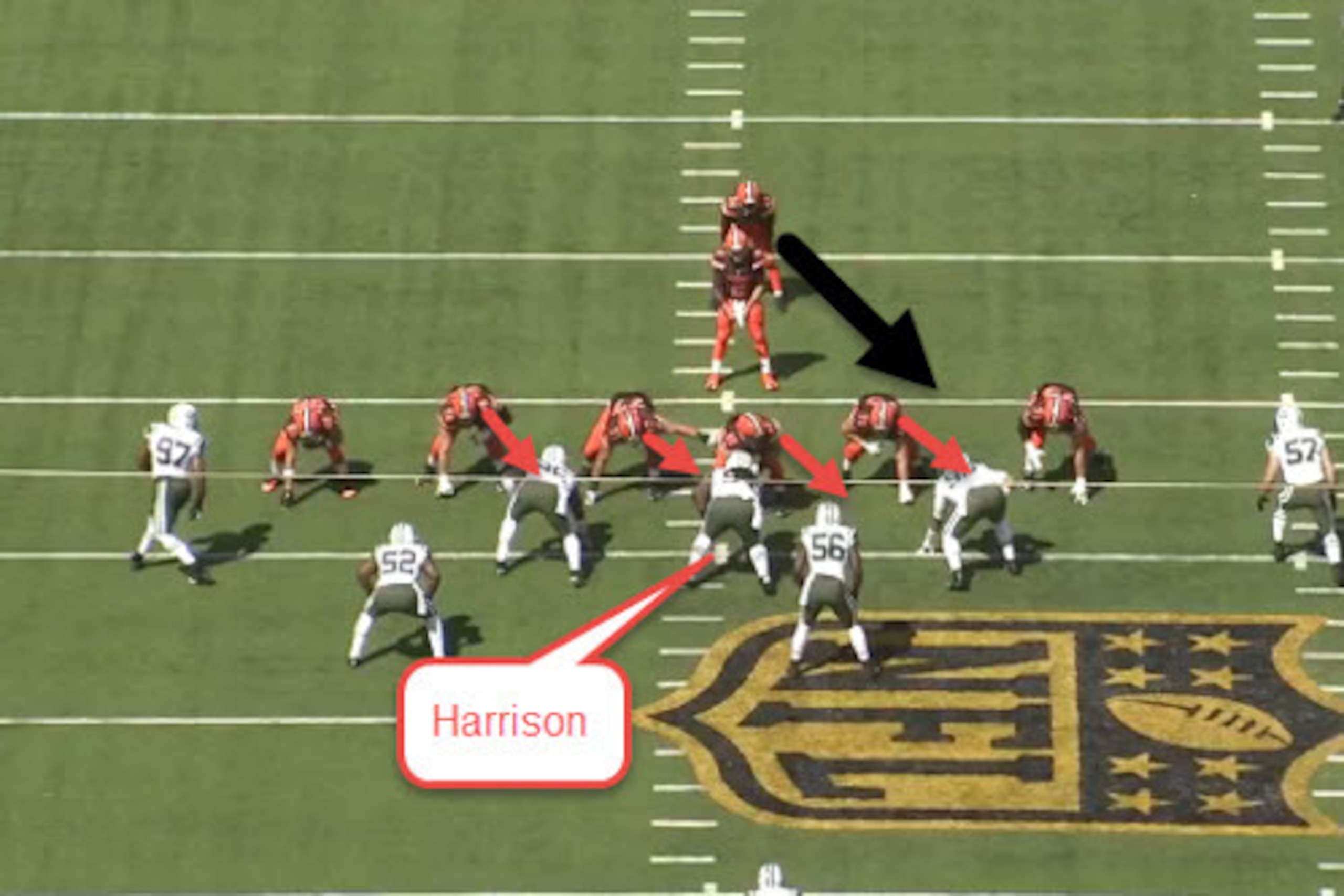
In the opening frame, quarterback Johnny Manziel is in the shotgun with Crowell directly behind him. Harrison, meanwhile, is lined up over Browns center Alex Mack.
The Browns offensive line is going to slant in the direction of the run, which, from the running back’s perspective, is to the left side, where the play appeared to be designed to go between the left guard and left tackle.
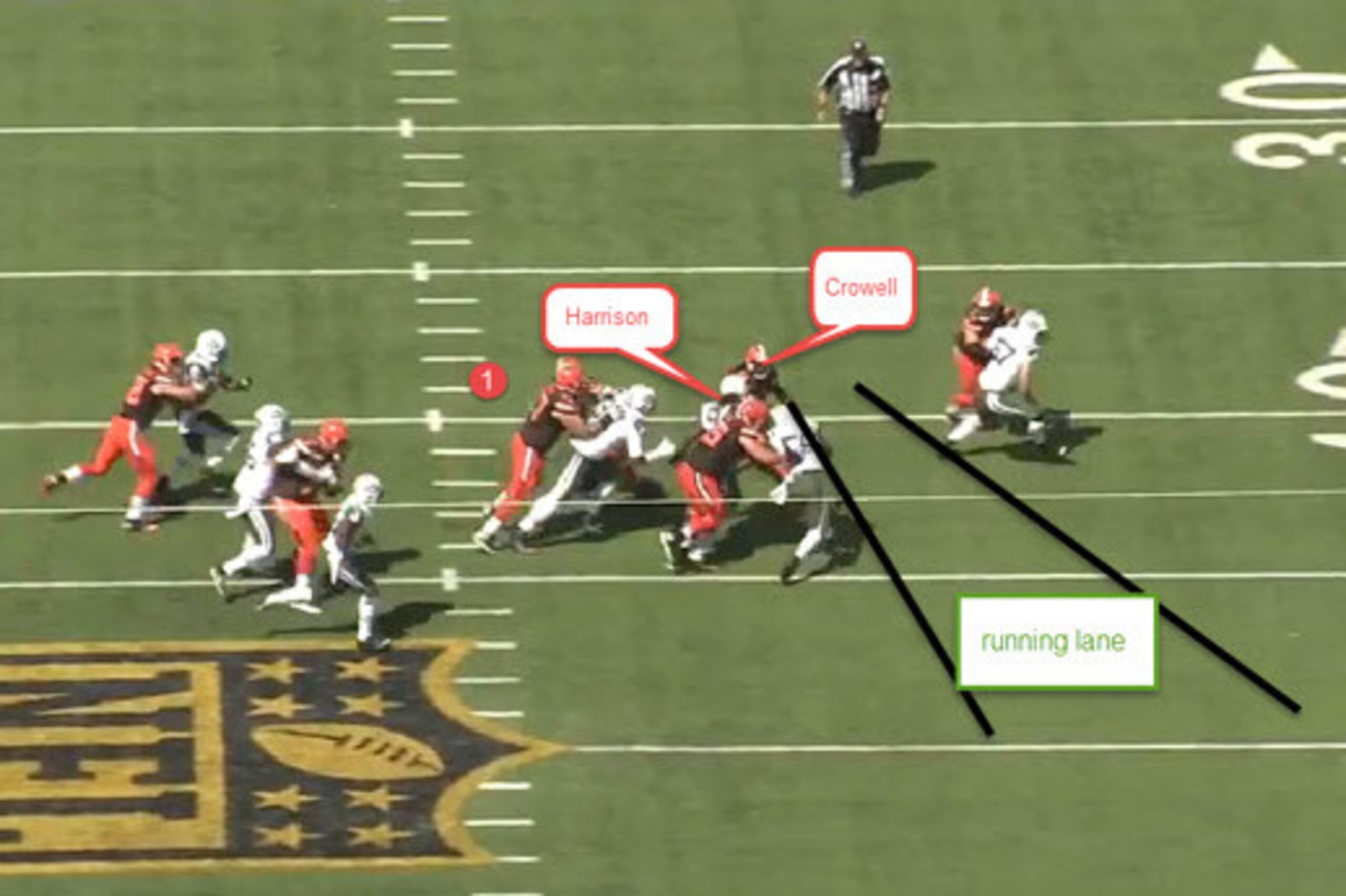
As the play develops, Harrison attempts to shoot the gap between Mack and the right guard. When he realizes Mack has the gap secured (No. 1), Harrison redirects into an open gap just as Crowell starts to turn up field.
Meanwhile, the running back is eyeballing the daylight that appears in front of him and perhaps doesn't see the charging Harrison until the last second, given that a quick shuttle step to his left might have put him outside of Harrison’s reach.
No matter, as Harrison quickly swoops in and drops the running back for a three-yard loss.
A reason why Harrison was so effective in making stops is that, unlike many of the Giants' defensive interior linemen, he had the ability to get off blocks, change direction and shoot gaps with a sudden burst of quickness that oftentimes caught offensive linemen by surprise.
What About the Pass Rush?
Let’s talk briefly about the pass rush. Per Pro Football Focus, Harrison played in almost as many pass-rushing snaps (284) as he did run defense (290) last season.
It remains to be seen whether Harrison will stay on the field as a pass-rusher for the Giants, who like to bring in an extra defensive end to take the place of one of their interior linemen.
Whether defensive coordinator Steve Spagnuolo, who did that with Justin Tuck and then most recently with Robert Ayers, will do it again this year all depends on whether second-year man Owa Odighizuwa shows he can rush the passer at this level after appearing in just four games his rookie season.
If no solid third pass-rushing option emerges, Harrison can fill that role as well. While one shouldn’t expect him to draw gaudy sack numbers—he has 1.5 career sacks in four seasons—what he can do is eat up multiple blockers in the hope of leaving one of the other pass-rushers to defeat solo blocking.
If Harrison engages two blockers, as his film has shown to be the case, that might allow for Spagnuolo, who historically has run an attacking defense, to get a little more creative with blitz packages he wasn’t able to deploy as often last year due to the issues in the defensive secondary.
Conclusion
Sam Monson of Pro Football Focus noted the Jets tried to get Harrison more involved in passing downs given how effective he was in run defense.
However, as Monson noted, despite the bump in his pass-rushing assignments, Harrison recorded a half-sack and 14 total pressures from 226 pass-rushing snaps, leaving Monson to conclude the Giants are gambling that Harrison can be more than a two-down player.
While the money paid to Harrison makes him the sixth-highest-paid 4-3 defensive tackle out of 77 players, per Over the Cap, and might seem outrageous for a run-stopping specialist, if Harrison can help keep the opponent in 2nd- and 3rd-and-long situations that set up the pass-rushers to do their things, his contract will have been worth it.
Patricia Traina covers the Giants for Inside Football, the Journal Inquirer and Sports Xchange. All quotes and information were obtained firsthand unless otherwise sourced.
Follow me on Twitter @Patricia_Traina.
.jpg?w=2560 "Browns Jaguars Football")