Grayshirting May Not Be for Everyone, but That Doesn't Mean It's a Bad Thing
TUSCALOOSA, Ala. — It was approximately two weeks before national signing day in 2015 and Christian Bell suddenly had a major decision to make.
He had been committed to the University of Alabama for more than a year, and the defensive end at nearby Hoover High School who projected to play linebacker at the next level was asked if he would grayshirt the 2015 season, meaning he would delay his enrollment six months.
"My initial reaction, I was like, there's no way I was going to accept that," Bell said. "But then I sat down, prayed, talked to family members, coaches, people that helped me with my decision."

Bell said it eventually wasn't that difficult to make, especially since he had aspects of his game that needed improvement. So he worked with a trainer, gained a needed 20 pounds and coached a youth team—discovering a potential career path in the process.
"I learned that I love it," he said. "Now that I did that, I'm definitely gonna have to do that if football doesn't work out.
"Yeah. [Grayshirting] is worth it."
Although grayshirting has become an ugly word to some in the recruiting world, especially since it can be used to negatively recruit, it's one of those concepts that's in the eye of the beholder.
For some players, it's worth it. Others obviously hate it.
With its most recent recruiting class, Alabama asked three players to consider grayshirting and all balked. Specifically, linebacker Riley Cole de-committed and eventually signed with South Alabama, tight end Brendan Scales similarly landed at Missouri and safety Joshua Perry ended up at Memphis.
"Deuteronomy 31:6. pic.twitter.com/l3C7aVKMNm
— Riley cole (@Rileyc44) January 31, 2016"
All three were rated as being 3-star prospects by the 247Sports composite rankings, with Scales ranked the No. 377 player in the nation, Perry 661 and Cole 934.
In other words, they were considered projects by Alabama's standards.
Last year, Alabama had the same number of players who had been considered 3-star prospects as recruits as consensus 5-star talents, 18 (to go with 49 4-star players). Not only was it the only program that could claim that, the Crimson Tide had nearly twice as many 5-star players as every other team (USC was second with 10).
For 2016, the reigning national champions lost just two of those 5-star players, running back Derrick Henry and defensive lineman A'Shawn Robinson, and picked up three more in its latest recruiting class. So it seemed pretty obvious that any projects lacking experience wouldn't be expected to make immediate contributions.

Saban explained his outlook on grayshirting when asked about Bell on national signing day.
"I think that I view that as a real positive, because we want the player, but we feel that the player is probably going to get redshirted based on where he is in his development, whether he needs to get bigger or stronger, or whatever," he said.
"When we do that, we usually do that early in the process, so guys have a chance to weigh any other opportunity they may want to do that. But it does give them an opportunity to come to Alabama, and it does give them the time to develop. In most cases, the guys that we do that with, that's really our goal, and our intention for them.
"We recruit them. We want them to come here. We just think it would help their development if they matured before they enrolled."
Critics claim that what Saban's doing is skirting the rules, both the 25-man signing limit that exists in the Southeastern Conference (known as the Houston Nutt rule after Ole Miss signed 37 players in 2009), and the 85-man scholarship limit. Former Florida president Bernie Machen went so far as to call such efforts "disgusting" in a 2011 editorial he wrote for SI.com.
Other conferences have been outspoken as well, including the Big Ten even though Urban Meyer has brought the practice to Ohio State and Jim Harbaugh has taken things to another level at Michigan.
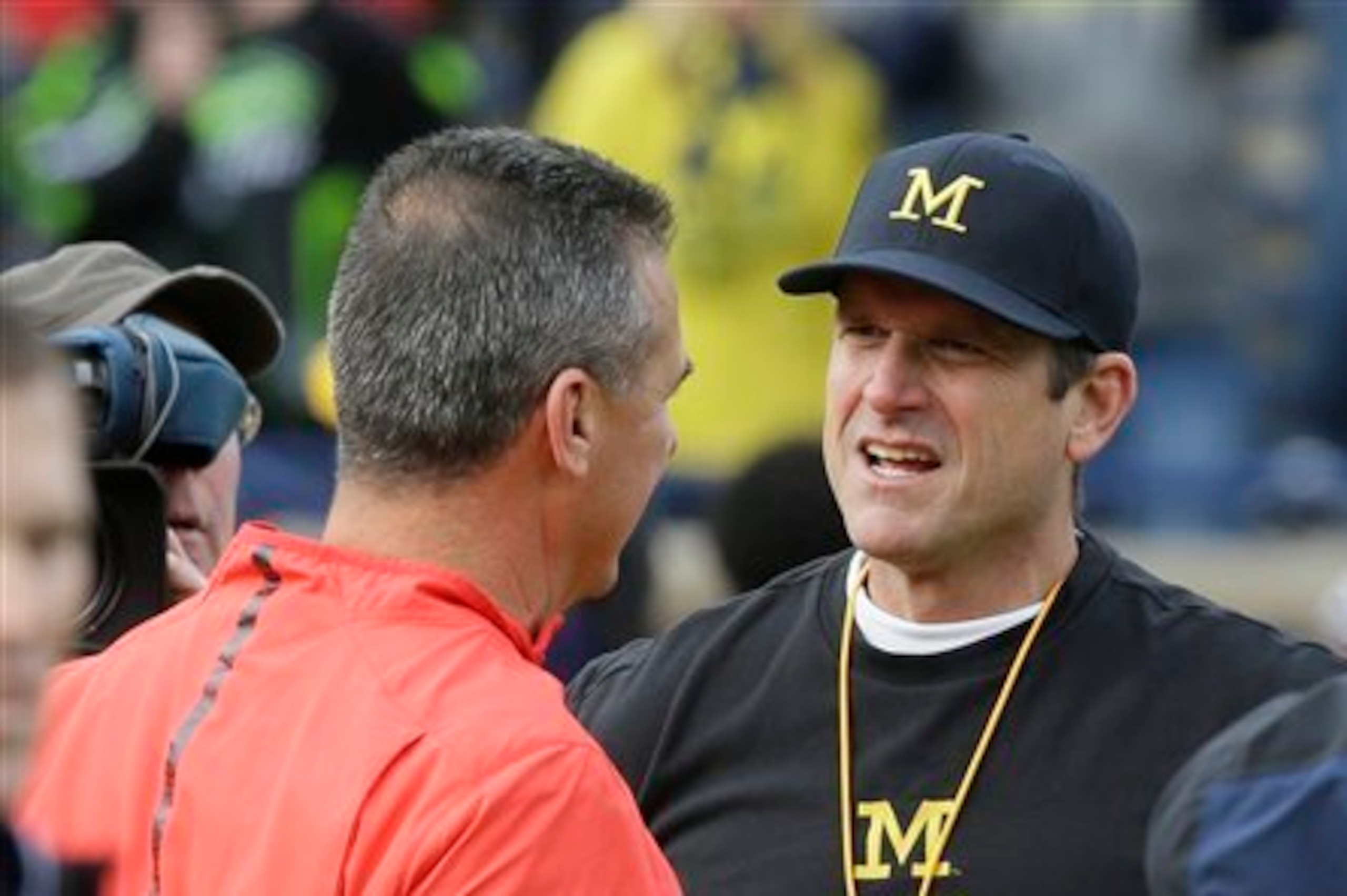
After more than one prospect decommitted just before national signing day and claimed that they no longer had scholarship offers, Harbaugh made no apologies about how he handles recruiting.
"It's a meritocracy," Harbaugh told Nick Baumgadner of MLive.com. "They've got to continue to perform when there's early commitments. Both in the classroom, on the field and as a citizen in the community. That's how we're going about it.
"I don't hide from that at all and I won't. That's what we demand."
Meanwhile, proponents say Saban is merely demonstrating forward thinking and good planning because roster attrition is inevitable.
According to the National Student Clearinghouse only 52.9 percent of students who enrolled in U.S. colleges and universities in the fall of 2009 earned a degree within six years.
Alabama football has one of the highest graduation rates in the nation (86, percent according to the latest NCAA Graduation Success Rate data that includes transfers as compared to 64 percent claimed by the federal rate), but it has never come close to having a recruiting class stay intact, with every prospect graduating.
That's what Saban factors in, whether it be through academic issues, players transferring for a better chance at playing time or whatever. Alabama has finished with the nation's top recruiting class for six straight years and won four of the last seven national championships, so it's hard to argue with the results.
But when it comes to grayshirting, they're mixed.
In 2012, Alabama had two players it asked to grayshirt, who were both coming off knee injuries and likely wouldn't have contributed to the national championship team. Running back Justin Taylor initially agreed but then declined and signed with Kentucky, while Darius Philon headed to Arkansas.
Both players ended up redshirting their first season.

Taylor was given his release from Kentucky in 2013 and transferred to South Carolina State. Last season, he had 56 carries for 248 yards and three touchdowns and caught another pass for another score for the FCS school.
Philon stuck at Arkansas—sort of. In 2013, he started the final five games and had a career-high eight tackles against Alabama. The subsequent season, he started every game for the Razorbacks, but then declared himself eligible for the NFL draft as a redshirt sophomore.
With 92 career tackles, including 20.5 for a loss and seven sacks, the San Diego Chargers took a chance on him with the No. 192 selection in the sixth round. Philon missed roughly half of his rookie season with a hip injury and was credited five tackles.
In 2013, Alabama asked offensive lineman Bradley Bozeman, who was coming off a knee injury, if he would grayshirt, and after thinking it over, he agreed. However, when the Crimson Tide had an extra roster spot open up over the summer, coaches brought him in just before the start of training camp.
Bozeman redshirted, became the backup center in 2014, when he made two starts and played in nine games and participated in every game last season.

Saban's predecessor, Mike Shula, had both quarterback John Parker Wilson and offensive lineman Drew Davis grayshirt in 2004. Wilson used the time to gain 30 pounds, getting his weight up to 215, and Davis added 10 pounds to report at 285. Both ended up becoming starters.
The initial plan for William Vlachos was to grayshirt in 2007, but when Shula was fired, Saban decided to forego that and made him part of his initial recruiting class. Vlachos developed into a three-year starter who was named a finalist for the Rimington Award for the nation's top center, second-team All-American and first-team All-SEC.
"What was going through my mind was if he wanted me or not, because I was a Mike Shula guy," Vlachos said in 2011. "I committed here because this is where I always wanted to go."
That was the bottom line for Bell, the No. 445thprospect in 2015 who enrolled in January and will finally participate in his first Crimson Tide practice on Friday when Alabama holds its first official spring workout. Listed at 6'4", 240 pounds looks ready to go.
"I would just say it depends on your situation," Bell said about grayshirting. "People, kids our age, usually look at it as a bad thing. But in the long run, it can help you out."
Quotes were obtained firsthand unless otherwise noted. Recruiting information courtesy of 247Sports.
Christopher Walsh is a lead SEC college football writer. Follow Christopher on Twitter @WritingWalsh.


.jpg?w=2560 "Dak to Stroud: Get Some Wins 💯")
.jpg?w=2560 "5 NFL Players Getting Trade Buzz")