
The Best Offensive Minds in College Football
No offense to a certain defensive-minded professional football championship game that just played out in front of millions of viewers over the weekend, but at the college level we still love our production.
It's as much a necessity as helmets and shoulder pads to have an effective offensive game plan at the college level in order to survive, and to do more than that requires plenty of innovation. Resting on tried-and-true tactics doesn't cut it anymore, not with the players becoming bigger, faster, stronger and more adaptive to what's happening on the field.
Alabama and Clemson had two of the country's most punishing defenses, but when they met in the national championship game, it ultimately came down to which team could do more with the ball. The result was 75 points and a combined 1,023 yards of offense.
Much credit goes to the players who take the play calls and turn them into positive results, but here we're focusing on the people who are making those calls. Particularly, those who come up with the game's most creative and productive schemes.
Follow along as we pick the brains of the best offensive minds in college football—chosen for not just the schemes that they run (and how well they've produced) but also for their ability to make it work in varying situations and environments.
Art Briles, Baylor
1 of 8
The resume
- 1979-1999: Various Texas high schools
- 2000-2002: Texas Tech running backs coach
- 2003-2007: Houston head coach
- 2008-present: Baylor head coach
The scheme
As far as we can tell, there's not a specific name for the offense Art Briles runs. It's a mix of the spread and the Air Raid, but one that throws the ball deep more often than normal and uses running backs more than quarterbacks to carry the ball. It's also adaptable on the fly, as we saw down the stretch in 2015 when injuries at QB caused the Bears to morph into an old-school veer offense that set a bowl record with 645 rushing yards against North Carolina in the Russell Athletic Bowl.
The mentality
"It's a visual world. When you see something, you retain it. When you read something, you believe it and dream it. You have to form that image. When you see it, that image is there.
"
— Briles on not using a playbook, to Seth Davis of CampusInsiders.com
The results
Baylor was an FBS doormat before Briles came from Houston in 2008, and now it's among the most potent offensive teams in the country, as well as one of the most successful. The Bears have ranked no worse than fourth nationally in scoring for five straight seasons, including three in a row at No. 1, and the last three seasons they've also led FBS in total offense.
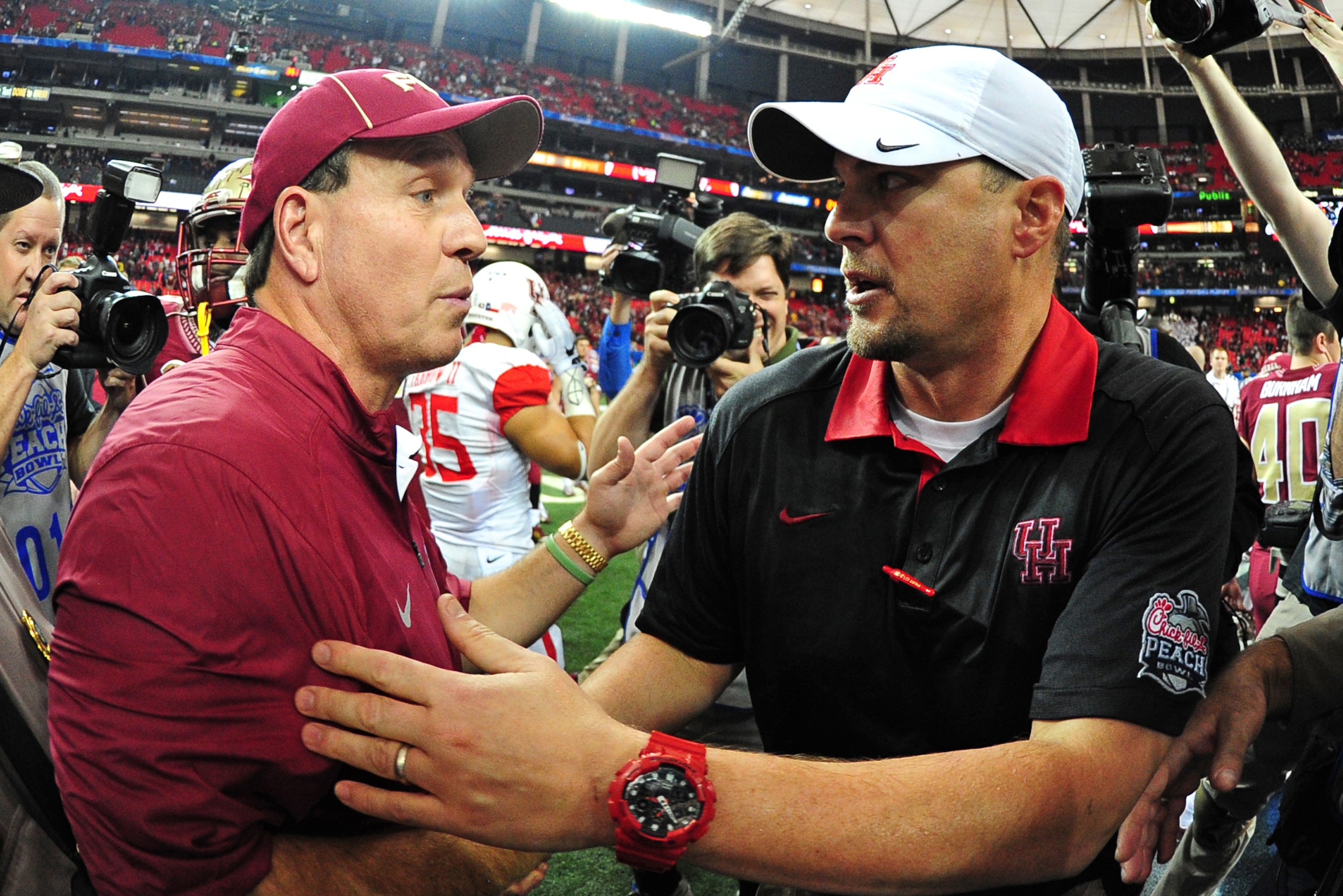
Jimbo Fisher, Florida State
2 of 8
The resume
- 1888-1990: Samford quarterbacks coach
- 1991-1992: Samford offensive coordinator/QBs
- 1993-1998: Auburn quarterbacks coach
- 1999: Cincinnati offensive coordinator/QBs
- 2000-2006: LSU offensive coordinator/QBs
- 2007-2009: Florida State offensive coordinator/QBs
- 2010-present: FSU head coach
The scheme
Jimbo Fisher is part of a dying breed, at least at the college level, as a tried-and-true believer in a pro-style attack that centers on a pocket passer with a strong and accurate arm. However, he understands the importance of mobility at that position, though it won't be the first direction his teams go if he can help it. His approach has produced a bevy of NFL quarterbacks as well as those at various other offensive spots, all of whom head into the pros with a leg up on athletes who are schooled on more gimmicky schemes.
The mentality
"You go to school to be a lawyer, you go to the best law school. You want to be an NFL player, you go to teams that run NFL systems. When our guys get [to the NFL] they say they’re very comfortable, the schemes and concepts are very similar.
"
— Fisher in 2014, per ESPN.com's Jared Shanker
The results
The 2015 season was a bit of an anomaly for Fisher's Seminoles, which were young and thus struggled to pick up the complicated playbook. But the proof is in the pudding, or at least in the draft numbers, as Bud Elliott of SB Nation notes that since Fisher became an offensive coordinator in 2008 he's produced 17 offensive draft picks including eight linemen.
Tom Herman, Houston
3 of 8
The resume
- 1998: Texas Lutheran wide receivers coach
- 1999-2000: Texas graduate assistant
- 2001-2004: Sam Houston State wide receivers/special teams coach
- 2005-2006: Texas State offensive coordinator/quarterbacks coach
- 2007-2008: Rice offensive coordinator/QBs
- 2009-2011: Iowa State offensive coordinator/QBs
- 2012-2014: Ohio State offensive coordinator/QBs
- 2015-present: Houston head coach
The scheme
Tom Herman's offense has its roots in the spread but with more of a power feel. A downhill running attack will look to draw contact and bring the defense into the box, only to then throw over it soon thereafter. It's also one that maximizes the skills of the players, as we saw when Herman helped Ohio State win a national title with a third-string quarterback in 2014.
The mentality
"You've gotta run the football. Have to, have to, have to. We're just going to do it from the shotgun, from spread formations. We're basically a two-back run team that just happens to run from the shotgun. We gain an extra advantage with the QB.
"
— Herman, via SB Nation's Bill Connelly
The results
Under Herman's watch at Ohio State, J.T. Barrett was a promising but unproven redshirt freshman who within the course of a few months was a Heisman contender. Then, Cardale Jones went from third string to a potential first-round draft pick in three games. Now with Houston, Herman has turned Greg Ward Jr. into arguably the best dual-threat passer in the country.


Lane Kiffin, Alabama
4 of 8
The resume
- 2001: USC tight ends coach
- 2002-2004: USC wide receivers coach
- 2005-2006: USC offensive coordinator
- 2007-2008: Oakland Raiders head coach
- 2009: Tennessee head coach
- 2010-2013: USC head coach
- 2014-present: Alabama offensive coordinator/quarterbacks coach
The scheme
Lane Kiffin's background is a pro-style one, using the basic formations that you find on most NFL teams that he learned under Pete Carroll at USC. That hasn't changed completely, but in his time with Alabama it's morphed into an approach that caters to the skills of his players and isn't tied to a predetermined model. And the version we'll see in 2016 is probably going to be different from the 2014 and 2015 editions.
The mentality
"You’re always trying to get matchups, and sometimes they work and sometimes they don’t, because (the other team will) coach too and they have good players as well. But you’re always trying to get certain coverages for certain plays, and that’s what we do all week, to figure out, ‘Do they play this versus this in these situations so we can run these plays?
"
— Kiffin during his national championship game press conference
The results
He might not have what it takes to be a head coach, but there's no denying Kiffin knows how to call plays. He turned Blake Sims from a career backup into a record-breaking quarterback in 2014 and this past season worked similar wonders with Jake Coker (while also overseeing Derrick Henry's Heisman-winning performance). Kiffin also is a master of knowing right away whether his plays will work, celebrating as early as possible.
Mike Leach, Washington State
5 of 8
The resume
- 1989-1991: Iowa Wesleyan offensive coordinator/offensive line coach
- 1992-1993: Valdosta State offensive coordinator/WRs/QBs
- 1994-1996: Valdosta State offensive coordinator/OL
- 1997-1998: Kentucky offensive coordinator/QBs
- 1999: Oklahoma offensive coordinator/QBs
- 2000-2009: Texas Tech head coach
- 2012-present: Washington State head coach
The scheme
Mike Leach didn't create the Air Raid, but he's keeping that style of throw-it-almost-every-time attack from getting tossed aside as unreliable. If anything, he's shown how it can work wherever you use it, turning Washington State into the top passing program in the country. It's also been the least-balanced offense over the past four years, with the 294 rushing attempts in 2015 (compared to 738 throws) signifying the most the Cougars have run the ball during his tenure.
The mentality
"Technique is more important than the scheme. You have a chance with whatever you run, if you have great technique. If you have a great scheme but you don’t execute it well, you have no chance.
"
— from Swing Your Sword, Leach's 2011 autobiography (h/t Deseret News)
The results
Leach's teams don't always win a lot—the 9-4 record this past season was his second-best in 14 years as a head coach—but they never fail to rack up points and yards, especially the quarterback. B.J. Symons set the FBS single-season record of 5,833 passing yards at Texas Tech in 2003, while Washington State's Connor Halliday set the single-game mark with 734 yards in 2014.
Urban Meyer, Ohio State
6 of 8
The resume
- 1986-1987: Ohio State graduate assistant
- 1988: Illinois State outside linebackers coach
- 1989: Illinois State quarterbacks/wide receivers coach
- 1990-1995: Colorado State wide receivers coach
- 1996-2000: Notre Dame wide receivers coach
- 2001-2002: Bowling Green head coach
- 2003-2004: Utah head coach
- 2005-2010: Florida head coach
- 2012-present: Ohio State head coach
The scheme
Urban Meyer likes to spread the field as much as possible, creating space for his playmakers to operate while also forcing defenses to pick and choose what they're going to focus on. The result has been Heisman Trophy winners and candidates at the quarterback and running back position and a style that could produce a run or a pass (or sometimes both) out of every possible formation.
The mentality
"I think scheme is overrated. I think it's comical when I hear, 'it doesn't fit our system.' Well, change your system. ...We'll always take the better player and find a way to make him fit.
"
— Meyer on recruiting and finding the best athletes for his team, per Ari Wasserman of Cleveland.com
The results
Meyer has won everywhere he's been, usually because of the offense, and with better talent at his last two stops (Florida and Ohio State), that has resulted in national championships. His 2015 OSU team struggled moving the ball, though, until it settled on the right players to give the ball to.
Rich Rodriguez, Arizona
7 of 8
The resume
- 1986: Salem defensive backs/special teams coach
- 1987: Salem assistant head coach/defensive coordinator
- 1988: Salem head coach
- 1989: West Virginia outside linebackers coach
- 1990-1996: Glenville State head coach
- 1997-1998: Tulane offensive coordinator/QBs coach
- 1999-2000: Clemson offensive coordinator/QBs
- 2001-2007: West Virginia head coach
- 2008-2010: Michigan head coach
- 2012-present: Arizona head coach
The scheme
Rich Rodriguez's offenses are built on tempo, timing and speed. And lots of it. He has an aversion to huddles and is constantly looking for ways to go faster, using a zone-read approach that mixes the run and the pass to keep defenses backpedaling and unsure of what's coming next. He prefers a quarterback who can run the ball, though a strong and accurate arm is necessary to keep the pace going.
The mentality
"Run and throw with the numbers.
"
— Rodriguez, during a 2013 coaching clinic, via SportsDVDs
The results
Rodriguez's Arizona teams have averaged a crisp 80 offensive plays per game in his four seasons, among the most in FBS during that time span. Each of those squads has produced at least 453 yards and 33 points per game.
Bob Stitt, Montana
8 of 8
The resume
- 1990-1993: Doane offensive coordinator/offensive line coach
- 1994-1998: Austin College assistant head coach/offensive coordinator/special teams coach
- 1999: Harvard offensive coordinator
- 2000-2014: Colorado School of Mines head coach
- 2015-present: Montana head coach
The scheme
Bob Stitt has been coaching for more than a quarter century, but his work had gone relatively unnoticed until West Virginia coach Dana Holgorsen gave him a shoutout after the 2012 Orange Bowl. That turned the nation on Stitt and his fondness for experimentation and innovation, most notably with the “fly sweep” play that is like an end-around but is really a shovel pass.
The mentality
"You always try to stay two steps ahead of the defense and keep changing, because if you've got a top offense in the country or your conference, everybody's just going to watch your tape all winter and try to stop you. You've got to come out with something completely new. We're changing all the time so people can't zero in on what we're doing.
"
— Stitt in 2012, per USA Today's Dan Wolken
The results
Stitt got his big break last year when Montana pulled him out of the Division II ranks, where he'd won 108 games in 15 seasons. His first Grizzlies team went 8-5 and made the FCS playoffs, averaging more than 82 offensive snaps per game.
Follow Brian J. Pedersen on Twitter at @realBJP.
_0.png?w=2560)
.jpg?w=2560)

.jpg?w=2560 "NFL investigating 2 referees for separate viral exchanges")
.jpg?w=2560 "OBJ Calls Out Giants 😳")


.jpg?w=2560 "Tyreek makes another cryptic post amid Chiefs rumors")
.jpg?w=2560 "Ward Nearly Walks Out of Presser 😳")