Which Power 5 Conference Will Be the Most Difficult to Win in 2016?
Winning a conference title is the gateway to the College Football Playoff, though it's not a guarantee since only four spots are available for five power leagues. It takes more than just being a conference champion; it requires overcoming tough competition that makes for a great resume.
But not too tough, or else a conference champion might have too many blemishes to earn a playoff bid. Just ask Stanford, which went 8-1 in the ultra-deep Pac-12 Conference, but because that gave it two losses, it was the odd team out of the hunt for a national championship.
As we start looking toward the 2016 season, it's important to remember that performance in league play will ultimately trump what teams do in nonconference games. The big early matchups that highlight the first few weeks of September should make for great action, but the winners or losers won't have sealed their fate yet because the more important conference slate is still to come.
.jpg?w=2560 "AP Poll Top Five Week 9")
.jpg?w=2560)
And that's where the overall difficulty of the conference comes into play.
USA Today's Jeff Sagarin rated every FBS conference or division at the end of the 2015 season, and it was no surprise the power leagues held the top nine spots. A look at the order they finished, though, also shows which ones were stronger than the rest.
| Rank | Conference/Division | Overall Record | Bowl teams |
| 1. | SEC West | 65-27 | 7 |
| 2. | Pac-12 North | 47-31 | 5 |
| 3. | Big 12 | 71-56 | 7 |
| 4. | Pac-12 South | 43-36 | 5 |
| 5. | Big Ten East | 54-36 | 5 |
| 6. | ACC Coastal | 49-41 | 5 |
| 7. | ACC Atlantic | 49-41 | 4 |
| 8. | Big Ten West | 51-39 | 5 |
| 9. | SEC East | 46-42 | 3 |
How will these conferences stack up in 2016? There are several factors that will help us determine which league will be the toughest to win next season.
Schedule Makeup
The Big Ten makes the move to a nine-game conference schedule in 2016, which will mean every team plays three crossover games instead of two. Because of this, many of the matchups between top teams from the East and West divisions that didn't happen last year will be on the docket.
For instance, in order for Iowa to defend its West title, it will not only have to outlast Northwestern and Wisconsin (both of which come to Iowa City), but it must also outlast Penn State and Michigan from the East. Last season, the Hawkeyes' crossover games were against Indiana and Rutgers. Consequently, East contenders Michigan, Michigan State and Ohio State each play at least two of the West's 10-win teams.
"This is the template that everybody thinks is best going forward from a variety of perspectives," Big Ten commissioner Jim Delaney said last summer (h/t Paul Myerberg of USA Today).
This doesn't put the Big Ten on par with the Pac-12 in terms of schedule difficulty, but it gets it closer. The Pac-12, because it has only 12 schools, plays four crossover games as part of the nine-game league slate, and thus the number of quality teams from either side that winds up dodging each other is minimal.
Additionally, an agreement made when the league expanded in 2011 ensures all four California schools face off each season, locking up two of their crossover matchups every year.
The ACC and SEC remain entrenched with an eight-game league schedule, allowing for only two crossover games per season, and each also has predetermined crossover series between “traditional rivals” such as Auburn and Georgia in the SEC and Florida State and Miami (Florida) in the ACC.
And then there's the Big 12, which with its 10-team lineup is able to play a true round robin. That would change if the conference opts to expand, though the approval to have a league title game without having 12 teams (or two divisions) is likely to quell interest in that route.
The Big 12, Big Ten and Pac-12's use of nine-game schedules does provide a minor advantage for half their teams, though, with some getting to play an extra home game, while others end up with five road games in conference play.
League Balance
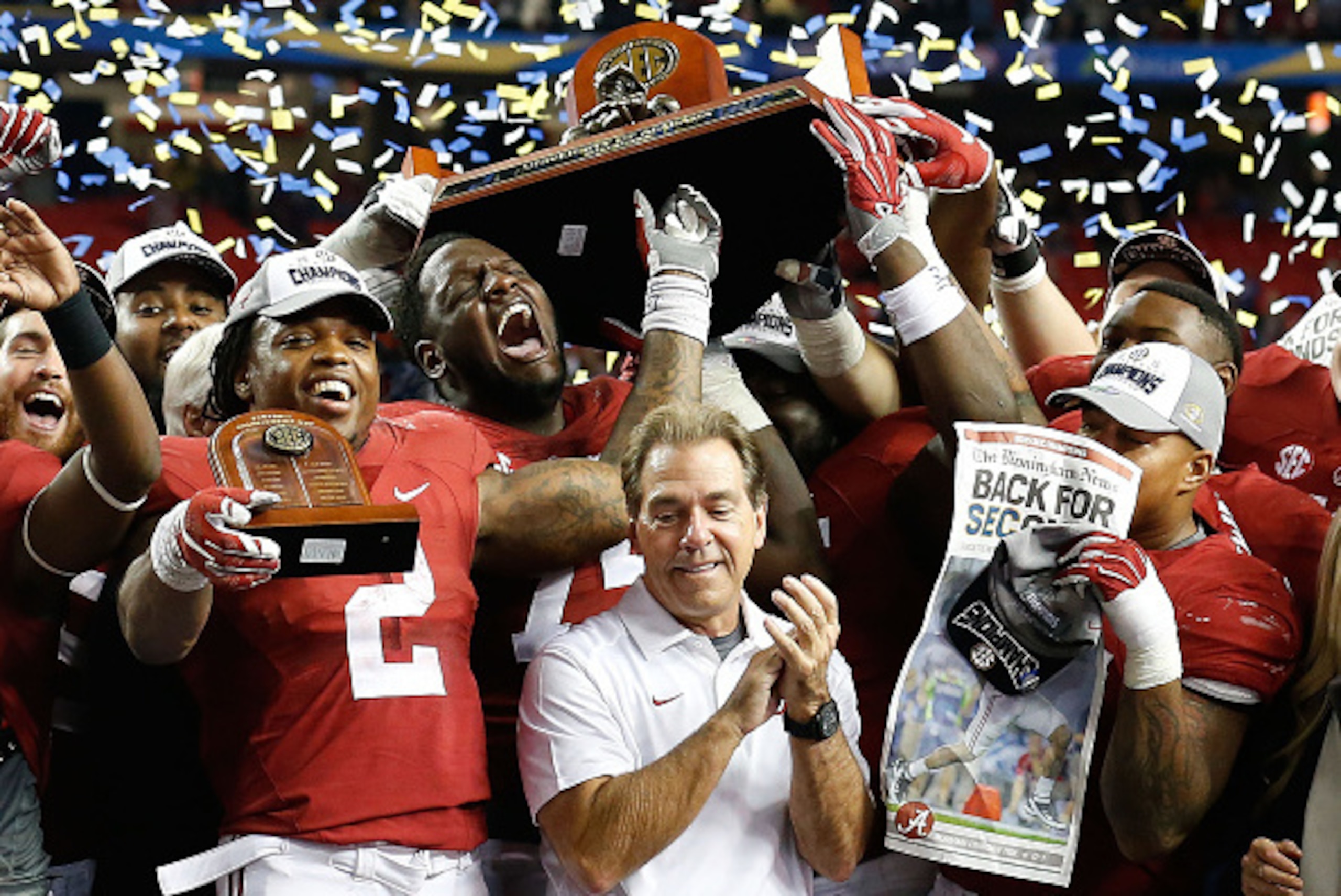
The SEC's West Division retained its crown as college football's most difficult division, sending all seven teams to bowl games for the second year in a row and seeing six of them win. That included victories in the Cotton and Sugar Bowls, as well as Alabama's national championship.
After running through the gauntlet during the regular season, those bowl games probably felt like exhibitions for the West's teams. The same went for Alabama in the SEC title game, as the East Division was woefully weak in comparison to the West.
That could be the case again in 2016, especially with three schools (Georgia, Missouri and South Carolina) hiring first-time head coaches and coming in with defensive backgrounds. Tennessee was the only East team to finish in the SEC's top half in total offense last season, making for a considerably lopsided league that led to a mismatch between Florida and Alabama for the title.
Unless the Vols or someone else dominates the East and holds its own in crossover games, it will have little shot to win the conference championship game.
The three other power leagues that are split into divisions were far more even in 2015, though the Pac-12 North and ACC Coastal tipped the scales a bit last year after previously being the second-class sides. The Coastal's rise should continue in 2016, thanks to the addition of well-regarded coaches Mark Richt (Miami), Bronco Mendenhall (Virginia) and Justine Fuente (Virginia Tech) to an already strong list.
The Big Ten might be the most balanced league overall, though, with an equal number of contending teams, bottom feeders and those hoping to be the former instead of the latter.
The Big 12 is removed from this argument because of its one-division format, as well as its lack of a conference title game.
Returning Talent
What's coming back and what needs to be replaced is a much bigger factor for individual teams and their chance to win their leagues than for the conference as a whole. Every star player could end up needing to be replaced, and that wouldn't make a league easier or harder to win, though the number of starters and standouts that one team brings back over another might lessen the number of legitimate contenders.
For argument's sake, though, let's look at the number of top-tier players that each power conference is in line to have back for 2016. In terms of players who made at least one of the most notable All-American teams, the SEC has the most returning star talent with seven 2015 All-Americans. The Big Ten is second, with five, while the ACC and Big 12 return three apiece. In December, USA Today's Dan Wolken asked which conference was the best based on coaches:
Bringing up the rear is the Pac-12, which has just two All-Americans set to return in 2016. Stanford's Christian McCaffrey ended up making different teams as either a running back or all-purpose player, so you could technically credit the Pac-12 with three.
Ultimately, the overall strength of a league and its difficulty is going to be determined more by the new stars and starters and how their respective teams maximize their talents.
Conclusion
The more conference games a team has to play, the harder it's going to be to win that league. Along with the quality of the opponents it'll face, these are the two key factors in determining overall conference strength and difficulty.
And those are the two reasons the Big 12 will be the hardest to come out on top of in 2016.

It has taken eight wins to claim the Big 12 title each year since the league dropped down to 10 teams in 2011, when it also increased from eight to nine conference games. No team has gone unbeaten since the switch, and twice an 8-1 record was only good enough for a share of first place.
The Pac-12 has had an 8-1 division champ every season since expanding, but it has also had one with at least two or three losses each time as well. The Big Ten has had several unbeaten division champs since reaching 12 teams, and again at 14, but the increase to nine games will make it harder to emerge unscathed.
It's not enough to make the Big Ten tougher than the Big 12, though, because without a true round robin, there are still chances to dodge tough opponents.
The size of the ACC and SEC should make them among the tougher to win, but only playing eight games holds more weight than anything else.
The Big 12 may eventually join the rest of the power conferences and add schools, host a title game or both. If and when that happens, it might make the league less daunting to get through, but for the time being, its uniqueness helps make it the most difficult conference to win for the 2016 season.
Follow Brian J. Pedersen on Twitter at @realBJP.



.jpg?w=2560 "Raiders Could Start Mendoza")


.jpg?w=2560 "Rodgers Iced Out on Plane 💎")

.jpg?w=2560 "Packers Safety Slams Refs 🤬")