

Which States Are Producing the Most National Championship Talent?
When No. 1 Clemson and No. 2 Alabama line up for the College Football Playoff National Championship Game on Monday, it'll be a star-studded game full of household names and future NFL stars—not to mention an all-time great coach (Nick Saban) versus another who's creating his own path (Dabo Swinney).
But rewind three, four or even five years ago. The two rosters competing for college football's top honor had to come from somewhere. What are the origins of a championship-caliber team?
We traced the two-deep depth charts for Alabama and Clemson (plus a few key reserve contributors) to find out the states from which they came. Not surprisingly, there's a heavy Southeastern presence, as there have been with multiple recent BCS champs.
TOP NEWS

Week 5 AP Top 25 Poll 🔢

Updated CFP Bracket Projections 🔮
Top Overreactions after Week 5 of CFB Season 😧
Where does championship-caliber talent come from? We traced more than 80 players from both sides to find out.
Winning Your Home State Actually Matters
If you've ever listened to a head coach's national signing day press conference, you've probably heard the phrase "we have to win our state in recruiting" more times than you can count. It sounds like coachspeak on the surface, but there's actually a lot of truth in it.
Looking at this year's championship contenders as an example, it's easy to understand why. In-state prospects accounted for about about one-third of Alabama's starters and key contributors. That number drops slightly for Clemson but remains at just under 30 percent.
| Team | In state | Florida | Georgia | Louisiana | North Carolina |
| Alabama | 15 | 4 | 6 | 6 | 1 |
| Clemson | 12 | 9 | 7 | -- | 8 |
The table above shows the Tide and Tigers are getting a bulk of their key players within their own state borders. However, each program also had roughly three or four pipeline states in which it acquired another high percentage of players.
Not surprisingly, these pipeline regions are either border states or, like Florida, act as a recruiting ground for pretty much everybody in major college football.
In either case, Alabama and Clemson have geography on their side. When leaving the state, Alabama gets a bulk of its key players from Florida, Georgia and Louisiana, with some traces from Texas, Mississippi and the like. Clemson also mines Georgia and Florida but has a presence in North Carolina and Virginia as well.
Basically, if Alabama and Clemson were the circles in a recruiting Venn diagram, Florida and Georgia would be in the center.
Ultimately, though, winning the in-state recruiting battle is important, even if the state is not traditionally considered one of the richest talent producers. Prospects like running back Marcus Lattimore (2010) and defensive end Jadeveon Clowney (2011) boosted the profile for recruiting in South Carolina—not just because they were so highly rated, but because they opted to stay home.
Neither, of course, went to Clemson, but they were part of raising the national profile of South Carolina football. That's what a top in-state player can do for a program.
Origins of the Blue-Chip Players
Recruiting isn't an exact science, but there is a correlation between teams that regularly recruit at a high level and ones that win (or at least compete for) national championships. Go ahead and look at the last handful of title-winning teams, and then look at how they recruited. No one's winning with only 2-and-3-star players.
Yet the popular contrarian opinion to have is that recruiting stars are laughable, at least when compared to coaching and player development. This is what Fort Worth Star-Telegram columnist Mac Engel tweeted during the Orange Bowl between Clemson and Oklahoma, noting that Sooners quarterback Baker Mayfield was a walk-on:
Mayfield's path to stardom certainly goes against the norm, but he's also an exception to the rule. Oklahoma's star running back, Samaje Perine—a player literally standing right next to Mayfield in the backfield—was a 4-star prospect. Go through Oklahoma's starting 22, and you're more likely to find recruits of Perine's mold than Mayfield's.
The not-so-hush-hush insider secret of the business is that all of those factors—recruiting, coaching and development and even scheme fit—matter; nothing exists in a vacuum by itself.
Alabama and Clemson have mastered all of those elements. Neither would be playing Monday if it hadn't. But it all starts with recruiting. According to 247Sports composite rankings, here are Alabama's and Clemson's average recruiting class rank over the last five years (to account for redshirt seniors and true freshmen):
Clemson: 12.5.
Alabama: 1.
The Tide, in fact, had the No. 1 class in the country in each of the last five years.
From where do the blue-chip (4-and-5-star) players over the last five years hail? In the table below, signees were charted from the following areas: home state, Florida and Georgia and the top pipeline state.
| Team | In state | Florida | Georgia | Louisiana | North Carolina |
| Alabama | 10 | 2 | 4 | 5 | -- |
| Clemson | 3 | 7 | 4 | -- | 5 |
Seeing as a large chunk of Alabama's key contributors are in-state products, it makes sense that most of the blue-chip players are as well. Guys like linebacker Reuben Foster were once 5-star prospects from Alabama. Still, the Tide have succeeded in plucking blue-chip players from Florida and Georgia, like Heisman-winning running back Derrick Henry and his backup Kenyan Drake, respectively.
Clemson's recruiting dominance has been more spread-out. It has to be. As mentioned before, South Carolina isn't quite on the same level as some other talent-rich states. The big-time players who have come out of that state haven't always signed with the Tigers, either.
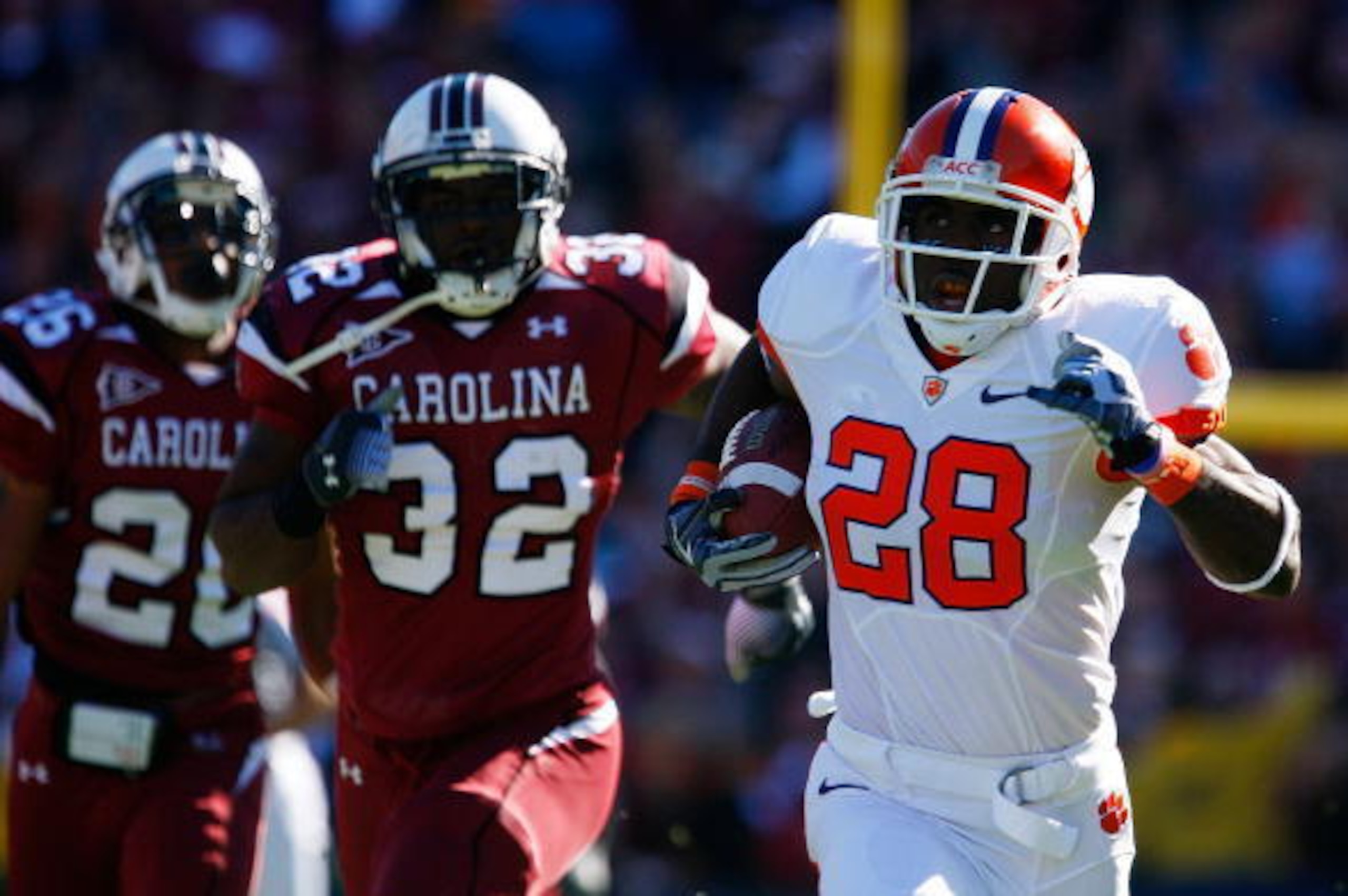
Linebacker Ben Boulware and receiver Mike Williams (injured) were in-state products, but some of the biggest names came from out of state. Quarterback Deshaun Watson is from Georgia. Cornerback Mackensie Alexander is from Florida.
Clemson has been forced to win outside its state more than Alabama, but that doesn't mean it hasn't done so successfully. Clemson's presence took a major turn in 2006 when Swinney, then an assistant for the Tigers, recruited a 5-star running back by the name of C.J. Spiller out of Florida.
Alabama has made its way to this point with lots of homegrown talent and more blue-chip players than you can possibly imagine. Clemson didn't exactly do it the hard way, but Swinney deserves a lot of credit for building a championship-caliber program at a place where the best players in the country don't line up at his door.
Conclusion
With all due respect to the rest of the country, the South has a built-in recruiting advantage. You probably already knew this, but it's a fact nonetheless. The number of 4- and -5-star players per capita is simply more concentrated in the Southeast, as SbS Football tweeted earlier in the year:
There are outliers, of course. Ohio State can pick up plenty of in-state products while having the brand to recruit nationally. Notre Dame has completely transformed its recruiting pitch by becoming a partial member of the ACC.
Generally speaking, though, it should be no surprise that the above graphic matches the table below charting the number of national championship game appearances by state:
| State | Appearances | Wins | Losses |
| Florida | 8 | 5 | 3 |
| Alabama | 5 | 4 | 1 |
| Ohio | 4 | 2 | 2 |
| Oklahoma | 4 | 1 | 3 |
| Louisiana | 3 | 2 | 1 |
| California | 2 | 1 | 1 |
| Texas | 2 | 1 | 1 |
| Oregon | 2 | 1 | 1 |
Alabama and Clemson succeeded in recruiting their own backyards but also found plenty of players in neighboring states. Put simply, if you want to compete for a national championship, you have to pluck blue-chippers from states like Alabama, Florida, Georgia, Louisiana and Texas; the same can also be said for California, but that's in a completely different geographical region.
But good luck with that. Every program in college football is already chasing Alabama. Soon, they could be chasing Clemson, too.
“Those great businesses out there, those great programs, they don’t plateau. How do you do that? Well, you have to constantly reinvent, reinvest, reset, learn, grow, change,” Swinney said, via Matt Connolly of the State. “You have to do that. You don’t just change to change, but you have to always challenge yourself each and every year to say, ‘OK, well this may be how we’ve done it, but is it the right way?’"
Ben Kercheval is a lead writer for college football. All quotes cited unless obtained firsthand. All recruiting information compiled by 247Sports.
_0.png?w=2560)


.jpg?w=2560 "Grading WWE Raw 🔠")

.jpg?w=2560 "Bijan's INSANE 1st Half 🤩")
.jpg?w=2560 "Viral Rams Coach Vid 🖕")
.jpg?w=2560 "Injury-stricken Seahawks signing veteran RB")


.jpg?w=2560 "2 NFL Officials Suspended")
