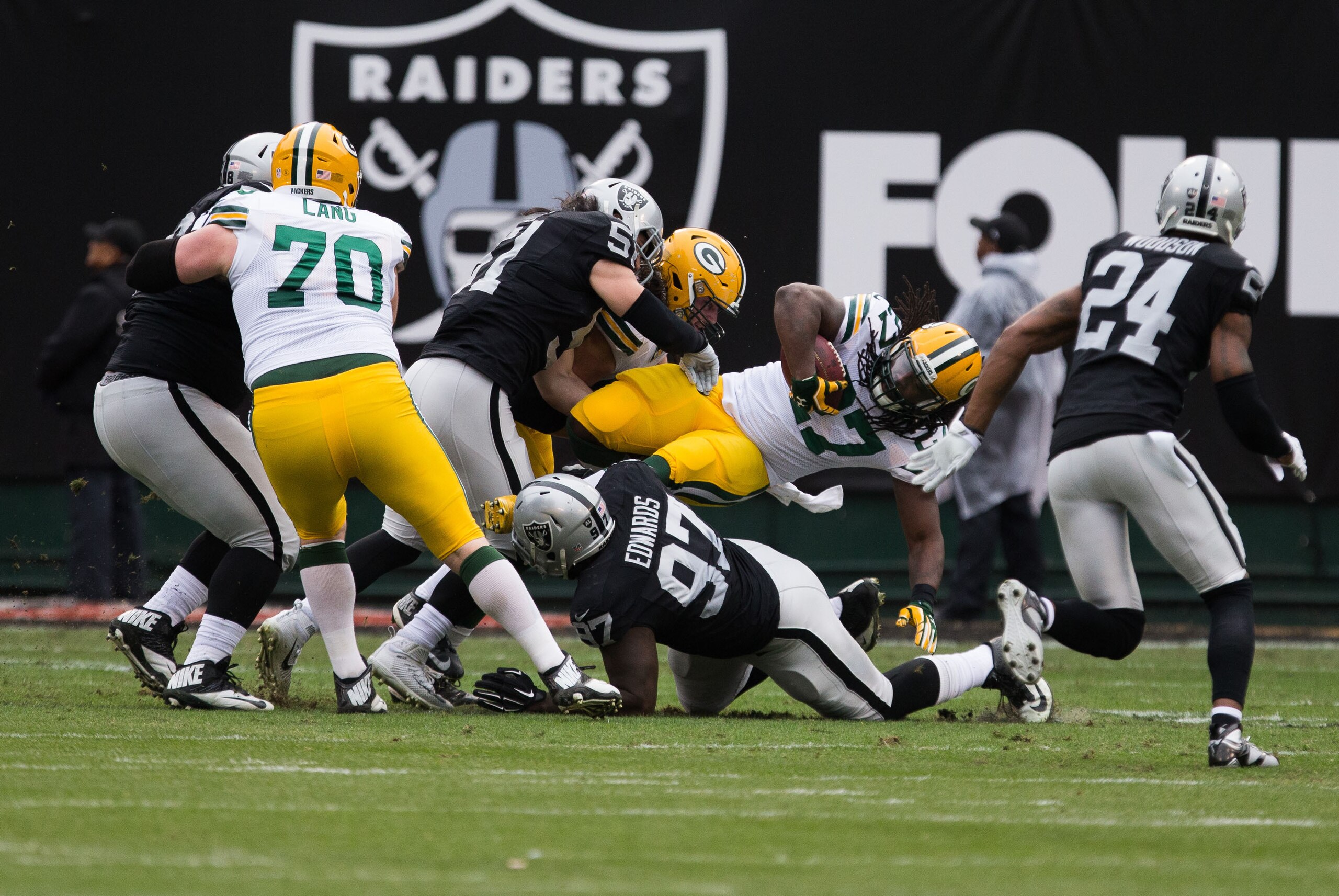


Take away all the variables an NFL team can have and offensive success boils down to essentially one thing: converting on third downs.
And given the Green Bay Packers' lack of success in that very area this season, it's not hard to understand why the offense has been sluggish and lacked productiveness.
The Packers have a third-down conversion percentage of 35.8 in 2015, per TeamRankings.com, the 24th-worst record in the league.
TOP NEWS
Contenders starting to separate themselves after Week 7

Geno Explains Wilson Exchange
.jpg?w=2560 "Rams Raiders Football")
Raiders Could Start Mendoza
That's down from a healthy 46.67 percent in 2014, which was good for No. 3 in the league.
| 2015 | 35.80% | 24th | 38.64% | 32.95% |
| 2014 | 46.67% | 3rd | 52.94% | 39.62% |
Sure, a great quarterback, top receivers, a hard-nosed running back and a tight end who can create mismatches are all factors that separate great teams from poor ones.
But if you have some or all of those things and still can't maintain possession of the ball long enough to get into the red zone, ultimately it's difficult to put up more points than your opponent.
The Packers have a great quarterback, decent receivers, an inconsistent but sometimes explosive run game and below-average tight ends.
But continually failing to convert third downs—and 3rd-and-short situations in particular—has limited the offense's time in possession, placed greater strain on the defense and limited what was once a prolific scoring offense to 24.6 points per game on average.
Sure, that figure is still 10th in the league, but when you consider teams such as the Carolina Panthers, Arizona Cardinals and Seattle Seahawks—all potential NFC playoff foes for the Packers—are scoring anywhere from 26 to 32 points per game on average, it matters.
For all its complexities, football boils down to one simple tenet: score more points than your opponent and you win.
For some teams, having trouble on third downs wouldn't hamper their ability to score because they have a deep game that can see them reach the red zone in just a handful of 15- or 20-yard plays.
The Packers, however, have been sorely missing Jordy Nelson as a deep threat and have gotten only moderate explosiveness from their other pass-catchers.
Per Pro Football Focus, Packers receivers only have 14 receptions of 20 or more yards in 2015, and the receiver with the most such catches—James Jones—has just eight, which ranks 17th in the league.
Compare that to 2014, when the Packers had 20 explosive plays through the air, and Nelson's 12 ranked eighth among all receivers.
Keep in mind these are targets downfield of at least 20 yards, not catch-and-run receptions that total 20 or more yards by the time the player is tackled or scores.
So with a less potent downfield presence in 2014, be that from the lack of Nelson, the change in play-calling, the coverage the receivers are facing or a combination of all, more third downs present themselves. And that places more onus on the run game to get the job done.
Per ESPN's Rob Demovsky, the Packers have found themselves in 22 3rd-and-1 situations this season (through mid-December). Of those, they converted just 11.
Though that 50 percent conversion rate is much higher than their 35.8 percent on the year, teams generally convert more on 3rd-and-1. Thus, the Packers are actually 30th in the league in that category.
You can't necessarily chalk the failure on 3rd-and-1 up to predictable play-calling. The Packers have run the ball in 3rd-and-1 situations 15 times and attempted a pass the other seven times.
And when a team continues to fall short on third down, it sends out shock waves that reverberate through the rest of the offense, often creating a chain reaction of failures from drive to drive.
As offensive coordinator Edgar Bennett said, per Demovsky:
"Obviously, it’s a big down. It is an important down. It’s important for both sides. A big part of it is continuing to move the chains, and short yardage is a big part of that. It’s huge from a momentum standpoint, and you kind of go back and look at some of the things as far as the 'why' part, it goes back to being fundamentally sound and also executing the play.
We always talk about winning the one-on-one battles. It’s never just one person. In order for the unit to be successful, each and every guy must do their job.
"
The problems have stemmed from many of those individuals who have a job to do in those situations, both personnel and coaching staff.
It starts with the coach's play call. Per ESPN Sports & Information and, via Demovksy, head coach Mike McCarthy's teams have not had great success in third-down situations over the years. Since 2006, those Packers teams rank tied for 27th with a 61 percent success rate.
From there, the offensive line has a job to do. The Packers line is ranked 19th in the league in 2015 in run blocking, per Pro Football Focus. That's down from No. 8 in 2014 despite the same starting five carrying through into this season, though injuries have played a role in the line's performance.
Football Outsiders ranks Green Bay 27th in its stuffed metric, which measures the percentage of runs in which the running back is tackled at or behind the line of scrimmage.
But that's not completely specific to third-down situations, so we'll drill down further: The Packers are 56 percent in power success, meaning the "percentage of runs on third or fourth down, two yards or less to go, that achieved a first down or touchdown."
That power-success stat conflates offensive-line play and running back play, so we'll move onto the most important factor in a third-down conversion attempt: the player with the ball.
Eddie Lacy is only 14 of 23 (60.9 percent) on 3rd-and-1 rushes in his career, per Demovsky. In 2015, he's 3 of 7 for 43 percent.
James Starks is performing only slightly better this season in such situations, at 3 of 6 for 50 percent.

One thing that's been obvious since McCarthy took back play-calling duties from Tom Clements is the increase in snaps for fullback John Kuhn, and perhaps it's not surprising given the veteran's success on 3rd-and-1 in his career: 22 of 29, 75.9 percent.
Kuhn is 1-for-1 in 2015. The Packers could choose to have the quarterback sneak the ball over the line, but they've only attempted it once so far this season, and Aaron Rodgers was successful.
Of course, though the Packers have been particularly awful on 3rd-and-1 this season, that's not to say 3rd-and-long hasn't been a problem, either.
When the offense can only generate a couple yards on first and second down, too much pressure falls on Rodgers to convert the ensuing third down. With a somewhat inexperienced receiving corps struggling with drops this season, that's easier said than done.
As of mid-November, Rodgers' completion percentage on third downs had fallen to a career-low 56.9 percent, per ESPN Stats & Information (via ESPN's Jason Wilde), and it hasn't improved much since.
"We have to convert third downs," Rodgers said, per Wilde. "I have to be more accurate on third downs and give us more opportunities. When we're converting those third downs, it gives us a chance to run the football again on first and second down. It gives us a chance to take some [downfield] shots in the [play]-action game."
The lack of balance between the run and the pass, the difficulty for receivers getting free in coverage and the tendency of the offense to become one-dimensional have all been issues for the Packers in 2015.
But instead of thinking of them as separate problems, consider they are all rooted in the team's mediocre performance on third downs.
Once that conversion percentage goes up, the offense will see multiple opportunities open up as it moves down the field at a brisker clip, maintains possession of the ball longer and gives itself more opportunities to score.
.jpg?w=2560 "Steelers Saints Football")




.jpg?w=2560 "🚨 Week 8 AP Top 25 Poll")