

The 5 Most Telling Stats for the Wolverines This Season
Statistics don't tell the whole story, but they provide valuable insight into the outcome of the Michigan Wolverines' 2015 season.
From an offensive turnaround to a defensive lapse as well as overall performance, a few numbers quantify the results of the on-field production. While some are encouraging, others show why Michigan struggled a bit down the stretch.
Factors used to choose the stats were season-long standouts and a reflection of the eye test during various stretches of the year.
Rushing Yards vs. Ryan Glasgow's Presence
1 of 5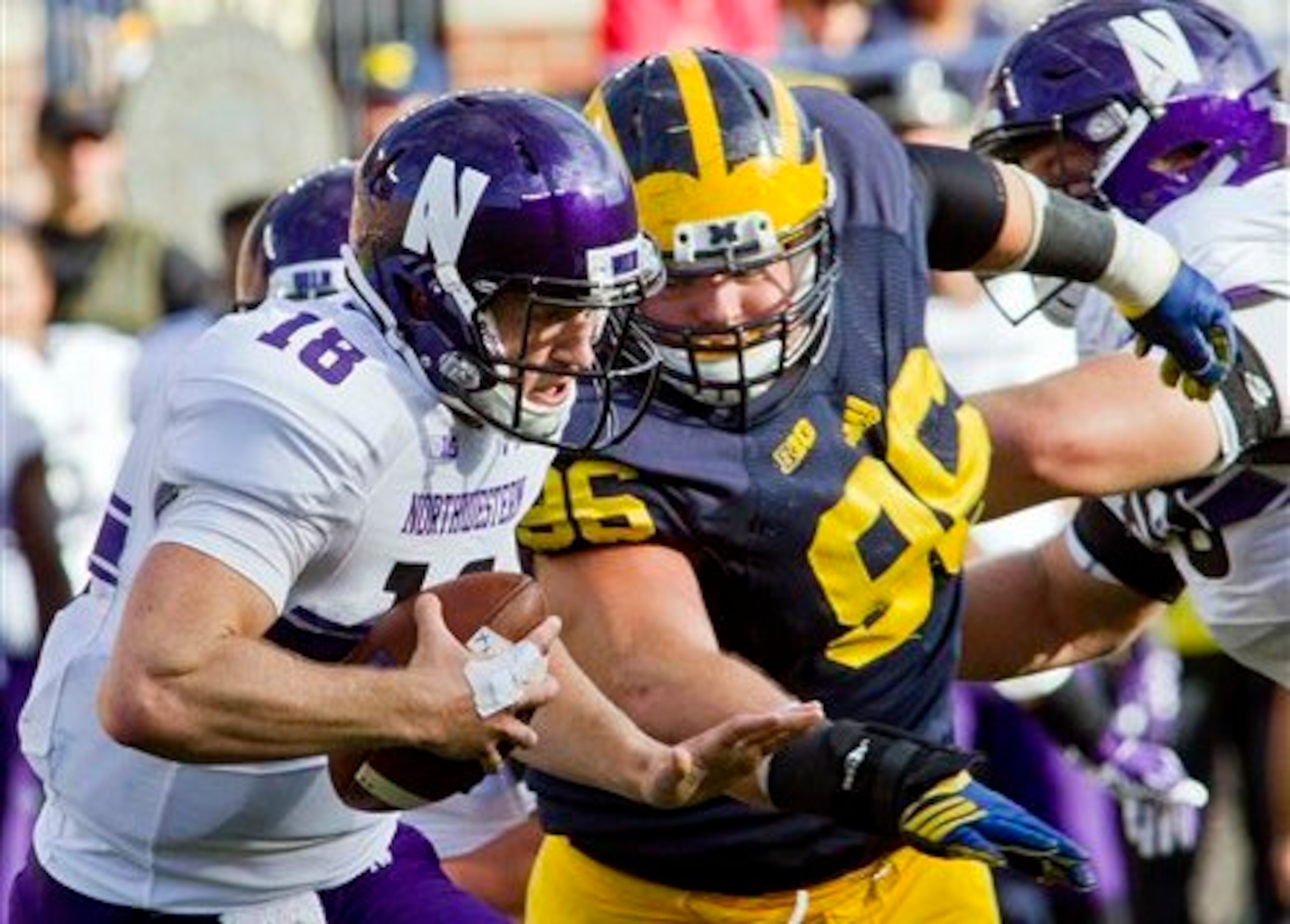
Minnesota had some success on the ground against Michigan, but that was merely considered an outlier since the defense had ceded no more than 2.6 yards per carry in six straight games.
Rutgers running back Robert Martin ripped off a 54-yarder, yet the Wolverines otherwise allowed an average of 2.4 yards.
However, an injury to nose tackle Ryan Glasgow during the Rutgers blowout turned that one-game and one-play aberration into a trend.
Indiana shredded Michigan for 307 yards and two scores, punctuated by an eight-play, 69-yard go-ahead touchdown drive late in the fourth quarter. The Hoosiers—who didn't throw a single pass on the possession—also ran for the two-point conversion.
Though Penn State's Saquon Barkley busted loose for a 56-yard gain, the Wolverines settled down and limited the Nittany Lions to 14 yards on the next 21 carries. Even without Glasgow, that was the expectation against Penn State's porous offensive line.
But Ohio State was bound to be an issue, and it was. Ezekiel Elliott rushed for 214 yards and two touchdowns, while J.T. Barrett added 139 yards and three scores.
How much of that would have happened with Glasgow on the field? We'll never know.
The Big Three
2 of 5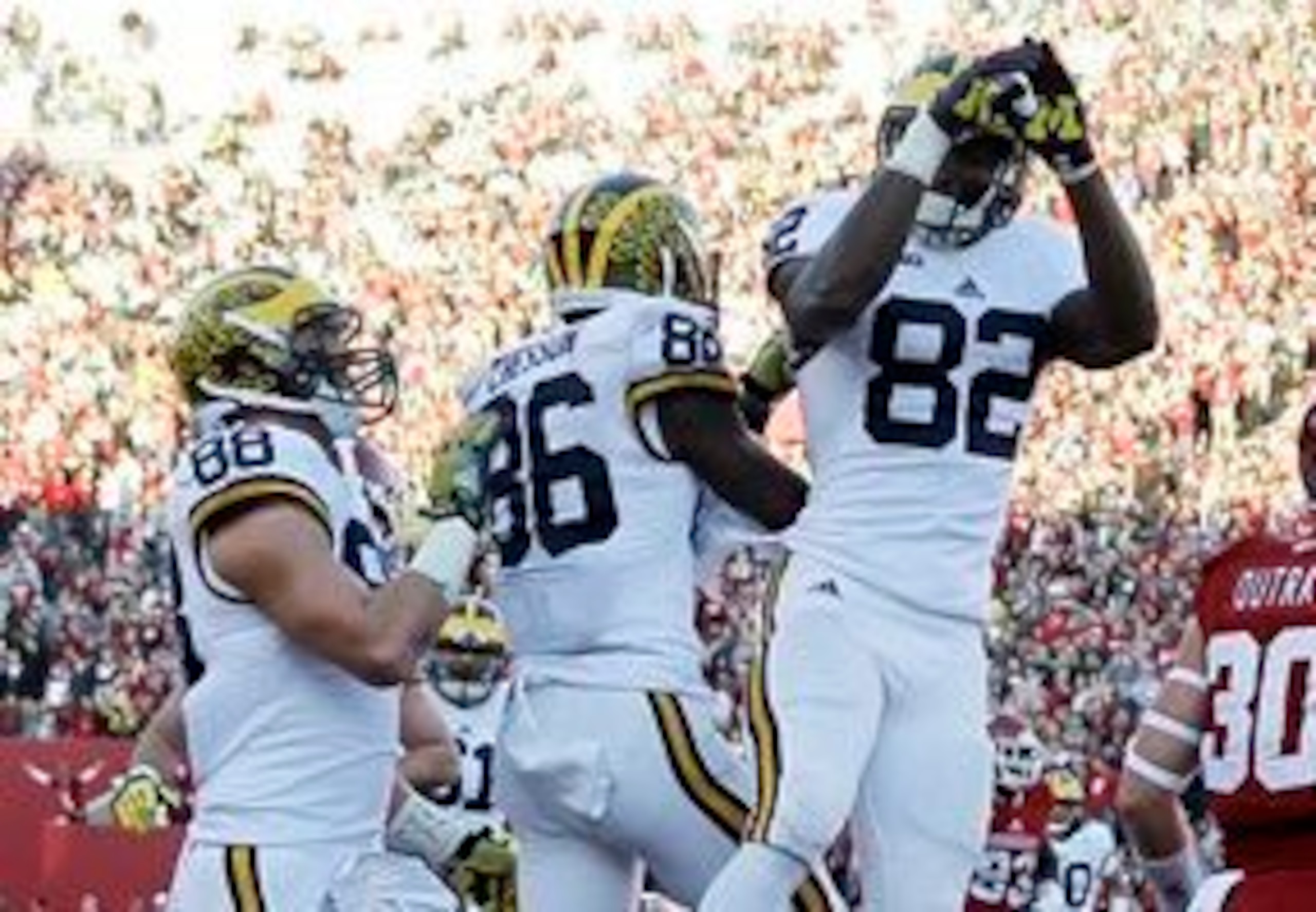
Jake Butt, Jehu Chesson and Amara Darboh had plenty to celebrate not only against Indiana but all season long.
The junior tight end Butt recorded 48 receptions for 620 yards and three touchdowns. Chesson grabbed 45 passes for 646 yards and a team-leading eight scores. Darboh led Michigan with 56 receptions and 703 yards, adding five touchdowns.
Overall, the trio accounted for 62.6 percent of the team's catches, 70.0 percent of the yards and 88.9 percent of the touchdowns. The Wolverines only had three key targets, but they still managed to produce at a high level.
Just two other targets had double-digit receptions or 100-plus yards or caught a touchdown.
Standard-Down Rushing Yards
3 of 5
Football Outsiders has a tremendous stat called standard-down line rush yards. Here's the definition of what it tracks: "The raw, unadjusted per-carry line yardage for a team on standard downs (first down, 2nd-and-7 or fewer, 3rd-and-4 or fewer, 4th-and-4 or fewer)."
Michigan probably doesn't like looking at it, though, since the offense finished with an average of 2.69 yards per standard-down carry. That ranked 99th out of 128 FBS programs.
The absence of major success on the ground wasn't shocking because of an average offensive line, but it certainly contributed to a game-planning change over the final month of the year.


Late-Season Shift to Jake Rudock
4 of 5
Once the Wolverines realized they could trust Jake Rudock—and he stopped committing bad turnovers—the aerial attack became the focal point of the Michigan offense.
After throwing 43 times during the season opener at Utah, the Iowa transfer averaged 24.9 pass attempts over the next seven games. But the rushing attack regularly failed, and Rudock started to show he was capable of carrying the offense, not simply guiding it.
Rudock amassed a career-best 337 yards against Rutgers. He topped that mark the following week against Indiana with 440 yards, also throwing six touchdowns—which doubled his previous personal high.
The senior launched 38 and 32 passes against Penn State and Ohio State, respectively, finishing November with 35.3 attempts per game.
Third-Down Defensive Success
5 of 5
No matter how good a defense is, opposing offenses ought to be able to convert 3rd-and-3 or less. A bigger test of the defense is how it performs against intermediate third downs.
Per Bleacher Report research, the Wolverines surrendered 23 conversions on 42 attempts with three yards or fewer to go. The 54.8 success rate isn't great, but it's not awful, either.
In 92 third-down situations with between four and 10 yards to the sticks, Michigan absolutely locked down the opponent. Just 10 of those 92—10.9 percent—gained the necessary yardage.
Thanks to a 7.6-yard average distance to go and the intermediate prowess, the Wolverines finished the regular season as the nation's No. 3 third-down defense and with a 9-3 record.
All recruiting information via 247Sports. Stats from cfbstats.com or B/R research. Quotes obtained firsthand unless otherwise noted. Follow Bleacher Report CFB Writer David Kenyon on Twitter @Kenyon19_BR.
_0.png?w=2560)


.jpg?w=2560 "Grading WWE Raw 🔠")


.jpg?w=2560 "2 NFL Officials Suspended")


.jpg?w=2560 "Viral Rams Coach Vid 🖕")