

Oregon vs. Stanford: Game Grades, Analysis for Ducks and Cardinal
Quarterback Kevin Hogan almost orchestrated a wild come-from-behind victory, but he and No. 7 Stanford came up short in a thrilling 38-36 upset loss to Oregon in Stanford Stadium Saturday night.
The Cardinal (8-2) were in the thick of the College Football Playoff race, but the big win from the Ducks (7-3) has likely knocked them out of contention.
Here's how both teams graded out from the exciting showdown.
TOP NEWS

Week 5 AP Top 25 Poll 🔢

Updated CFP Bracket Projections 🔮
Top Overreactions after Week 5 of CFB Season 😧
| Pass Offense | B | B+ |
| Run Offense | A | B |
| Pass Defense | B | C |
| Run Defense | C- | B- |
| Special Teams | C | B |
| Coaching | A | A |
Oregon Ducks Grade Analysis
Pass Offense
It's not that Oregon's pass offense was bad early—it was just nonexistent as the offense hammered the run to start the game. Vernon Adams didn't throw his first pass until the early stages of the second quarter, and he didn't do anything of note until he threw a 47-yard touchdown strike to Darren Carrington at the end of the first half.
Adams finished with 205 passing yards, completing 10 of 12 passes for two touchdowns and no interceptions.
Run Offense
Oregon wanted to establish the ground game early, and that was evident as it called seven straight runs to open the game. It only took the Ducks two minutes to get on the board, as they averaged more than 21.4 yards on their first seven carries.
That set the tone for the whole night. Royce Freeman paced the team, running for 105 yards and a touchdown as the Ducks totaled 231 rushing yards Saturday night.
Pass Defense
Hogan has been labeled as a game manager at the quarterback position, and that's what he was early on Saturday night. The Ducks couldn't do anything to disrupt his rhythm until a pass bounced off Christian McCaffrey's chest and right into the arms of linebacker Rodney Hardrick.
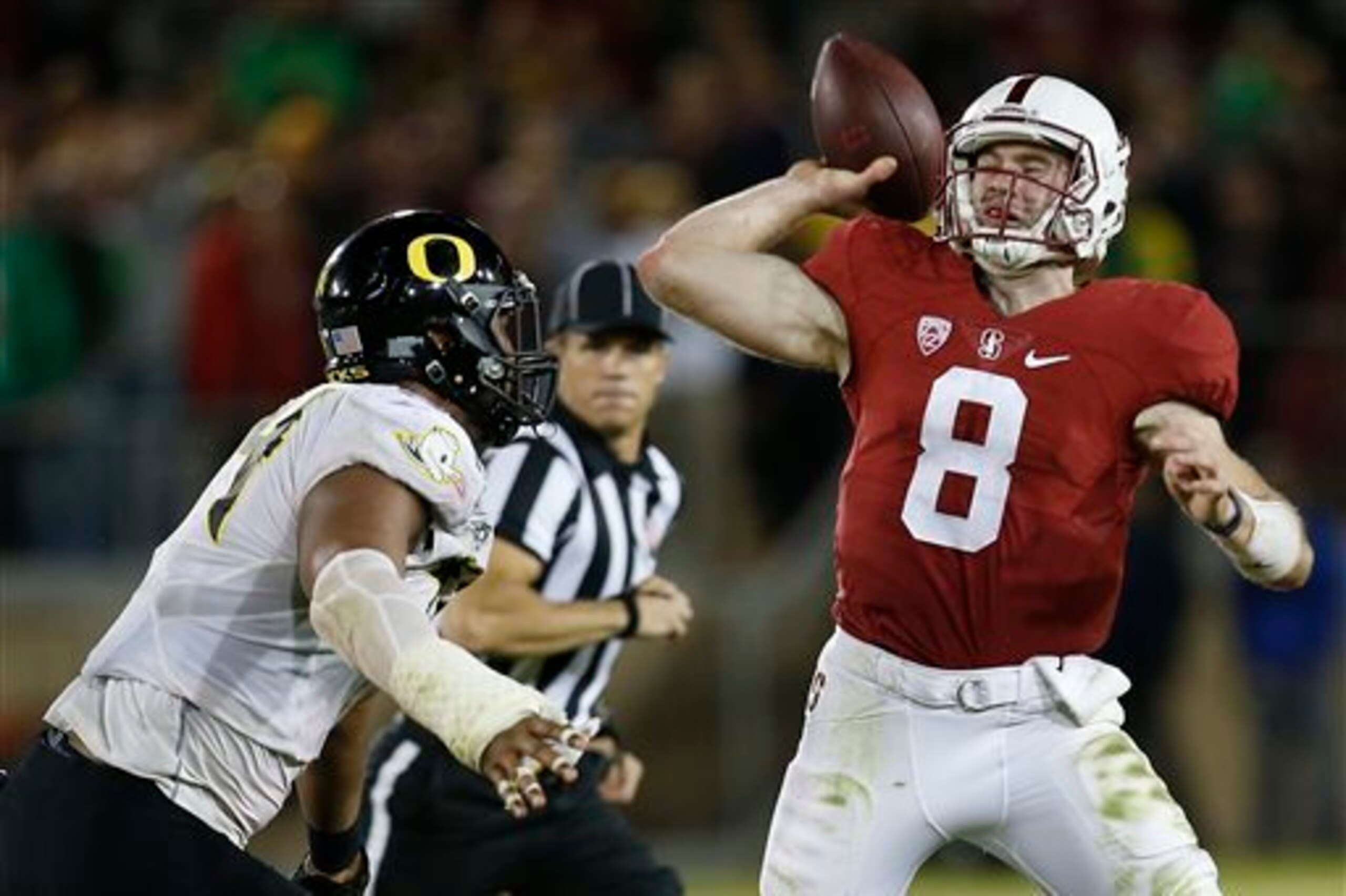
Hogan still managed to throw for 304 yards and complete 75.7 percent of his passes.
Run Defense
Anytime a defense faces Stanford, it has to prepare for a dogfight in the trenches. The Cardinal ran right at the Ducks Saturday night, piling up an incredible 25 carries in the first half alone. Oregon did a good job of limiting the big play, but the Cardinal still averaged 5.5 yards per carry in the first half.
It was more of the same in the second half as Stanford finished with 202 rushing yards on 47 carries, averaging 4.3 yards per carry.
Special Teams
It was a quiet night for Oregon's special teams—and especially in the first half when Aidan Schneider wasn't asked to attempt a field goal, Ian Wheeler had just one punt (for 29 yards), and Charles Nelson had just one return (for 19 yards).
The second half was almost as uneventful, with the exception that Schneider drilled a 31-yard field goal that proved to be the difference.
Coaching
Oregon has never adjusted its style of play against power teams. The Ducks want to score as many points as quickly as possible, and that was evident as the Cardinal dominated the time of possession 42 minutes to 18. The Ducks came in and did what they wanted, and it worked to perfection as they upset one of the country's strongest teams.
| Pass Offense | B- | B |
| Run Offense | B | B- |
| Pass Defense | D | D |
| Run Defense | F | C+ |
| Special Teams | A | B |
| Coaching | C | D |
Stanford Cardinal Grade Analysis
Pass Offense
The Cardinal established a good connection between Hogan and Michael Rector early, who hauled in five of the 13 Stanford receptions in the first half for 63 yards. Hogan was essentially perfect, throwing just four incompletions through two quarters, and his early interception was the result of a perfectly placed pass that bounced off his receiver's chest and directly into the hands of a defender.
Hogan completed 28 of 37 passes for 304 yards and two touchdowns against one interception.
Run Offense
Stanford did exactly what it wanted in the run game, especially in the first half, when it used McCaffrey as the workhorse against the Ducks defense. The sophomore toted the ball 19 times for 92 yards and a touchdown through two quarters, but the first-half highlight belonged to Hogan when he ran through (and over) the Oregon defense on a 22-yard touchdown.
The Cardinal finished with 202 rushing yards on 47 carries.
Pass Defense
Oregon didn't test Stanford's secondary much in the first half as Adams attempted just six passes, but one of the biggest plays of the game came when he dropped back for a pass. Stanford's pass rush got after Adams and forced a fumble, and linebacker Kevin Anderson scooped it and returned it 51 yards to set the offense up inside Oregon's 10-yard line.
The Cardinal gave up 109 passing yards in the first half and 202 total against Adams and the Ducks.
Run Defense
Stanford came into the game with the nation's No. 25 run defense, allowing just 123.4 rushing yards per game. It only took Oregon seven plays to eclipse that mark as it used its array of ball-carriers to gash the Cardinal's front seven.
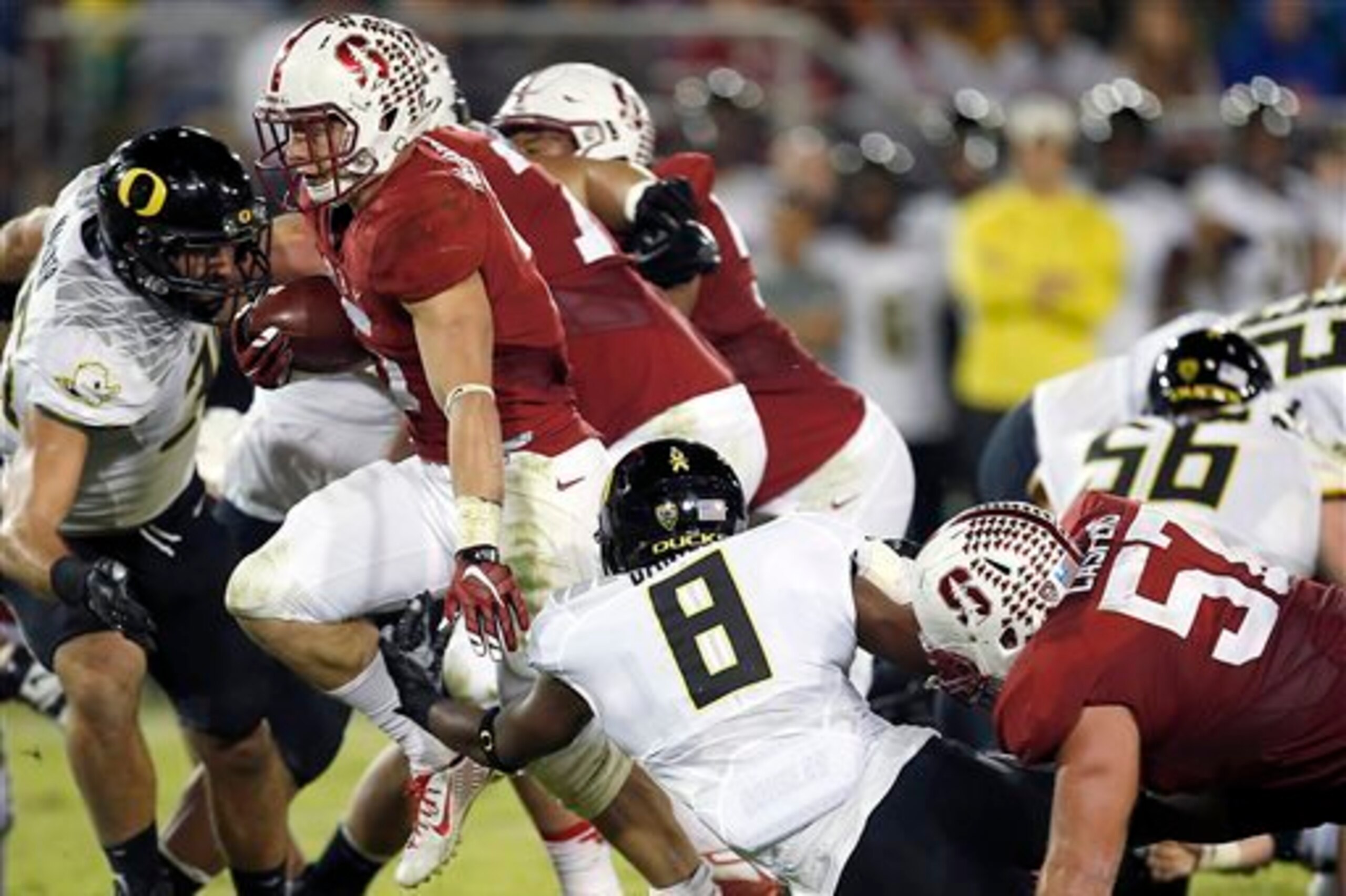
Stanford settled in after that first-quarter onslaught, though, as the Ducks ran for just 81 yards on their final 29 carries of the game.
Special Teams
Stanford kicker Conrad Ukropina had a sensational first half, drilling a trio of field goals from 24, 34 and 49 yards. His fortunes turned in the third quarter when he missed a 43-yard attempt that Stanford desperately needed, but overall, it was a solid night from the Cardinal's special teams. Alex Robinson's only punt went for 50 yards, but McCaffrey wasn't able to break free on any returns.
Coaching
Oregon typically struggles against big teams with physical fronts on both sides of the ball, and that's the identity Stanford has built over the last decade. But even though the Cardinal dominated the time of possession, they weren't able to take the potency away from the Ducks offense despite their limited opportunities.
It was the defense that faltered Saturday night, and because of that, Stanford's playoff hopes suffered a severe (and likely permanent) blow.
_0.png?w=2560)

.jpg?w=2560 "Grading WWE Raw 🔠")

.jpg?w=2560 "Viral Rams Coach Vid 🖕")

.jpg?w=2560 "Injury-stricken Seahawks signing veteran RB")

.jpg?w=2560 "Bijan's INSANE 1st Half 🤩")
