

How Green Bay Packers Can Use Offensive Efficiency to Find the End Zone
The 2015 iteration of the Green Bay Packers offense is missing pass-catchers with burner speed and an unstoppable deep threat.
In fact, the Packers are currently ranked 26th in the league in total offense, averaging 340.9 total yards and 225.3 passing yards per game.
But all of that is fine, in theory. The Packers don't need to feature an explosive offense comprised of multiple plays of 20, 30, 40-plus yards in order to be successful.
TOP NEWS

New NFL Power Rankings 📊
The Robinsons POUND the Rock 🪨
Takeaways from Falcons' dominant MNF win
They just have to get into the end zone.
For as much as this unit has struggled in 2015—and you can argue whether that's the result of missing Jordy Nelson, the lack of a run game, injuries to receivers, subpar tight ends or Aaron Rodgers' play—it has still been finding its way into the end zone.
Heading into their Week 10 matchup against the Detroit Lions, in fact, the Packers are No. 10 in the league in points per game, averaging 25.4.
| 340.9 | 25th | 225.3 | 25th | 25.4 | 10th |
At the end of the day, all that matters is scoring more points than one's opponent; there are no points for style.
The Packers don't have to put on a show to get into the end zone, but they do need to get down the field. Here's how they can do it well enough to outscore opponents in the next eight weeks.
Green Bay is certainly missing Nelson this season, and it could benefit from a huge, fast pass-catching tight end. But the team's woes this season are not due to a lack of playmakers; instead, the scheme isn't quite using those players to the best of their abilities.
ESPN's Rob Demovksy shared how "fast" each NFL team's offense is by adding the 40-yard dash results of each team's top three receivers and No. 1 tight end. The Packers' group of Randall Cobb, Davante Adams, James Jones and Richard Rodgers averages out to a league-worst 4.65 seconds.
Now, most measurements taken at the NFL combine fall by the wayside once a player builds a body of NFL work. But one oft-repeated phrase that is absolutely true: You can't coach speed.
However, 40 times in and of themselves aren't the final word on speed.
With a 4.55 40 time, Cobb isn't one of the league's fastest slot receivers on paper, but he is quick enough to get the corner and gain yards after the catch. This fact passes the eye test when watching him on tape.
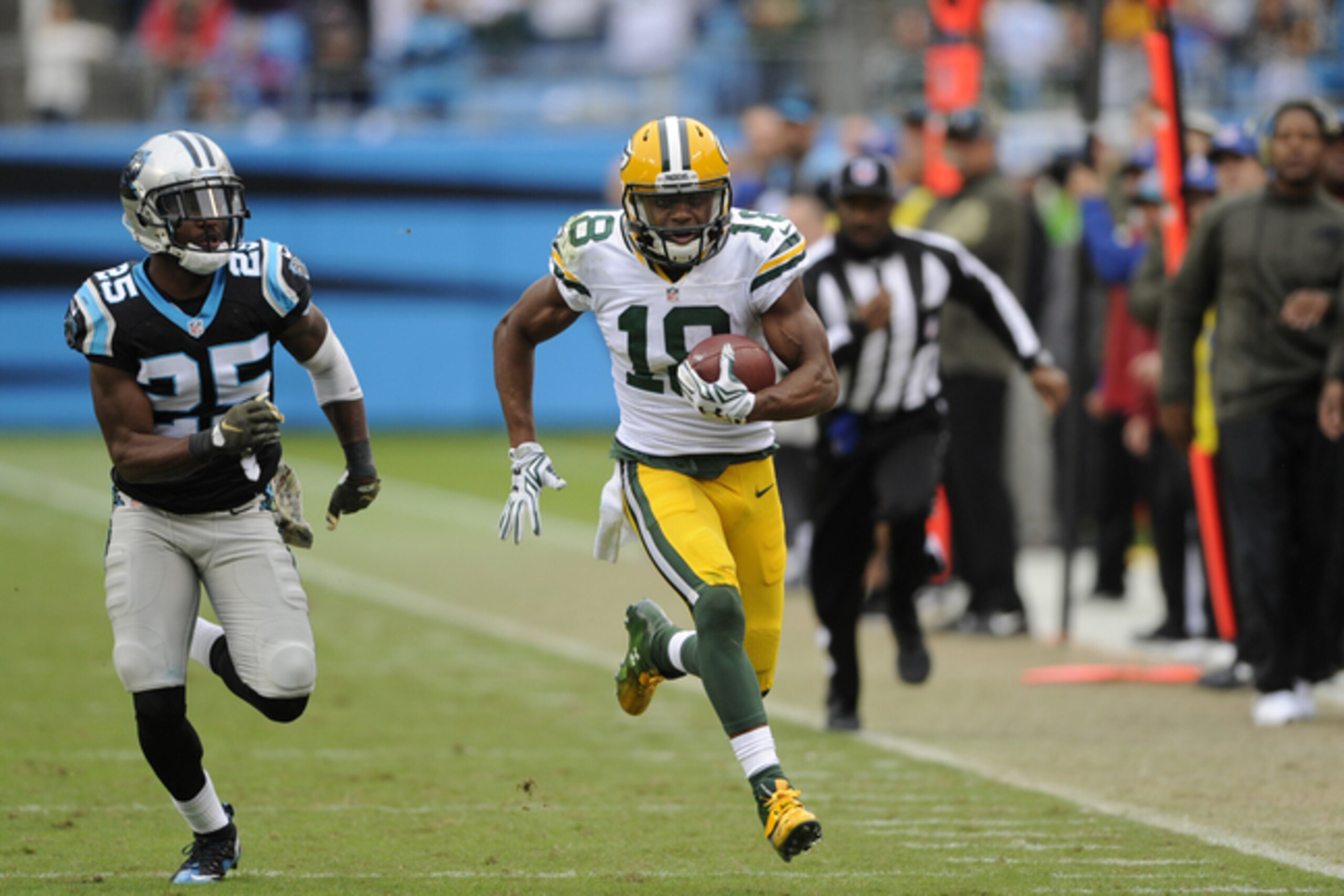
However, tight end Rodgers, who ran a 4.87-second 40 and whose speed was considered pedestrian at the combine, unfortunately looks slow on the field.
He averages only 4.6 yards after the catch per reception, per Pro Football Focus, largely because he can't accelerate past safeties after catching short-yardage passes.
This was evident against Carolina, when Rodgers couldn't beat safety Roman Harper for more than two yards.
Lack of speed isn't a death knell for offenses, though. For instance, the Patriots came out as the second-slowest team in the NFL, and they are leading the league in scoring (34.5 points per game) and are second in production (420.3 total yards per game).
That's because New England's scheme utilizes its weapons to the best of their abilities, allowing them to be successful despite limitations in skill or technique.
This is the area in which the Packers haven't always been successful in 2015. While it could in part be due to the shift in play-calling responsibilities from Mike McCarthy to Tom Clements, that's too easy of an answer. McCarthy is still closely involved in the game plan and in the play selection on the sidelines.
The answer to the problems in the Packers offense is efficiency. If players aren't going to be able to break for a 50-yard gain on a post route, for instance, they have to be successful in the short and intermediate game.
That, as always, begins with the run game. Now that James Starks has surpassed Eddie Lacy as the No. 1 back on the depth chart, the Packers should be able to increase their average yards per carry. Starks is averaging 4.3 yards per attempt, while Lacy was averaging just 3.7.
The Packers also need to get their best weapons into position to make plays on the field. Cobb is one of the few receivers in this group who is quick enough to beat his defender on a short pass and gain yards upfield. Green Bay needs to move him around to find favorable matchups, whether that's lining him up in the right slot, the left slot or the backfield.
When rookie speedster Ty Montgomery returns to the lineup, he and Cobb can run man-beater routes from both slots, confusing defenders and nearly ensuring that one of them will be open for Rodgers on a quick slant.
Perhaps the need to defend both Montgomery and Cobb in the slot would allow Rodgers to find a deeper open target in single-high safety coverage occasionally, but again: That should not be the strategy for this Packers offense.
Efficiency is key; converting first downs and working down the field gets the job done just fine. This also has the added bonus of tiring the opposing defense and eating up the clock.
Montgomery was limited in practice on Wednesday, as Michael Cohen of the Milwaukee Journal Sentinel reported. There's no word yet on his status for Week 10.
As Cohen's tweet also demonstrates, the offensive line is banged up, and that unit is key to the Packers improving at working steadily down the field.
Both pass blocking and run blocking were atrocious against the Panthers, with the line giving up five sacks and 14 hits on Rodgers.
In the rushing game, the backs only averaged 3.3 yards per carry, with the attempts in the A-gap between left guard Josh Sitton and center Corey Linsley going particularly badly, per Pro Football Focus. Lacy attempted two rushes through that gap and gained only four yards, while Starks had one attempt through that hole for no yards.
It may seem that all this comes down to a tall order: The receivers, running backs and offensive line must all improve in order for the offense to get better. But it's not as much of a long road back as it sounds.
The scheme needs to help the players be successful. The Packers need to game plan for short or intermediate gains down the field, and Rodgers needs to focus on the positive gains, not the tempting big play.
The receivers need to win their routes and gain yards, because well-designed route-running can mitigate lack of speed or explosiveness.
"You know the technique that you’ve been coached to do to win your route," said James Jones, per Demovsky. "It doesn’t matter how fast you are or how slow you are or how quick you are. Everybody in that room has made plays. Everybody in that room knows how to run routes and get open."
If the Packers can scheme like New England, for example, and get their receivers into places where Rodgers can hit them quickly, it will minimize opponents' pass rushes and help Green Bay's weapons find success down the field.
More man-beater routes and crossing plays can put more receivers into Rodgers' line of sight and allow him to find an open target and release the ball quicker.
This offense doesn't need 50-yard plays to find the end zone; its 25.4 points per game proves that. It just needs lots of five-yard ones.

.jpg?w=2560 "Commanders Eagles Football")
.jpg?w=2560 "Grading WWE Raw 🔠")



.jpg?w=2560 "Viral Rams Coach Vid 🖕")