

Kobe Bryant and Phil Jackson Aching to Prove NBA Hasn't Left Them Behind
Five years after winning their last NBA title together, Kobe Bryant and Phil Jackson are meeting again, this time as opponents, both of them chasing something they aren't supposed to need anymore.
Validation.
Sunday's matchup between Bryant's Los Angeles Lakers and Jackson's New York Knicks hardly serves as a referendum on legacies or forthcoming success and failure, with both teams rooted in nothing more than collective states of TBD.
TOP NEWS

LeBron's Special Helicopter Deal

MJ Makes Record-Setting Donation 🙌
Shams: KAT, Hart Could Be Trade Names
New York is a fringe playoff contender headed in the right direction but still trying to distance itself from a decade of serial shortsightedness. Los Angeles couldn't be further removed from the Western Conference postseason discussion if it found the edge of the universe.
It wasn't long ago that Jackson and Bryant once ruled the NBA with their rings and their dynasties and the formality that they would one day walk away, for good, at the top of their respective professions.
Now, with both still entrenched in the league's daily grind, they're trying to prove they belong at all—Jackson as a triumphant coach plying his philosophies in the front office, Bryant as the championship-caging all-star turned ineffective remnant of the past.
Kobe vs. the Future

Bryant is plenty familiar with the criticism.
The trade demands. The feud with Shaquille O'Neal, his running mate for three championship pushes. His treatment of certain teammates. Public displays of dissatisfaction.
Bryant's warts, just as much as his five rings and 17 All-Star selections (14 appearances), are part of his legacy. But as he plays through his 20th season, the negative perceptions of him are supposed to soften.
To some extent, they have. That's what a definitive sense of the end does. Bryant's career is speeding toward conclusion, and there now exists a greater appreciation for the longevity behind his polarizing reign.
Likewise, over the previous two seasons, as injuries limited him to 41 total appearances, Bryant has been less delusional and more accepting of his own mortality.
His latest moment of humility, per ESPN.com's Baxter Holmes, was perhaps his most humble gesture to date: "I'm the 200th-best player in the league right now. I freaking suck."
In this way, Bryant has humanized himself. He seems more accessible, more introspective, even if jokingly so. And by reaching that point, Bryant should now be in swan-song mode, enjoying a mostly positive sendoff into retirement, whenever that may be, regardless of how the rest of his playing days unfold.
From the moment he put pen to paper on that two-year, $48.5 million extension in 2013, though, pleasantly ebbing into his twilight was never an option.

It isn't just the money, but what that money represents: Bryant is still the Lakers' guy.
Even as he's spent 70-plus percent of their regular-season games since 2013-14 on the shelf, even as they've welcomed aboard the likes of Jordan Clarkson, Julius Randle and D'Angelo Russell, Bryant has remained their top priority.
The result: an environment in which the Lakers' future is being put on hold so that Bryant's war against time can continue.
Bleacher Report's Kevin Ding expanded upon Los Angeles' upside-down approach to the end of Bryant's career, citing head coach Byron Scott as the chief enabler:
"For all his brilliance, and partly because of it, Bryant is fundamentally a challenge to coach. No one but Phil Jackson has really been able to do it, and even Jackson had mixed results. We've suspected all along that it might be thorny for Bryant to accept his limitations late in his career. The Lakers' hope was that a true friend in Scott would be able to genuinely communicate with Bryant in a way no other coach could.
Yet, Scott showed last season he can't be objective with regard to Bryant. Remember, it was Scott who pushed Bryant to play more minutes than even Bryant believed were safe for him—because Scott expected Bryant would just beat the world the way he used to.
"
That Kobe Bryant, the one who used preconceived limitations as steppingstones, doesn't exist anymore. He isn't supposed to exist. Thirty-seven-year-olds fade. They regress. They assume complementary roles, if they're still in the league at all.
Maybe Bryant spoiled the Lakers into thinking they had an exception on their hands. In 2012-13, at the age of 34, with more than 50,000 regular-season and postseason minutes on his treads, he became the oldest player to average at least 27 points, five rebounds and six assists per game.
Perhaps his crazed sense of self is just too powerful for them to rein in. Maybe Scott is simply failing to adequately convey the Lakers' desired direction. Perhaps it's a mixture of everything.

Whatever it is, Bryant's attempts to hold on are overshadowing what should be the Lakers' attempts to move on.
He leads all Lakers (minimum 20 minutes played) in usage rate. He has missed more shots than Nick Young has attempted. He's on track to post the third-worst assist percentage of his career. His effective field-goal percentage is the lowest it has ever been.
And still the Lakers let Bryant's fight against the future—against their next generation, against the present-day superstars who have passed him by—rage on.
Phil's New Frontier

Even now, with the Knicks in much better shape than they were when Jackson was named team president in 2014, it's difficult to understand why the 11-time coaching champion willingly subjected himself to New York's extensive rebuilding project.
Was he, on some level, driven by the Lakers' decision to hire Mike D'Antoni instead of him in 2012? Did the absence of his triangle offense from the NBA landscape shake him to the core?
Is $60 million just a lot of money?
Jackson's motives don't particularly matter now. Only the results are of concern.
Just a few months ago, those returns seemed disastrous. The Knicks wrapped up 2014-15 with a franchise-worst 17 victories. Jackson tore apart the team at the first sign of chaos, a modern-day move if there ever was one, but he still appeared to be living in the past.
As CBS Sports' Zach Harper wrote:
"Jackson openly questioned the importance of 3-point shooting. He preached the Triangle and put out a coaching staff and a roster last season that played at the third-slowest pace in the league. He inherited a mess, and instead of throwing that turmoil under the bus, he spoke of the intent of making the playoffs in the first year. He challenged the modern style of basketball and what was clearly working around the league -- scoffing at the notion it dared matter in a league Jackson's teams dominated for two decades.
"
Adaptation is an integral part of building an NBA contender from the ground up, and Jackson didn't initially seem open to making any adjustments.
Hope lay not in a high draft pick, but in his mystique. The Knicks would use their cap space to sign marquee free agents, and Jackson's reputation—which he mortgaged by jumping back into the Association's fray—would rise again.
Then the offseason actually happened.
The Knicks used their No. 4 pick on Kristaps Porzingis, a long-term project. They traded for Jerian Grant, a pick-and-roll point guard best suited outside the triangle. They didn't sign any huge names, instead settling for role players Arron Afflalo, Robin Lopez, Kyle O'Quinn and Derrick Williams, most of whom are also unfit for the triangle.
Jackson the executive has evolved in that way, in that willingness to tinker and adapt and deviate from the original plan. So too have the Knicks.
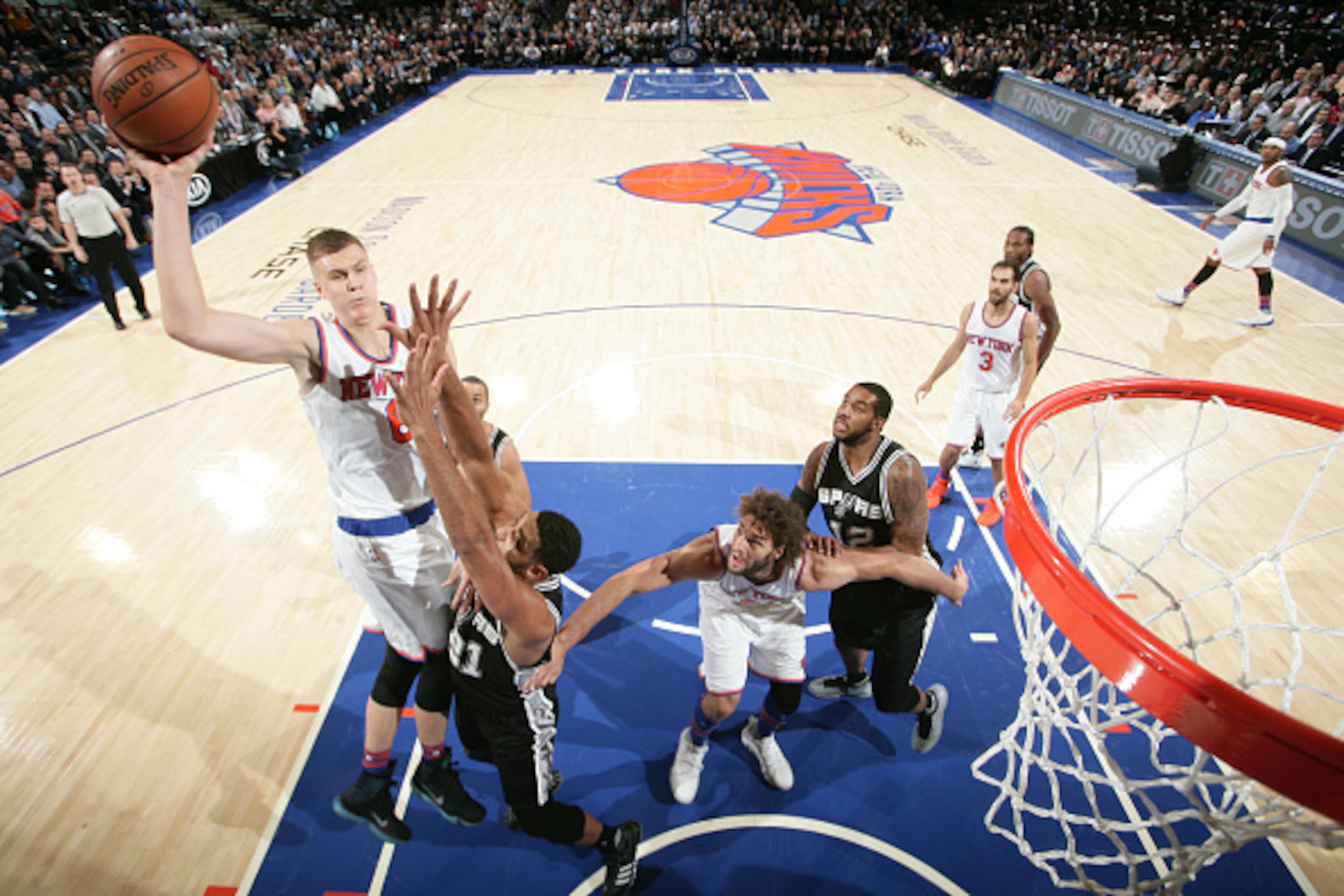
They remain a work in progress but are noticeably more polished. They're devoting more possessions to pick-and-rolls, even if it's not yet enough. They're markedly faster, even if, per the Wall Street Journal's Chris Herring, they're not always putting that speed to good use.
Not everything has changed, to be sure.
More than 30 percent of the Knicks' shot attempts are coming from mid-range, which is entirely too many; no top-10 offense allocated 30 percent of its looks to mid-range opportunities last season. Head coach Derek Fisher also needs to iron out a definitive rotation, one that doesn't have him fielding random lineup combinations in the fourth quarter.
Still, the Knicks are anything but a spitting image of Jackson's original vision. And that's his first major victory.
The Search for Better, Not the Best, Days
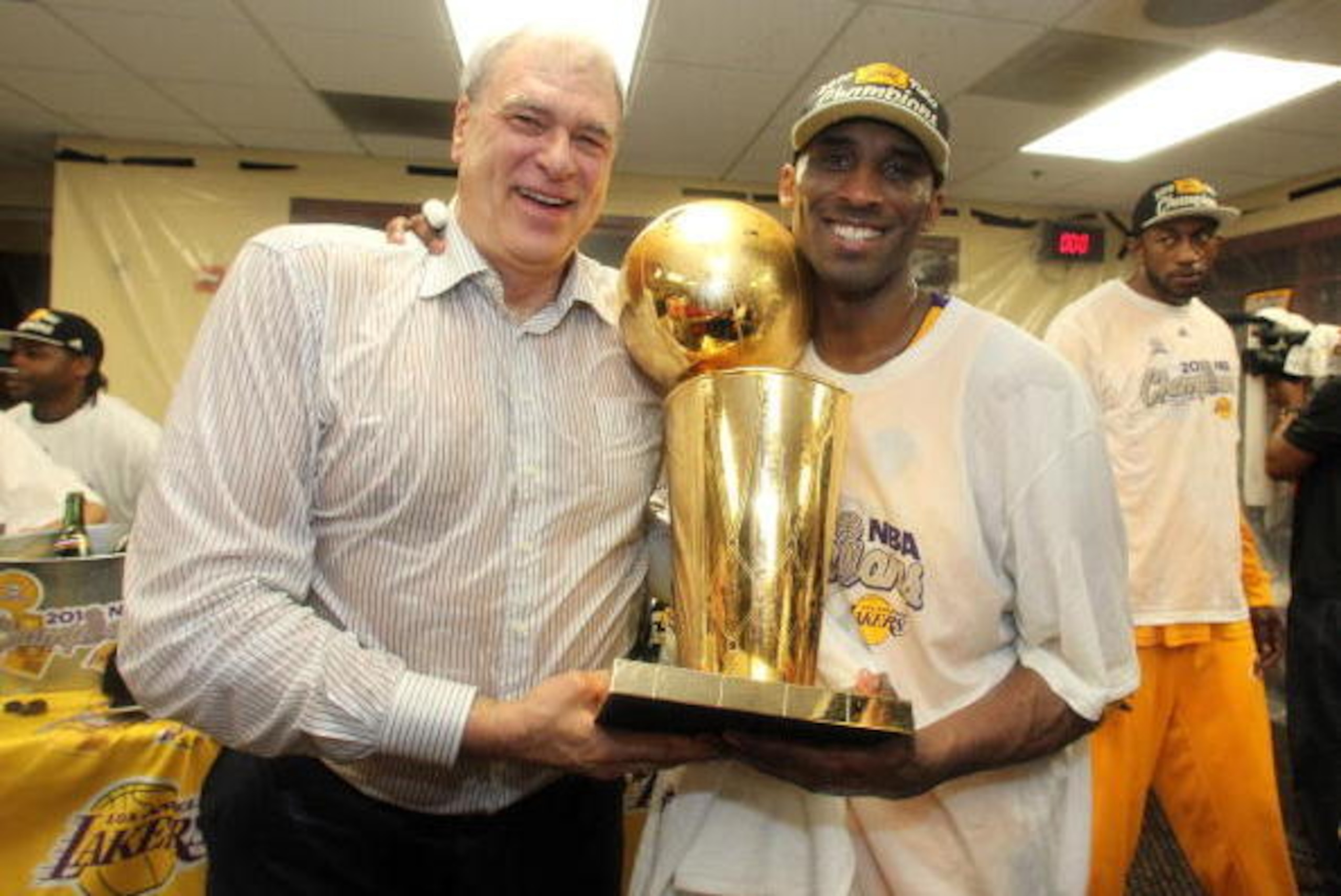
Nothing Bryant and Jackson do, or fail to do, before taking their permanent leave will erase what they've already done, both separately and together. Each and every one of their feats, their championship rings, still matters.
At the same time, there is no going back. It will never get any better than it once was. The Knicks, while much improved, may not start contending for championships until Jackson's five-year deal runs its course; Bryant is chasing nothing more than late-career respectability through inexplicable volume.
The days of the NBA's bowing to both basketball icons are over.
To the contrary, as Jackson and Bryant plow through this new, foreign stage of their careers, their greatest challenge remains surviving in an era that views both as something less.
Stats courtesy of Basketball-Reference.com and NBA.com unless otherwise cited and are accurate leading into games for Nov. 5.
Dan Favale covers the NBA for Bleacher Report. Follow him on Twitter, @danfavale.

.jpg?w=2560 "Grading WWE Raw 🔠")


.jpg?w=2560 "Viral Rams Coach Vid 🖕")
.jpg?w=2560 "Injury-stricken Seahawks signing veteran RB")