

The Nightmare Scenario for College Football Playoff Selection Committee
Relax. It'll all work itself out.
That was the message relayed by Bleacher Report colleague Adam Kramer Tuesday night following the unveiling of the first College Football Playoff Top 25. Kramer's not wrong, nor is he alone. While ESPN's rankings show can easily spark heated feelings and a sense of controversy—that is, of course, ultimately the point of the show—the general chorus of reaction was levelheaded.
TOP NEWS

Week 5 AP Top 25 Poll 🔢

Updated CFP Bracket Projections 🔮
Top Overreactions after Week 5 of CFB Season 😧
Ohio State was ranked 16th in last year's initial poll.
All of these things are true in and of themselves. However, they all operate under the assumption things will, in fact, work out naturally.
But what if they don't? After all, there have been few truly dominant teams. What if, instead of things getting clearer, they get more convoluted? As Chris Vannini of CoachingSearch.com tweeted, so many schedules across college football are both incomplete and back-loaded. Paul Myerberg of USA Today noted the sheer number of ranked teams that still have to play one another in a finite time span.
For every optimist, there is a pessimist. Here's assuming nothing in college football "works itself out." Here's betting every team loses at least once—shoot, maybe twice. Here's thinking of a world of conference tie-breakers and Group of 5 playoff crashers.
Here's college football's nightmare scenario. (For visual representation, allow us to direct you to the late, great Chris Farley attempting to sell brake pads.)
The SEC's Postseason Streak is Jeopardized
Since the SEC is almost always at the center of the discussion, it's as good a place to start as any.
Jon Solomon of CBS Sports called the first playoff standings an "SEC love affair," and it's hard to say that's not the case. "The committee ranked LSU, Alabama, Florida, Ole Miss, Texas A&M and Mississippi State all higher than those teams are slotted in both the Associated Press and USA Today coaches polls," Solomon wrote.
Specifically, the Alabama Crimson Tide coming in at No. 4 struck a particular nerve.
“How [Alabama] won those games that they won against quality opponents, I think that sends a strong message of why we ranked Alabama higher than Florida,” committee chair Jeff Long said.
The noteworthy detail about Alabama, however, is it does not control its SEC West destiny. Even if the Tide beat LSU on Saturday, they sit behind Ole Miss in the West standings because of a head-to-head loss. If the Rebels win out, they go to Atlanta for the SEC title game, not Alabama (or LSU).
Ole Miss, though, has two losses (to Florida and Memphis). If Ole Miss wins the SEC as a two-loss team, it potentially puts the SEC's postseason appearance in jeopardy by allowing an undefeated Memphis to vault into the top four. Whether the Rebels are capable of that is another story.
Yet a two-loss Ole Miss still might not be the worst thing that could happen to the SEC. Let's say Florida wraps up the SEC East on Saturday against Vanderbilt. Since the Commodores have all of three wins, and the Gators facing them at home, it's no surprise OddsShark.com lists Florida as a three-touchdown favorite.
But then, Florida then loses a stunner at South Carolina and drops its rivalry game against Florida State. The Gators would still be Atlanta-bound, but as a three-loss team. What if Florida then beats Ole Miss for the second time this year to become SEC champs?
Does the selection committee do the expected thing and leave the SEC out of the playoff field? Or, does it dare insert a one-loss, non-divisional winner like Alabama or LSU into the field? It could be 2011 all over again.
On That Note: Let's Talk About Memphis
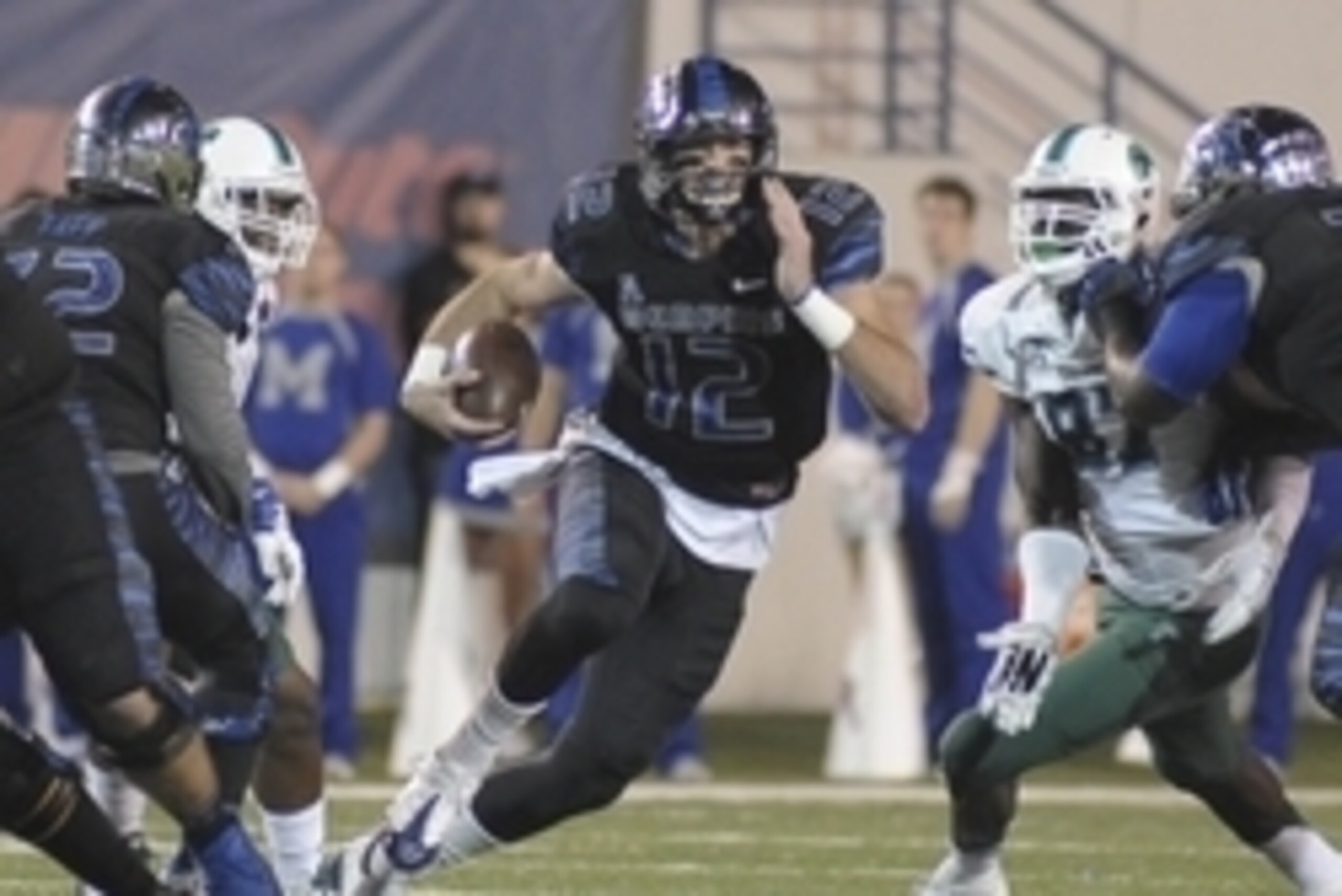
College football's postseason format was not expanded to allow greater access for Group of 5 teams. Ironically, though, the field could feature a Group of 5 team sooner rather than later if college football decides to get especially weird.
Memphis has officially arrived as the playoff Cinderella, coming in at No. 13 in the rankings. The Tigers look the part of a contender and could be the best team outside the power conferences since the days of the Boise State Broncos under head coach Chris Petersen and TCU when the Horned Frogs were in the Mountain West.
The most intriguing part about Memphis is, aside from its win over Ole Miss, this team hasn't faced its toughest stretch yet. Beginning Saturday, the Tigers embark on a three-game stretch—vs. Navy, at No. 25 Houston and at No. 22 Temple—in which its opponents are a combined 21-2. Both losses (by Navy and Temple) came at the hands of Notre Dame.
If the Tigers go unbeaten, they will legitimately be in the playoff conversation. It would be a long shot, as Ralph Russo of the Associated Press and Matt Hinton, formerly of Grantland, opined, but it would be a shot nonetheless.
Perhaps no team in college football would benefit from a cannibalized SEC like Memphis. If nothing else, an undefeated Memphis versus two-loss SEC champion Ole Miss versus one-loss Alabama or LSU would make for a fascinating, and possibly difficult, decision for the committee.
The ACC Screws Itself
Clemson is the ACC's best hope for playoff inclusion, and it's not all that close. The Tigers are the No. 1 team according to the selection committee, and there's no way they drop four spots if they win out.
The Florida State Seminoles are another story. Though FSU has only one loss, it's to a Georgia Tech Yellow Jackets team that might not make a bowl game. Regardless of how that game ended, it's a bad loss. Starting the playoff rankings at No. 16 isn't insurmountable by itself for the Seminoles—eventual national champs Ohio State started there last year—but the loss to the Yellow Jackets might be.
Florida State's ACC title hopes aren't dead, though. In fact, they're alive and well if the Seminoles beat Clemson on Saturday. Such a scenario would be a massive blow to the ACC's playoff hopes. As Stewart Mandel of Fox Sports tweets, the deciding blow would be if the Seminoles win the ACC but lose to Florida in nonconference play.
The other situation in which the ACC could screw itself out of a playoff spot is if Clemson runs the table in the regular season but somehow drops the conference championship game. Similar to the SEC, the committee would have to decide if a nonconference champion Clemson is still one of the four best teams in college football.
Can anyone say 2003 Oklahoma?
Tiebreakers, Part I: The Big Ten
The playoff path for Ohio State, and even Michigan State, is clear if they keep on winning. The Buckeyes rank third in the standings with the Spartans coming in at No. 7. The Nov. 21 game between these two is still weighted with significance.
However, Ohio State also still has to play Michigan on Nov. 28. That's a far bigger challenge than initially thought since Wolverines head coach Jim Harbaugh has turned things around quicker than anticipated. The possibility exists of a three-way tie atop the Big Ten East standings with Michigan, Michigan State and Ohio State finishing 7-1 in conference play. (Michigan State has already beat Michigan.)
For things to get truly wonky, Ohio State would have to beat Michigan State and then lose to Michigan the following week. Tom Dienhart of the Big Ten Network explains what would happen in such a scenario.
The long story short? The playoff committee would play a deciding role in who wins the East division:
"The highest ranked team in the first College Football Playoff poll following the completion of Big Ten regular season conference play shall be the representative in the Big Ten Championship Game, unless the two highest ranked tied teams are ranked within one spot of each other in the College Football Playoff poll. In this case, the head-to-head results of the top two ranked tied teams shall determine the representative in the Big Ten Championship Game.
It would come down to this because the tie wouldn’t be broken by the conference’s first four tiebreakers.
Those are right here:
The records of the three tied teams will be compared against each other. (They all would be 1-1 vs. each other)
The records of the three tied teams will be compared within their division. (They all would be 4-1)
The records of the three teams will be compared against the next highest placed teams in their division in order of finish (4, 5, 6, and 7). (They all would be 4-0)
The records of the three teams will be compared against all common conference opponents. (They all would be 4-0)
"
Oh yeah, that will be fun and not at all entrenched in controversy. Nope, not one bit.
Tiebreakers, Part II: The Big 12
You mean the top of the Big 12 could have a tie? Where have we seen this before?
Last spring, the Big 12 adjusted its tiebreaker procedures to give clarity to what was an unnecessarily confusing title race. In short, if two teams are tied, the head-to-head winner will be named the champion. If this had been in place last year, Baylor would have, officially speaking, been the Big 12's top team.
But it's really the three-team tiebreaker where things get interesting:
"If three or more teams are tied, steps 1 through 4 will be followed until a determination is made. Once a team has been eliminated from a multi-team comparison, it is dropped from further comparisons. If only two teams remain tied after any step, the winner of the game between the two tied teams shall be the Champion.
The conference records of the three or more teams will be compared against each other.
The conference records of the three or more teams will be compared against the next highest placed team(s) in the conference (4, 5 and 6….).
When comparing against the next highest placed teams, a two-way tie among the next highest placed teams will be broken by head-to-head before the comparison begins.
If more than a two-way tie exists among the next highest placed teams, record against the collective tied teams as a group will be used.
Scoring differential among the tied teams. The team with the lowest difference between points scored and points allowed in games vs. the tied teams are eliminated from consideration.
Draw (In the event steps 1-3 cannot break a multi-team tie the champion will be determined by draw at the Conference office.
"
It's good to know the Big 12's protocol on tiebreakers, but the reality is if three teams finish with a loss—say, Baylor, Oklahoma State and TCU—the conference is likely being shut out of the playoff for the second year in a row. That would propel the Big 12 to install a deregulated conference championship, which would give its eventual champion one more critical game against a quality opponent.
The only way a one-loss Big 12 team gets into the playoff is if there are several two-loss conference champions among the Power 5 leagues.

The Pac-12's Uphill Climb
One of the many takeaways from Tuesdays rankings is the Pac-12 is in the worst position of any Power 5 conference. Stanford is the Pac-12's highest-ranked team at No. 11 with Utah one spot behind at No. 12. Only one other Pac-12 team is ranked: No. 23 UCLA.
The playoff hopes for the Cardinal and Utes are still alive, but there's obviously no precedent set for a team coming from as far back in the rankings as UCLA.
"Basically, the league has no margin for error," Stewart Mandel of Fox Sports wrote. "Either Stanford or Utah needs to run the table and finish as a 12-1 champion and hope both TCU and Baylor stumble."
Interestingly, the Pac-12's biggest game might not even be played between two conference opponents. The Nov. 28 game between Notre Dame and Stanford has major playoff implications for both teams. As Mandel notes, if the Irish win out and beat the Cardinal, it may not matter if Stanford wins the Pac-12.
If Notre Dame beats Stanford, the Pac-12 might collectively (and secretly) pull for Utah to win out, provided the Utes still only have one loss.
What Does it Mean?
Here's what the playoff committee could be dealing with if the worst of worst-case scenarios comes to fruition:
| Conference | Nightmare Scenario(s) |
| ACC | Undefeated Clemson loses ACC title game OR two-loss Florida State wins ACC |
| Big Ten | Big Ten East three-way tiebreaker as decided by the playoff rankings |
| Big 12 | Big 12 two-team tiebreaker OR three-team tiebreaker |
| Pac-12 | Two-loss Stanford wins Pac-12 |
| SEC | Two-loss Ole Miss wins SEC OR three-loss Florida wins SEC |
| Group of 5 | Memphis goes 13-0 |
Good luck with that.
The last time college football's postseason was truly in a state of upheaval was 2007. While 2015 hasn't quite reached those levels of tomfoolery, the potential is there.
So brace yourselves, playoff committee. The job isn't an easy one, and it's not without criticism, but Year 1 proved to be relatively straightforward. It also helped that No. 4 Ohio State won the whole thing, making that selection look glorious.
The point being, the committee hasn't faced a situation—or number of simultaneous, non-mutually exclusive situations—in which it was truly tested. Just as many of college football's top teams will be put through the grinder in November, so too could the committee's thought process and decision-making.
To paraphrase a popular college football saying: The selection committee ain't played nobody yet.
Ben Kercheval is a lead writer for college football. All quotes cited unless obtained firsthand.
_0.png?w=2560)


.jpg?w=2560 "Grading WWE Raw 🔠")


.jpg?w=2560 "Viral Rams Coach Vid 🖕")


.jpg?w=2560 "Injury-stricken Seahawks signing veteran RB")
