Breaking Down What's Wrong with the New York Giants Run Defense
After a strong start to the 2015 season, the New York Giants run defense, which resided in the top three spots league wide from Weeks 2 through 5, has taken a free-fall to 21st in the league after seven weeks thanks to its allowing opponents an average of 113.4 rushing yards per game.
What on earth is going on here? Is there a single solution to fix the problems of the last three weeks?
Lastly, is defensive tackle Markus Kuhn’s return to the defensive tackle rotation, which seems to have coincided with the start of the downward spiral for the Giants run defense, to blame?
TOP NEWS
.jpg?w=2560 "Colts Football")
Jonathan Taylor Landing Spots
.jpg?w=2560 "NFL Paris Football")
NFL House in Paris Closes for Protests (AP)
.jpg?w=2560 "Seahawks Chiefs Football")
Trevon Diggs Cut by Seahawks
A Downward Trend
In their first four games of the season, New York’s opponents rushed for an average of 69.7 yards per game (279 yards on 89 carries, an average of 22 rushing attempts per game).
These last three games—against the 49ers, Eagles and Cowboys—those numbers have soared. Over that period, opponents have rushed the ball 105 times (average of 35 times per game) for 512 yards (average of 170.6 per game).
Let’s break down the opponent’s rushes over the last three games in more detail. In the following table, I’ve calculated the percentage of unsuccessful rushes (for zero or negative yardage), successful runs between one and five yards and successful runs that went for five or more yards.
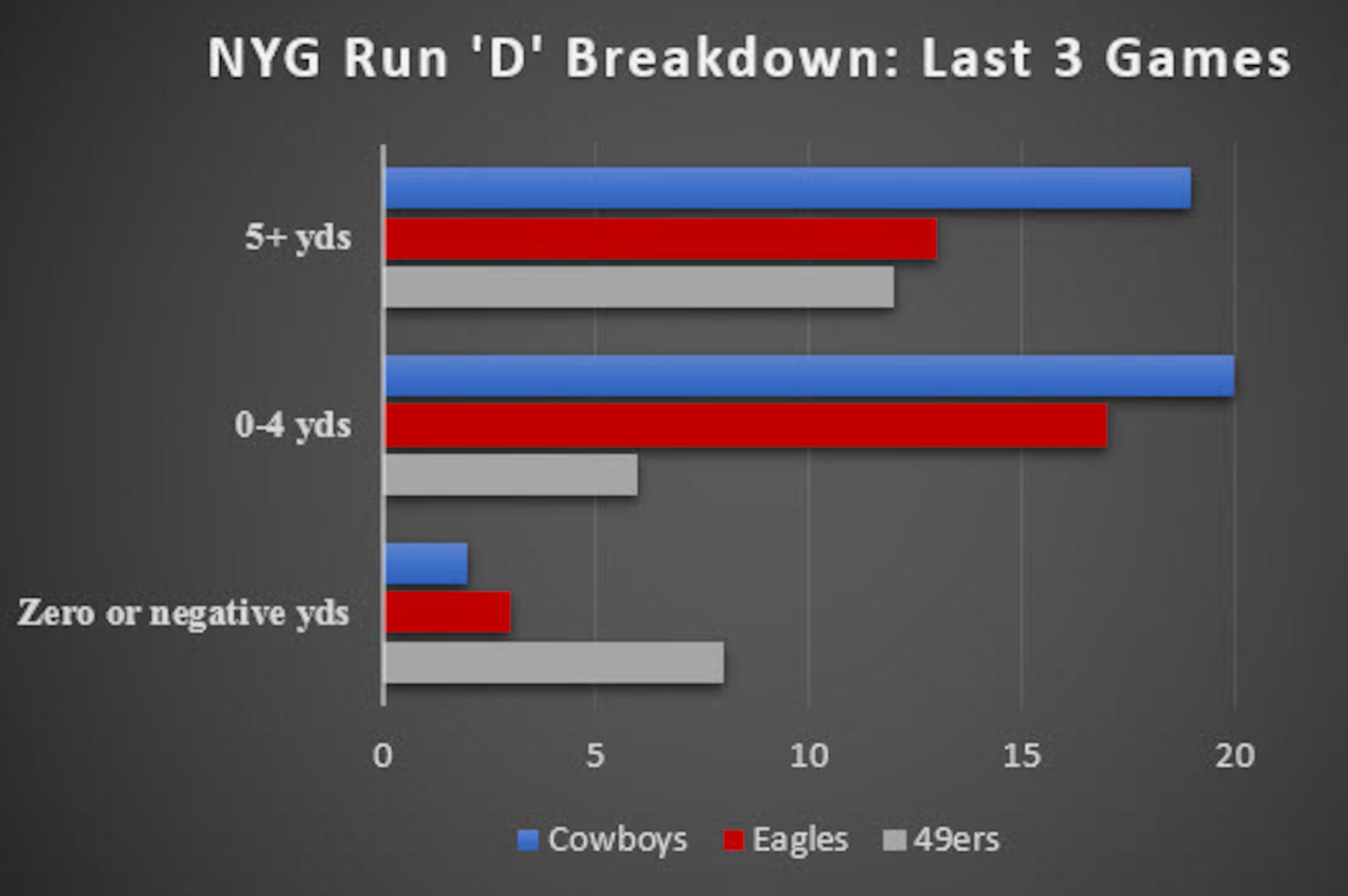
One conclusion that can be drawn from this data that would align with head coach Tom Coughlin’s statement regarding missed assignments, is that the number of zero or negative yards has shrunk over this three-week period while the number of rushes for five or more yards has increased.
Not good.
Where Daylight Can Be Found
Another question in analyzing the run defense’s issues is where the opponents are having the most success running the ball.
According to NFL Game Statistics and Information Systems, here is the breakdown of where opponents’ rushing yards are coming from against the Giants run defense and where each direction ranks league wide in terms of number of times the spot was attacked and the average yards given up.
| No. of Plays | 34 | 22 | 17 | 32 | 23 | 28 | 31 |
| NFL Rank | 3 | 10 | 17 | 24 | 10 | 4 | 3 |
| Avg. Gain | 6.62 | 3.59 | 4.65 | 4.41 | 3.22 | 2.21 | 4.03 |
| NFL Rank | 26 | 15 | 24 | 21 | 11 | 3 | 15 |
Now that we have an idea where opponents are finding success, why can’t the Giants stop them?
A Closer Look at the Problems
In looking through a sampling of plays, there hasn’t been one specific reason why the run blocking has been so poor of late.
Coughlin verified this when he spoke to reporters via conference call on Monday.
“We’ve got to do a better job of holding the point, of being where we’re supposed to be from a gap responsibility, of recognizing the style run that’s coming. We lost leverage on the corner consistently.”
Anything else?
“It’s a number of things—they blocked very well, we were sometimes out of position, and sometimes not maintaining our leverage and our contain responsibilities.
"Our tackling at times was shoddy. We didn’t get away with block tackles, which you don’t like to see anyway, but some of the people in the secondary were trying to implement that and it wasn’t successful. There’s a bunch of reasons why.”
There sure is. Let’s look at some examples.
Exhibit A: Failing to Shed Blocks
On this play coming in the third quarter with 2:35 left, running back Darren McFadden cuts through a nice-size hole for a 22-yard gain, his longest run from scrimmage, as Giants defenders get pushed around like bumper cars in an amusement park.
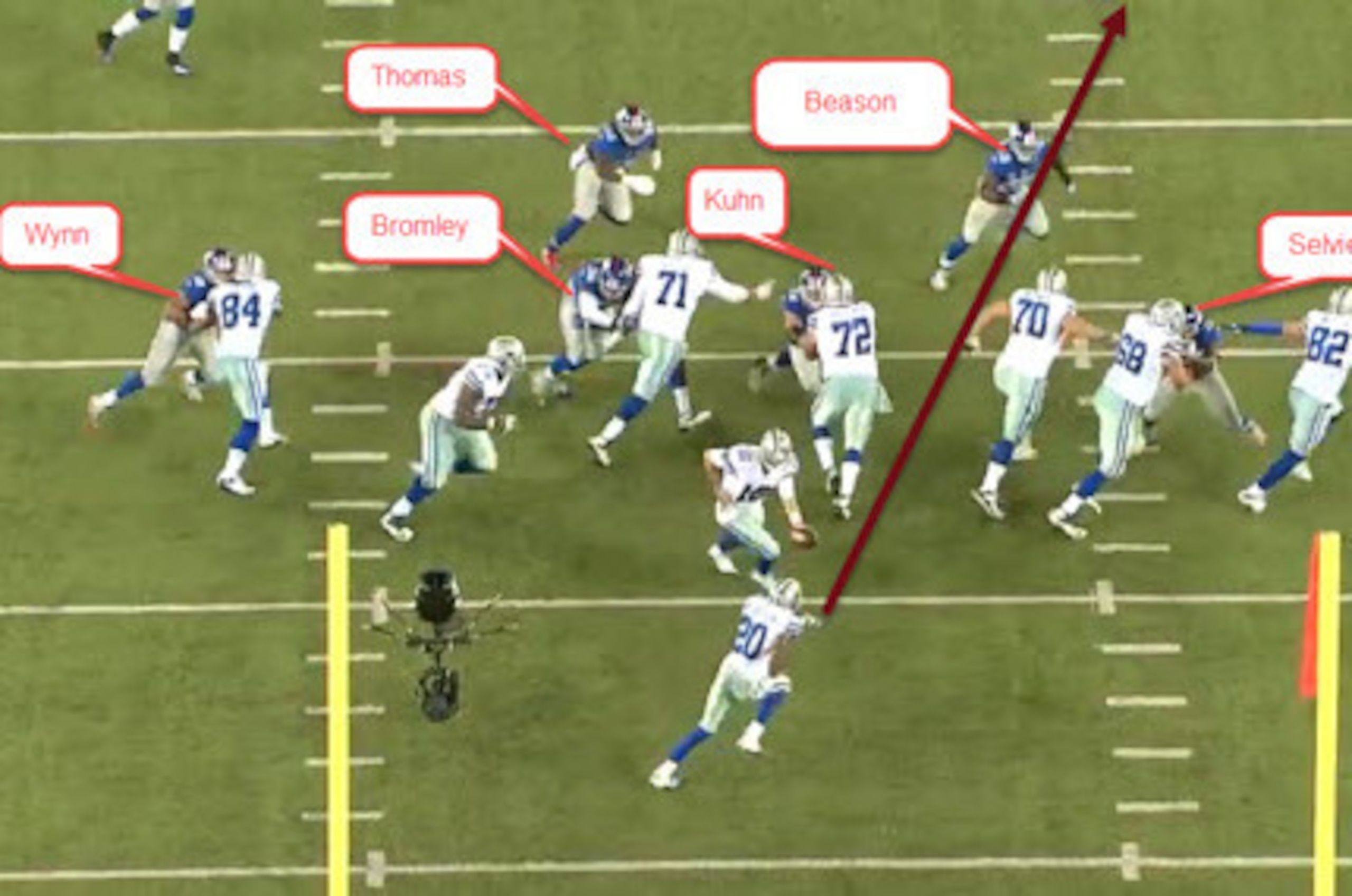
On the outer edge, Kerry Wynn gets swallowed up by backup tight end James Hanna. Kuhn is moved out of the way all too easily by center Travis Frederick, who simply gives him a shove.
Ditto for linebacker Jon Beason, who’s pushed aside by Zack Martin (No. 70).
And while not visible in this screen shot, receiver Brice Butler shoves safety Brandon Meriweather, who ends up off balance and flat on the ground as McFadden penetrates deep into the second level and beyond.
The problem? A size mismatch. Dallas’ offensive line is one of if not the biggest in the league. The Giants, when building their front seven, seemed to sacrifice size for speed, so when they go against behemoths like this, it’s usually no competition.
Exhibit B: Not Protecting the Edge
Because the Dallas game is probably still fresh in everyone’s mind, people no doubt remember how successful the Cowboys were in running plays off the edge.
And why not? The Cowboys ran 14 runs to either the left end or the right end (mostly the left end, which would come against the right defensive end).
Of those 14, six plays went for 10 or more yards. And of the Cowboys' 233 rushing yards, 108 came on the edges.
The idea to test the Giants on the edges likely came from the Giants' game against the 49ers, when Carlos Hyde burst around the corner for a 22-yard, third-quarter run at 11:01 in the game, one of the 49ers' longest plays from scrimmage in that game.
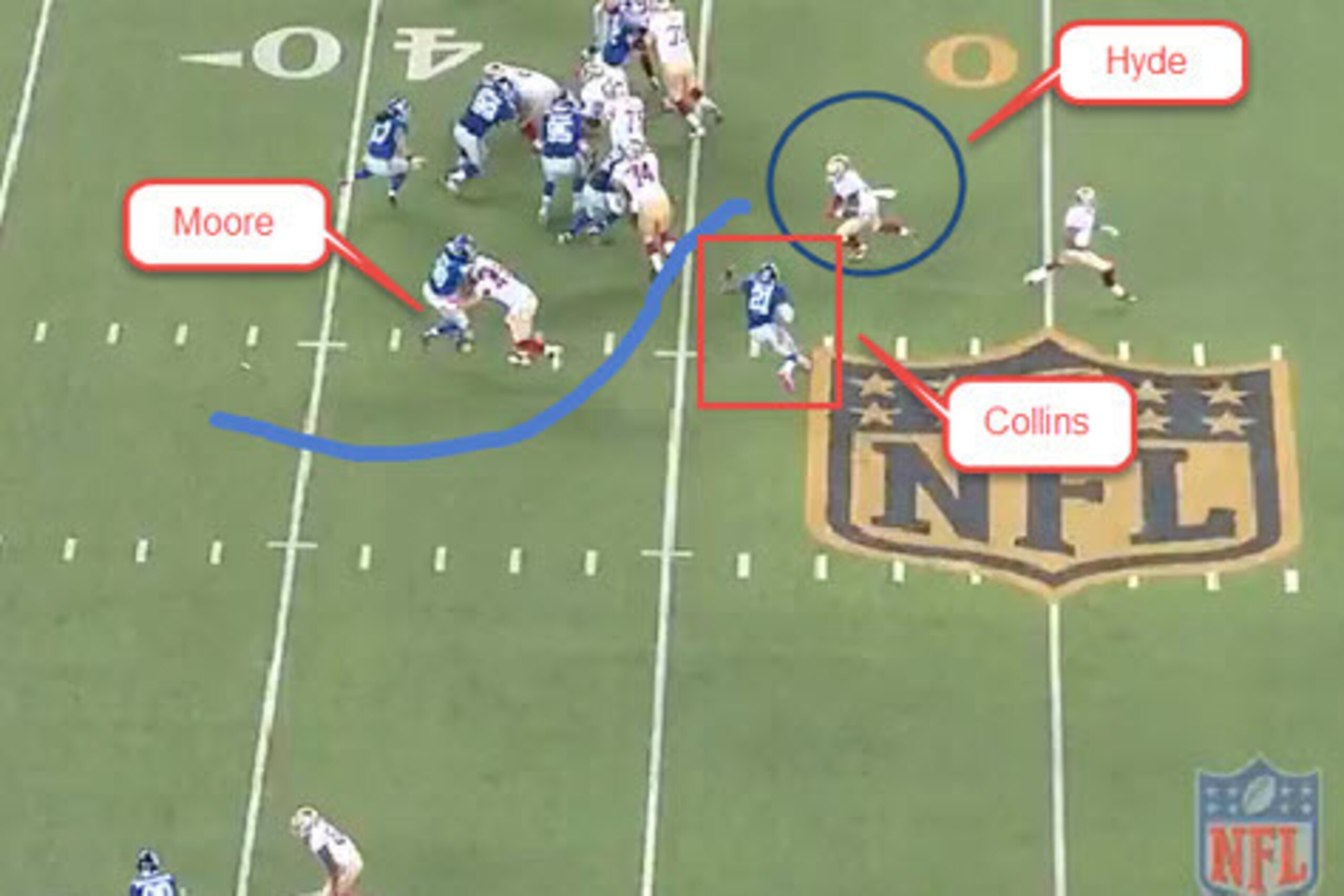
On this particular play, safety Landon Collins came barreling in, leaving the left edge wide open. Hyde cut back his run and had a huge chunk of field to run down untouched for the big gain.
However, the big run isn’t so much on Collins as is it on defensive end Damontre Moore. Moore, not exactly known for his run defense, could not shed his block, which left the edge wide open. If he sheds that block, it’s more than likely he and/or Collins stop Hyde for a loss of yardage.
Let’s look at another example, this one from the Dallas game, this coming on the Cowboys’ very first rushing attempt, a 12-yard gain on a run left by receiver Lucky Whitehead with 9:40 left.

In this instance, right defensive end Kerry Wynn bought quarterback Matt Cassel’s fake handoff to the running back, thus over-committing in his gap. What Wynn should have done here was exhibit the very same patience that has earned him more snaps on defense.
With tight end Jason Witten having blocked safety Landon Collins, Whitehead had a clear path to turn the ball up field, though eventually, Collins shed Witten’s block and was able to make the tackle 15 yards later.
Exhibit C: Pile-ups
If you commute by car every day, you know there’s nothing more frustrating that when there is an accident that slows down the flow of traffic.
And if you’ve ever been cruising along on a three-lane highway only to suddenly come up against a bottleneck in which three lanes have to merge into one, that’s especially frustrating.
A similar situation is what happened on the one-yard touchdown run by McFadden in the second quarter (side note: To no one’s surprise, almost every run the Cowboys executed went directly to the side where defensive tackle Kuhn was lined up—more on him in just a bit).
So here is the Giants’ goal-line defense. The idea is for the guys up front to occupy blockers, stay on their feet and allow the two linebackers (Beason and Mark Herzlich) to come up and keep the Cowboys out of the end zone.
When there is a pile-up in front of them, as was the case on this play, that task suddenly becomes more difficult, if not impossible.
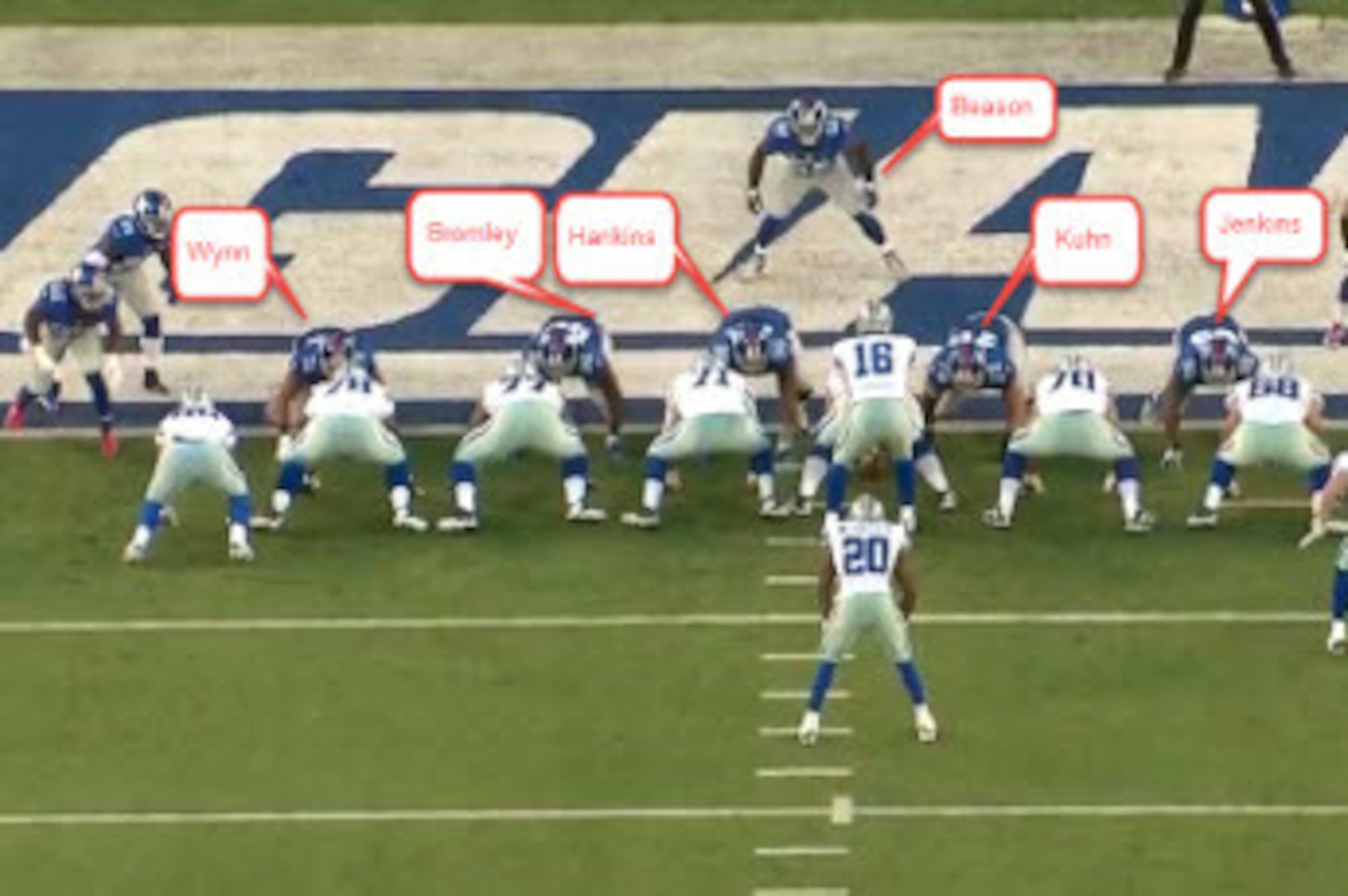
In what everyone in the stadium no doubt saw coming, the Cowboys ran to the left.
Cowboys center Travis Frederick won his battle against Kuhn, knocking him down to the ground. That created a bit of a bottleneck, forcing Beason, who remember came into this game with a knee injury and who, as we learned this week, also suffered an ankle injury.
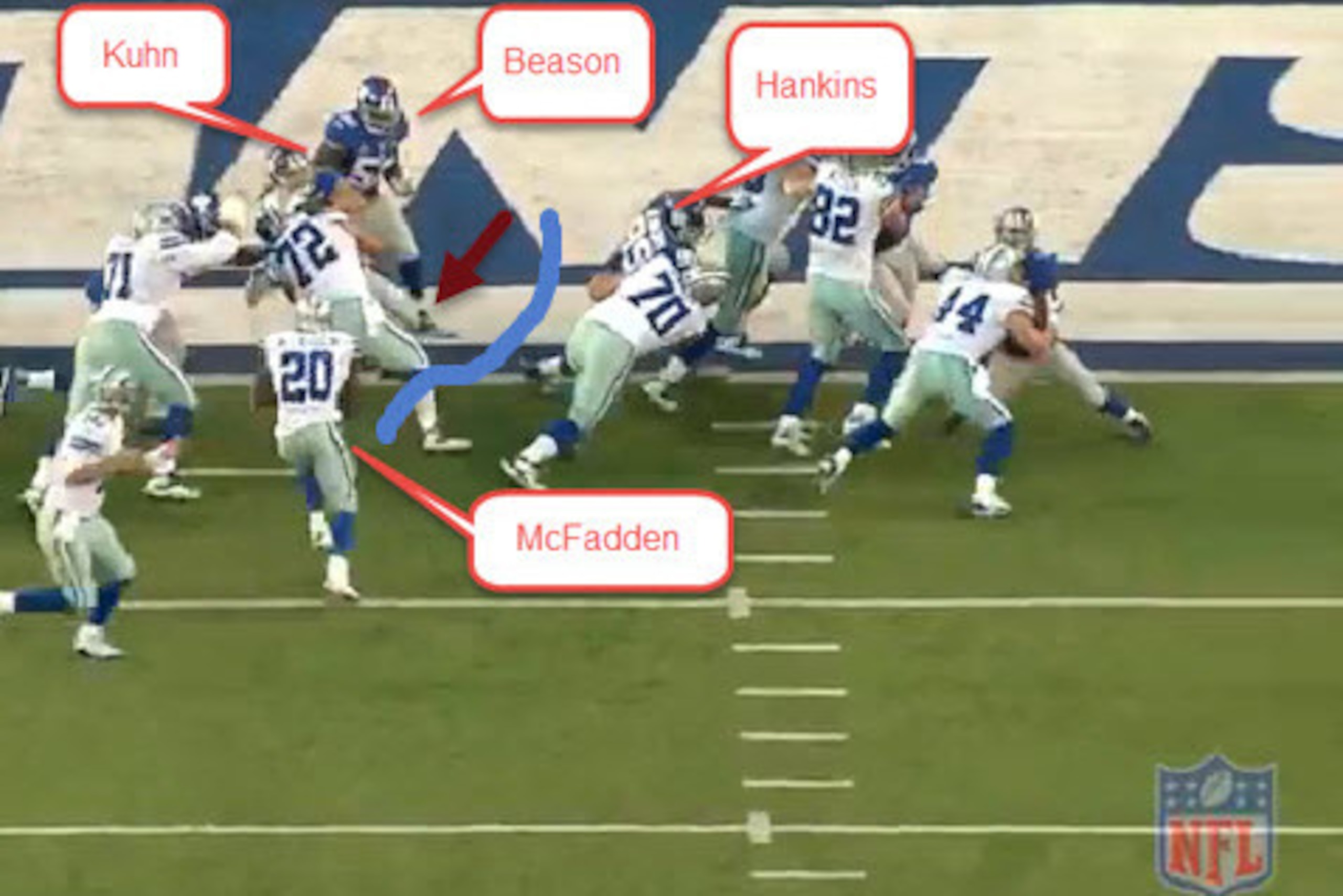
With the Cowboys slanting their blocking to the right, Johnathan Hankins is removed from the hole by solo blocking.
Meanwhile, Kuhn is twisted into a pretzel—the dark-red arrow points to Kuhn's leg that’s about to jut out and thus force the ailing Beason to take a less direct path to the hole.
The result? Beason’s angle to McFadden is wide, and the running back goes into the end zone for the easy score.
Exhibit D: Missed Tackles
According to data from Pro Football Focus, the Giants’ tackling started to get a little bit sloppy starting in Week 4.
In their first three games, the Giants missed 14 tackles. In Week 4 vs. the Bills, they missed 14, followed by 10 missed tackles the following week against the 49ers, eight against the Eagles and five against Dallas.
Those numbers are no doubt the reason behind both Coughlin and defensive coordinator Steve Spagnuolo on separate occasions mentioning tackling as being an issue, though it does need to be noted that the missed tackle numbers likely include both run and pass plays.
A Quick Look at DT Markus Kuhn
Considering defensive tackle Kuhn is a weight-room enthusiast, logic would dictate that he has more than functional strength when it comes to shedding solo blocks.
However, he struggles to shed solo blocks. Why? The problem appears to be a lack of consistent leverage and balance.
He's more often than not on the ground while a play is in progress, which is not where you want to see your defensive linemen. (See the second screen grab in Exhibit C for an example.)
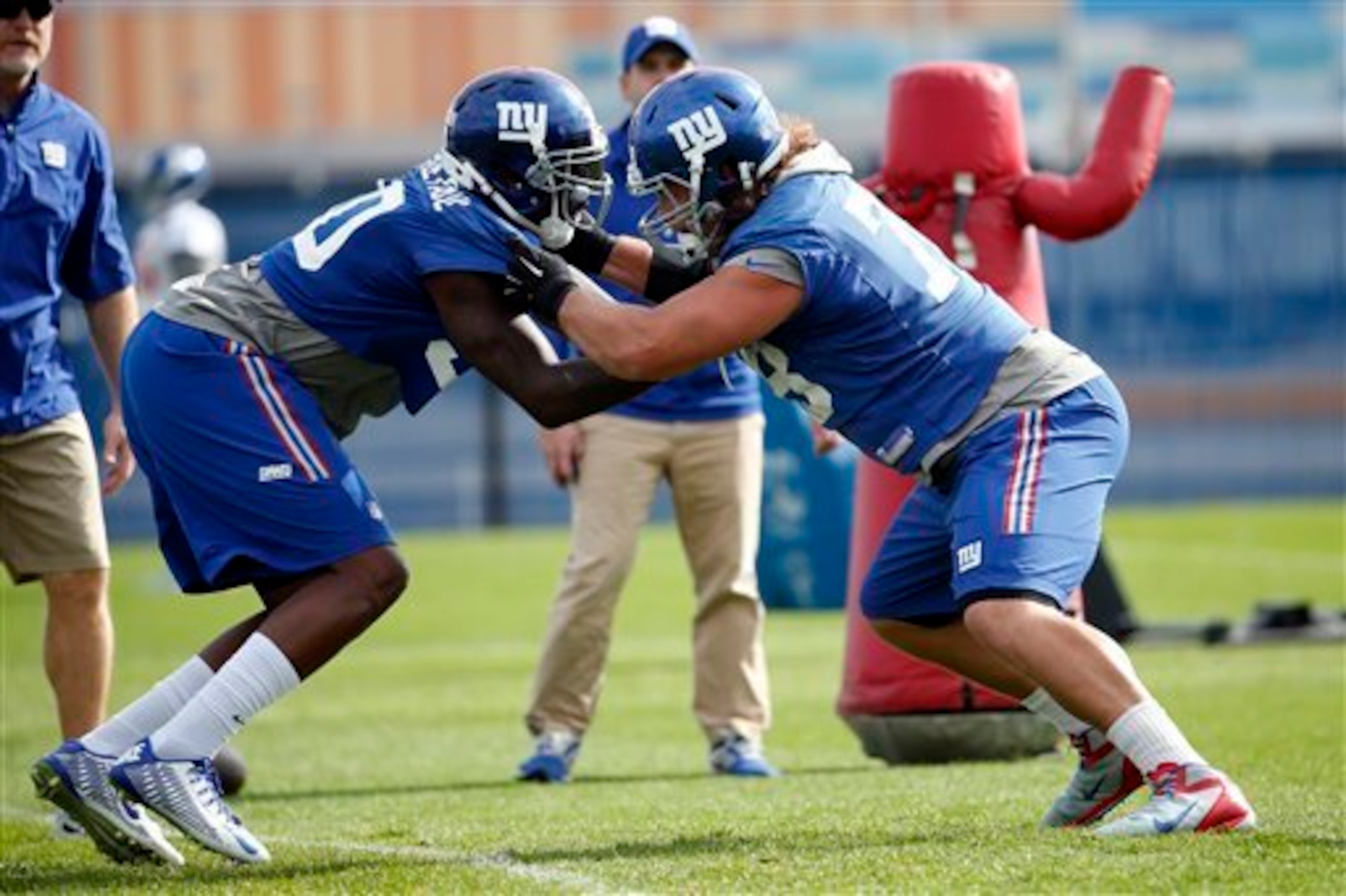
Part of that problem appears to be a failure to bring his hips underneath him, which means he’s losing any leverage he might have, thus making any strength advantage he has useless.
Kuhn seems especially susceptible against angled blocks where if he doesn’t have a solid enough base, he’s going to be cast aside rather easily by solo blocking.
Thus, if his job is to play the plugger and to draw multiple blockers and teams realize that he can be defeated by solo blocking, guess what?
The second blocker who might otherwise be assigned to block the plugger can now go block another defender.
With all that said, while fans like to hone in on Kuhn as being the sole reason for the defense's woes, this is not the case. Playing defense is an 11-man effort and Kuhn is just one of the 11 who needs to play better.
The Solutions
As much as Giants fans believe that the return of defensive end Jason Pierre-Paul, who per Pro Football Focus was the Giants defense’s second-highest graded run defender (behind Hankins) last season, is going to fix a lot of things wrong with the front four, Pierre-Paul, assuming he’s anywhere close to being the player he once was, is only part of the solution.
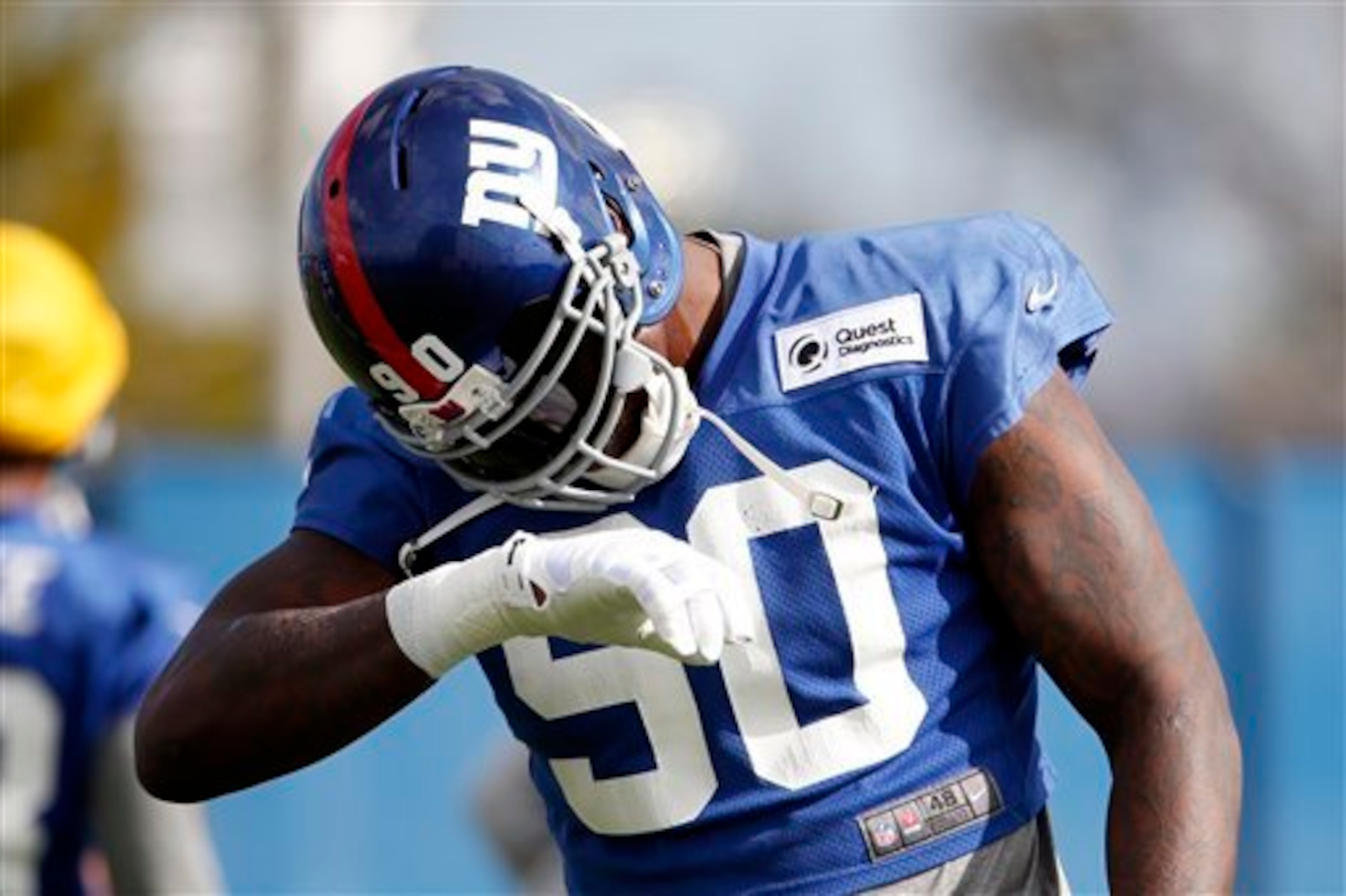
Remember, last season even with Pierre-Paul in there, the Giants were frequently gashed on the other end, which was held down by Mathias Kiwanuka. So the first thing the defensive front needs is to make sure the defensive ends are playing honest assignment football.
The second thing is to make sure the interior linemen leave paths for the linebackers and safeties to fill the holes. That one extra split-second or two in which a linebacker or safety has to make a detour around a fallen defensive tackle can and does make a difference.
The third, and obvious fix is improved tackling. At this point in the season, working on live tackling at every practice doesn’t happen.
To help his players, Spagnuolo set up a large punching bag and has them go through drills on a regular basis in which they must wrap up the “man” represented by the bag at the proper level.
Patricia Traina covers the Giants for Inside Football, the Journal Inquirer and Sports Xchange. All quotes and information were obtained firsthand unless otherwise sourced.
Follow me on Twitter, @Patricia_Traina.
.jpg?w=2560)