

What the Preseason Taught Us About the 2015-16 NBA Season
Does preseason prognostication perfectly predict actual NBA standings?
Of course not.
John Jenkins won't be coming close to 20 points per game during the regular season. You can forget about Tyler Hansbrough averaging double-digit rebounds or Jameer Nelson competing for the assist crown. The Charlotte Hornets won't remain on pace to win 72 games for very long, and the Dallas Mavericks will probably erase their goose egg in the wins column before we're too deep into the actual campaign.
TOP NEWS

Pic of LeBron's Helicopter Commute 🚁
Jokić Pops Out at CU Game 🦬

NBA Power Rankings Entering Preseason 🔢
But the preseason isn't meaningless. So long as you understand the necessary caveats and exercise caution as you rush to form snap judgments, you can glean some valuable information. That's the goal here as we use the FATS model to identify teams that are legitimately trending up and down.
What is FATS? Standing for factor adjusted team similarities, it's a model I developed that looks at both offensive and defensive Four Factors for a squad then compares those results to every team in NBA history. The closest matches help show how good the current unit actually is, allowing us to come up with an accurate win projection. If you're interested in all the nuances, you can check them out here.
Keeping in mind that strength of schedule is not accounted for here—particularly important considering some teams squared off with non-NBA squads during their exhibition schedules—and not every important rotation member played nearly as much as he would in the regular season, this is what FATS tells us about each and every team in the Association based solely on preseason action:
| 1 | Boston Celtics | 54-28 | 6-1 |
| 2 | Washington Wizards | 53-29 | 4-3 |
| 3 | Charlotte Hornets | 51-31 | 7-1 |
| 4 | Detroit Pistons | 50-32 | 3-5 |
| 5 | New York Knicks | 48-34 | 4-2 |
| 6 | Indiana Pacers | 46-36 | 5-2 |
| 7 | Miami Heat | 45-37 | 4-4 |
| 8 | Orlando Magic | 44-38 | 6-2 |
| 9 | Milwaukee Bucks | 44-38 | 2-4 |
| 10 | Toronto Raptors | 38-44 | 5-2 |
| 11 | Atlanta Hawks | 33-49 | 4-3 |
| 12 | Cleveland Cavaliers | 32-50 | 1-6 |
| 13 | Chicago Bulls | 31-51 | 4-4 |
| 14 | Brooklyn Nets | 29-53 | 2-4 |
| 15 | Philadelphia 76ers | 25-57 | 2-5 |
And for the West:
| 1 | Oklahoma City Thunder | 58-24 | 5-1 |
| 2 | Denver Nuggets | 46-36 | 4-3 |
| 3 | Memphis Grizzlies | 45-37 | 6-1 |
| 4 | Golden State Warriors | 42-40 | 3-4 |
| 5 | Portland Trail Blazers | 42-40 | 3-4 |
| 6 | Phoenix Suns | 41-41 | 4-2 |
| 7 | Sacramento Kings | 40-42 | 5-1 |
| 8 | San Antonio Spurs | 37-45 | 2-4 |
| 9 | Los Angeles Clippers | 35-47 | 3-3 |
| 10 | Utah Jazz | 34-48 | 3-4 |
| 11 | Los Angeles Lakers | 31-51 | 3-5 |
| 12 | Houston Rockets | 30-52 | 3-5 |
| 13 | New Orleans Pelicans | 28-54 | 3-4 |
| 14 | Dallas Mavericks | 26-56 | 0-7 |
| 15 | Minnesota Timberwolves | 23-59 | 2-5 |
This is where it's important to play detective.
The Golden State Warriors will not finish only slightly above .500. The Charlotte Hornets won't end up with 51 wins after losing Michael Kidd-Gilchrist for the entirety of the 2015-16 campaign. The Cleveland Cavaliers won't struggle to break past the 30-win threshold once some modicum of health returns to them.
But some of the revelations are still noteworthy.
Lesson No. 1: The Oklahoma City Thunder Offense Is Legit
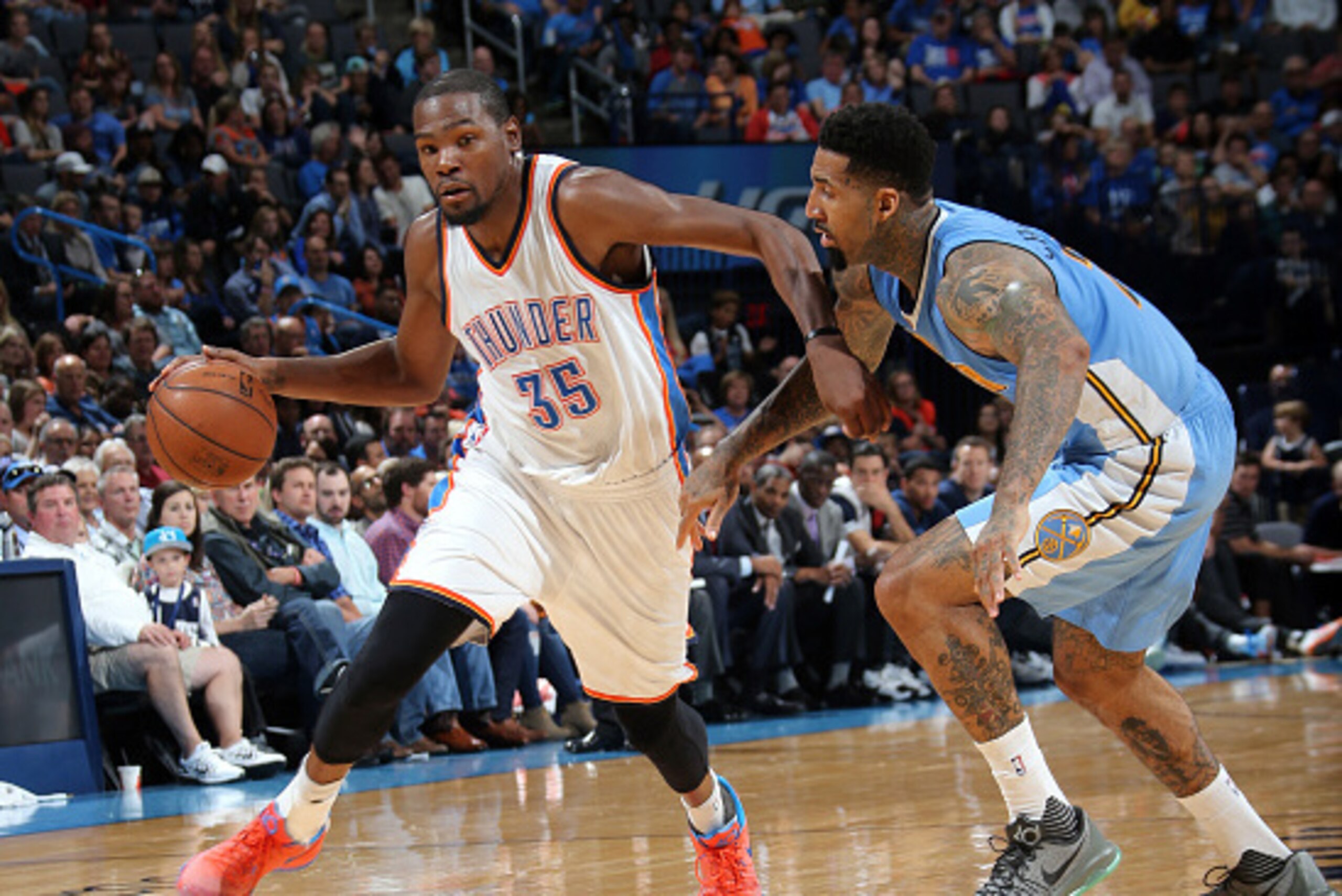
Switching from Scott Brooks to Billy Donovan at head coach is a massive change, and it was initially reasonable to expect some struggles as the Oklahoma City Thunder adjusted to their new style. After all, Brooks was notoriously fond of running isolation sets and displaying a complete lack of creativity on the scoring end, while the Donovan offense figured to involve plenty of movement at all times.
But even with Kevin Durant and Russell Westbrook limited to right around 25 minutes per contest during a 5-1 preseason slate, the Thunder were just about unstoppable on offense. Granted, they played against a weak slate of competition, highlighted by a blowout victory over Fenerbahce Ulker, but they still hummed along far more than we could have realistically forecast.
According to RealGM.com's statistical databases, the Thunder posted an offensive rating of 109, which left them trailing only the Washington Wizards (112.7). For further perspective, that would've been the No. 6 mark during the 2014-15 regular season.
If we dig deeper and look at the Four Factors on offense, OKC becomes even more impressive:
| Oklahoma City Thunder | 0.552 | 29.1 | 17.1 | 0.192 |
| Preseason Average* | 0.480 | 24 | 15.2 | 0.255 |
| NBA Rank | No. 1 | No. 3 | No. 27 | No. 28 |
Turnovers are always going to be problematic for this offense, given the risks that players such as Durant and Westbrook are willing to take.
But getting to the free-throw line and making those attempts isn't typically such a big problem for the Thunder. Per Basketball-Reference.com, they were actually No. 10 in free throws made per field-goal attempt during the 2014-15 campaign, No. 5 in 2013-14 and No. 1 in 2012-13.
This is where playing time enters into the equation. Durant and Westbrook are two of the best at earning whistles and converting at the charity stripe, so having them on the court more often will only help Oklahoma City.
However, the biggest difference has been the prevalence of space—a concept viewed as an important one ever since the start of training camp. Per Nick Gallo of NBA.com:
"The Thunder's hallmark will always be defense, but so far in camp the offense has also been a focal point. Earlier in the week, Anthony Morrow used the word 'space' when asked what stood out to him about Donovan and the coaching staff's new offensive scheme. With elite, dynamic scorers like Kevin Durant and Russell Westbrook handling the ball and shooters and finishers all around the floor, having an extra foot to work with can be the difference between a basket and a turnover.
"
Even though the Thunder have racked up some turnovers, they've scored far more baskets.
If you were expecting an adjustment period during the opening salvo of Donovan's first NBA regular season, it's now time to reconsider.
Lesson No. 2: Ditto for the New York Knicks Defense

"When you have somebody out there that's willing to work for the team first, that's contagious," Robin Lopez recently explained to Newsday.com's Al Iannazzone. "In Phoenix, I learned that from Steve Nash, Grant Hill, so many different guys. When you're playing with somebody like Steve, like Grant, that just passes on to you."
The new defensive centerpiece of the New York Knicks has been patient zero in this novel epidemic for the Knicks. After finishing with a putrid No. 28 rank in defensive rating during last year's go-round, the team is actually buying in on the point-preventing end, and the man in the middle deserves much of the credit. Even when he's not protecting the rim, he's helping inspire his teammates to buckle down.
Case in point, the Knicks are playing significantly better perimeter defense, per ESPN.com's Ian Begley:
"New York allowed the highest opponent 3-point field goal percentage in the NBA (38 percent). Based on the preseason, it seems like the club has made some progress in that area.
The Knicks finished in the top-five in opponent 3-point field goal percentage (26.4 percent). If this trend continues, it should help the Knicks improve a defense that last season ranked 28th in the NBA.
"
Flaws still exist, but much as was the case for the Thunder offense, the Four Factors show a significant amount of progress for New York. After displaying so much porosity during the last campaign, that is a big deal in and of itself:
| New York Knicks | 0.45 | 75.6 | 15.1 | 0.201 |
| Preseason Average* | 0.478 | 76.4 | 15.1 | 0.238 |
| NBA Rank | No. 6 | No. 18 | No. 15 | No. 7 |
Defensive rebounding remains a substantial weakness, but it's hard not to look at those average and above-average figures in a positive light. This is a team that wasn't particularly disciplined on defense during Derek Fisher's first season as a head coach, but the Knicks are now avoiding fouls and contesting far more looks.
The results are impressive enough in a vacuum, considering FATS has the Knicks comparing most favorably to a bunch of historical defenses that were much better than the league-average rating. Based on the preseason, the top comparison stems from the 2002-03 Sacramento Kings, whom Basketball-Reference.com shows allowing fewer points per 100 possessions than every squad in the Association that year, save the stingy New Jersey Nets.
But removing the vacuum makes these strides even more notable. After all, the Knicks are trending up in each of the four all-important categories:
Allowing lower shooting percentages, forcing more turnovers, ending a higher percentage of possessions with defensive rebounds and sending opponents to the line less frequently are the best combination you can possibly ask for on the defensive end.
Even if the Knicks regress a bit during the regular season, they're due for some substantial improvement and can reasonably expect to challenge for a top-half finish in defensive rating.
Lesson No. 3: Don't Sleep on the Indiana Pacers
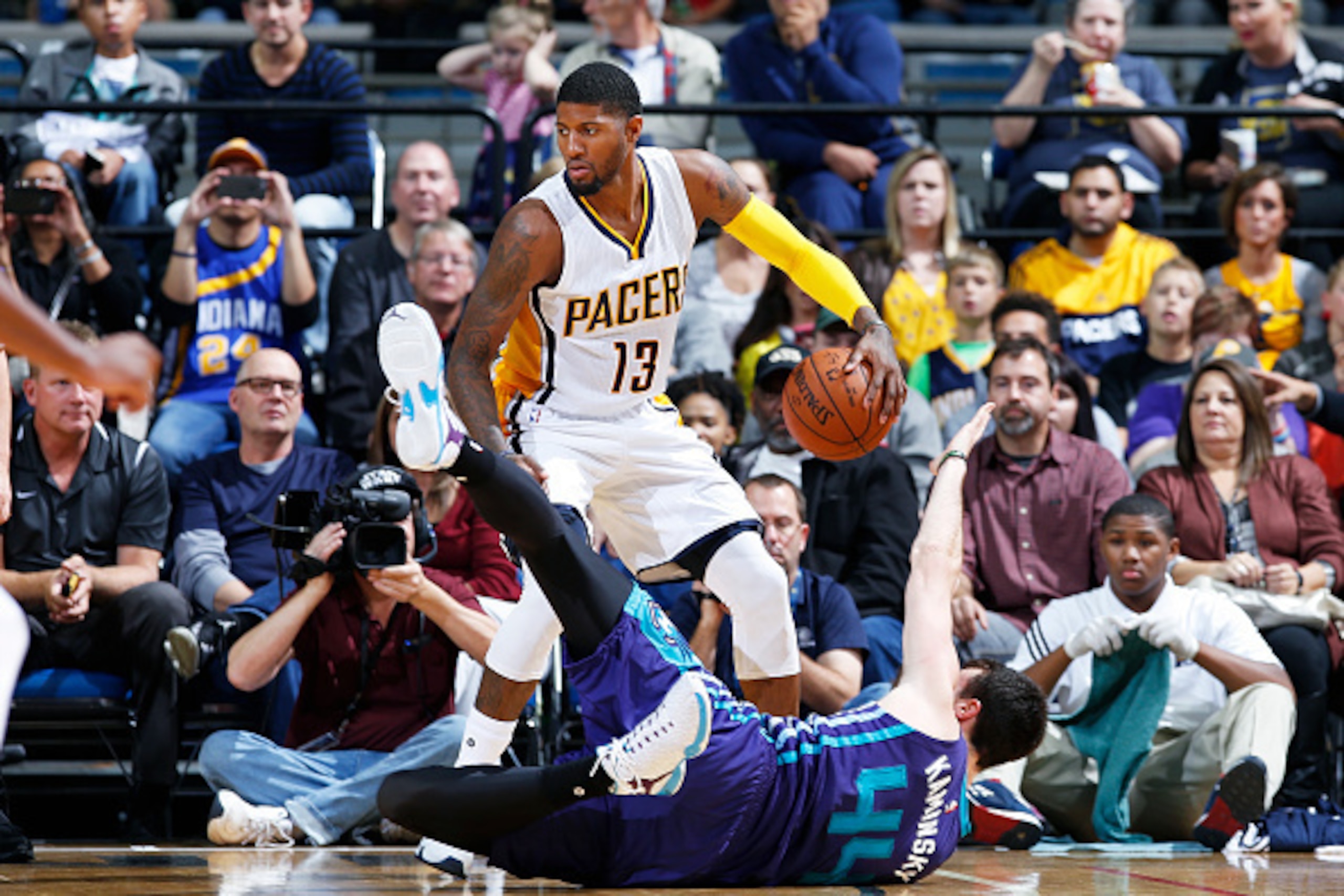
If good feelings aren't reigning supreme in Indianapolis, they should be.
Paul George seems to be accepting his new role as a small-ball power forward, telling NBA.com's Steve Aschburner that he is now "more at ease" transitioning to a different spot in the lineup. He didn't seem to be showing many ill effects from the broken leg suffered last summer while averaging 18.7 points, 6.3 rebounds, 1.6 assists and 1.1 steals on 43.2 percent shooting from the field and 39 percent from beyond the arc during the preseason.
Myles Turner may have struggled with his shot, but he still proved himself as a rebounding stud and defensive threat, which lends legitimacy to his potentially earning a big spot in the rotation. As he continues to adjust to the rigors of the NBA game, he should only gain comfort.
But the best news is that the Pacers went 5-2 against a legitimate slate of preseason competition, and the record wasn't fluky at all. FATS had Indiana playing like a 46-win team throughout the exhibition season, and that's partially the result of a willingness to quickly embrace a new identity.
For years, the Pacers have been a defensively slanted organization under head coach Frank Vogel, but that's changing with Monta Ellis coming to town and the established frontcourt starters now playing for teams in the Western Conference.
With an effective field-goal percentage that lagged behind the marks earned by 20 other members of the Association, the Pacers weren't exactly accurate shooters. But they still managed to create second-chance opportunities, limited turnovers better than any other team and were above-average at the charity stripe.
Ball movement has also been key, as George Hill detailed for Nate Taylor of IndyStar.com after a victory over the Charlotte Hornets allowed Indiana to close the preseason on a high note:
"In the first half, we were keyed in on trying to create for ourselves rather than create for each other. We came in the locker room and the veterans got together and said, 'Hey, it starts with us.' We came out with energy and we moved the ball and played for each other. I think that's when we made our big run. I think we can be a dangerous team as long as we continue to play together.
"
The Pacers aren't suddenly going to reassert themselves as favorites to take home one of the top seeds in the Eastern Conference, but the preseason did help legitimize them as postseason candidates. After one year in the lottery and an offseason filled with substantial changes, that's all they can ask for right now.
Lesson No. 4: Randy Wittman Learned from the Playoffs
It all clicked for head coach Randy Wittman's Washington Wizards during the playoffs.
Even without John Wall for a portion of their postseason run, they were able to sweep the Toronto Raptors and legitimately challenge the Atlanta Hawks for the right to clash with the Cleveland Cavaliers in the Eastern Conference Finals.
Why? Because this team finally realized that small-ball lineups were advantageous and began taking far more three-point attempts at the expense of the mid-range looks that often hampered it during the regular season.
Prior to exhibition season, we didn't know if Wittman would apply what he learned. He's been rather rigid in his teachings during past efforts, and there was no telling whether he'd go back to the tried-and-true methods for the opening portion of the 2015-16 campaign.
So much for that doubt.
Washington's offense flat-out rolled through the preseason schedule, thriving in a number of the Four Factors on offense:
| Washington Wizards | 0.537 | 21.3 | 13.1 | 0.255 |
| Preseason Average* | 0.48 | 24 | 15.2 | 0.255 |
| NBA Rank | No. 2 | No. 21 | No. 5 | No. 15 |
Based on historical correlations between each of the factors and winning percentage, effective field-goal percentage is the most important category. And that's cause for celebration in the nation's capital, considering only the Oklahoma City Thunder were more efficient from the field.
As such, the Wizards actually compare most favorably to some of the most prominent offensive machines in NBA history:
| 96.84 | 2004-05 Phoenix Suns | 107.92 | No. 2 |
| 96.68 | 2014-15 Los Angeles Clippers | 106.44 | No. 18 |
| 96.59 | 1997-98 Seattle SuperSonics | 106.29 | No. 20 |
| 96.46 | 2006-07 Phoenix Suns | 106.95 | No. 9 |
| 96.35 | 1987-88 Boston Celtics | 106.85 | No. 13 |
That's not a mistake. FATS shows that the preseason Wizards' five closest comparisons all finished among the top 20 offenses in NBA history, including two of the run-and-gun Phoenix Suns units from the Mike D'Antoni era that registered top-10 marks.
And this is without a single member of the roster logging at least 25 minutes per game. John Wall's diminished run is especially notable, since he played only 22.6 minutes during his average preseason appearance and will obviously be spending significantly more time on the court when games actually count.
If it seems like there's a conglomerate of teams in the Eastern Conference fighting for the No. 2 spot, it should. Frankly, the Cleveland Cavaliers could join that bunch instead of running away with the NBA's weaker half if they can't stay healthy.
Counting the Wizards out of the hunt would be a huge mistake, especially considering how dominant this offense figures to be when the best players are on the court as much as possible.
All stats, unless otherwise indicated, come from Basketball-Reference.com, RealGM.com and my own personal databases.
Adam Fromal covers the NBA for Bleacher Report. Follow him on Twitter:@fromal09.

.jpg?w=2560 "OBJ Calls Out Giants After Release")

.jpg?w=2560 "Rap: Lions, LaPorta End Contract Talks")

.jpg?w=2560 "Report: Baker May Miss Up to 6 Weeks")