Through six weeks of the 2015 college football season, the Michigan Wolverines football program has produced a handful of startling statistics.
Whether the basic or analytical variety, Michigan has assembled some downright shocking numbers as a team—particularly on the defensive side of the ball.
Most individual players don't particularly stand out, since the offensive scheme hasn't focused on a single contributor to carry the load. Unless the running back has a dominant season, that's a typical Jim Harbaugh trend.
If the Wolverines can continue producing at the following levels, they might find themselves closing in on a Big Ten Championship Game appearance—a stunning thought before the season.
Red-Zone Efficiency
1 of 5
Once quarterback Jake Rudock and Co. have reached the red zone, the drives have resulted in points almost automatically.
Michigan has entered the opposition's 20-yard line on 20 possessions and has scored on 19 occasions, with 15 touchdowns and four field goals. The 95 percent scoring clip is tied for 12th-best in the nation, while the 75 percent touchdown rate is tied for 10th.
The only time a red-zone trip didn't end in points was when the Wolverines were already up 31-0 on BYU and attempting to kill the clock.
A failed 4th-and-2 with less than five minutes remaining and a 31-point lead is the team's only blemish. That'll work.
Lack of Explosive Plays Allowed
2 of 5
Michigan is ranked No. 1 nationally in points allowed (6.3) and No. 2 in total defense (181.3 yards) per game, but while those numbers are impressive, the bigger story is a lack of explosive plays from opponents.
The Wolverines have forced offenses to sustain drives, which has become an amazingly difficult task.
Michigan opponents—Utah, Oregon State, UNLV, BYU and Maryland combined—have managed nine gains of 20-plus yards. That's second-best in the nation.
Additionally, the one play of 30-plus yards was UNLV's Devonte Boyd tallying a 55-yard catch in the closing seconds of the fourth quarter, so it was essentially inconsequential.
Michigan has given up 12.5 first downs per outing—once again, second-best nationally—so the absence of big plays is a significant contributor to and part of an elite defense.
Points After Turnovers
3 of 5Rudock hasn't done a tremendous job of keeping possession. He's tossed six interceptions and lost two fumbles, while Ty Isaac has coughed up the ball once, too.
However, every time defensive coordinator D.J. Durkin's unit has received a chance to pick up Rudock, it's done just that.
Despite nine turnovers, Michigan has allowed seven points—a lone touchdown—and it wasn't even the defense's fault. Utah's Justin Thomas recorded a pick-six.
On the other hand, the Wolverines have turned nine takeaways into 32 points, an average of 3.6 per turnover via four touchdowns (a two-point conversion) and a field goal.
The consistent defensive stands might not be sustainable, but they sure are impressive.

.jpg?w=2560)
Point Differential
4 of 5
The expectation for Michigan's 2015 campaign was a strong defense that might not be able to save a mediocre offense.
My, how things have changed.
Utah tallied 24 points in the season opener, but the Wolverines have surrendered a total—a total!—of 14 points since then, including three consecutive shutouts heading into a battle with Michigan State.
Michigan holds a 68-7 advantage in the second quarter and has scored 43 in the final frame, registered 38 points in the opening quarter and managed 28 immediately after the halftime break.
In other words, each of the team's single-quarter scoring outputs is nearly higher than the total allowed. If that's not startling, what is?
Third-Down Conversions
5 of 5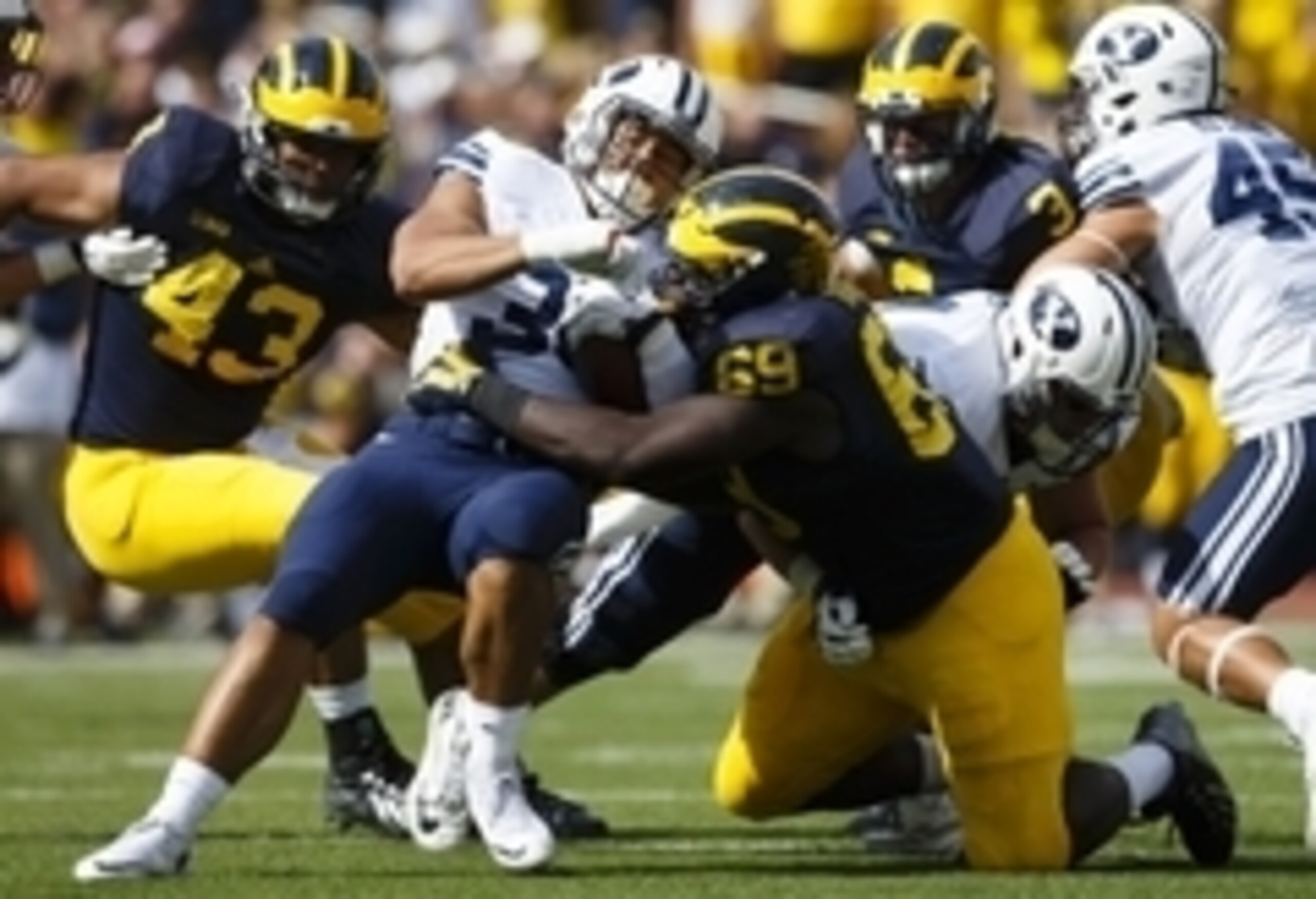
Not only are the Wolverines killing drives when they have an opportunity, but the defense has rarely even given its opponent a fighting chance.
At 18.8 percent, the Michigan defense is tied with Boston College for the best third-down percentage in the nation. But breaking it down even further, the success rate on third down is mystifying.
| Yards to Go | Conversions | Attempts | Percentage |
| 1-3 | 8 | 17 | 47.1 |
| 4-6 | 1 | 10 | 10.0 |
| 7-10 | 1 | 37 | 2.7 |
| 11-15 | 6 | 14 | 42.9 |
| 16-20 | 0 | 6 | 0 |
| 21-plus | 0 | 1 | 0 |
| Total | 16 | 85 | 18.8 |
Strangely enough, teams are mildly successful with 11 to 15 yards to go on third down. Since those situations happen approximately two times per game, though, there's little concern.
But what seems unbelievable is on third down with between four and 10 yards to go, opponents have gained the necessary distance just twice in 47 tries—a mind-boggling 4.3 percent.
The average third-down yard-to-go mark is 8.4 yards. That's absurd.
All recruiting information via 247Sports. Stats from cfbstats.com and B/R research. Quotes obtained firsthand unless otherwise noted. Follow Bleacher Report CFB Writer David Kenyon on Twitter @Kenyon19_BR.


.jpg?w=2560 "Jonathan Taylor Landing Spots")
.jpg?w=2560 "NFL House in Paris Closes for Protests (AP)")

.jpg?w=2560 "Malik Beasley Negotiating Plea Deal (AP)")