

Utah Is the National Championship Contender Nobody Saw Coming
Identities are usually forever in college football. It is nearly impossible to change them. And the sport's big boys are so desperate to keep others out of their club that they even legislate that reality—make all the rules so that they can have all the power, play for all the glory and keep all the money.
Somehow, Utah slipped in the door to the club while no one was looking. That's the way the Utes would want it: unnoticed. They are ranked No. 5 and are working on their third undefeated season in 12 years, but until now, they have managed to do it in secret, maybe popping up to beat an Alabama in a Sugar Bowl and then going back into hiding.
TOP NEWS

🚨 Week 5 AP Top 25 Poll
Colorado State DC gets fired mid-game during blowout loss
Massive Shakeup in CFB Top 25 List 🔢
Shhh, don't tell anyone: They are one of the big boys now.
Did anyone notice that happening? They hope not.
Coach Kyle Whittingham still needs to use the underdog theme to motivate his team. I asked him about the lack of attention and if he uses it to his advantage.
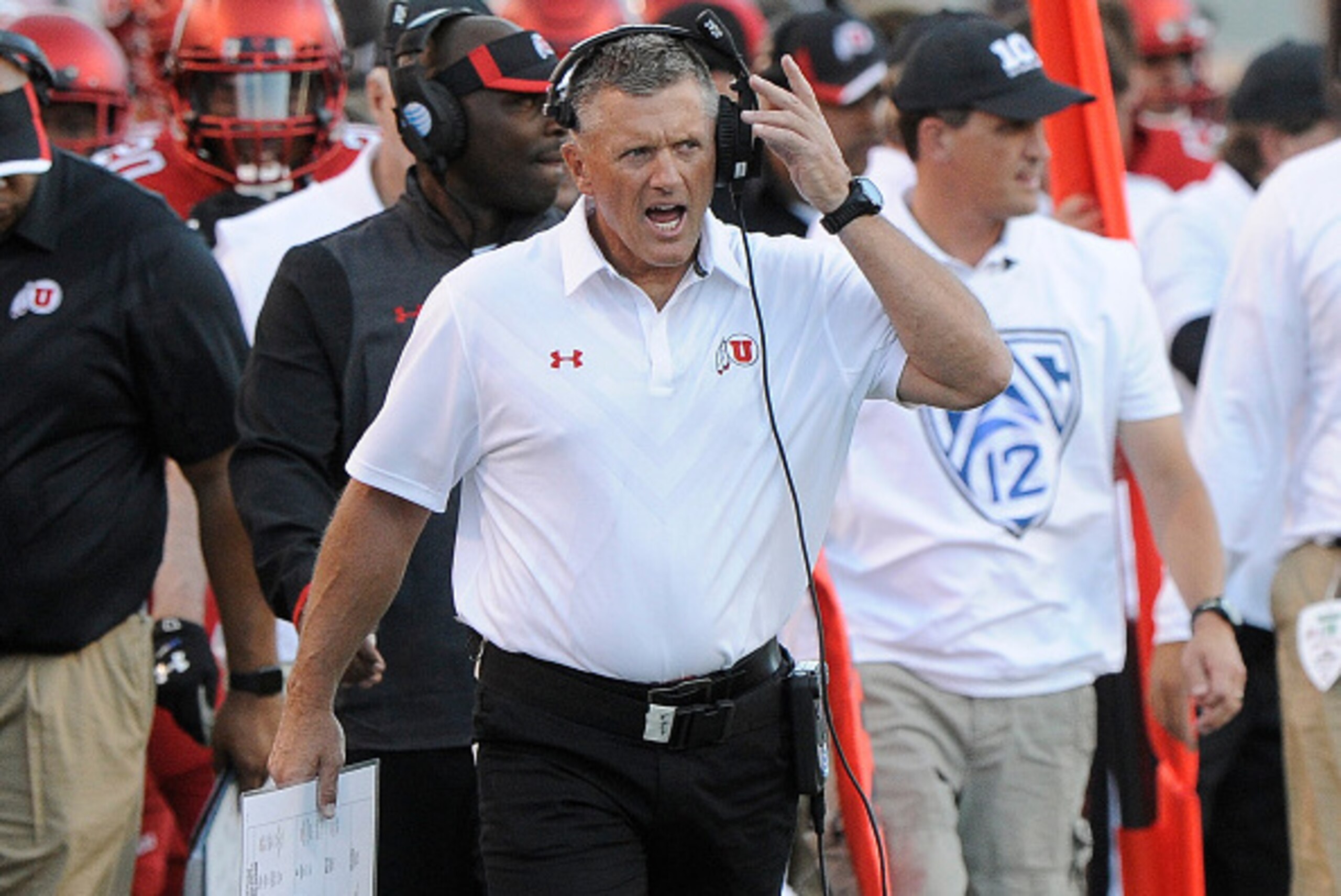
"Absolutely," he said. "We've played with a chip on our shoulder for a lot of years. We'll continue to do so."
Utah is the little engine that still kind of likes being called the little engine. It's what the Utes are comfortable being. Less comfortable is being the site of ESPN's College GameDay this week. ESPN chose Cal-Utah over Miami-Florida State.
It's quite a trick to keep a chip on your shoulder when you're ranked No. 5 in the country, with seven No. 1 votes. When you blow out Oregon and push around Jim Harbaugh's Michigan, you can't keep hiding.
So does being exposed as big-time change the feel of things?
| 2015 | Pac-12 | 4-0 | |
| 2014 | Pac-12 | 9-4 | Las Vegas-W |
| 2013 | Pac-12 | 5-7 | |
| 2012 | Pac-12 | 5-7 | |
| 2011 | Pac-12 | 8-5 | Sun-W |
| 2010 | MWC | 10-3 | Maaco-L |
| 2009 | MWC | 10-3 | Poinsettia-W |
| 2008 | MWC | 13-0 | Sugar-W |
| 2007 | MWC | 9-4 | Poinsettia-W |
| 2006 | MWC | 8-5 | Armed Forces-W |
| 2005 | MWC | 7-5 | Emerald-W |
"I guess that could be a little different feel," Whittingham said. "But we've been through this before, in '04 and '08."
Well, not exactly. Yes, those were the two other undefeated seasons, but they had ceilings beneath a title game.
Given a fair shake in those years, would they have won a title?
"That'll be the debate with us forever," said Brian Johnson, the quarterback on that 2008 undefeated team that beat Alabama. "I'm sure everyone on our team felt we could stand up to anyone.
"That team was really, really talented. I thought we could have played with anyone in the country. A lot of those guys are still playing on Sundays."
Johnson is coaching on Saturdays. He's the quarterbacks coach at Mississippi State now.
Utah, meanwhile, was one of the last teams in the door to the big conferences for the 2011 season, jumping from the Mountain West to the Pac-12. Now, it is on the right side of the legislation and can play for a national title, not just be good enough to win one.
Johnson felt that 2008 team was that good, but it didn't get a shot. The problem was that Utah was playing from behind. It started the season unranked. Too many poll voters—and this isn't him talking—vote the traditional powers high up in the rankings, and then it takes a miracle to let an outsider move up.
"If you stacked our resume against other teams…" he started to say.
And then he stopped. To finish his thought: It wasn't that Utah wasn't the best team. It was that it was in the category of schools called a major college but not really allowed to compete with other major programs for the biggest prize.
"That's true," he said.
It's not true now, though Johnson—who was an assistant coach and then offensive coordinator after the Utes moved to the Pac-12—agreed with Whittingham that Utah has never stopped thinking of itself as the underdog.
"It didn't really change the program," he said. "I mean the way it is built. It was still all about hard work and outworking opponents. They're still recruiting the same kinds of kids who have that chip on your shoulder.
"I came out of high school in Texas, and I didn't really have a ton of offers. They gave me a chance."
See? Johnson still talks about his old team as if it were the little guy. It was the place that launched Urban Meyer's career, as he led Utah to its 2004 undefeated season. But at that point, Utah was seen as one of those schools where winning coaches could launch to bigger jobs.
Whittingham has been the head coach there for 11 years now. He was there when Johnson and the Utes beat Alabama 31-17 in the Sugar Bowl in 2009. Johnson was named MVP of the game.
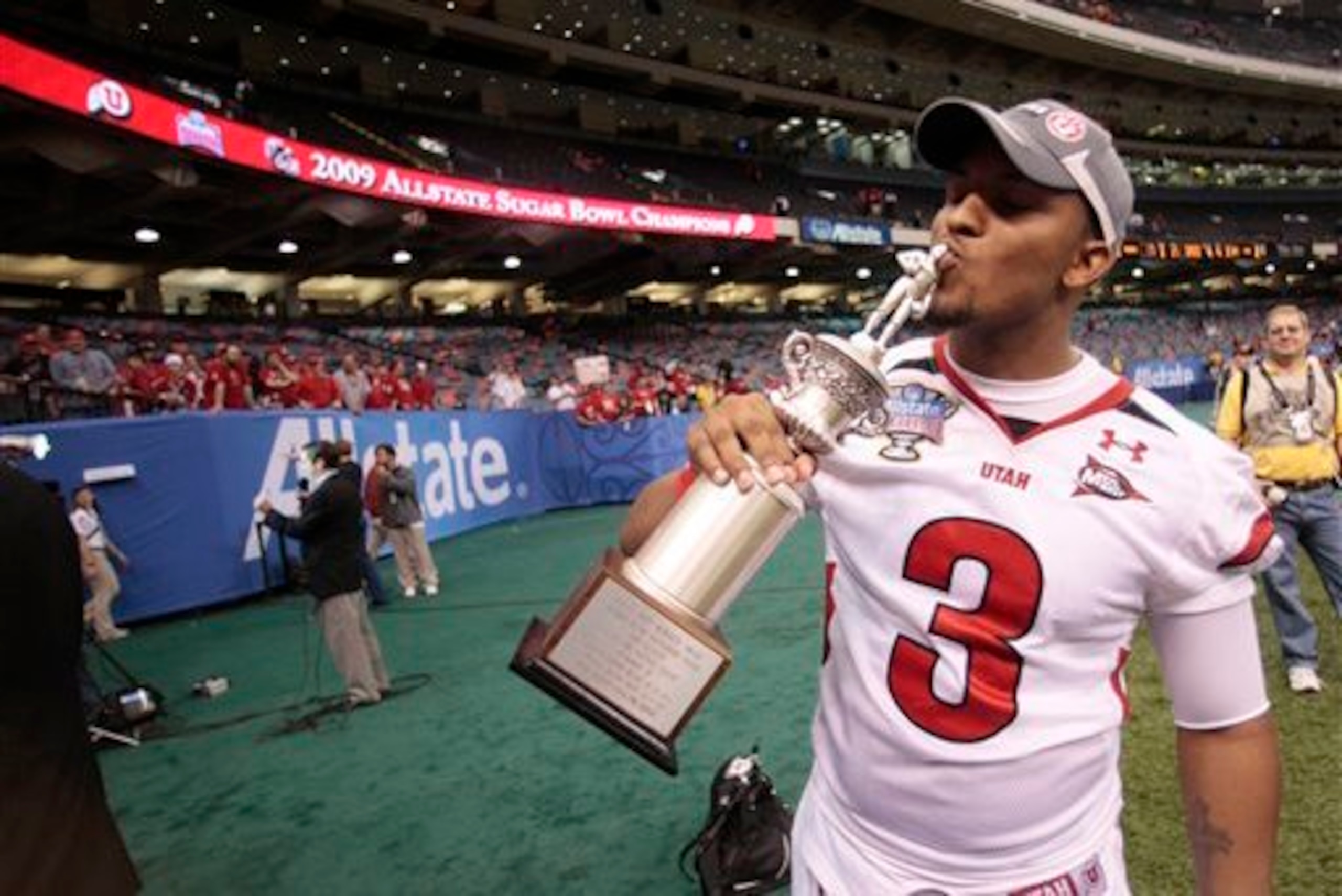
Back then, Utah was publicly resentful of the system that was leaving it out. Now that it's in, it isn't changing. For four years, Utah never threatened in the Pac-12 South. Media who cover the conference picked the Utes to finish fifth out of six teams in the division this year.
For as long as Whittingham has been around, he still seems unknown. Like Utah. He played in the USFL and the CFL, and he was even a replacement player for the Rams in 1987. (That's the nice word for a "scab.") He learned under Meyer and, according to CBSSports.com's Dennis Dodd, still talks with him every week.
Running back Devontae Booker provides the power, and quarterback Travis Wilson has finally figured out what he's doing. The thing about Utah is that the players seem to be in the right place all the time. Booker is another one of those mid-major types of finds that Utah lives on: He bounced around with bad grades, couldn't make it to a top team and then ended up at Utah, succeeding even in the classroom.
So Utah moves on toward a national title run as one of college football's great underdogs.
This is life as the little engine that could. Only now, it really could.
Greg Couch covers college football for Bleacher Report.
_0.png?w=2560)
.jpg?w=2560 "OBJ Calls Out Giants After Release")

.jpg?w=2560 "Rap: Lions, LaPorta End Contract Talks")

.jpg?w=2560 "Report: Baker May Miss Up to 6 Weeks")