Breaking Down How to Stop LSU RB Leonard Fournette
Of all the potential assignments in college football, none has proved harder this season than stopping LSU running back Leonard Fournette.
Only a true sophomore, Fournette has rushed for 864 yards in four games—a cool average of 216 yards that by far ranks No. 1 in the country. The closest player to Fournette, San Jose State senior Tyler Ervin, averages 160 yards per game, while the closest power conference player, Georgia sophomore Nick Chubb, averages 149.
Despite this, however, stopping Fournette is not impossible. It's next to impossible, but can be done with the right combination of scheme, personnel, discipline, execution and, frankly, dumb luck.

.jpg?w=2560)
Here are three keys for slowing down the nation's best runner.
Hold and Wait For Backup
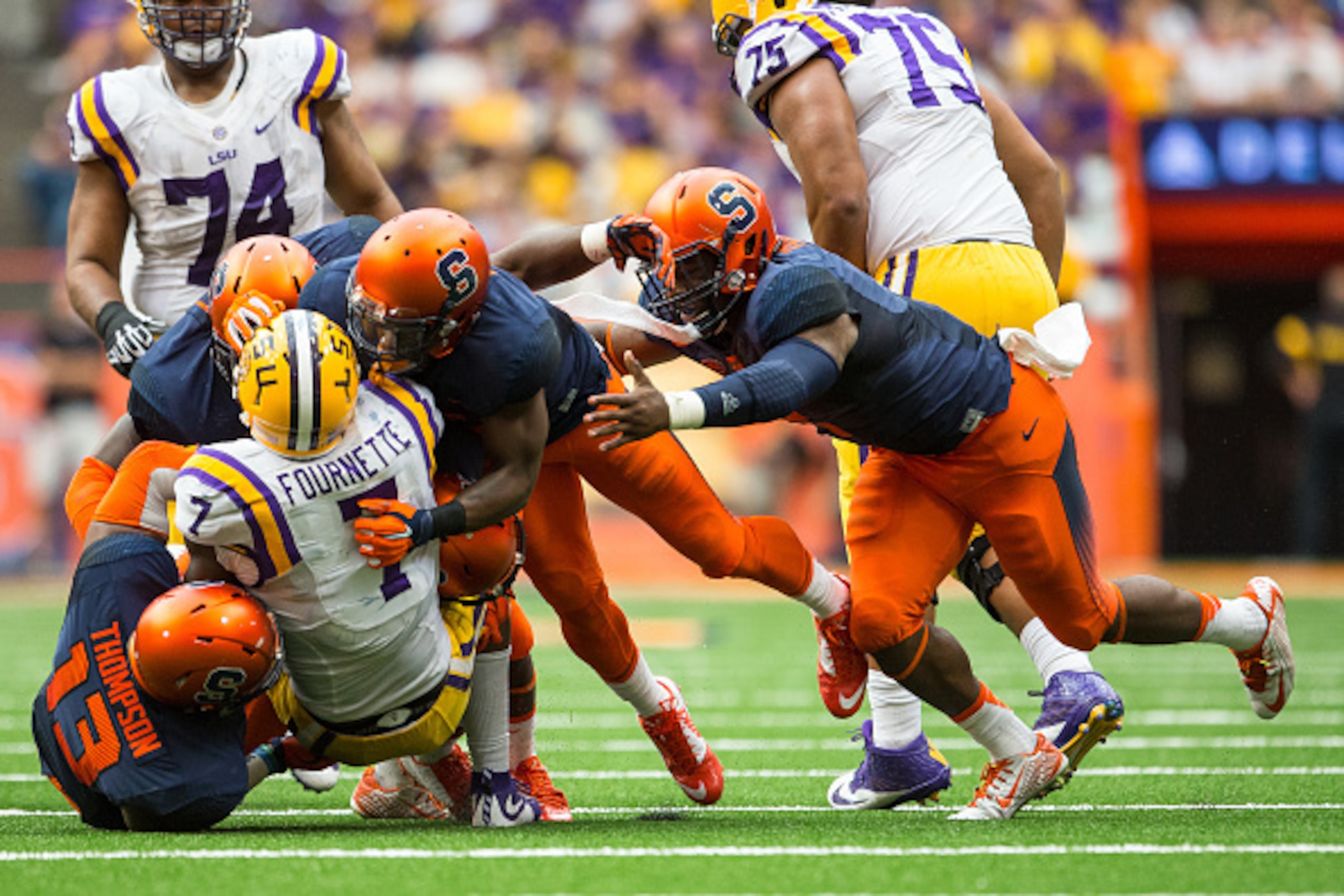
The key to stopping Fournette is limiting yards after contact. According to Steve Palazzolo of Pro Football Focus and ESPN Insider, the sophomore leads the country with an average of 4.9 yards after being hit.
The best way to stop Fournette's yards after contact is to tackle him, but that goes without saying. It's just a tall order for anybody, even an FBS linebacker, to meet Fournette in the hole or on the edge and bring him down on their own. Fournette is 6'1", 230 pounds and built like a heavyweight UFC fighter. Defenses can't rely on making one-on-one plays.
What they can hope for is gang tackling. They can hope defenders who do get caught on an island with Fournette will grapple him, slow his momentum and wait for reinforcements. Acknowledging that Fournette is the best player on the field, and therefore requires different treatment than other running backs, is the first step to containing him.
Here's a great example from Syracuse linebacker Marqez Hodge:
Hodge is 5'11", 221 pounds. He's standing in place while Fournette is running downhill. He knows there's no way to drive him back and plant him, to execute a proper form tackle, but he engages Fournette and holds firm until his teammates arrive.
Here's what happened when former Texas A&M safety Howard Matthews did not hold and wait for backup:
Bad idea.
Force Him Off His Line
Fournette is shifty for his size, but not an overall outlier in shiftiness.
He's a one-cut, downhill runner whose best work comes when he stays the course, explodes through the hole and rips through arm tackles in the secondary.
He's less successful when defenders knock him off his line in the backfield, forcing him to improvise with agile cuts and vision. Of course, that's true with any running back, but because Fournette is so good running in a straight line, the difference here is more pronounced.
He can still make plays out of nothing, as he proved on multiple runs against Mississippi State, but forcing Fournette off his line, especially by setting the edge on tosses and stretches, is the best way to keep him from getting downhill cleanly.
Here's an example of Syracuse doing a good job:
Fournette wants the edge, but defensive end Luke Arciniega gets a push on left tackle Jerald Hawkins. Slot receiver Malachi Dupre misses a seal block on the blitzing defender, so Fournette has to cut inside. He breaks a tackle and gains positive yards, but by setting the edge, Syrcause kept Fournette off his line and minimized his impact.
Here's an example of what happens when Fournette does keep his line (and also when tacklers try to cut his legs instead of wrapping up and waiting for teammates in the open field):
Also a bad idea.
Pitch a Clean Game
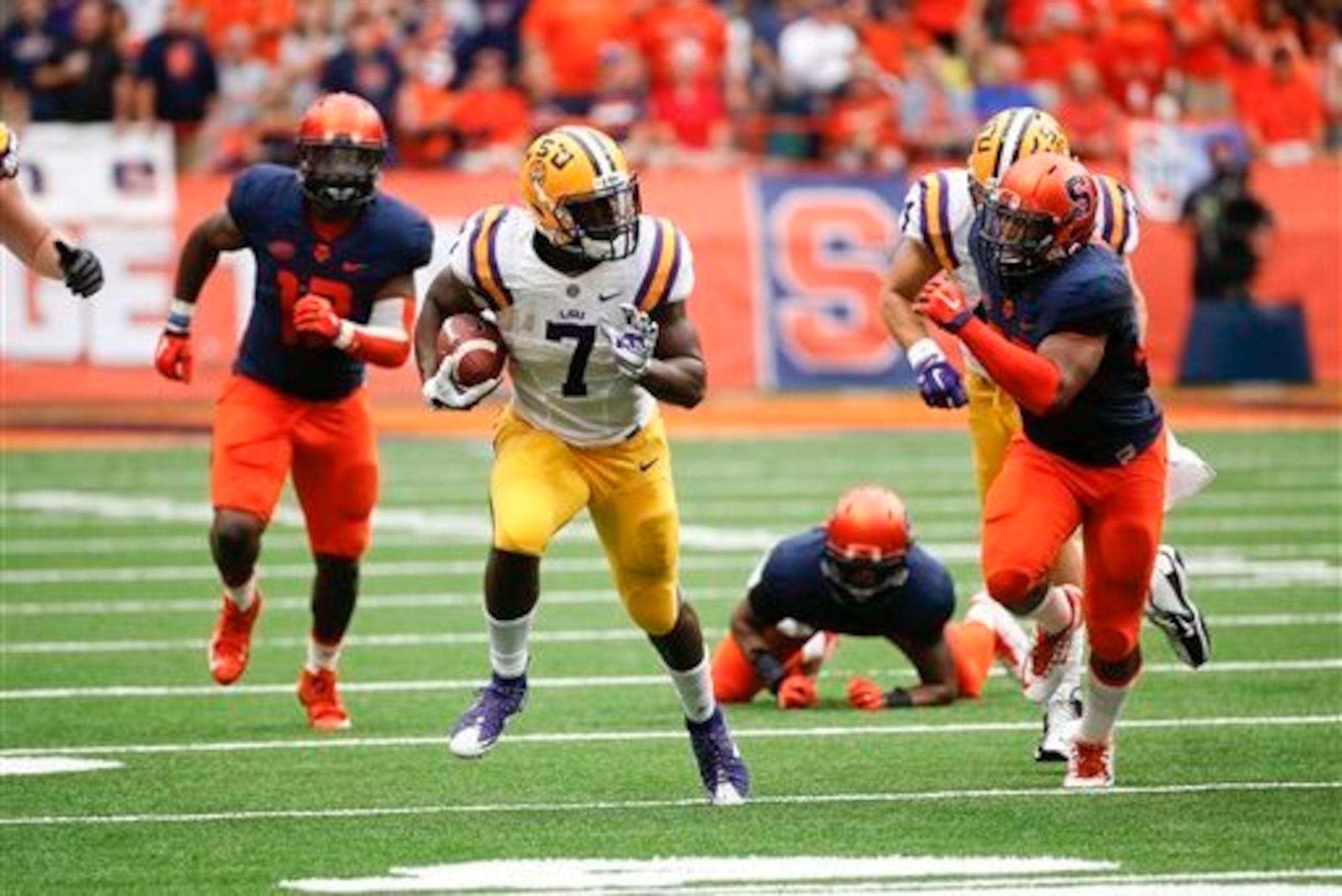
Notice how Syracuse was featured in both of the above "good examples?" That's because the Orange, by and large, played Fournette as well as they could have. They fought hard and executed their keys.
Or at least they did on most of their defensive snaps. Excluding his two longest runs, Fournette rushed 24 times for 134 yards in the Carrier Dome. Those are solid numbers, but almost any defense in the country would accept them.
The problem? Fournette's two longest runs went for 48 and 62 yards. The first came on a broken play off a pitch from quarterback Brandon Harris, and the second came on a mad dash through the middle.
And that's how Fournette tallied 244 rushing yards at Syracuse. The Orange held him below his batting average but allowed two big home runs. Against the Mike Trout of college football, you have to pitch a near-perfect game.
"All it takes is one guy out of his gap and another guy not fitting and replacing for a great football player like [Fournette] to make a big play and he did," Syracuse head coach Scott Shafer told reporters after the loss. "If you want to win these games, then you’ve got to survive the big play opportunities and we didn’t do that today."
So far, no team has.
But that doesn't mean no team can.


.jpg?w=2560 "Jonathan Taylor Landing Spots")
.jpg?w=2560 "NFL House in Paris Closes for Protests (AP)")


.jpg?w=2560 "Trevon Diggs Cut by Seahawks")