Would a 24-Hour Marathon Work for College Football?
Twenty-four straight hours of college football, you say? Where do we sign?
Nothing like this is in the works yet, but with the 2015 season so close to arriving, we here at Bleacher Report are always thinking of new ways to maximize the college football experience. And nothing would maximize it like a full day of college football from beginning to end.
As it does every year, ESPN announced the upcoming schedule for its College Hoops Tip-Off Marathon, a full day of nonstop coverage for men's and women's college hoops games. For college basketball diehards, this is the next-best thing to the first two days of the NCAA tournament. After roughly eight months of waiting, it's all college basketball, all the time.
TOP NEWS

Updated CFP Bracket Projections 🔮

Week 5 AP Top 25 Poll 🔢
Top Overreactions after Week 5 of CFB Season 😧
College football fans go through a similar offseason, wandering aimlessly through a desert of predictions, hot takes, preseason polls and the like. It's entertaining enough for the most part to bide time, but it's all pretty meaningless until the first kickoff.
The first major game of the 2015 season will be North Carolina and South Carolina on Sept. 3 in Charlotte, North Carolina. If you're really desperate, North Dakota State and Montana play on Aug. 29.
But what if college football decided to go the way of its basketball counterpart and provide viewers with 24 hours of nonstop action to open the season? Think of it like bowl season—except condensed into 24 hours.
It could work. Here's how:
First, you would only need 11, maybe 12 games at most, to broadcast. The College Hoops Tip-Off Marathon features 16 games, with only a handful overlapping one other. Otherwise, the schedule is straightforward. When one game ends, another one begins. On and on it goes in a line. Since college basketball games last about two hours, ESPN needs more inventory to fill its 24-hour block.
According to NCAA data obtained by Jon Solomon of CBSSports.com, the average college football game length in 2014 was three hours and 23 minutes. It's not uncommon to see a four-hour game, either, though. Lining college football games up one after the other, ESPN, the primary rights holder in college football, could get away with broadcasting about seven games from start to finish. Add in another four or five overlapping games on ESPN2, ESPNU and perhaps even ABC, and that's a full slate.
Keep in mind, too, that Fox, CBS and conference-affiliated networks will be broadcasting their own games. Michigan at Utah on Thursday, Sept. 3, for example, will be played on Fox Sports 1. So don't worry: There will be plenty of games to follow.
Next, start it on the first Thursday night of the season and carry it over into Friday. These two nights are already loaded with games as it is, so finding teams to play wouldn't be a problem. This way, the first college football Saturday of the season and its major games are preserved. Louisville and Auburn in Atlanta? Wisconsin and Alabama in Arlington, Texas? They'd still be there.
Here comes the tricky part, though: overnight scheduling. It's easy enough to find two teams to play at 8 p.m. ET. Even Pac-12 games kicking off at 10 p.m. ET are commonplace. As someone who regularly stays up past 1 a.m. CT on a college football Saturday, rest assured that going past midnight is no big deal.
It's the 2 a.m. to 8 a.m. ET slot that poses problems.
This is when television and conferences execs would have to get creative. You know those late-night games in Hawaii that regularly kick off at midnight? ESPN would need a home opener to be played in Honolulu, six hours behind ET, to fill the early morning hours.
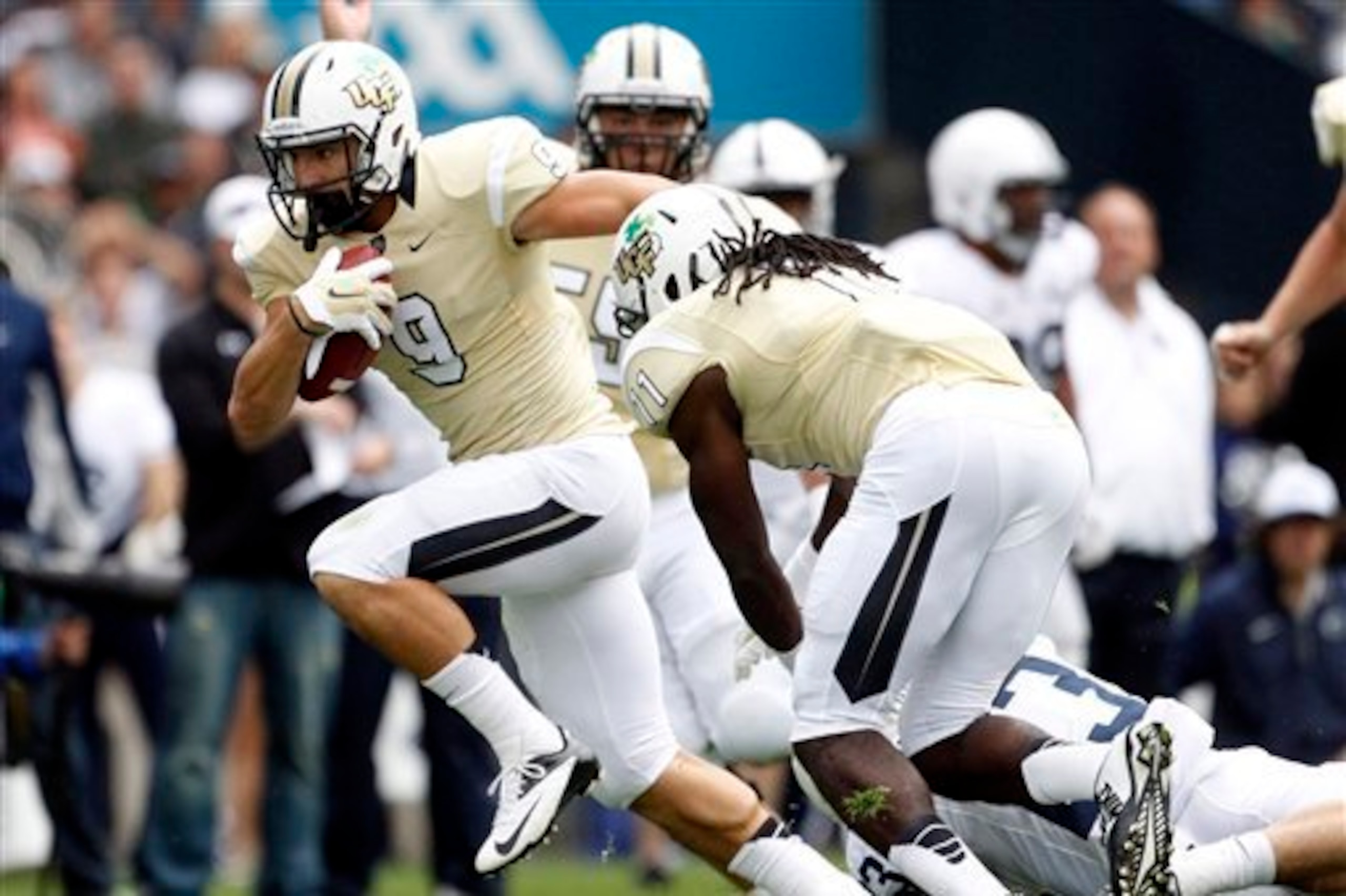
Overseas games would take some of the pressure off, as well. In 2014, Penn State and Central Florida played in Dublin, Ireland, at 8:30 a.m. ET (Dublin is five hours ahead of ET). A game in Ireland at a similar time would take the marathon right up to a more normal noon slot on Friday. (For the record, the first game on Friday, Sept. 4 between UNC-Charlotte and Georgia State is at 3:30 p.m. ET.)
That leaves a slot from around 4 a.m. to 8 a.m.
There's always the possibility of a college football game in London, something the NFL has experimented with. Additionally, the Pac-12 and Mountain West have flirted with the idea of playing a bowl game in Melbourne, Australia, which is 14 hours ahead of ET. But what about a regular-season game down under? A 6 p.m. game on Friday in Melbourne would broadcast at 4 a.m. ET in Bristol, Connecticut.
"We're selling the concept and the game. It's competitive and it's authentic," Paul Sergeant, CEO of Melbourne Stadiums Ltd., told Ed Wyatt of SportsPressNW.com in June. If Melbourne is willing to host a college football bowl game, it would likely be willing to host a regular-season game as well.
Is it ideal for coaches and players? Not at all, but when has that ever stopped college football from taking its product overseas for a game? And it would be just that: a single game. The overnight and early-morning slots would be three games back-to-back-to-back to minimize the amount of hoop-jumping.
Hypothetically, here's what a college football kickoff marathon could look like using games from the 2015 season-opening weekend (note that some games/times have been adjusted to make the schedule fit):
| Game | Time | Network |
| North Carolina vs. South Carolina | Thursday, 8 p.m. ET (Charlotte, NC) | ESPN |
| Oklahoma State at Central Michigan | 8:30 p.m. ET | ESPNU |
| TCU at Minnesota | 9:30 p.m. ET | ESPN2 |
| Colorado at Hawaii | Friday, Midnight | ESPN |
| TBD vs. TBD | 4 a.m. ET (Melbourne, Australia) | ESPN |
| TBD vs. TBD | 8 a.m. ET (Dublin Ireland) | ESPN |
| UNC-Charlotte at Georgia State | Noon ET | ESPN |
| Baylor at SMU | 1 p.m. ET | ESPN2 |
| Michigan State at Western Michigan | 3:30 p.m. ET | ESPN |
| Rhode Island at Syracuse | 4 p.m. ET | ESPNU |
| Washington at Boise State | 7 p.m. ET | ESPN |
Of course, with scheduling being the way that it is, a kickoff marathon for 2016, '17 or '18 would be far more appealing. There'd be more Washington vs. Boise State and less Charlotte vs. Georgia State.
Logistically, there are few hurdles to get through—though, admittedly, the hurdles are big. If ESPN could (and would be willing to) get through the overnight and early-morning slates, it would have quite a marathon of games to broadcast.
And college football fans everywhere would rejoice. Or fall asleep at work. Either one.
Ben Kercheval is a lead writer for college football. All quotes cited unless obtained firsthand.
_0.png?w=2560)


.jpg?w=2560 "2 NFL Officials Suspended")

.jpg?w=2560 "Injury-stricken Seahawks signing veteran RB")

.jpg?w=2560 "Mahomes' Wife Trolls Kubiak 💀")