
Eli Manning Just Might Get His Monster Contract Whether Deserving or Not
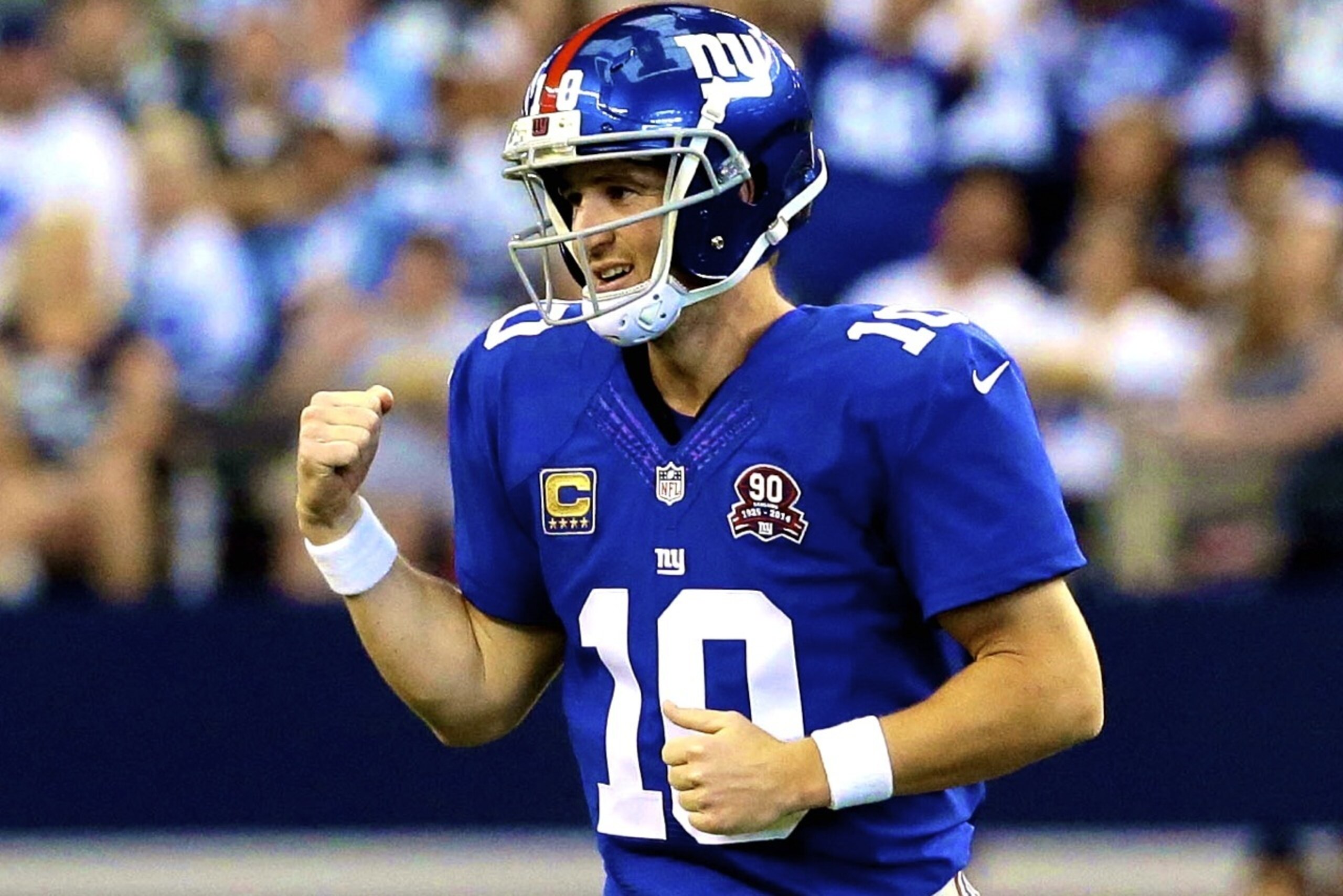
Football Internet threw up its collective hands on Tuesday, August 18, when NFL Media's Ian Rapoport, cited here by Pro Football Talk, reported New York Giants quarterback Eli Manning wants to be the highest-paid player in the game.
No one in the sports Twittersphere and/or blogosphere should take this as an invitation to rehash the dreaded elite debate or seriously consider the notion of Eli Manning being one of the best quarterbacks in the NFL—let alone the hilarious old chestnut that Eli is the better of the two Manning brothers.
| Aaron Rodgers | $22,000,000 |
| Russell Wilson | $21,900,000 |
| Ben Roethlisberger | $21,850,000 |
| Philip Rivers | $20,812,500 |
| Cam Newton | $20,760,000 |
| Matt Ryan | $20,750,000 |
| Joe Flacco | $20,100,000 |
| Drew Brees | $20,000,000 |
| Ryan Tannehill | $19,250,000 |
| Ndamukong Suh | $19,062,500 |
.jpg?w=2560 "Commanders Eagles Football")


Being the highest-paid player in the NFL, should it happen, won't mean the Giants actually think Eli's the best player in the NFL. Or best quarterback in the NFL. Or even, necessarily, one of the best quarterbacks in the NFL.
To be sure, salary correlates closely with success. Even surer, NFL players keep a close eye on both their personal statistics and the cash-money pecking order. NFL agents do the same; being able to negotiate a bar-setting deal is a feather in any representative's cap—especially when their client isn't anywhere near the best in the business.
Look at the top 10 average annual salaries in the NFL for 2015.
Is it just a coincidence that Russell Wilson happens to make exactly $100,000 less per year than Aaron Rodgers, or Ben Roethlisberger $50,000 less than that? Is it an odd circumstance that Dolphins defensive tackle Ndamukong Suh is in the top 10 overall but still $188,000 below teammate Ryan Tannehill?
Nope, absolutely not. Players, agents and teams measure these deals against each other, down to the penny. But every once in a while, factors beyond the team's control drive the market to new heights.
The Economics
What drives up quarterbacks' prices is the most basic economic principle of all: supply and demand.
Manning is a veteran quarterback with two Super Bowl rings who'll likely pass the 40,000-yard career passing mark in the first week of this season. He's coming off one of his best years ever and recovered nicely from a slow start—mostly thanks to his instant rapport with rookie phenomenon Odell Beckham Jr. Arguably best of all, Manning hasn't missed a start in the past 10 seasons.
Quarterbacks as good as Manning are incredibly hard to come by. As we've already seen this offseason with Russell Wilson, teams simply don't let quarterbacks walk away. Unless the Giants spent a top, top draft pick on a quarterback, they likely won't find one who could go out and start for them for a decade.
Every team wants stability at the quarterback position. There are very few quarterbacks who can provide that, and Eli's one of the very few—so he blows out the price curve, right?
Well, not exactly. Russell Wilson is at least as good as Eli, and far younger. His value on the open market would be much, much higher than Manning's. That said, Wilson just signed a four-year deal with less average annual value than Rodgers'.
How can Manning command millions more?
The Leverage
Manning's got the Giants in a tricky spot. As Mike Florio of Pro Football Talk pointed out, even the nonexclusive franchise-tag value of Manning's contract next year will be higher than Rodgers' current AAV—so unless the Giants are willing to let Manning walk away for nothing, they're already on the hook for at least that much.
Wilson was playing on a third-round rookie deal, and the rest of the team was built up in the salary-cap space around that contract. There was no way the Seahawks were going to replace Wilson's production for that little money—but falling back to a replacement-level quarterback and leaning on the rest of the foundation would still likely result in a winning season.
If the Giants let Manning walk, the falloff leaves them with...almost nothing.
When the Baltimore Ravens won Super Bowl XLVII, a mass exodus on defense and Joe Flacco's expiring contract created enormous leverage—and the contract Flacco ended up with far outstripped his on-field production to that point.
Had the Ravens let Flacco leave, they'd have had to rebuild from scratch.
The Messaging
Here's what happens if the Giants don't give Manning what he wants: The Giants will be left with a deeply uninspiring defense, neither good nor young nor cheap, and almost nothing on offense to build around (save, obviously, Beckham).
The current squad, with Manning playing at or near his best, is a cusp playoff team that could win the division with a few lucky breaks. Take away Manning, or hit the Giants with a few bad breaks, and things get ugly quickly.
Were Manning to walk out the door in return for nothing, the message would be clear: We're giving up. If 68-year-old head coach Tom Coughlin didn't retire, he'd likely be nudged out the door. The Giants would have to go full youth movement, because contention would be at least a couple of years away anyway.
Yet, if Manning's around long enough for the Giants to find or groom a replacement—and they can find a few more young pieces to build around in the meantime—they don't ever have to wave the white flag. While they prepare for a brighter future, they can keep hovering around .500 for the next few years and hope they get lucky in the playoffs.
Hey, it's happened twice before.
The Looming Spike
Lost in all this talk about current quarterback contracts is future quarterback contracts.
That massive, monster, arguably undeserved uber-deal Flacco signed a few years ago? It's now seventh on the AAV depth chart, per Spotrac.com. The Ravens were hardly shackled by it; in fact, they've put together a very strong contender.

Meanwhile, the salary cap is due to spike in 2016. Florio has speculated the cap could jump to as high as $160 million—$37 million more per year than when Flacco signed his deal. Flacco took up 16.3 percent of the Ravens' cap in 2013; that same share of $160 million would be $26.1 million.
The Giants could easily give Manning $22 million per year right now, then watch and laugh as the rest of the league re-signs its quarterbacks to $24, $25 or $26 million contracts over the next two or three seasons. By the time Eli's ready to join his brother Peyton in retirement, a five-year contract worth an average of $22 million per year could look incredibly cheap.
The harder you look at the Giants' situation, the more signing Manning right now makes sense.
Even if Eli never plays better than he did in 2014, making him the highest-paid quarterback of 2015 might be something the Giants can't afford not to do.
.jpg?w=2560 "Chiefs Dolphins Football")
.jpg?w=2560 "Cardinals Giants Football")



.jpg?w=2560 "Injury-stricken Seahawks signing veteran RB")