Richard Rodgers Set for Breakout Year in Green Bay Packers Offense
There are many reasons not to know Richard Rodgers.
He wasn't a top pick in his draft class. He didn't have a productive rookie year. He plays for a franchise that generally doesn't seek out media attention, at a position that doesn't draw as much attention as others. He's not even the most famous Rodgers on his team. In fact, he's not even close.
Richard Rodgers is a Green Bay Packers tight end. The franchise selected him in the third round of the 2014 NFL draft. Rodgers not only conceded the spotlight to wide receivers Jordy Nelson and Randall Cobb during his rookie season, but he also split time at tight end with Andrew Quarless.
.jpg?w=2560 "Commanders Eagles Football")


That limited him to just 483 snaps, per Football Outsiders, while Quarless played over 700. He caught just 20 regular-season receptions for 225 yards and two touchdowns before adding five receptions for 48 yards and a touchdown in two playoff games.
Although he flashed talent, Rodgers wasn't expected to push Quarless out of the lineup entering the offseason. Quarless is a talented player who offers the Packers value as a blocker and as a receiver.
However, Quarless' offseason took a turn for the worse. The 26-year-old was arrested for allegedly firing a gun in public, which led to McCarthy expressing his disappointment in the tight end. On Monday, Quarless told reporters he feared the Packers might cut him following the arrest and said he apologized to McCarthy for "bringing negativity to this place."
Even before Quarless' issues arose, Rodgers' stock was already on the rise with his quarterback. Late last season, Aaron Rodgers spoke fondly of the California native (via the Green Bay Press-Gazette):
"He's got incredible hands; I dare say the best hands on the team. He went through a stretch in training camp where he didn't drop a pass. Yeah, he's an exceptional player with great potential for us. Obviously, he hasn't gotten a lot of opportunities, but he knows football and I think he's got himself in really good shape.
"
Aaron spoke further about the second-year player's athleticism, something that is going to be key for determining his NFL success. He officially measured 6'4" and 257 pounds at the combine last year, but he is likely lighter than that now.
Those kinds of dimensions combined with enough athleticism to attack different levels of the defense make him a potential matchup problem for defenses. The Packers haven't had a tight end of that kind since Jermichael Finley's career came to an abrupt end in 2013 due to a spinal cord injury.
In the Packers offense, the tight end needs to make plays over the middle of the field consistently. Aaron Rodgers throws to every area of the field.

Last season, Rodgers produced against different kinds of coverages. Thirteen of his receptions came against zone coverage, while the remaining 12 balls he caught came against man coverage. On this play against the New Orleans Saints, Rodgers showed off his ability to adjust to zone coverage and absorb contact.
It's 3rd-and-20; Rodgers is lined up tight to the line of scrimmage in the slot.
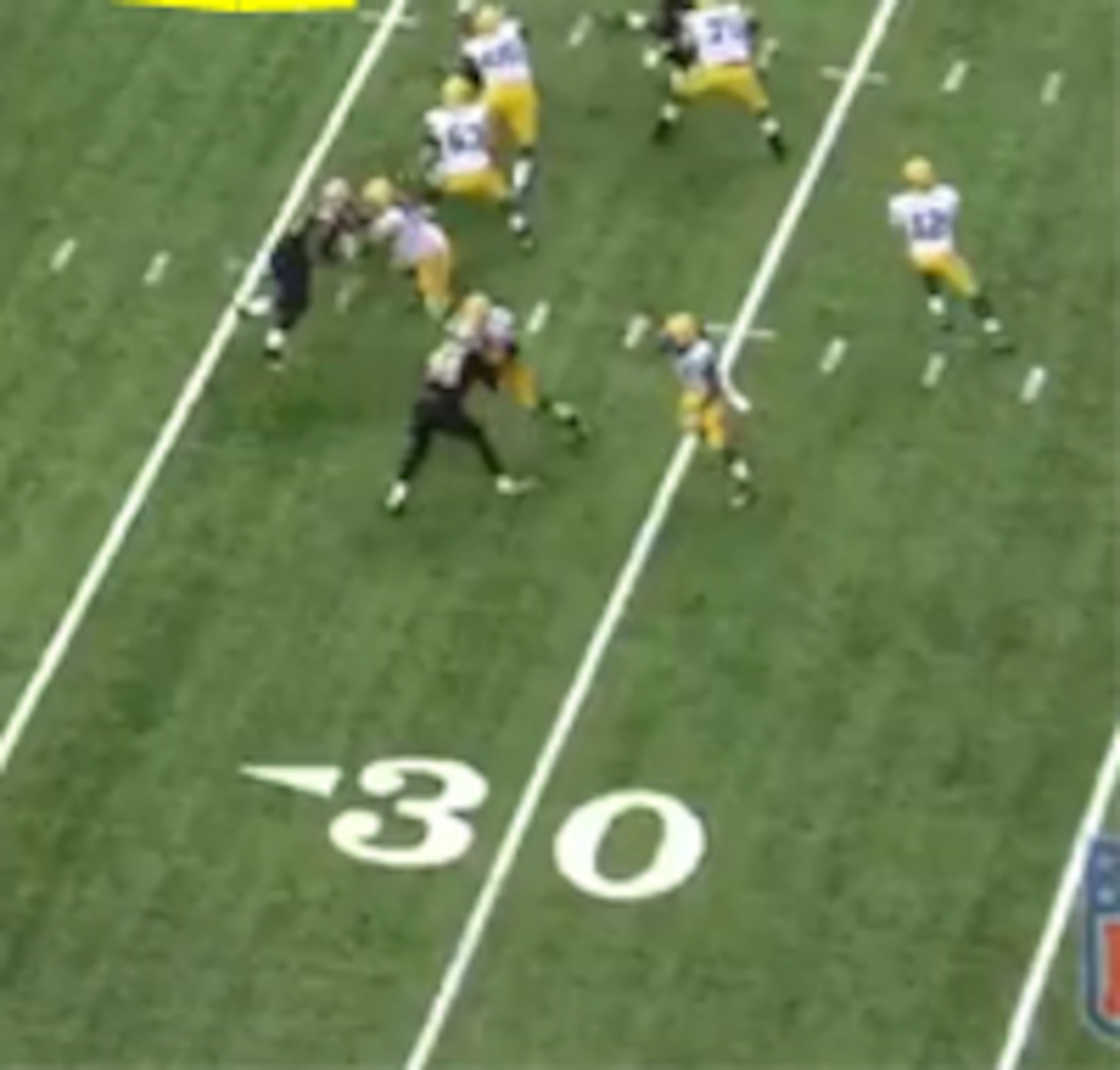
Rodgers is running a deep in route. He is initially confronted by a linebacker playing underneath coverage. That linebacker is directly in line with the tight end, so Rodgers widens his route to get around him. This is an important move because it allows Rodgers to cut infield behind the linebacker.
Cutting infield behind the linebacker allows Rodgers to do so without the linebacker tracking him. Once he turns infield, he sets his route down in the pocket of space between the underneath coverage and the safeties.

Both safeties arrive with the football, making contact with Rodgers' back as he secures it in his hands. Rodgers must absorb the hits from both defenders to secure possession of the ball. He does this comfortably to complete the 14-yard gain.
This particular play didn't result in a first down, but it's the type of play that typically does. It's the type of play tight ends in the league are expected to make, but not all players make them consistently.
Showing the technical awareness to not cut his route off early when confronted by the linebacker and the physical strength to control the ball against contact may seem like simple aspects of the play, but they're not easy.
Often, easy NFL plays only appear to be easy because of how well the players involved execute them. Rodgers has the potential to create a lot of easy yards for his quarterback.

This play offers an example of Rodgers working against off-man coverage. He is lined up across from the NFL's best strong safety—Kam Chancellor. Because of the underneath defender's presence coming across the field, Rodgers has to lengthen his stem instead of immediately slanting infield.
Due to the down-and-distance combination, Rodgers was likely going to have to force his way toward Chancellor before cutting infield either way.

Chancellor never put himself in position to prevent an underneath reception for Rodgers. He was playing the down-and-distance combination by lining up on the first-down line to come up and tackle Rodgers before he could get move the chains. The NFL's hardest-hitting safety played this perfectly up until after Rodgers caught the ball.
When Rodgers snagged it, Chancellor was arriving to hit him. He was just in front of the line of scrimmage, and Rodgers was turning back for the ball, so the safety should have been able to blow up the tight end.
He couldn't, though.
Rodgers is bulky and strong, but how small of a target he offers Chancellor is crucial here. By adjusting his body, he is able to force Chancellor's hit into a rolling-tackle attempt. Instead of running through Rodgers, Chancellor is trying to drag the tight end to the ground.
He does so very quickly, but it's not quick enough to prevent Rodgers from rolling across the first-down marker.
Making plays against off coverage is typically easier than against press. Rodgers is a tight end, so he's not exceptionally refined in his technique releasing from the line, but he doesn't need to be. That is because he combines strength, size, balance and precise feet to push past defensive backs.
On this play against the Detroit Lions, Rodgers lines up in the slot before pushing his way through the defender's outside shoulder. Once downfield, he plants his outside foot and pushes back across the defender's face at speed.

Rodgers' route didn't create separation against the defensive back, but it set up positioning. He was able to box out the defender before making an impressive reception away from his body against tight coverage. The offense gained six yards on this 3rd-and-4 play.
Combining the ability to consistently make these plays and exhibit an explosiveness to get downfield is what makes a tight end a matchup problem.
In the Packers offense, Rodgers doesn't need to be a matchup problem because he is the complementary piece. Defenses have to prioritize both Randall Cobb and Jordy Nelson in their game plans ahead of players such as Rodgers, Eddie Lacy and Davante Adams.
This should free Rodgers up, making it easier to find space and be able take advantage of it with his athleticism. Even if it doesn't, he has the ability to create his own separation against safeties and linebackers.

On this play against the Philadelphia Eagles, Rodgers is again lined up in the slot. On this occasion, he is going to be covered by Malcolm Jenkins in man coverage. He will be given space as the Eagles blitz at the snap, but Jenkins is a converted cornerback with the athleticism to run in space.
Being that it is 3rd-and-10, Jenkins also has the added benefit of not having to be aggressive on underneath routes.
Jenkins initially has good positioning against Rodgers. However, the tight end angles his route downfield before making a subtle-but-sharp push toward the sideline. This causes Jenkins to stumble, giving Rodgers a chance to accelerate away from him.
Once in this position, Jenkins can't recover against Rodgers before he catches the ball. When the ball arrives, Rodgers is 10 yards downfield.
Jenkins recovers to begin a tackle attempt 16 yards downfield, but the tight end is able to throw him to the ground, stumbling forward for a few more yards. This play ultimately turned into a 19-yard gain that came with relative ease because of Rodgers' physical talent and footwork.
The Packers don't necessarily need more weapons on offense. Richard Rodgers could even get lost in the crowd in terms of production for next season.
Still, with a quarterback such as Aaron Rodgers, the Packers have someone who is capable of sustaining production for more than just two or three targets. If the second-year tight end can prove his consistency in a greater role, there is no reason to think that his signal-caller wouldn't heavily rely on him.
Though there are many reasons not to know Richard Rodgers at this point of his career, he's poised to change that this coming season.
.jpg?w=2560 "Chiefs Dolphins Football")
.jpg?w=2560 "Texans-Mixon Released Football")


.jpg?w=2560 "Love's Body Already 'Tired'")