Inside Oklahoma's Healing Process in the Aftermath of the SAE Racism Scandal
Charles Tapper, a junior defensive end for the Oklahoma Sooners, was lounging around his off-campus apartment playing NBA 2K with fellow lineman Charles Walker and cornerback Zack Sanchez on the evening of Sunday, March 8. With a 5:45 a.m. workout scheduled for the next day, the time was quickly approaching for them to head to bed.
Then Tapper, a team captain, got a call.
"Man, where are you guys?" yelled Eric Striker, fellow captain, his gravelly voice at a fever pitch. "Why aren't y'all flipping out about what's going on? You haven't seen what happened with the SAE guys?"
TOP NEWS
.png?w=2560)
Week 1 Winners & Losers 📊
Western Michigan Loss Has Fans Irate
.jpg?w=2560 "Dolphins Commanders Camp Football")
Jayden Daniels Left Off LSU Montage
"Nah, what are you talking about?" Tapper asked.
"Man, I'm gonna send you the video!" Striker said. "Y'all need to get over here right now! We can't just let this slip under the rug."

In the bowels of the Citrus Bowl after last year's embarrassing 40-6 loss to Clemson—which ended an 8-5 debacle of a season—Oklahoma football coach Bob Stoops told the assembled media, "I want to start off expressing my disappointment and anger at the way this season went. I take accountability, responsibility for all of it. It starts with me and ends with me."
Little did he know that his disappointment and anger would deepen a few months later after an unforeseen controversy during what some would suggest was the most critical stretch of spring practices during his tenure.
College football coaches, at least those with Stoops' distinguished resume, are all about control. But the Sooners coach instinctively grasped that in order for his team to move forward, in order to heal and grow as football players and men, things didn't necessarily need to start or end with him.
He realized that, in this specific instance, he couldn't micromanage—he needed to cede the play-calling to his players.
The wobbly, slightly out of focus nine-second video clip was captured by someone's cell phone aboard a chartered bus carrying members of the University of Oklahoma's Sigma Alpha Epsilon chapter, their dates and a number of high school students who were potential fraternity recruits on Saturday, March 7.
Dressed in formal attire, they were headed to a party to celebrate SAE's Founders Day.
At some point during the ride, the fraternity members began excitedly clapping their hands, animatedly pumping their fists and boisterously reciting a racist chant that had seemingly been rehearsed and customarily woven into the fabric of their chapter's culture.
Two young frat members stand up, their red faces beaming with joy as they lead the cheer. The mantra is recited to the tune of the popular children's song "If You're Happy and You Know It."
"There will never be a n----r in SAE. You can hang them from a tree, but they'll never sign with me. There will never be a n----r in SAE."
Warning: This video contains offensive language.
The next day, the university's student paper, the Oklahoma Daily, received the video in an email. Within the next 24 hours, it became one of the hottest trending topics on Twitter. A national furor ensued.
Every major news outlet descended on the Norman campus. A highly touted football recruit in the Class of 2016, 6'5", 280-pound offensive lineman Jean Delance of Mesquite, Texas, was so disturbed by the incident that he rescinded his verbal commitment to Oklahoma.
School President David Boren launched an immediate investigation and swiftly moved to have the chapter banned from campus. SAE's national office closed the chapter and suspended its members hours after the video surfaced.
By March 10, moving trucks were hauling away furniture and the fraternity members' personal possessions. OU facility workers removed the large Greek letters from the SAE house as the expansive building was shuttered.
Two of the students who had taken a leadership role in the incident, Levi Pettit and Parker Rice, were expelled.
Tapper had actually viewed a sliver of the video earlier, when a classmate from his Cherokee foreign language class asked him if he'd seen it.
"When I saw it earlier, I couldn't really hear all the words and what they were saying," Tapper recalled as he sat outside of the team's locker room on a too-small chair, still attired in his dirt- and grass-stained white practice uniform two days before OU's spring football game. Salty remnants of dried sweat were caked on his forehead, discoloring his closely cropped beard.
"I didn't hear all of the lyrics and the full context of what they were actually saying the first time I saw it," Tapper said. "But when Striker sent it over, that's when I realized how ugly it really was."
Tapper, Sanchez and Walker abandoned their video game trash-talk and hustled over to the nearby Buffalo Wild Wings on Classen Boulevard, where a growing crowd of Sooner athletes was gathering.
"We were all talking about how we could address the situation, how we could get involved and do something," Tapper said. "We started strategizing, but as the crowd got bigger, we decided we needed to be in a private space. So then we headed over to Striker's house."
Striker, a 6'0", 225-pound All-American linebacker from Seffner, Florida, was having a difficult time controlling his rage.
He'd already sent out an incensed, profanity-laced Snapchat video.
"I was in a meeting watching film when it was sent to me," Striker said. "When I watched it after the meeting, I was so pissed off that my head and my stomach hurt. My heart dropped."
After arriving home, he couldn't stop pacing back and forth. He started calling his teammates, searching for a way to channel his mushrooming fury.
Striker had experienced a litany of microaggressions with OU frat members that he felt were laced with racism since he arrived on campus as a freshman.
"There were a lot of incidents where classmates would invite me to a party at their frat house," Striker said. "We showed up, and the person who invited us had to actually come to the door and vouch for us to get in. It was not a good vibe at all."
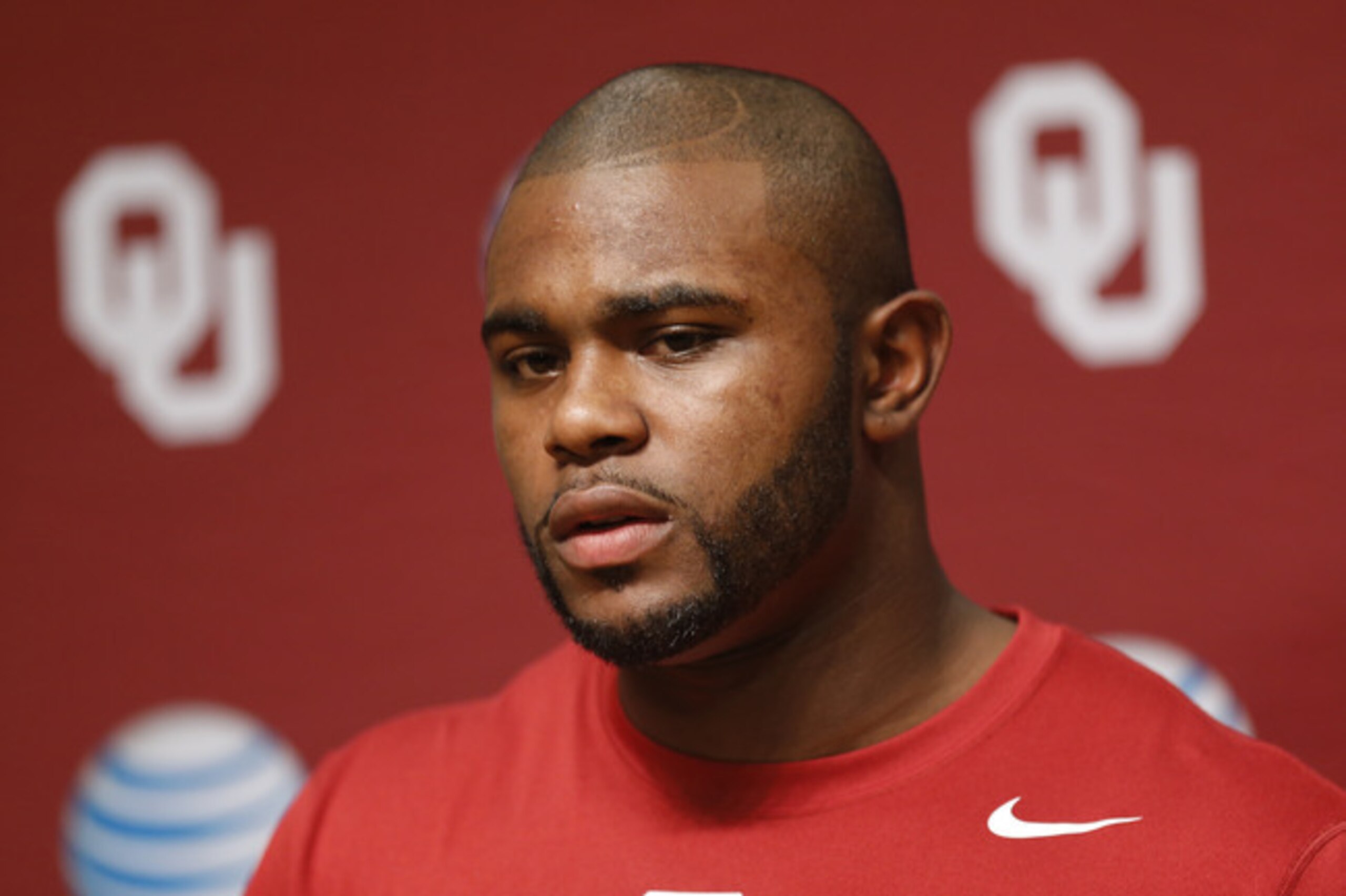
As he spoke, you could feel the hurt in his sincerity. At times, he paused thoughtfully, searching for the right words through deep breaths. He orated with a preacher's cadence, gesturing for emphasis.
"I could tell when and where I was not welcomed," Striker continued while lounging against a wall outside of the team auditorium a few days prior to the spring game.
His mom had always offered him books when he was younger, instructing him to read certain sentences, paragraphs and chapters. She'd ask him follow-up questions about what he'd learned.
His home library contained manuscripts about black leaders such as Frederick Douglass, Booker T. Washington, Marcus Garvey, Malcolm X and Martin Luther King Jr., among others.
One book that his mother handed him in the 10th grade, The Making of a Slave by Willie Lynch—which is a study of the brutal physical and psychological tools used to condition black slaves—made him break down in tears.
"I hit a wall when I read the Willie Lynch book," Striker said. "It hurt me so much, I broke down. But my mother put me in a position to think outside the box and to see things beyond what is simply in front you. It was mandatory in my house growing up to have an understanding of history and the African-American experience in this country."
With approximately 30 Sooner athletes gathered at his house on that Sunday evening when the SAE video went viral, they talked about what kind of steps and actions they could take within the university community.
"We just kept saying that this was something that we weren't going to tolerate or let happen," Striker said. "We knew that this was bigger than football and bigger than the University of Oklahoma. We were determined that something good was going to come from this."
The impromptu meeting lasted until the wee hours of the morning. It could hardly be characterized as one that followed Robert's Rules of Order.
"Everybody was just essentially expressing their hurt and anger," Tapper said. "Things got really raw and emotional."
With his mind racing after the meeting dispersed, Striker couldn't sleep.
Exhausted, with bloodshot eyes, he attended an on-campus march that morning that had been organized by Unheard, the student group that initially brought the SAE video to light.
Many familiar with SAE and the inner workings of other predominantly white fraternities did not see the situation at Oklahoma as an anomaly, but rather as an enduring problem.
SAE was founded in the antebellum south in 1856 and has a long history of racially demeaning behaviors. In 1949, when Harvard's Student Council passed a ban on discrimination based on color, nationality or race, SAE's national charter said that only "members of the Caucasian race" could join the fraternity. Faced with losing its Harvard affiliation, SAE acquiesced and changed its charter.
An SAE party on Martin Luther King's birthday in 1982 at the University of Cincinnati featured flyers asking students to bring things such as a canceled welfare check, "your father if you know who he is" and "a radio bigger than your head." The flyer also included prominent images of James Earl Ray, the man convicted of King's assassination.
At Texas A&M in 1992, an SAE "jungle fever" party featured revelers in black face and slave huts. Other racially charged incidents involving SAE members have sporadically surfaced all over the country in recent years, including one at Washington University in St. Louis two years ago, when pledges were ordered to hurl racial slurs at a group of black students.
Christopher Felix became a fan of the University of Oklahoma's football program when he was five years old. While out shopping one Saturday afternoon, his father stopped to check the score of the game being televised.
"Dad, who are we going for?" Felix asked.
"Son, we're going for OU," his dad replied.
"I've been a Sooner fan ever since that day," said Felix, who is a member of Alpha Phi Alpha, the nation's oldest historically black fraternity. He's a mechanical engineering major who is also minoring in business.
Felix was walking into what he thought would be a regular meeting on campus that Sunday evening when the video surfaced, and he immediately found himself, and his beloved OU community, immersed in a firestorm.
When he saw the school's football players active and engaged, he knew that the incident and the groundswell of activism on campus was prone to reach a wider audience.
"There is a lot of power in celebrity, and there are few bigger celebrities in Norman and in the entire state of Oklahoma than the football players at OU," Felix said. "When they said they weren't going to tolerate it, it became everybody's issue."
The day after the video went viral, all 105 members of the football squad gathered in the team auditorium, where they normally pore over film and digest on-field tactics and game plans. They began debating some different strategies.
Where photos commemorate the program's seven national championships and a quote in white script reads, "The only yardstick for success our society has is being a champion. No one remembers anything else," the players argued back and forth about what role, if any, they should play.
"Things got very heated, especially at that first meeting," said wide receiver Sterling Shepard, a political science major and another team captain. Shepard was a semifinalist for the Biletnikoff Award last season, presented annually to the country's best receiver.
"None of us were equipped to handle a situation like this," Shepard said. "Guys were almost getting into fights because everybody comes from different belief systems, political thoughts and economic backgrounds. The room was split."
"You had guys standing up and saying, 'I didn't come here to be a civil rights activist, I came here to play football,'" said senior center and Academic All-American Ty Darlington, a member of the Sooners leadership council.
Tapper, Striker, Shepard and other black players shared their hurt and previous experiences with racism with their white teammates.
"Obviously, being a white male here, as much as I can empathize and say that I understand how they feel, I haven't lived that," said Darlington, a native of Apopka, Florida, whose mom was once a cheerleader when she attended OU. "I had to sit down with them and try to understand, in depth, what they were going through."

Stoops was angry when he saw the video. Growing up in the rugged blue-collar town of Youngstown, Ohio, as the son of a legendary high school football coach, he had a diverse group of friends and teammates. The vehicle of sport, he later learned, allowed them to transcend their differences and appreciate one another as individuals.
"I truly believe that a big part of our job as coaches is relating to our players as if they're a part of our family, because they are," Stoops said while sitting on a comfortable leather couch in his spacious, wood-accentuated office in the Barry Switzer Center.
With two days of work remaining before the spring game, you could see the intensity etched into his poker face, even as he hastily flipped through a copy of Mitch Albom's The Five People You Meet in Heaven, a book he has already read.
"You have to have a sense of the pulse of your team," Stoops continued. "I felt strongly, with the level of emotion that so many of them had with this, that we were going to have to work through it. It was about allowing them the space to do that. And they were very thoughtful and put a lot of time into meeting and thinking about what the message should be and how we were going to deliver it."
Four days after the SAE video went viral, and just five days after spring practice began, the football players shunned their pads, skipped practice and held a silent protest—dressed in black, linked arm-in-arm—with Stoops and the entire coaching staff participating, demanding punishment for more than just the two SAE students who were swiftly expelled by Boren.
"We found out that the song in that video was being taught at a national convention, on a cruise," Stoops said. "The team's purpose was to bring attention, not only to the young guys at Oklahoma who said it, but to who was teaching this. Why would something like that be taught, and why did they feel like it was acceptable?"

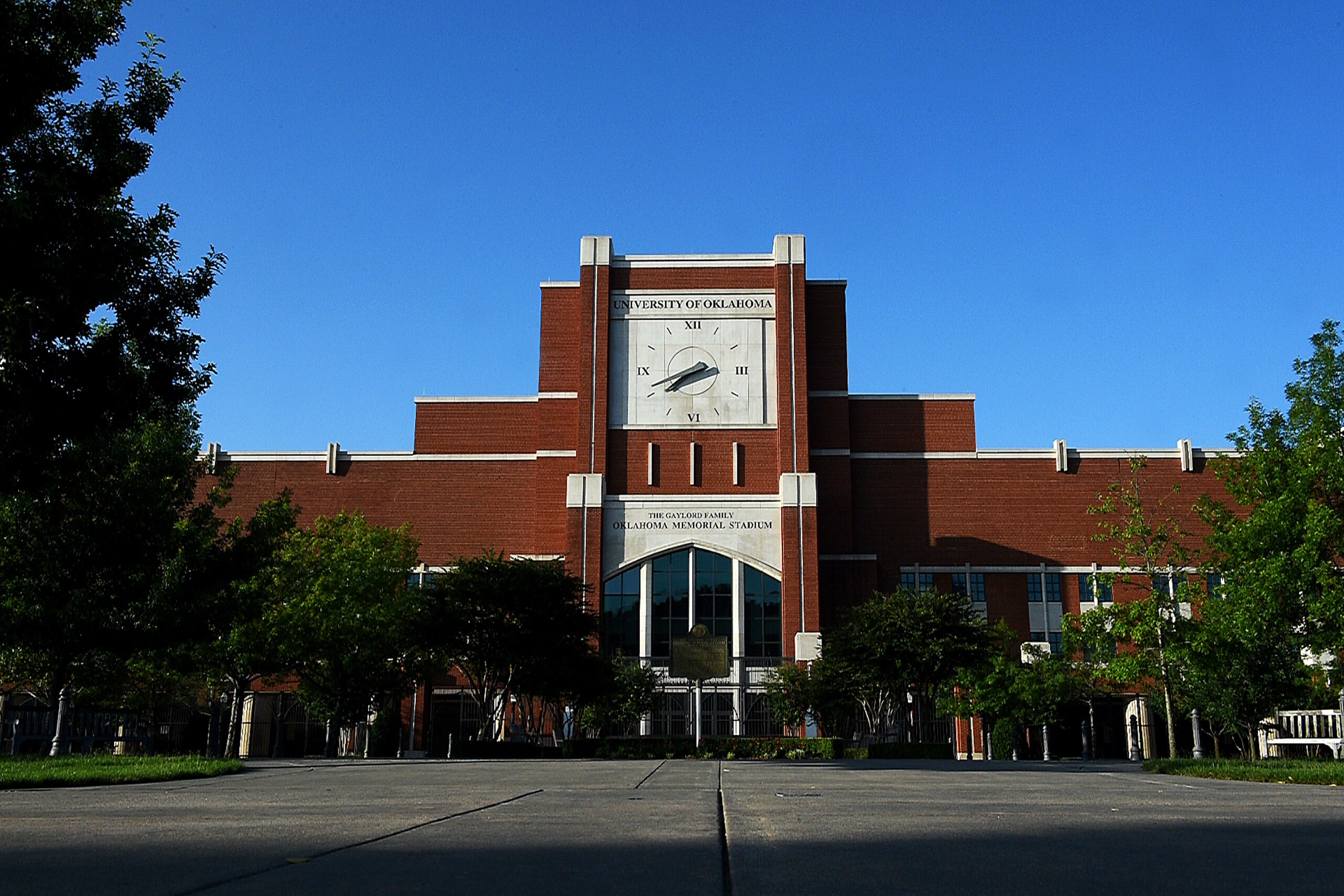
The day prior, as the next-to-last practice before the spring game wrapped up, the crack of shoulder pads crashing together, whistles and hand claps echoed in the cavernous and empty Memorial Stadium. Footballs whizzed through the air as ominous storm clouds hovered above.
Soon, the mesmerizing spectacle of OU football will be back, a fact that Sooner Nation can't welcome soon enough.
But remnants of the damage to a wounded community can still be found at 730 College Avenue, the former address of the Sigma Alpha Epsilon house.
On a magnificent, luminous early afternoon the day before the spring game, when the main walkways on campus are awash with bustling students, most of them wearing T-shirts, shorts and flip-flops, the scene on College Avenue is subdued. The parking lot at the old SAE house is cordoned off by yellow caution tape attached to five orange OU traffic cones, with a hulking floodlight to the left of the lot entrance.
The gate with two standing, roaring lions that leads to the huge house is chained. Someone has spray-painted "Tear it D" in black letters on the right side of the house, with a squiggly line trailing after the letter D.
The windows out back are boarded up with plywood. The basketball half-court behind the house, with its soft, fancy purple and grey rubbery surface, is missing the rim from its backboard.
A few steps away, a landscaper is blowing leaves and tending to the meticulous lawn of a white-columned sorority house.
Slightly more than a block away at JJ's Pizza Stop on West Lindsay, a group of white freshmen males, some of them sporting Greek fraternity letters, are enjoying the lazy afternoon. A few of them are watching the Masters on the elevated flat screen near the establishment's entrance as they snack on appetizers and talk about Tiger Woods and Jordan Spieth. Others are off to the side shooting pool.
When the conversation switches to the spring football game, they talk about growing up as OU football fans and how crazy the stadium is on game days. When asked how they thought the football team responded to the SAE video, their smiles and laughter disappear.
One abruptly says, "No. We're not talking about that," as another summons the guys over from the pool table to let them know what's going on.
But Will O'Connor, a conscientious, innocent-looking first-year student from Tulsa who is a pre-med and biology major, does talk about it.
"I'm in a group called the President's Leadership Class, and Coach Stoops talks to the group at least once a year," O'Connor said. "This was a week after the incident, so tensions were still high. He was very emotional but very positive. He talked about how his own family and children, along with the football family, had been hurt and affected."
At the spring game, some members of the 1985 team gathered to begin a yearlong celebration of the 30th anniversary of their national championship.
Jamelle Holieway, that squad's electrifying option savant who remains the only true freshmen to quarterback a major college football team to the national title, enjoyed the hugs and jokes he shared with former teammates like tight end Keith Jackson and former coach Barry Switzer.
"I was sad that the people at the university had to go through something like that," Holieway said. "That video was a black eye that was felt by a lot of people. And when I saw Coach Stoops and the players out there together, protesting and making their statement, I felt like that was the first step toward mending what had been broken."
Holieway loved being around his old teammates, reminiscing about the good times. And he has faith that the good times will return to OU football very soon.
"Playing good football is going to help everybody heal, because everybody comes together around the Sooners," he said.
"We were a close team before, and we're probably a closer team now," Stoops said. "When you're a part of athletics and in an environment like this, you learn to love the other guy regardless of their background. This situation was thrust on us, but we were obviously strong enough to handle it, to look it in the eye and to try to bring about a national change. And that was our purpose.
"Because you have incidents like this all over the country, and there doesn't need to be any more."
Wandering through the student union a few days prior to the spring game, the mood of the many students lounging and milling about is mostly buoyant.
The most powerful and inviting elements of the atmosphere are the photos that hang on the walls—the black and white snapshots that stare back at you. These are frozen images of school history—like the ones featuring the OU football team in 1896, the men of ROTC in 1939, the school orchestra in 1906, a sorority rush event in 1939, the track team in 1906 and an individual photo of Prentice Gautt, Oklahoma's first black football player in 1956.
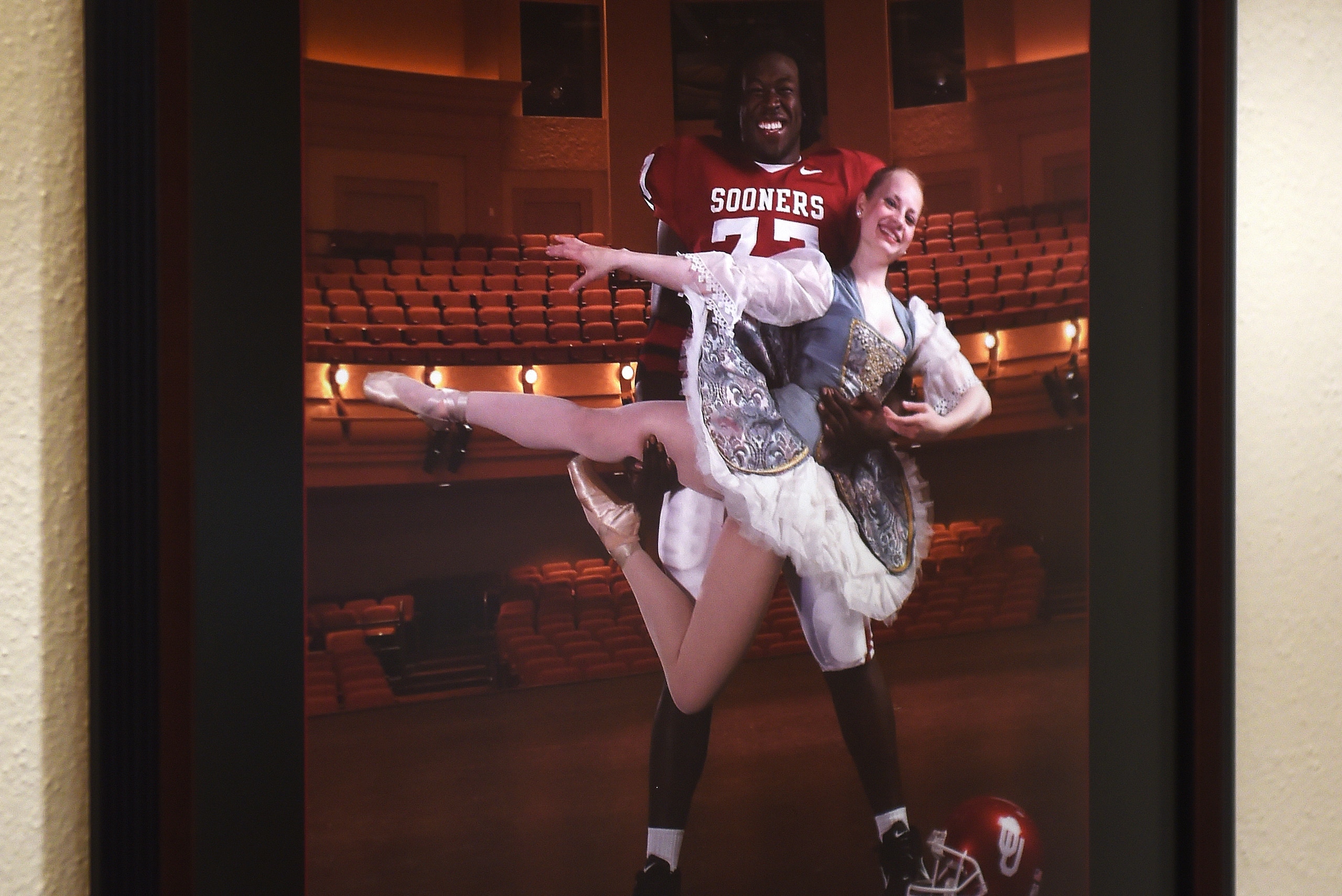
On the third floor, to the right of the office of Student Life, is a poster from 2005. Its symbolism is inescapable. Standing center stage in the dazzling Reynolds Performing Arts Center is mammoth former Sooners offensive lineman Davin Joseph. Dressed in his crisp uniform and sporting a wide, toothy grin, he is holding a diminutive ballerina in the air. Above the photo is a caption that says, "University of Oklahoma." Below, it says, "We Have It All!"
Football's powerful force and unique strength is supporting, lifting and holding up something beautiful. They're an odd couple. But they're working together. She assumes her ballerina pose. He carries her. Both jobs are hard work. But they're both smiling.
Alejandro Danois is a senior writer and editor with The Shadow League. The former senior editor of Bounce Magazine, he's also had work published by the New York Times, Sporting News, Baltimore Sun, Los Angeles Times, Ebony magazine and others. Follow him on Twitter @alidanois.
.jpg?w=2560 "Projecting NFL Win Totals")