Like It or Not, LeBron Is Going to Make His Voice Heard, and Why Shouldn't He?
LeBron James has never made it a secret, from the start, what he's about.
Empowerment.
He's repeatedly shown he doesn't always view authority structures the way traditionalists might, nor does he necessarily believe in all of the boundaries society has arbitrarily set for elite athletes. He's shown that by trusting childhood friends rather than more experienced experts to handle his marketing and business affairs. He's shown that by exercising his free-agent rights to leave Cleveland when that didn't conform with conventional wisdom of what a hometown hero should do.

He's shown that by choosing to return to Cleveland, in part, because he preferred to serve as the CEO of a Cavaliers (re)startup than remain a middle manager in the more established Miami Heat company, with its more rigid chain of command. He's shown that by recently accepting the position of vice president of the players association, even with all his time-consuming commitments. And he's shown that, mostly, by emphasizing again and again he plays for the pleasure of fellow labor—his teammates—rather than at the pleasure of management.
He believes in himself, above anyone else, and he knows the power he wields—not over just a single team but all of them. He believes he's learned enough about the game and the league to have earned the right to be heard, in every circumstance. He believes he's more than mere labor in the labor-management construct. He's irreplaceable labor, which makes him an irrepressible force.
Somehow, many are still surprised when he makes executive decisions on the court, exerts his influence in the huddle or shares his preferences with the front office.
Some are still bothered by it.
Why?
After 12 seasons in the NBA, 10 postseasons, four straight trips to the NBA Finals before this season, two championships and two Olympic gold medals?

After all he's encountered, endured and overcome?
After he can say, as he often does, "there's nothing I haven't seen," and it doesn't seem like a stretch?
He hasn't, on some matters, earned the right of rebuttal? Shouldn't he be allowed to make his voice heard in the huddle and throughout the organization, especially when he's the only person of prominence who has hoisted the Larry O'Brien Championship Trophy?
Why?
Because it's not what athletes are supposed to do?
Or because it's not what he's supposed to do?
This comes to mind after the latest round of eye-rolling and finger-wagging, following the latest ESPN.com report about his interactions with coach David Blatt. According to Marc Stein, who had sideline access during the Finals, James was calling timeouts, making substitutions, overruling Blatt's play calls and huddling directly with favored assistant Tyronn Lue. Naturally, this sounded the Internet and radio sirens to charge James with the first-degree felony of insubordination.
To start, none of this was especially surprising, if you'd been closely following the Cavaliers all season.
Also, it's true that it isn't ideal for a star and coach to be, or even appear, disconnected; you'd always prefer the relationship between, say, Tim Duncan and Gregg Popovich, when possible, even though that takes time to develop.
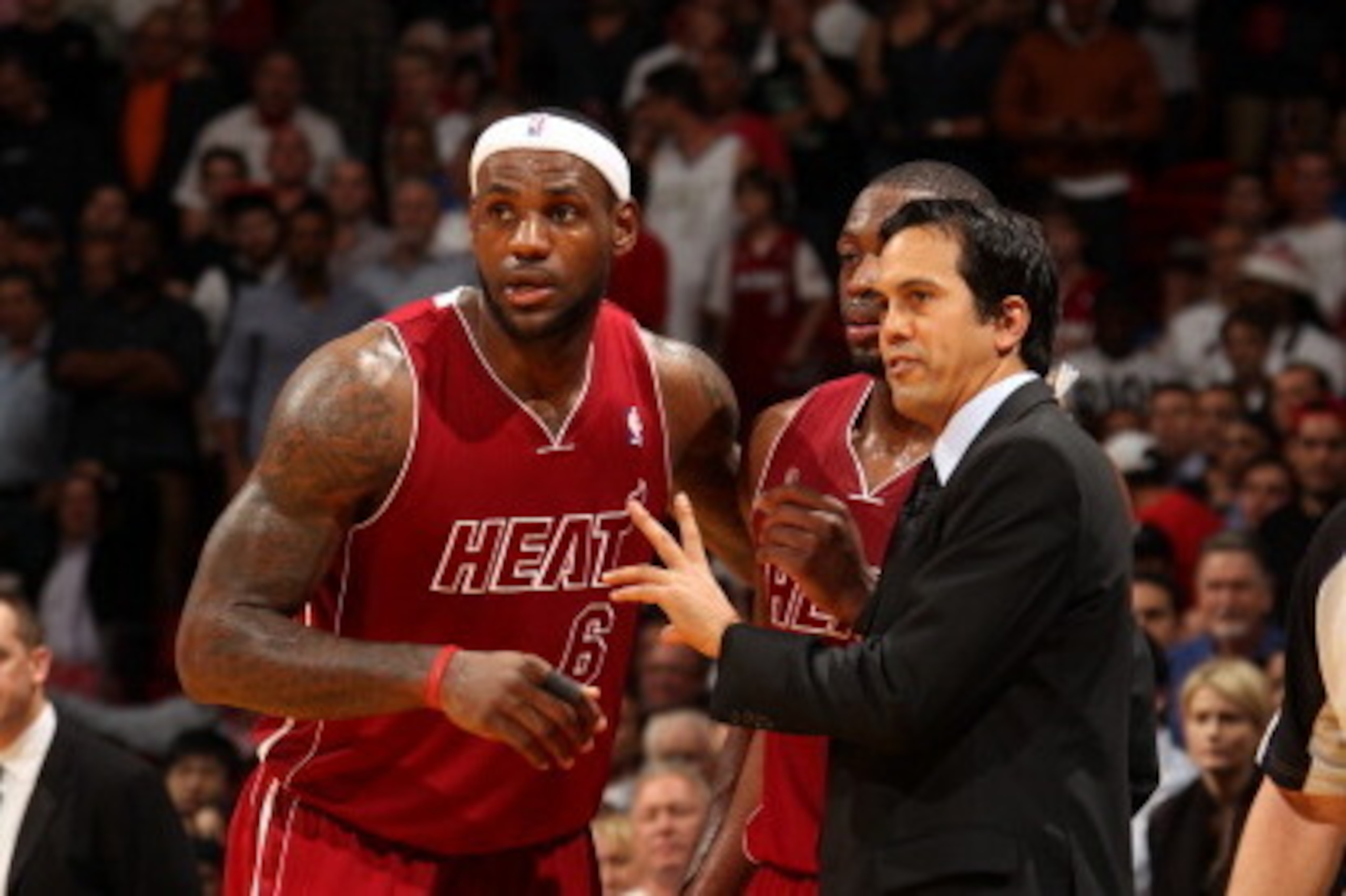
Indeed, James would be best served with a coach with the gravitas (in terms of NBA coaching resume) and gumption (which Erik Spoelstra had, even without the other) to consistently challenge him, to push him out of his comfort zone and to draw the absolute best from him. That didn't occur this season, as evidenced by his straying from the post and precipitous drop in efficiency, with his nosedive in assisted baskets also speaking to the lack of body and ball movement in the offense.
But, even while considering all of that, outrage is out of place.
It's not especially unusual for stars to develop decidedly different ideas from those of their coaches and to express those ideas more passionately at times of the greatest stress, with the NBA Finals certainly sufficing as such a situation. Larry Bird and K.C. Jones had, by most accounts, a healthy relationship, and yet a prominent former coach, covering the NBA Finals, reminded Bleacher Report how Bird would demand a change to a play call and, after making the change work, later publicly give Jones the credit. Dwyane Wade endorsed Spoelstra's hiring in Miami, but James bore witness to that duo's fair share of flareups, including the one in the 2012 playoffs in Indianapolis, only some of which made it to the broadcast. Spoelstra started framing these situations positively, as "Miami Heat huddles."
This doesn't just happen in basketball either, unless you've never seen an NFL quarterback snap at a coordinator late on an NFL Sunday—but for some reason, fans and media grant QBs greater leeway to vent...and audible. (James made the latter point in May, during the last media conniption about his role in orchestrating offense: "Why wouldn't you give me the freedom to call plays? That's like telling Peyton Manning or Tom Brady, don't give them the freedom to change them in the huddle. I'm a smart, cerebral basketball player, my basketball IQ is very high, and I take that very seriously. So I know what best suits our team and our coaching staff does as well.")
While it would be worrisome if a star's contradiction or dismissiveness toward a coach trickled down to his impressionable teammates, transforming into collective mockery or even mutiny, there's been no clear evidence of that occurring here.
Cavaliers players, old and young, have seemed to come to their own conclusions about the coach, for better or worse. When I set out, during the NBA Finals, to write a column crediting Blatt for keeping the Cavaliers on course amid adversity, none of the three players I approached chose to bash Blatt. Nor, however, did any heartily endorse my premise, preferring to praise "the coaching staff" rather than any single individual.
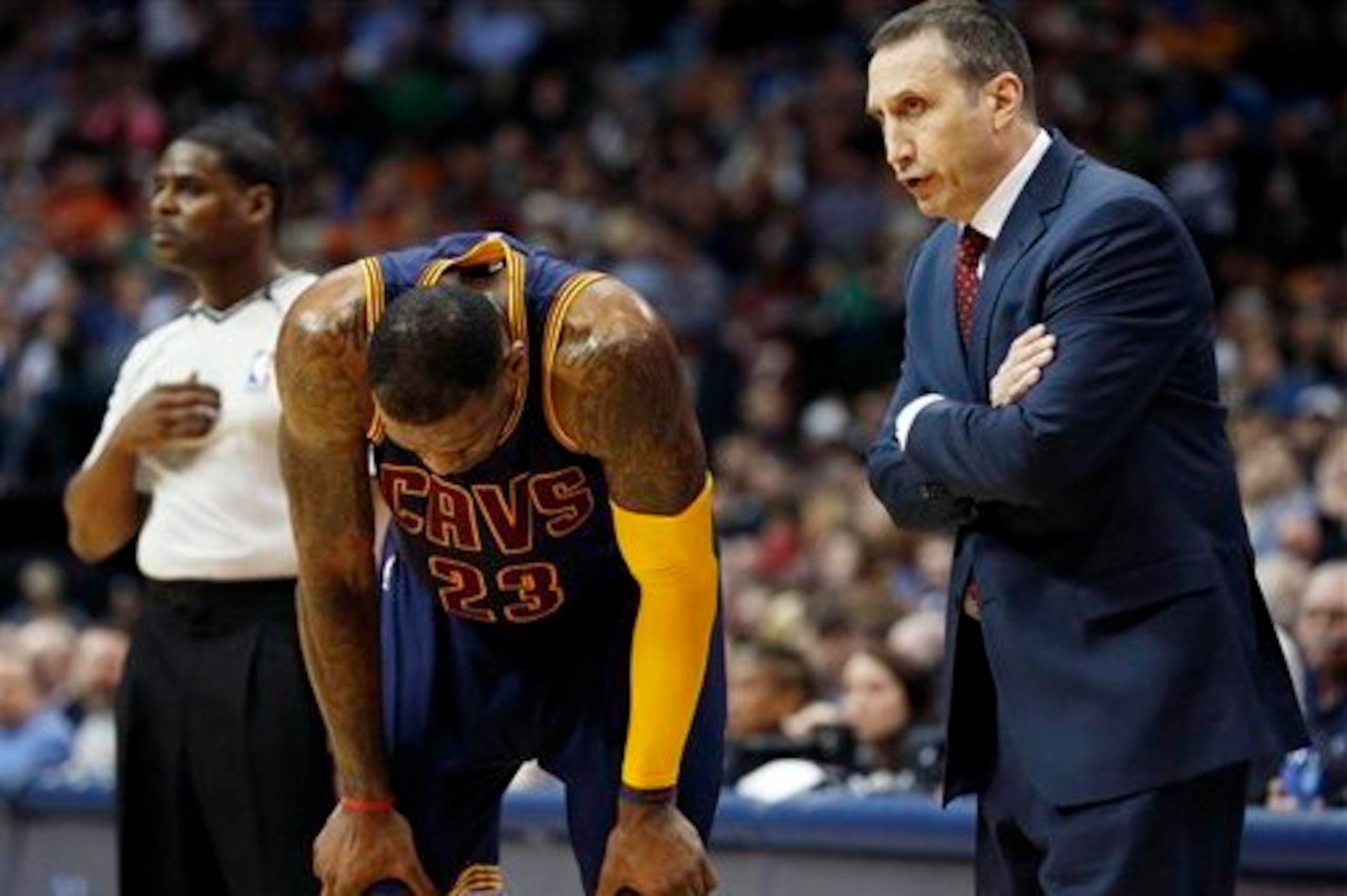
This season, James has made a few references to the Cavs' "rookie coach," a characterization Blatt abhors. But it should be noted James has never been especially effusive in his praise, or strong in his embrace, of his NBA head coaches, whether Paul Silas or Mike Brown or Spoelstra, typically offering tired cliches just to keep an interview session moving with the least possible controversy. He knows what to give, to get by, because of the authority construct most still cling to. But, at his core, he believes players matter most, which isn't an irrational perspective. They are the people the public are paying to watch. They most determine whether he wins or loses. He will always try to do what he believes is best for them, even if that sometimes comes in conflict with the head coach.
If he's happy with them, he's generally content.
That was clear again this season, when his mood brightened after GM David Griffin acquired three pieces James believed the Cavaliers needed well in advance of the trading deadline.
Which brings us to the next point of contention in the public, the other that usually starts the snickering: the perception that James is acting not only as the coach but also as the general manager.
James hasn't completely distanced himself from this perception; his friends on the Heat say he made a crack about it while losing to them on Christmas, one that kept them laughing long after that game ended. And there's no question that his current standing differs from what he experienced in Miami, where the Heat Way calls for much more conformity, greater separation between the front office and the player, and something closer to equality among the players themselves.
Pat Riley's core belief, expressed in an interview with Bleacher Report in March, is that teams have a sharper edge when there's a "nice tension that's ongoing that doesn't create crisis but where you can collaborate with both sides." That philosophy has certainly stood the test of time, with the structure manifesting itself in consistent success, the sort that has eluded the other South Florida professional sports franchises.
But the Heat Way clearly isn't for everyone. In the end, it wasn't for James, who found it too constricting. Nor was he alone, not in Heat history nor on any of his Heat rosters, to find the conformist culture, at least occasionally, oppressive. Sidle up to just about any former Heat player, and, regardless of his respect for Riley, you're sure to hear a Riley story accompanied with a sigh, smile and head shake.
James chose a different path, one that took him back to Cleveland, one in which he expected—and has been granted—more opportunity to shape the franchise's decisions. And, in this case, it really doesn't seem so crazy to let him do so. Nor does Griffin's ongoing intention, reiterated again this week, to solicit James' opinion on specific personnel matters, since he does have a pretty good idea of who can play and who can't. That doesn't mean James will be the one out there scouting players in small towns or overseas, or breaking down their tape, though he did some of the latter when the Cavaliers were coming close to completing their quest to acquire Timofey Mozgov, a quest that started long before James had rejoined the roster.
Nor does it mean that, when asked for input, James will always be correct in his talent assessments. He'll make some mistakes. But you'd struggle to name any NBA GM who doesn't, especially when acting without player input.
The Cavaliers knew what they were getting, and they—unlike the public—seem to get it. After all, it was part of the reason they got him away from Riley and Miami. They were getting someone who wanted to shape a franchise's future, with a say in decisions about whom to acquire and how to best use them. Someone who has never felt more empowered, after all he'd accomplished in his South Florida sabbatical.
At this point, he wouldn't have it any other way, regardless of the way the public typically constructs the player-coach and player-organization paradigms.
Nor should he need to.
Ethan Skolnick covers the NBA for Bleacher Report and is a co-host of NBA Sunday Tip, 9-11 a.m. ET on SiriusXM Bleacher Report Radio. Follow him on Twitter, @EthanJSkolnick.


.jpg?w=2560 "Chiefs, Steelers Eye WR Trades")