

C.J. Spiller Should Have Career Resurgence in 2015 with New Orleans Saints
C.J. Spiller's career with the Buffalo Bills always promised so much without delivering enough.
After being selected ninth in the 2010 NFL draft, Spiller played five years for the Bills. Injuries quelled his production, as he played in just 70 games and started 36. Spiller carried the ball 668 times for 3,321 yards and 12 touchdowns. He caught the ball 158 times for 1,195 yards and six touchdowns.
He also had 17 fumbles, or one every 48.6 touches.
TOP NEWS
Lane Johnson Retirement Post🦅

New NFL Power Rankings 📊
.jpg?w=2560 "Nolan Wells Lawsuit")
Terrell Owens Being Sued for Defamation
Yet, despite his struggles for the Bills, Spiller was signed to a significant contract as a free agent this year. The New Orleans Saints added him to their backfield with a four-year deal worth $16 million, $9 million of which was guaranteed. While those aren't huge numbers, they are notable for a running back these days.
The Saints signed Spiller not for his ability to be a bell-cow back but rather to fill a role that has been missing an ideal fit since the departure of Darren Sproles. Spiller will be head coach Sean Payton's receiving back.
| 2006 | Reggie Bush | 88 | 742 | 2 |
| 2007 | Reggie Bush | 73 | 417 | 2 |
| 2008 | Reggie Bush | 52 | 440 | 4 |
| 2009 | Reggie Bush | 47 | 335 | 3 |
| 2010 | Reggie Bush | 34 | 208 | 1 |
| 2011 | Darren Sproles | 86 | 710 | 7 |
| 2012 | Darren Sproles | 75 | 667 | 7 |
| 2013 | Pierre Thomas | 77 | 513 | 3 |
| 2014 | Pierre Thomas | 45 | 378 | 1 |
| Averages: | - | 64.1 | 490 | 3.3 |
Payton has always had a receiving back(s). When Reggie Bush and Sproles were at their best in New Orleans, each was extremely dangerous and productive working out of the backfield. Last year, Payton relied on the less effective Pierre Thomas and Travaris Cadet.
While Spiller may have experienced durability issues in Buffalo and struggled to be a feature back in a tough situation, he did prove his ability in the passing game.
Spiller is definitely closer to Bush or Sproles than he is to Cadet or Thomas. His explosiveness is what makes him so dangerous in space. Despite his limited action on the field over his career, the 27-year-old had 32 20-plus-yard runs and 13 20-plus-yard receptions during his time with the Bills.
Thirteen of those 45 total plays went for more than 40 yards.
Of most significance is what Spiller did during the 2012 season. Nine of his 13 20-plus-yard career receptions came in that one season. Spiller was phenomenal that year because he stayed healthy and was a perfect fit in then-head coach Chan Gailey's offense.
Gailey made an aggressive effort to get the ball to Spiller in space. The result saw him carry the ball 207 times for 1,244 yards and six touchdowns. That's an incredible six-yard average per carry. He added 43 receptions for 459 yards and two touchdowns in the passing game.
Although Payton's offense is obviously different from Gailey's, the principle of putting Spiller in space should carry over. Spiller didn't get into specifics when he signed with the Saints, but he did note the importance of Payton's approach and what his role would be, per NewOrleansSaints.com (h/t Kevin Patra of NFL.com):
"I've been following this offense very closely. We tried to do some similar stuff at Buffalo early on in my career. The way that they use their running backs in general is very intriguing. If you were in my position, you would be a fool not to visit or at least see how they could utilize your skill set, especially my type of skill set.
"
Payton understands that each individual player has a specific skill set that must be utilized when possible. In 2014, he relied on Thomas and Cadet as his receiving backs but clearly had separate game plans for each player in the passing game.
| Pierre Thomas | 45 | 21 | 14 | 10 |
| Travaris Cadet | 38 | 11 | 6 | 21 |
Cadet is essentially a receiver. At least, that's how the Saints used him. He played just 209 snaps last season, and an incredible 185 were passing plays, per Pro Football Focus. He showed off the versatility and comfort to line up all over the formation and run routes to different areas of the field.
While possessing that refined receiving ability, Cadet lacked the explosiveness to justify Payton giving him carries between the tackles.
It doesn't make sense for the Saints to use Spiller like they used Cadet. Payton spoke about how he views Spiller's skill set and touched on this after signing him, per ProFootballTalk's Mike Florio, via NewOrleansSaints.com (h/t Mark Inabinett of AL.com):
"Spiller's [skillset] is a unique one. I think one of things that helped us sign C.J. was the versatility that we look to have when he's in the game. We'll look at packages to put him out wide, packages where he's in the backfield with another running back. The key with him when you watch him on tape is finding a way to get him the ball in space because he's so explosive.
Our job is to make sure we look at this upcoming season and we get a guy like C.J. Spiller and we say, 'All right, here's a target. Here's a weapon we can use that's unique,' and we've got to be able to be flexible enough -- no different than when we were able to draft Reggie Bush and we weren't expecting that to happen. We changed a little bit what we were going to do. We'll do the same thing this year.
"
It's significant that Payton compares Spiller to Bush. They are very similar players, and Payton admits that you need to alter your approach somewhat to incorporate each player. Yet, the Saints don't need to make dramatic alterations to what they did last year with Thomas.
What Thomas was able to achieve in 2014 was impressive and heavily reliant on screen plays. He did nothing that Spiller can't emulate and improve upon because of his overall explosiveness and elusiveness.
Payton found a balance between creative and simplistic screen concepts to put Thomas in space last season. The simpler designs were just as effective as the more complicated ones, but they all were built on the same idea: get the back in space with blockers out front.
In the above play, Payton relies on a quick throw from Drew Brees and the back's speed to negate the need for extra blockers.
Screens to running backs typically ask offensive linemen to work in space and feature as key blockers for the back. Payton didn't do that on this play—instead, he asked his receivers to create enough initial space for the back to attack the second level of the defense.
Payton uses these kinds of screens as complements to his more elaborate screens that stress the offensive linemen more. He doesn't completely exclude his receivers from these plays, instead intelligently using them as key blockers or to run routes away from the play.
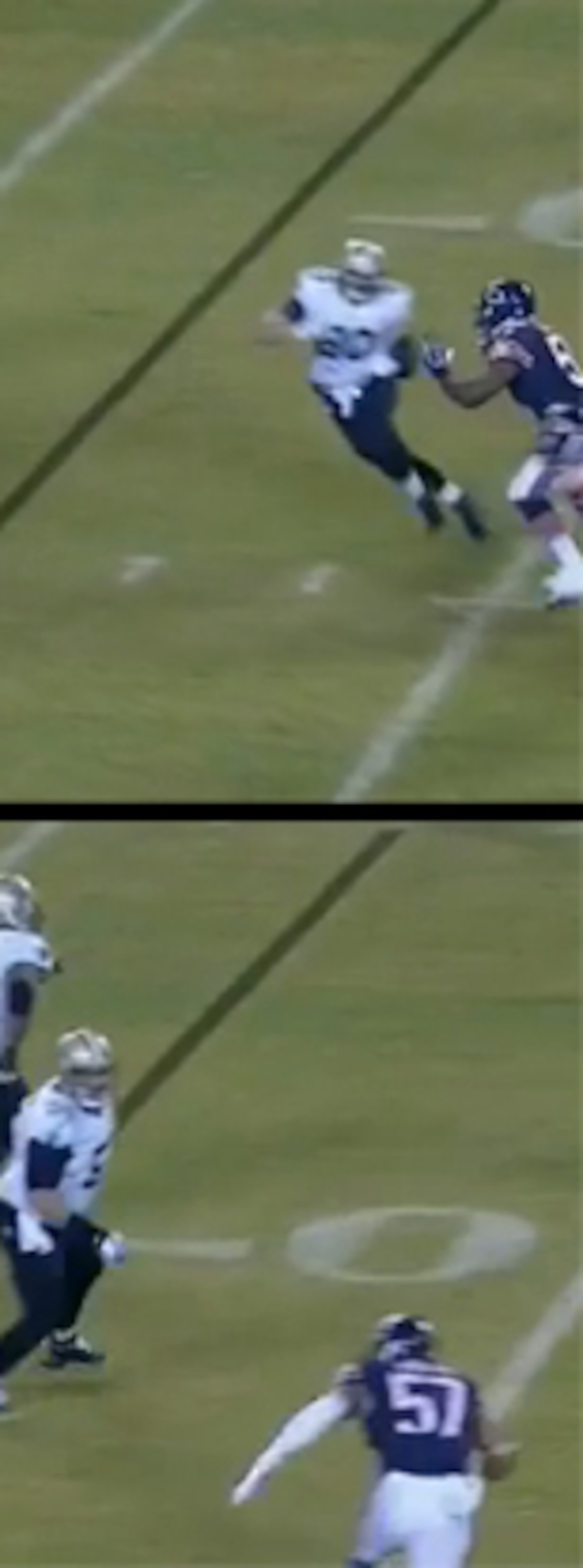
This play is a little bit more elaborate than the previous, but it's still a relatively basic and effective design. The Saints have four receivers on the field, two tight to the formation on the narrower side of the field and two spread wider on the open side of the field.
Notably, Thomas is aligned to the open side of the field.

The center, right guard and slot receiver are the three key blockers on this play. The center initially double-teams the defensive tackle to his left before turning back to the right side of the field. The right guard initially engages the defender across from him before using a swim move to hurry past him.
Each player sold his block momentarily before escaping into space.
Thomas followed the path set out by his right guard. That way, it appeared to the pass-rushing defender that he was attempting to pick up the blown block. Instead, he escaped into the flat on the right where there was a huge amount of space.
With three blockers against two immediate defenders, Thomas was able to escape downfield for a 39-yard gain relatively easily. Thomas wasn't asked to do anything on this play that was technically taxing. It was the kind of action that Spiller could easily carry out on a consistent basis.
In the same game, the Saints showed off a screen play that they ran on a regular basis to attack the short side of the field.
Thomas gains 31 yards on this play by simply hesitating before accelerating into the opposite flat. He has three offensive linemen running out in front of him before he even crosses the line of scrimmage. Particularly, those are the Saints' three interior offensive linemen.
Payton's offense asks more of his interior linemen than his tackles on screen plays.
That allows him to draw the pass rush farther upfield by dropping both tackles deep on most screen plays. It also puts more pressure on his interior linemen to be effective in space. This season, the Saints will have two new starters on the interior of their offensive line.
Max Unger is a proven center who should fit well in the Saints' scheme, but the left-guard spot looks a little more concerning. Andrus Peat was a first-round pick in 2015, but he is a left tackle rather than a guard. If he forces his way into the starting lineup, either he or Zach Strief could move inside.
If that doesn't happen, then former undrafted free agent Tim Lelito should be the starter.
Regardless of who starts at left guard for the Saints, the line should give Spiller much more help than any of his Bills offensive lines did over the past two seasons. Spiller was forced to create a huge percentage of the yards he gained in Buffalo.
The franchise simply never developed competent enough linemen to allow Spiller to be effective between the tackles.
Effectiveness between the tackles is less important for the veteran in New Orleans because of the presence of Mark Ingram. Ingram agreed to a deal comparable to what Spiller signed and has endured similar struggles throughout his career.
Neither player is built to be a feature back, but each has the skill set to perfectly complement the other as part of a duo. While Spiller's best work may come as a receiver on screen plays, he should also feature prominently in the running game.
A running game that Payton appears determined to rely on more in 2015.
In 2014, the Saints were a very effective running team. They ranked ninth in efficiency, according to Football Outsiders. Yet, despite being so efficient, they were only 13th in rushing yards per game because they attempted just 25.4 carries per game, 19th in the league.
Part of the Saints' reluctance to run the ball last season was a result of their porous defensive play that often saw them behind in games with no choice but to throw. That may happen again in 2015, but the efforts of the coaching staff in the offseason suggest that they are nevertheless going to alleviate the pressure on their aging starting quarterback.
That should only serve to make Spiller (and Ingram) more productive.
.jpg?w=2560 "Chargers Bills Football")
.jpg?w=2560 "Bills Browns Camp Football")
.jpg?w=2560 "Report: Seahawks Not Signing Mixon 😯")