
Coming up with an all-time-greats list for a program as tradition-rich as Tennessee football is not an easy task.
For generations, UT football has been among the nation's top programs. The Volunteers are 10th on the all-time wins list and sixth in bowl wins. There are legends up and down the list of all-time Vols greats, and a who's-who of the top college football and NFL players played their college careers on the Hill.
Evidence of Tennessee's prolific ability to churn out talented players can be seen in the culmination of a recent down cycle of the program. The 2015 NFL draft marked the first time in 51 years that no Vol was selected by a pro team.
Though it was sad to see such a long streak end, that's still a pretty remarkable run of success that spanned more than half a century.
The UT football program has stocked the NFL with stars for years. From the halcyon days of General Robert Neyland to the talent-stacked Tennessee teams of the 1990s, the Vols were among the nation's top teams.
Even after the forgettable final seasons of legendary coach Phillip Fulmer, the one year of Lane Kiffin and the failed hiring (and subsequent firing) of Derek Dooley, UT still ranks among college football's greats.
Stars such as Heath Shuler, Al Wilson, Jason Witten and Arian Foster were showcased on the UT teams of the 1990s and 2000s. Also, NFL greats like Peyton Manning, Beattie Feathers, Doug Atkins and Reggie White played their college days in Knoxville.
This list doesn't include Vols greats who weren't standout players. If so, Neyland would have made it, as would Fulmer. The list took into account playing careers mostly with at least some emphasis on their careers beyond. Also, any lasting legacy impact was taken into consideration.
So, picking an all-time UT top-10 list is tough. But where's the fun in not trying?
Let's take a look at Tennessee's top legends throughout such a rich history.
10. Al Wilson
1 of 10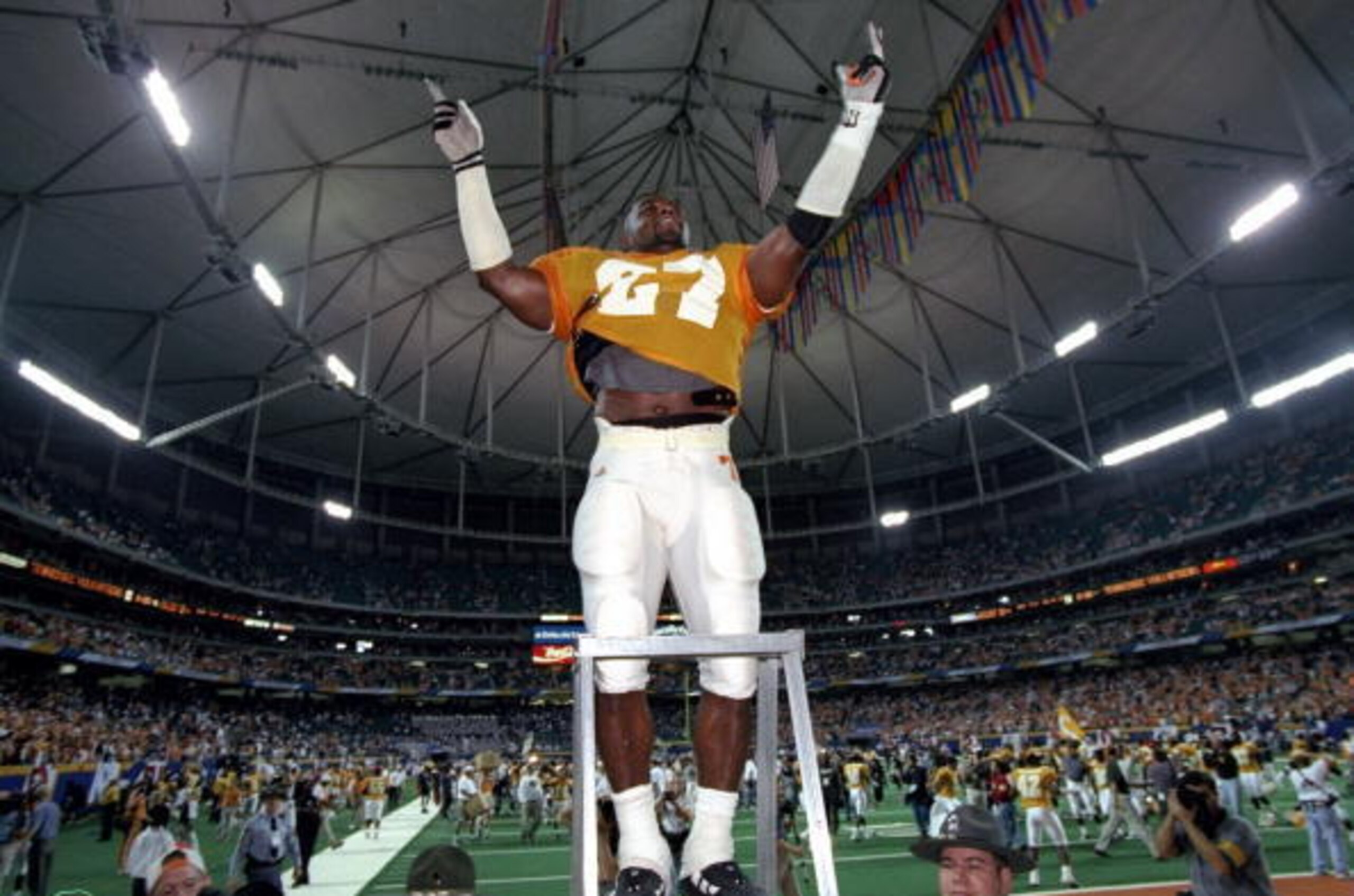
Aldra Kauwa Wilson is not statistically the best linebacker in Tennessee Volunteers history. But it's all the peripheral things that makes him a UT legend.
Sure, he was a great football player who was a gritty, talented, hard-nosed middle linebacker who parlayed his Tennessee success into a longtime NFL career. But he was so much more than that.
Before the 1998 national championship season made him a legend, Wilson was already a leader. Take this story from halftime of the 1997 SEC Championship Game against Auburn, for instance.
With Tennessee trailing 20-10 at halftime, the Vols needed somebody to step up. Former Daily Beacon sports writer Jim Masilak noted it was Wilson who answered the call:
"...the Vols were in desperate shape. They needed a spark. Things weren't going their way and everything they had dreamed of -- the conference championship, the Orange Bowl, the national championship -- was 30 minutes away from being dashed. Wilson, the Vols' junior linebacker, playing with an injured right ankle, wasn't going to stand for that.
"
One way Peyton Manning described the speech later is that it peeled the paint off the Georgia Dome locker-room wall.
As a freshman in 1995, Wilson finished with 25 tackles, a sack, two tackles for a loss, a pass breakup and an interception.
He became a starter in '96 and began his run of dominance, registering 87 tackles, recovering two fumbles, getting a sack, eight tackles for a loss and three pass breakups. As a junior in '97, Wilson finished with 83 tackles, a fumble recovery, five sacks, seven TFLs and three pass breakups.
Then, his All-American year, he had 77 total tackles, five fumble recoveries, two forced fumbles, four sacks, six tackles for a loss, three pass breakups and a pick. The most legendary game for Wilson came in a 12-tackle performance in UT's 20-17 overtime win against second-ranked Florida.
He made players better by just being around them, willing them to win, and he backed up his talk with exceptional play. That's what made him one of the greatest players ever to wear the orange and white.
9. Eric Berry
2 of 10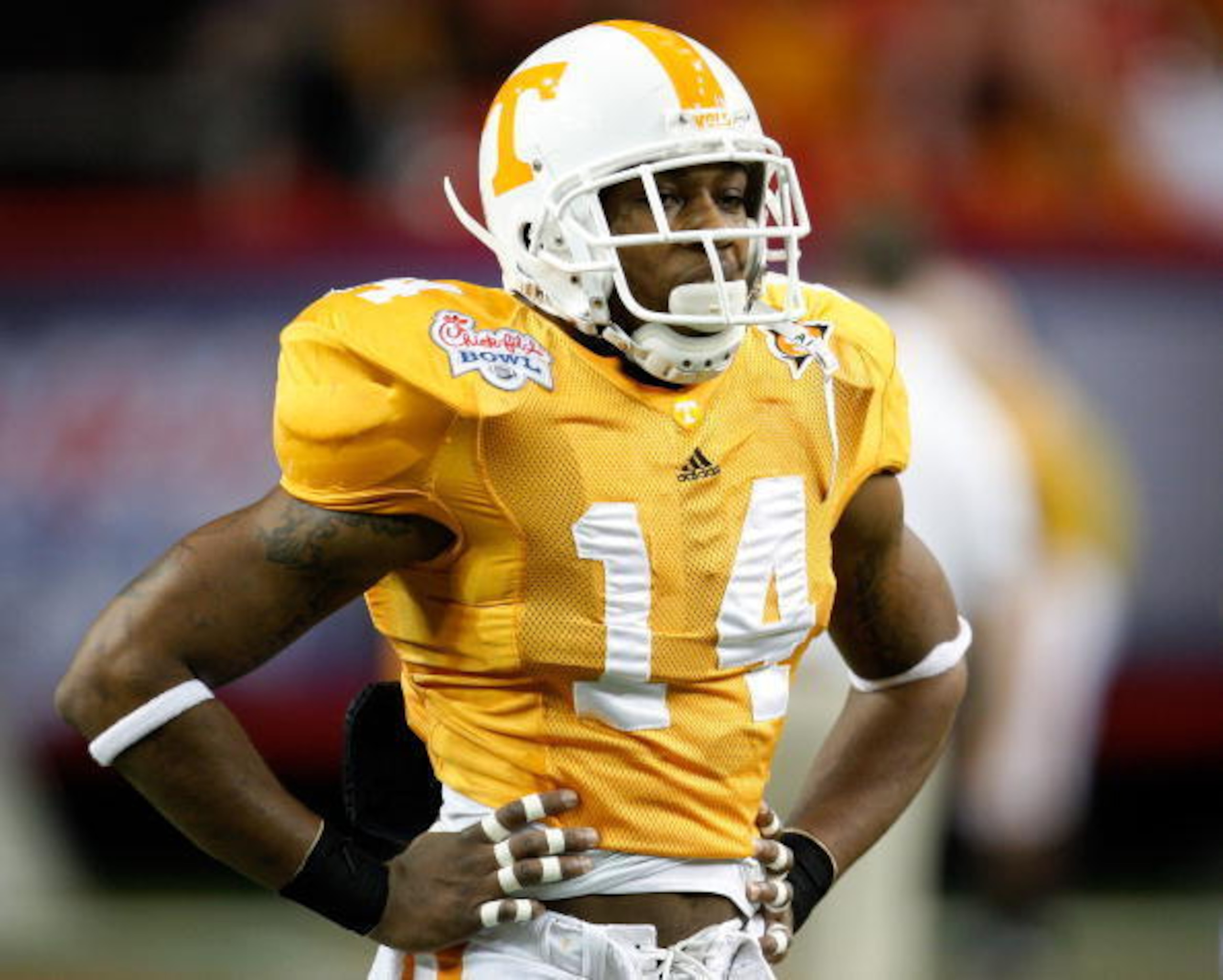
Even during a forgettable run of Tennessee history that included the unceremonious firing of legendary coach Phillip Fulmer and the Lane Kiffin-led 2009 season, the Vols had a megastar.
That would be defensive back Eric Berry, a prototypical SEC safety who was a hard-hitting, fast-running, one-man wrecking crew. He won the Jim Thorpe Award for the nation's top defensive back as a junior in Knoxville, and then he took his talents to the NFL.
The current Kansas City Chiefs playmaker turned into an All-Pro in the league, but he recently made headlines for the wrong reason. He's battling Hodgkin's lymphoma, a form of cancer, and Chiefs coach Andy Reid told NBCSports.com's Darin Gantt that his star is "doing well" after finishing treatment.
That's huge news for Vols fans that their legend can continue to do his thing in the league once he recovers.
When he roamed the field for UT, he was elite and easily one of the greatest safeties ever to play in the SEC.
Berry was a two-time unanimous All-American after being one of the highest-recruited players in the country out of Fairburn, Georgia's Creekside High School. He shunned offers from basically everybody in the nation, choosing to follow in his father's footsteps.
James Berry was a UT team captain and running back who played for Johnny Majors back in the 1980s. Currently, Eric Berry's younger twin brothers, Evan and Elliott, play for UT coach Butch Jones.
Vols football is a family tradition for the Berrys, but Eric was the best.
Berry finished his UT career in college football history's top two in interception-return yardage, and he won the 2008 SEC Defensive Player of the Year award as a sophomore. He was a member of Sports Illustrated's All-Decade team, and, at times, he was a one-man defense for the Vols.
8. Travis Henry
3 of 10
Backfield mate Jamal Lewis may have been more talented, but when it comes to prolific careers in Knoxville, Travis Henry gets a higher ranking on this list.
Part of the reason was his exceptional 1998 season in the wake of Lewis' season-ending knee injury that helped propel the Vols to the national championship.
A signature moment of that year was his dominating performance and ultimate game-winning touchdown run following Clint Stoerner's Hand-of-God fumble against Arkansas.
Before a seven-year NFL career, Henry was an All-American for the Vols. After a high school career in Frostproof, Florida, where he held the all-time prep yardage mark (a record that has since been broken), Henry elected to head north to play for coach Phillip Fulmer.
After many figured the Vols' undefeated season was doomed in '98 following Lewis' knee injury at Auburn, Henry came on and rushed for 998 yards and seven touchdowns. The Vols went 13-0 and beat Florida State in the Fiesta Bowl for the national title.
As a senior, he continued his dominance, rushing for 1,314 yards and 11 touchdowns, being named first-team All-SEC by the Associated Press and the Sporting News.
"Cheese"—nicknamed because he was as tough as a block of government cheese and just as difficult to get your hands around—holds the school records for rushing yards (3,078), rushing attempts (556), and 100-yard performances (14).
He was the most consistent running back during an era when the Vols dominated teams with their ability to run the ball.
.jpg?w=2560 "AP Poll Top Five Week 9")
.jpg?w=2560)
7. Bob Suffridge
4 of 10
It's sometimes difficult to find information about college football's greats from the 1930s and '40s, but Bob Suffridge was one of the most legendary of UT legends.
Playing for the great General Robert Neyland's best Vols teams, Suffridge is UT's only three-time All-American, earning those honors from 1938-40. Most astoundingly, the Vols never lost a regular-season game during his three-year career.
The two-way lineman known simply as "Suff" was 30-0 in his collegiate career during the regular season and lost just two total games. Though many of those old teams don't get the credit they deserve, there's no denying the greatness of the 1939 Vols.
They went 11-0 and did not allow a single point all year, ridiculously finishing second nationally instead of being credited as national champions.
As a senior, Suffridge won the Knute Rockne Memorial Trophy as the nation's most outstanding college lineman and was named MVP by the Atlanta Touchdown Club, according to UTSports.com. During that '40 campaign, UT was named national champions after its third consecutive SEC championship.
Suffridge became a member of the all-time AP All-America Team, the all-time All-SEC Team (1933-82) and the Half-Century All-America Team (1950), according to UTSports.
He also is a member of the 35-Year All-SEC Team named by the Atlanta Journal, the Tennessee Sports Hall of Fame and the Sugar Bowl, Rose Bowl and Orange Bowl halls of fame.
The Knoxville native also served as a lieutenant commander in the United States Navy, serving in World War II.
6. Beattie Feathers
5 of 10
When Beattie Feathers came to Knoxville from the border city of Bristol, Virginia, in 1931, he had to follow in the footsteps of a legend.
Gene McEver, who is still considered one of Tennessee's all-time greats, had just left UT, and Feathers was his replacement. He would go on to have an even better career.
The tailback and punter is perhaps the greatest ever to play in Knoxville, an outstanding runner who was called the "Bounding Antelope" for his high-stepping, fast running style. Throughout a standout pro career, Feathers became known as "Big Chief."
His NFL career is often overlooked, but Bleacher Report called him a "forgotten legend" in a 2010 article. He played during a time when the only media that chronicled the games was the newspaper.
Feathers' UT career got off to a resounding start, and his star only grew.
"Beattie didn't think in terms of first downs, only in terms of touchdowns," teammate Freddie Moses said, according to Feathers' UTSports.com's Hall of Fame bio.
Back when UT ran the single wing, the offense belonged to Feathers, who broke out with a 65-yard touchdown run as a sophomore in a 13-0 win over New York University in the 1931 Charity Bowl and never looked back.
As the Vols transitioned from the Southern Conference to the SEC, Feathers became the only Vol ever to win all-conference selections in both leagues. He was an All-American in 1933, led the Vols to two undefeated seasons and held a career 25-3-2 record.
As a rookie in 1934 with the Chicago Bears, Feathers became the first NFL player to rush for more than 1,000 yards and also averaged 9.9 yards per carry that is still an NFL record.
5. George Cafego
6 of 10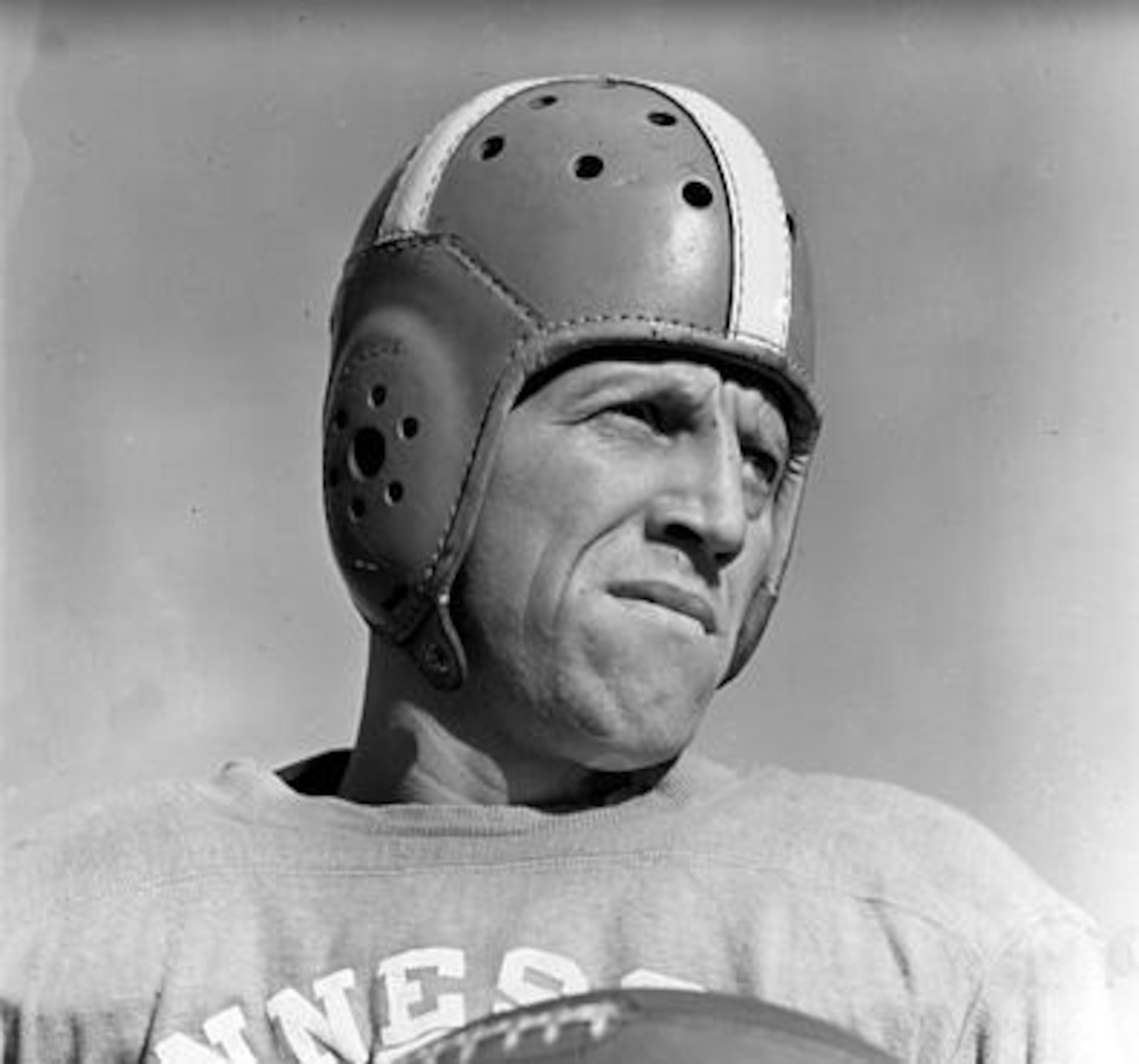
George "Bad News" Cafego wasn't just good for Tennessee. He was an all-time great.
The tailback/safety/quarterback played during an era when players routinely went both ways, and he was exceptional on both sides of the ball.
According to his UTSports Hall of Fame bio:
"Renowned for his blocking and running skills, Cafego also played safety and quarterback. On special teams, he returned kicks and punts as well as handled the punting duties. In his career, Cafego rushed for 1,589 yards, threw for 550 yards, returned 64 punts for 883 yards, returned 12 kickoffs for 391 yards and punted 115 times for a 38.3-yard average. He also had five interceptions.
"
As part of that 1939 undefeated, unscored-upon season, Cafego ran behind the blocking of Bob Suffridge and Co. to a brilliant season. UT's only loss that year came to Southern Cal in a bowl where Cafego sat with injury.
He came to Knoxville from a very rural area of Whipple, West Virginia, and became a star in Knoxville who wound up being a legend. He's perhaps one of the most recognizable names in UT football history due to his time as a player and a coach.
As Tom Mattingly once wrote in the Knoxville News-Sentinel: "Nobody's name rests higher in Tennessee football than George Cafego."
He won consecutive All-SEC and All-American honors, finishing seventh and fourth, respectively, in the Heisman Trophy voting in 1938 and 1939. The "Ultimate Volunteer" also served as an assistant coach at UT under five head coaches from 1955-85.
The "Hurrying Hungarian" also was the first overall pick of the 1940 draft by the Chicago Cardinals.
4. Doug Atkins
7 of 10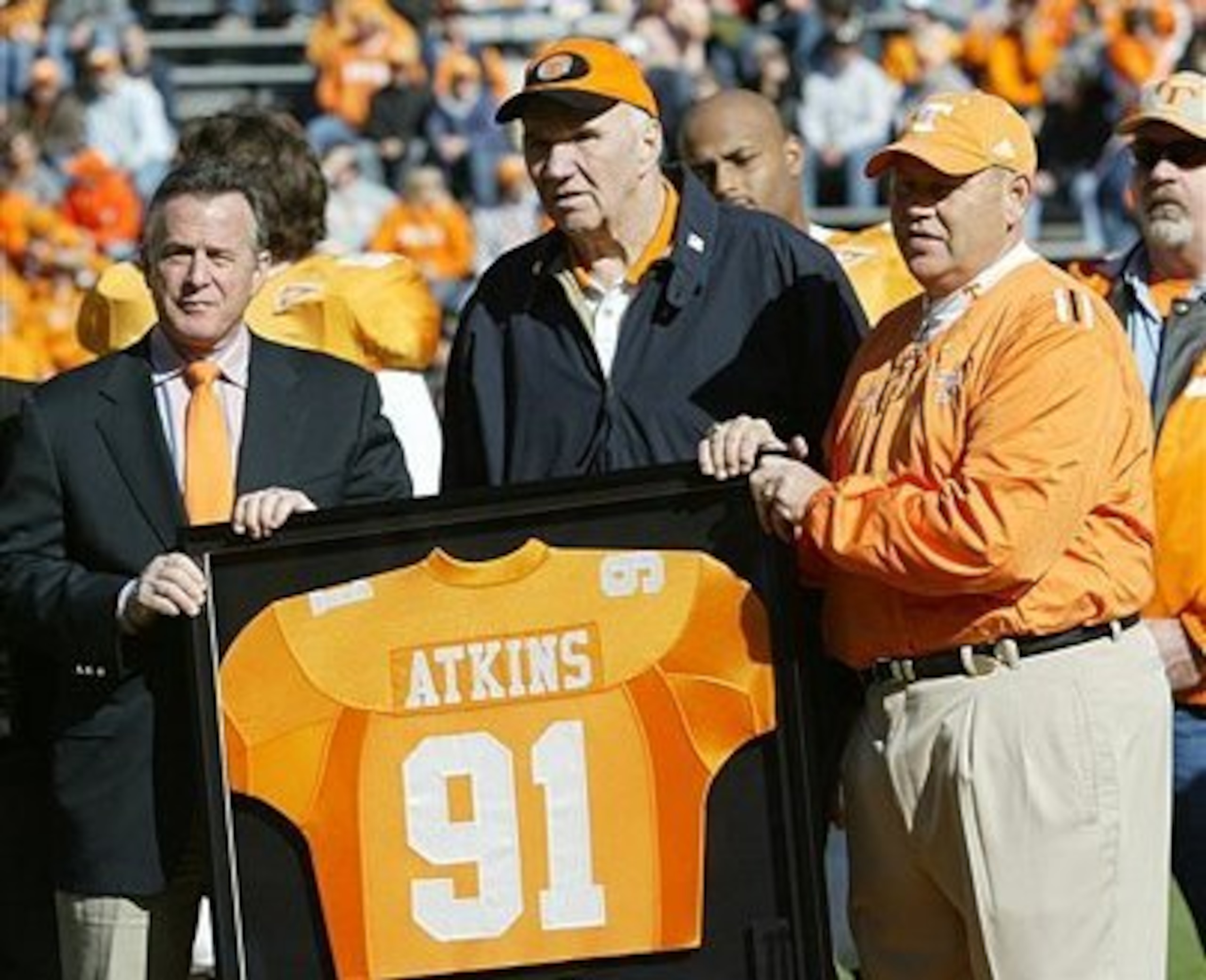
It's crazy that as great as Doug Atkins' career was, he may not even be the best defensive end in school history.
As Atkins' Hall of Fame bio on UTSports.com states, Atkins is considered by some to be the greatest defensive end in football history. But Reggie White may have been just a little better.
They're still both all-time greats, and Atkins at least belongs this high on the list.
Atkins was a two-time All-SEC member and was an All-American in 1952. He was the only player to be unanimously named to the All-SEC Quarter Century Team and was awarded SEC Player of the Quarter Century from 1950-74.
He's also a member of the all-time All-SEC team picked from the era of 1933-82.
Atkins was the defensive star of the 1951 national championship season, and UT honored him by proclaiming Sept. 11, 1976 "Doug Atkins Day." The Vols were 29-3-1 during Atkins' career.
Brown was a pro legend with the Cleveland Browns, Chicago Bears and New Orleans Saints, earning three All-Pro selections, making nine Pro Bowl appearances and winning two NFL championships. He is one of two Vols to be both college and pro Hall of Famers, along with Reggie White.
Atkins wasn't even supposed to play football at UT, as he was recruited on a basketball scholarship. Once General Neyland saw him, the gridiron was his future, and Atkins wound up getting his No. 91 retired.
Because of his accolades, Atkins could be considered the greatest defensive lineman in UT history. But White's career was probably better considering he played in the NFL during an era that arguably featured more talent.
3. Reggie White
8 of 10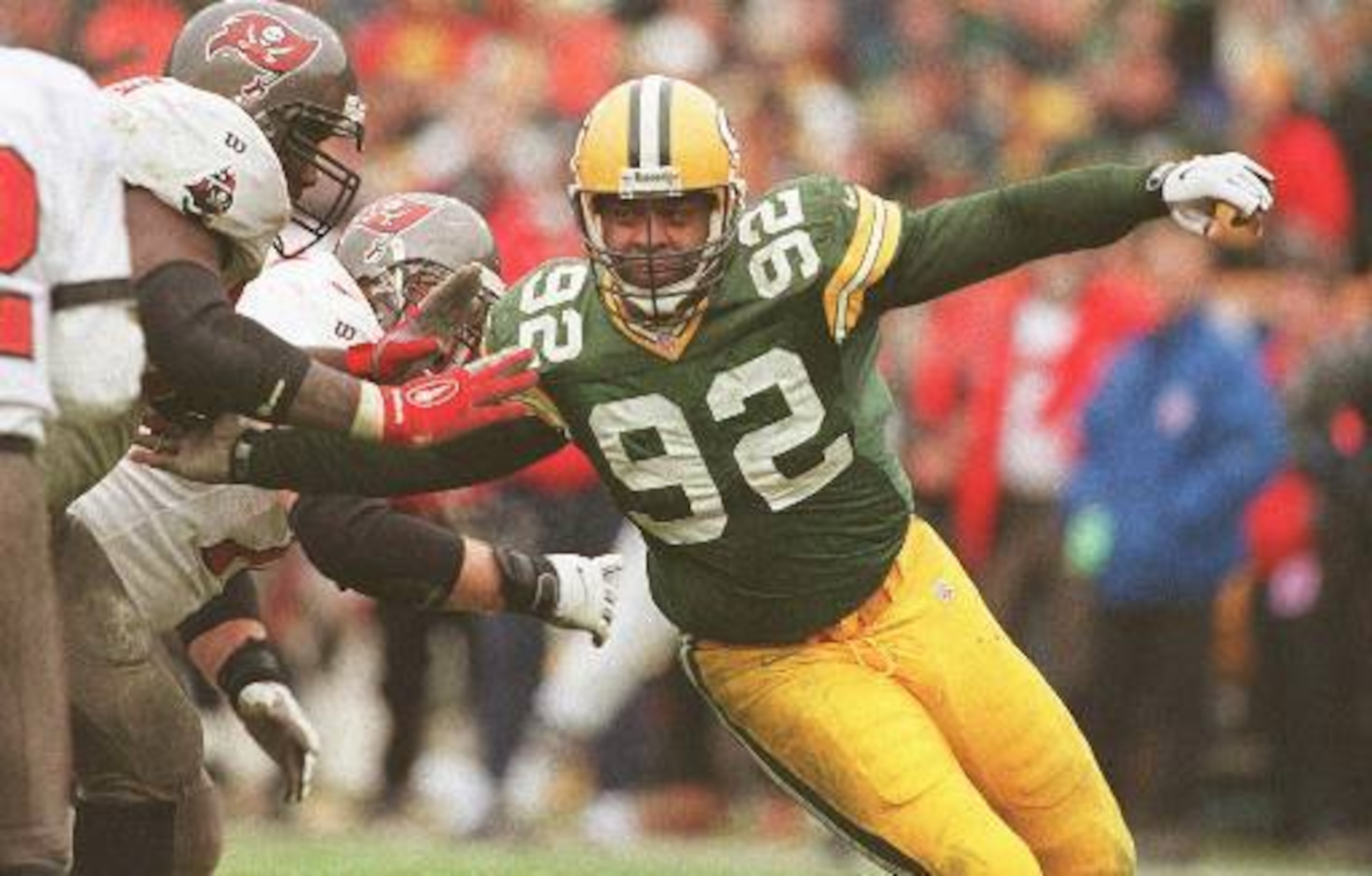
The late, great "Minister of Defense" is best known as an NFL legend who held the record with 198 career sacks until Bruce Smith broke it.
His career, which saw its glory days with the Philadelphia Eagles and Green Bay Packers, earned him a place in pro football's Hall of Fame as one of the greatest defenders ever to play the game.
But before the legendary defensive end was sacking NFL quarterbacks, the Chattanooga, Tennessee, native played for the Tennessee Volunteers. That's where his star was born.
His 32 sacks are still a school record, and he wasn't just a pass-rush specialist, either. During his first two seasons in Knoxville, he registered an eye-opening 146 tackles—crazy numbers for a defensive lineman.
As a senior at UT in 1983, he had 100 tackles (72 solo) and set a school record with 15 sacks. Despite his few years being exceptional, he turned into one of the nation's most recognizable talents during that senior season.
That year, he became the SEC's Player of the Year, becoming the first Vol to win the award since his head coach, Johnny Majors, did so in 1956.
With the USFL just coming into existence, White decided to sign with the Memphis Showboats, and then he moved on to the NFL, where he became a legend. He was a two-time NFL Defensive Player of the Year and played in 13 Pro Bowls.
White also was an ordained Baptist minister and died at the young age of 43 after suffering a fatal cardiac arrhythmia.
He's one of only two Vols, along with Doug Atkins, to be named to both the college football and pro football Halls of Fame.
2. Johnny Majors
9 of 10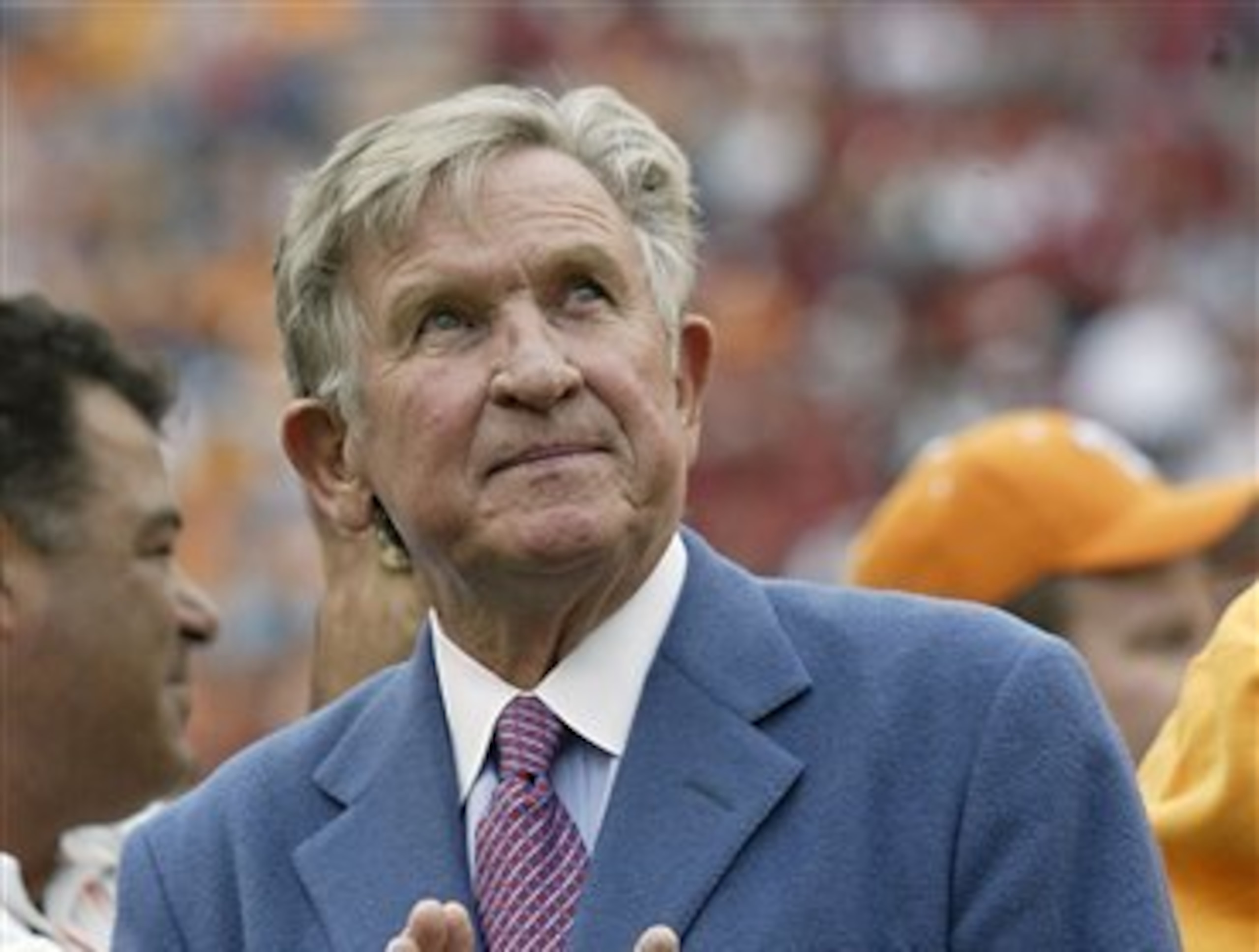
You can't get more of a Tennessee legend than Johnny Majors.
The Lynchburg native who played high school football in tiny Huntland before going on to star for the Tennessee Vols where he finished runner-up for a Heisman Trophy came back home to coach the Vols after winning a national championship at Pittsburgh.
That's about as "All-Vol" as you can get.
The standout halfback was a two-time All-SEC and All-American in 1955 and '56, finishing second to Notre Dame's Paul Hornung for the Heisman in the latter year. Jim Brown finished third.
As the leader of General Robert Neyland's famed single wing offense, Majors threw the ball and ran it playing tailback. He collected 1,622 rushing yards and threw for 1,135 yards, scoring 16 touchdowns during his UT career.
He also booted 83 punts for a 39.1-yard average. He also returned 36 punts for 438 yards and ran back 15 kickoffs for 344 yards.
Simply put, he did it all.
When Majors returned to coach UT in 1977, he took over a program that current Alabama athletic director Bill Battle had run down. It took Majors four years to turn the program back around, but he led the Vols to heights in the late 1980s and early 1990s that the program hadn't seen until the Majors years.
Things really began to turn in the 1985 season when the Vols went 9-1-2, winning the Sugar Bowl over the heavily favored Miami Hurricanes. After a rebuilding '86 campaign, UT went on to go 10-2-1 in 1987. After a losing '88 year, the Vols went on a tear, going 11-1, 9-2-2 and 9-3.
Majors suffered a heart attack prior to the 1992 season and was unceremoniously ushered out to make room for offensive coordinator Phillip Fulmer, who was considered one of the hottest young coaching candidates in the country.
Fulmer went on to have a great career, winning the 1998 national championship, but Majors was just as instrumental in the Tennessee turnaround. As a player and a coach, there are few names more synonymous with UT football than Majors.
1. Peyton Manning
10 of 10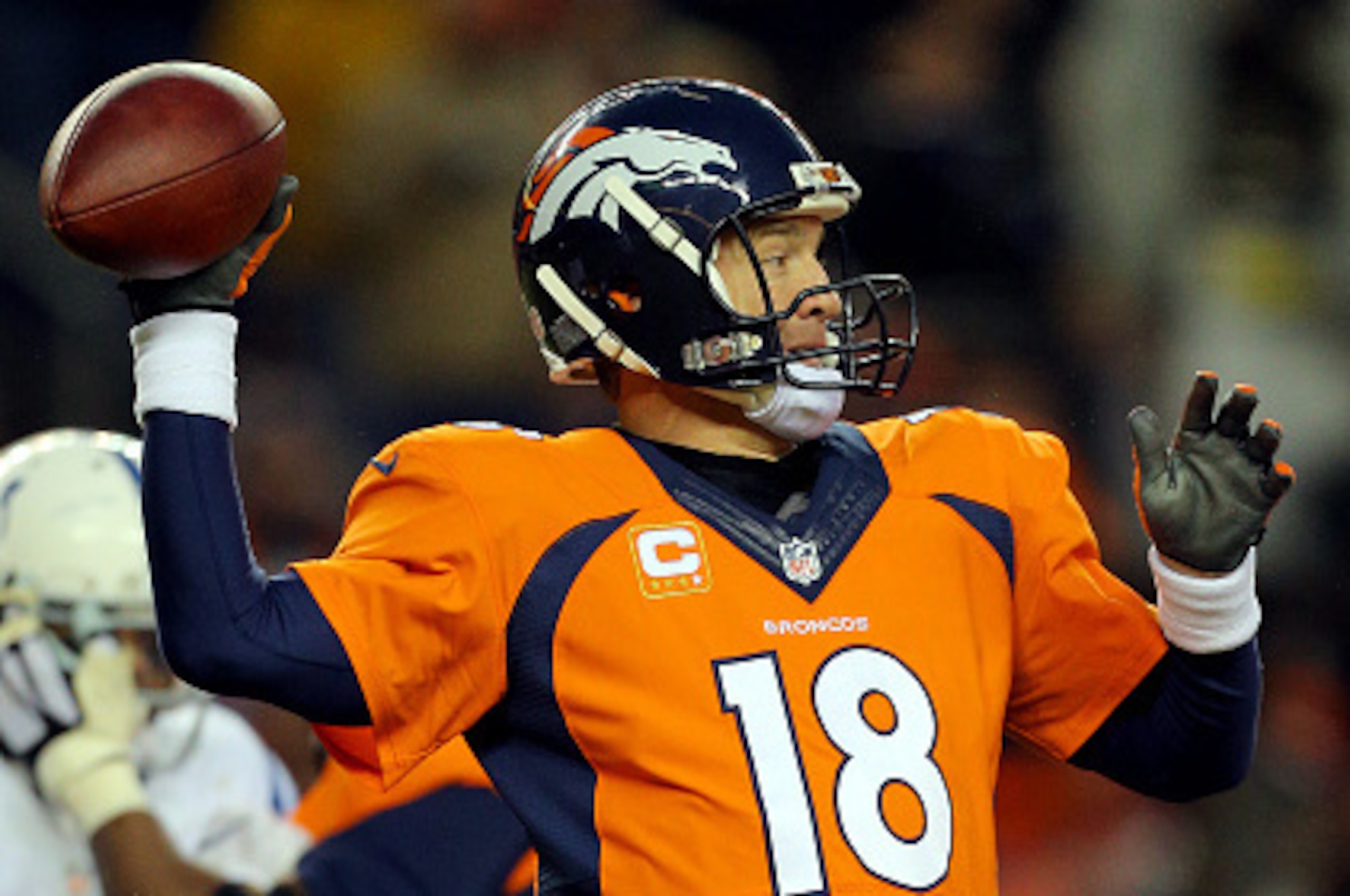
Everybody knows Peyton Manning is a Tennessee great. But it's the things he did for the Vols after his playing days in Knoxville were over that cemented his legacy.
Not only has he kept coming around during the offseason to participate in throwing programs, talk to players and just be around the university, what he has done in the NFL continues being a recruiting tool for the Vols.
A generation of players across the nation knew who UT was largely because of Manning, who is one of the players who has transcended NFL stardom to become a crossover star in television, commercials and in other facets of media throughout the country.
He's one of the most recognizable athletes in sports history.
While quarterback for the Vols, he set 42 NCAA, SEC or Tennessee records. He won the Maxwell Award as the nation's most outstanding player in 1997 as well as the Davey O'Brien National Quarterback Award, the Johnny Unitas Golden Arm Award and Player of the Year honors.
Inexplicably, Michigan defensive back Charles Woodson won the Heisman Trophy that year, but that didn't dim Manning's star one bit.
As a collegian, he threw for more than 11,000 yards and took the Vols to lofty heights. He famously returned to Knoxville for his senior season though he was considered to be the NFL's top draft pick, and that endeared him even more to fans.
He could run for governor of Tennessee and win in a landslide.
As a pro, Manning is arguably the greatest statistical quarterback in NFL history. As an Indianapolis Colt and Denver Bronco, he has participated in 14 Pro Bowls and is a five-time NFL MVP.
He's won one Super Bowl and is a prolific player who is the league's all-time passing touchdown leader and has thrown for more 4,000-yard seasons than anybody in league history.
There is no Tennessee graduate more recognizable than Peyton Manning, who is a living legend at UT and in the pros.
All quotes and observations gathered firsthand unless otherwise noted. All statistics gathered from UTSports.com, unless otherwise noted. All recruiting information obtained from 247Sports.
Brad Shepard covers SEC football and is the Tennessee lead writer for Bleacher Report. Follow Brad on Twitter @Brad_Shepard.



.jpg?w=2560 "Raiders Could Start Mendoza")

.jpg?w=2560 "Rodgers Iced Out on Plane 💎")

.jpg?w=2560 "Packers Safety Slams Refs 🤬")