
5-Man Units Telling 2015 NBA Finals Story Entering Game 3
The 2015 NBA Finals, just like every marquee clash that takes place on the sport's biggest stage, are often billed as a battle between superstars. Stephen Curry and LeBron James are taking their best shots at each another, and when those shots aren't dropping for one—as was the case for Curry in Game 2—the result seems almost preordained.
But as the series heads from the Bay Area to Northeast Ohio for a tiebreaking third contest, there's so much more that goes into any battle between the Golden State Warriors and Cleveland Cavaliers, and it starts with coaches using the right five-man units. Playing the wrong ones is just as much a recipe for disaster as the right ones are for success.
TOP NEWS

J-Dub Suffers Gruesome Injury

Blockbuster Trade Idea To Shake Up the East
Melo's Quote on Confidence 😎
Sure, the players on the court ultimately determine who wins and loses. It's up to them to make the best of game plans and actually hit their looks. If Curry uses a play that head coach Steve Kerr draws up and takes a wide-open triple, only to clank it off the iron—as he so often did on Sunday night—that's on him.
However, adjustments from the sidelines are crucial between two teams this competitive, especially as the Cavaliers attempt to form a new identity during the post-Kyrie Irving portion of their postseason.
The give and take as David Blatt and Kerr play chess so often goes overlooked, but it's nonetheless vitally important. Thus far, this series has been about dictating the size of the lineups used, and that's not likely to change as we move deeper into the Finals.
1. Harrison Barnes, Stephen Curry, Draymond Green, Andre Iguodala, Klay Thompson
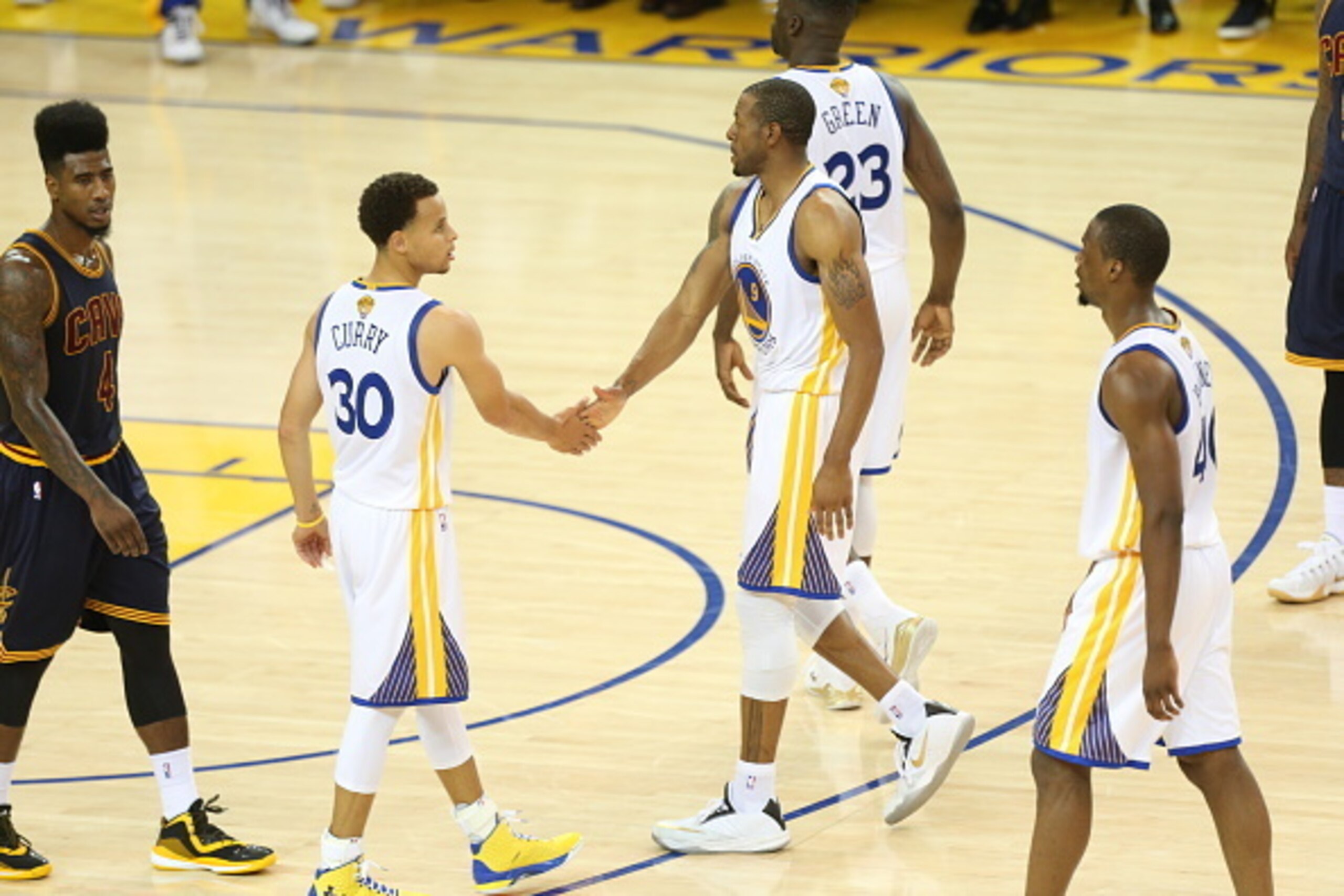
This five-man group can apparently dictate the Cavaliers' style of play. By replacing Andrew Bogut with the smaller Andre Iguodala, Kerr ensured that his team was significantly more versatile, as he could throw any of four defenders at LeBron James on a moment's notice.
And with so many players capable of displaying great lateral quickness on the defensive end as well as easily being able to help out and then recover to their own man, it made Stephen Curry's point-preventing role even more impactful. Whenever he was involved in a pick-and-roll with James handling, the 1-guard could hedge out significantly to slow down the inevitable drive from a certain four-time MVP, then recover to his own man.
In Game 1, the group spent only four minutes on the floor together. But on Sunday night, the Warriors were even more desperate to force Cleveland into small-ball stylings and often turned to this group in order to push Timofey Mozgov to the bench. In fact, it was the most used lineup of the night for Golden State.
And during both of the first two outings in these Finals, it's been a remarkably successful plan:
| Game 1 | 4 | 104.7 | 22.2 | 82.5 |
| Game 2 | 17 | 110.5 | 92.8 | 17.7 |
Those numbers are partially driven by sample size, but they're entirely insane.
Not only is Golden State able to generate offensive production from every spot in the lineup and score with relative ease even when Curry is struggling to throw rocks into the ocean, but it's also functioned as a lockdown defensive squad. The versatility of the defenders helps, as does Blatt reacting to Kerr's stratagems, not dictating the type of ball that's played.
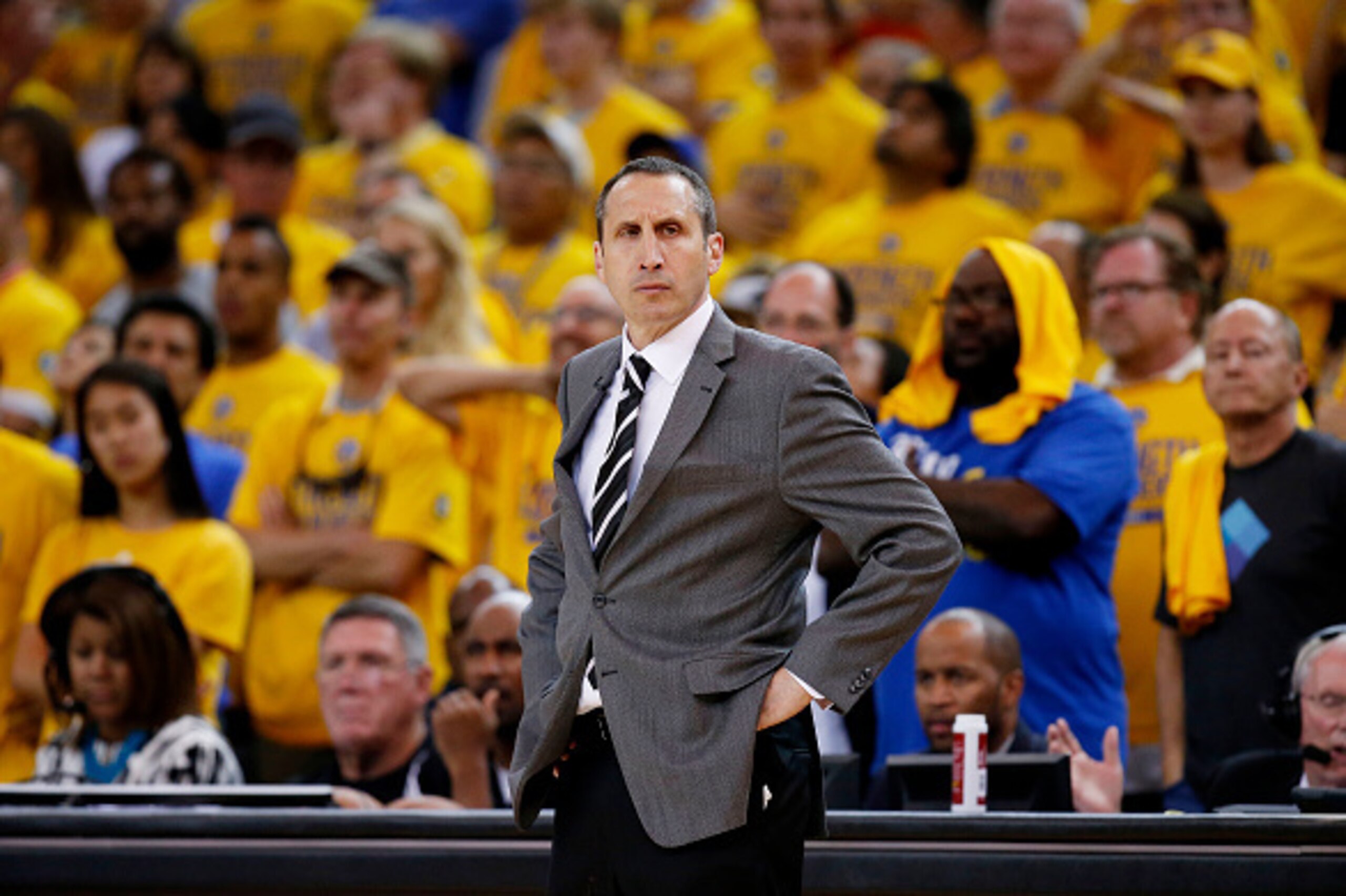
The Cleveland head coach could have put in Mozgov sooner, particularly with the Russian 7-footer absolutely thriving on the offensive end during the first half. Instead, he played only 29 minutes in a game that went to overtime and still helped his team outscore the Dubs by 11 points when he was on the floor.
As Harvey Araton wrote for the New York Times, "With the Warriors forced to converge around him, James found open shooters on the perimeter and helped center Timofey Mozgov to a 17-point night until Blatt matched the Warriors' small lineup by sending Mozgov to the bench."
Not only did the Cavaliers' offense stagnate after the change, but the Warriors began clicking a bit more.
With 1:50 remaining in the third quarter, Tristan Thompson entered the game for Mozgov while Cleveland boasted a six-point advantage—62-56. At the end of regulation, the score was tied at 87 apiece thanks to the Dubs putting together what was easily their best 12-minute stretch on offense.
The center didn't play during the entire fourth quarter, nor did he step onto the floor during live action in overtime—though he did enter the game for two Curry free throws and was subsequently removed after an ensuing timeout.
After the game, Blatt defended the choice, per NBA.com's Steve Aschburner, which was presumably a lot easier to do with a tick in the win column:
"First of all, Moz played great. He played extremely well the in first game too. We played the lineup we thought we needed to play to match up properly with them and at the same time not lose an advantage at the other end. As you guys know, we've played different lineups and used different lineups throughout the course of the year. But the lineup to finish the game is one that's been a winning lineup for us, and that's why we played it.
"
It's tough to believe this is a sustainable strategy. The Warriors are going to turn to these smaller stylings more often, and the Cavs will have to either force Kerr's hands by sticking Mozgov on the court and necessitating adjustments or watch as their own small unit improves. The former is the better alternative.
As Jonathan Tjarks wrote for RealGM after Game 2, James and Mozgov are really the only two members of the Cavs capable of winning the individual offensive battle at a position:
"The Cavs' line-up in Game 2 that had the most flow on offense had LeBron at the 4 and Mozgov at the 5. With the other three spots in the line-up all spotting up along the three-point line, there was enough room for Cleveland to feature both of their frontcourt players on offense. That's really the best place to attack the Warriors defense—win 1-on-1 match-ups in the frontcourt, compromise their defensive identity and force them to send help in the paint. The only two Cleveland frontcourt players who can consistently win offensive match-ups are LeBron and Mozgov.
"
If the mentality is doing what "we needed to play to match up properly with them," the Cavaliers are going to lose the series in rather definitive fashion. Cleveland has to try getting a step ahead rather than remain content playing a step behind and adjusting on the fly.
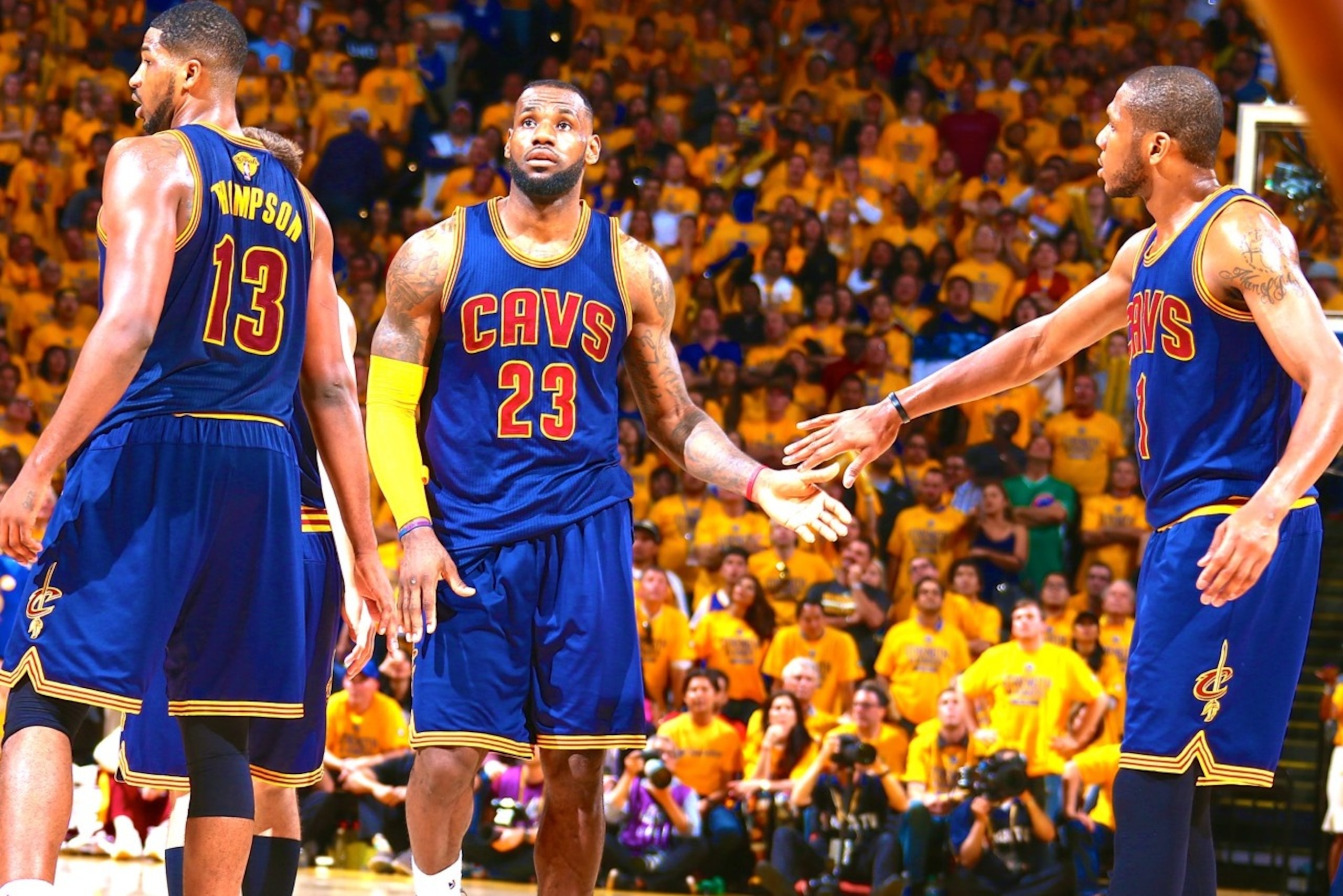
2. Matthew Dellavedova, LeBron James, James Jones, J.R. Smith, Tristan Thompson

Thus far, it appears that Cleveland will continue to be the one reacting, not forcing the reactions. And that means that this five-man group has to improve rather dramatically. With Iman Shumpert struggling, it spent 13 minutes on the floor during Game 2—more than any other lineup the Cavs used.
And that was not good.
Individually, these pieces are just fine.
Matthew Dellavedova played a fantastic defensive game against Curry throughout the night. He settled in on defense, worked his tail off to deny the MVP touches and made sure that he was up in his jersey whenever Curry did gain possession. Granted, the rest of the improved Cleveland defense deserves credit as well, but the Australian guard was the primary reason that his matchup had such an inexplicably poor shooting night, missing more triples than he had during any other game of his career.
"It had everything to do with Delly. ... He kept a body on Steph. He made Steph work. He was spectacular, defensively," James said about Irving's replacement after the victory, per Micah Adams of ESPN Stats & Information.
James himself was spectacular, of course.
If you're harping on his field-goal percentage—31.4 percent after going 11-of-35 from the field—you're missing the point. He still scored 39 points on those 35 shots and recorded 16 rebounds, 11 assists, a steal and a block. Since 1985, he's the only player to post those numbers in a Finals game.
Or in a playoff game, regardless of the round.
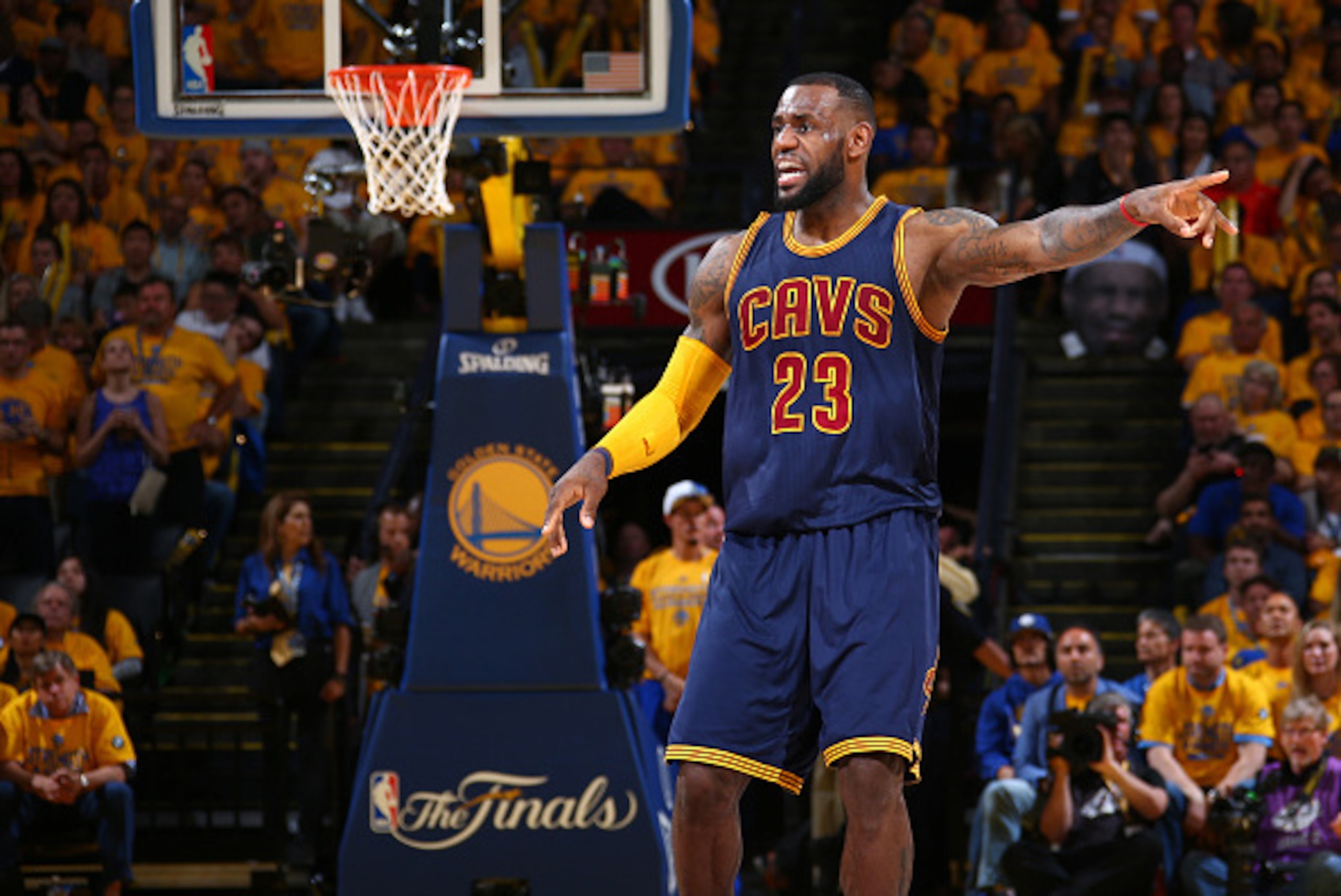
Sure, James struggled to connect during the stretch run, plagued by the lack of spacing and offensive production of his teammates when Mozgov was off the floor. He was still utterly fantastic thanks to his well-rounded impact.
"I'm not a high-volume shooter," the four-time MVP explained after the game, via Bleacher Report's Howard Beck. "I've never been in my career. But things have changed on our team, where the shots that Kevin and Kyrie would have has now been placed on myself and the rest of the guys as well. It's what needs to be done to help our team win."
And win they did.
Of course, the other individual pieces all found success. James Jones was connecting from the outside. J.R. Smith made some boneheaded plays but was still often a positive contributor. Tristan Thompson was a force on the offensive glass even if he brought literally no offense to the table.
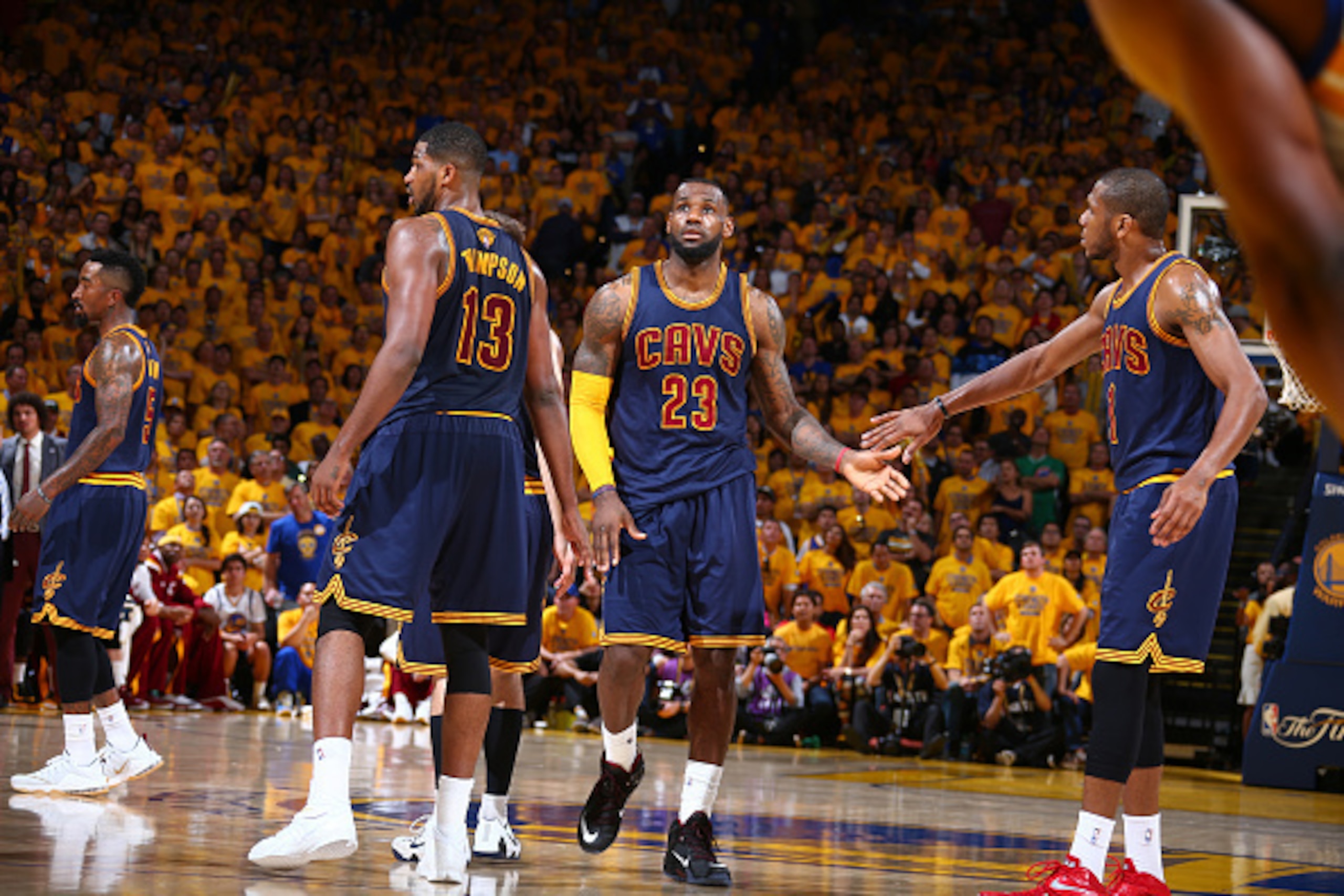
The problem here was the cohesiveness. Players got in each other's way and didn't complement the skills of one another, leading to detrimental spacing and allowing the Warriors to collapse around a driving James without fear of his deadly kick-out passes to the perimeter.
And that remained true even if Shumpert was on the floor instead of Jones, as was the case for six minutes. This five-man unit was outscored by 40.5 points per 100 possessions during Game 2, as opposed to "just" 34.3 when Dellavedova, James, Jones, Smith and Thompson were sharing the court.
That's not going to lead to many more victorious outings unless these lineups are used more infrequently or suddenly gain chemistry.
3. Harrison Barnes, Andrew Bogut, Stephen Curry, Draymond Green, Klay Thompson

It's not all positive for the Warriors. It can't be after an overtime loss to a handicapped team in Game 2 followed a narrow win in the series-opening contest, one that also required extra time.
Sure, you can write this loss off as a fluke that stemmed from an uncharacteristically inaccurate night on Curry's part. But at the same time, can Klay Thompson really be expected to put up 34 points each time the Dubs take the court?
Improvement is desperately needed from an offense that often ground to a halt, devolving the Warriors into a team that relied on jumpers far too often and abandoned the beautiful ball movement that had carried them this far into the NBA's second season. And it all begins with the starting five, especially because Mozgov's success in Game 2 should compel Blatt to turn to his bigger units a bit more often going forward.
Against Cleveland, the quintet composed of Harrison Barnes, Bogut, Curry, Green and Thompson wasn't able to find nearly as much success as it did during the first 82 games of the year—or earlier in the playoffs, for that matter.
| Regular Season | 14.0 | 114.4 | 94.8 | 19.6 |
| Postseason, Pre-Finals | 13.6 | 102.1 | 91.6 | 10.5 |
| Finals Game 1 | 19.0 | 117.4 | 114.2 | 3.2 |
| Finals Game 2 | 13.0 | 76.4 | 81 | Minus-4.6 |
Obviously, that's not a positive trend.
The typical starters have been fantastic all year long, but they haven't matched up well with Cleveland's big lineups. Bogut's inability to score has been problematic, and the suffocating defensive pressure of the Cavs has forced the ball movement into stagnation far too often. The Warriors don't often move like they're ankle-deep in quicksand.
Nonetheless, Kerr isn't going to abandon the strategy. This five-man group has worked all year long, and the Dubs certainly wouldn't be 1-1 in the NBA Finals without their contributions; an earlier exit from the playoffs would've been far more likely.
Even though the series is tied and is the first Finals to feature overtime periods in each of the first two games, the Warriors have been the superior bunch. Yes, that's in spite of Curry's shooting woes in Game 2.
Small-sample-size warnings apply here, but according to my FATS model and based solely on the head-to-head battles in the last two games, Golden State would win 9.7 more games than Cleveland over the course of an 82-game season.
Despite the tied status of the series, the Warriors have simply been better by a rather significant amount. And it still might not matter if they don't play the right lineups while forcing Blatt to make the wrong choices.
There's not much margin for error in the Finals.
All stats, unless otherwise indicated, come from NBA.com and Basketball-Reference.com.
Adam Fromal covers the NBA for Bleacher Report. Follow him on Twitter: @fromal09.




.jpg?w=2560 "Latest Peyton-Colts Rumors")