For Cavaliers and Hawks Coaches, Managing Injuries, Lineups Will Prove Tricky
ATLANTA — Memories, like pain, can fade over time, even for LeBron James, who has shown a remarkable ability to recollect even the smallest details of his basketball career. Thursday morning, when asked about the most uncomfortable injury that he managed to play through, James cited the right elbow issue that plagued him throughout the "'09 or '08" playoffs.
He wasn't quite sure.
"When we were making our run here in Cleveland, in my first stint," James said.
TOP NEWS

Embiid Out vs. Pistons
Luka 50 Piece in Win 🔥

Power Ranking Every NBA Team's Starting Lineup 🔢
Actually, it was 2010, and it was unforgettable for Cavaliers fans, since some—particularly after he left in free agency following a second-round elimination—chose not to believe that the ailment was the predominant cause of his uncharacteristically inefficient play. That was in part because the medical testing failed to uncover the source of his soreness.
"It's just I couldn't shoot the ball," James said Thursday at the Four Seasons Hotel, the day after he scored 31 points to give the Cavaliers a 1-0 lead against the Hawks in the Eastern Conference Finals. "I couldn't extend the ball. I don't know where it came from. Right after the season, it went away. It's the most frustrating thing I've been through while trying to make a championship run. That's the one I can kind of go off the top of my head with."
That's the one that made him feel like banging that head against a wall.
"It wasn't swelling," James said. "I don't know what was going on. I took multiple MRIs, got it checked, nothing they could find. Must have been a lot of—just work. It stopped me from doing a lot of things."
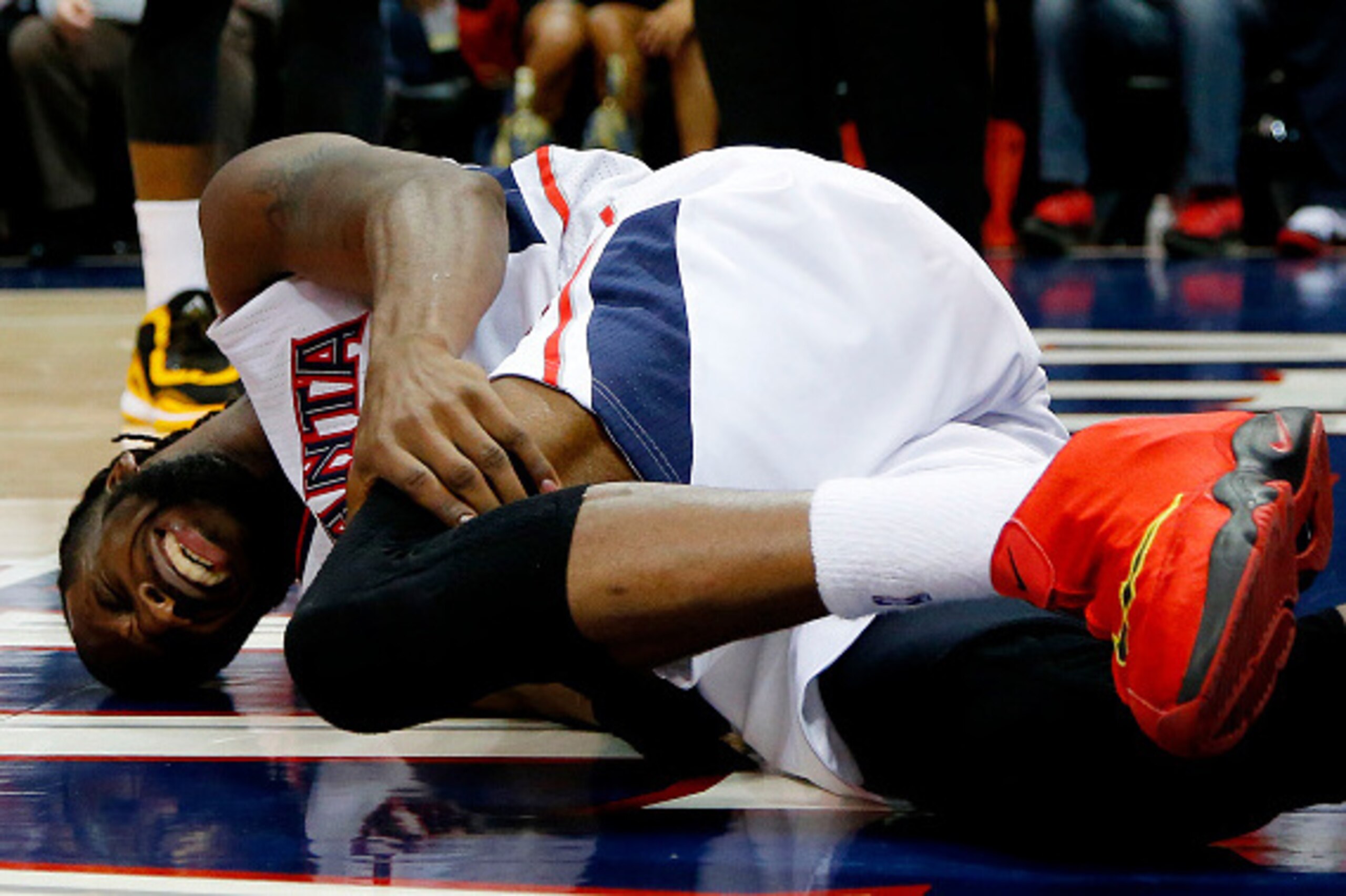
It didn't stop James from taking the court, just as current teammate Kyrie Irving's left knee and right foot problems haven't stopped him from taking the court in this postseason—at least until Friday night, for which his status is questionable after skipping the team's shootaround for additional testing. DeMarre Carroll is in a similar spot for Atlanta, also questionable following his frightening stumble Wednesday. His initial MRI showed no structural damage, and while the Hawks have been upbeat about his long-term prognosis since, the sense after Friday's shootaround was that he would sit this next one out.
One's playing status shouldn't impact the other, nor necessarily should the status of the series, with the Hawks trailing 1-0 and facing a treacherous trip to Cleveland for Games 3 and 4. Nor should what other players have done prior, such as James, who has tended to play through everything, even if it may have kept him from performing at his highest level, as was the case with his aforementioned elbow. As James told reporters after Friday's shootaround: "Health is more important than anything. Who am I to judge? Everybody's body is different."
Everybody's is, and yet sometimes we, as observers, don't want to acknowledge or appreciate that. Thus, you hear suggestions that someone is "soft," a stigma that Rockets center Dwight Howard has carried for much of his recent career, and which he began to counter somewhat by recording 19 points and 17 rebounds on a bum knee in Houston's Game 2 loss to Golden State on Thursday night.
Of course, that sort of performance will lead some to wonder how serious the injury was in reality. Sometimes, teammates are unconvinced and unsympathetic, particularly if they have their own hurts, and whispers grow louder to reporters about what another guy should be giving. That is particularly true when tests continue not to show anything serious, leading to an assumption that the discomfort is imaginary, and certainly not debilitating.
Naturally, players feel that peer and public pressure to perform with some pain, especially in a postseason situation. As Irving's coach, David Blatt, said Thursday: "This is playoff time. It's a little bit different than the regular season, obviously. Guys, they got to stretch the envelope a little bit more, when possible. That's also what the great ones do. They play through a lot of things that Sunday warriors don't."
But these situations put pressure on the coaches, too, pressure that Blatt and his Hawks counterpart, Mike Budenholzer, will feel Friday night and as the series progresses: pressure to protect players from themselves—playing when they physically shouldn't—and pressure to protect the team from their limitations.
Their considerations and complications are significant but different, even if, in both cases, they must put the player first, the team second, with everything else—especially the noise—irrelevant.
Start with Cleveland.
The first question is whether Irving is putting himself at any risk by continuing to play, with more clarity to come once he gets that additional MRI. If he is, he must sit.
The second is whether he is helping the Cavaliers by doing what he's done lately, ceding most ball-handling duties, eschewing attacking opportunities and avoiding, when possible, the tougher defensive matchups.
On that, it's more muddy.
Blatt insisted that Irving was an asset in his 27 Game 1 minutes, in which the third-team All-NBA guard made four of 10 shots, with 10 points, six assists and two turnovers. Still, only nine of those minutes came in the second half, and only three in the fourth quarter, even as James, infatuated with isolation, was dribbling away the lead as the Cavaliers' primary playmaker. Afterward, Irving reiterated that this has been "one of the most frustrating things I've ever dealt with," prior to sitting expressionless for several minutes, his knee in ice, a finger pressed pensively to his nose.
Some inside the organization, while not questioning his physical trouble, believe that Irving's mental state has been at least an equal inhibitor, and that the fourth-year player is struggling to adapt to the longest basketball season of his life, to the bumps and bruises that come with it, and may be keeping him from his top form. One reason that Blatt revealed Irving's ailments during the Chicago series was due to the sense that Irving was sulking, as he was being outplayed at times by Derrick Rose. Irving later expressed some relief that the truth had come out, and he was increasingly effective until another knee twist sidelined him for the second half of the clinching Game 6.
What do the numbers say? Irving has said he suffered the first of his injuries, the one to his foot, in Game 2 of the first round. Starting from that game forward, his traditional statistics are down from the regular season (17.8 points and 3.7 assists on 41.2 percent shooting compared to 21.7 points and 5.2 assists on 46.8 percent shooting). And in that period, the Cavaliers have actually been better when seven other players are on the court than when Irving is. That includes Matthew Dellavedova; Cleveland is plus-8.9 points per 100 possessions with Dellavedova playing and plus-3.7 per 100 possessions with Irving playing. That's a complete flip from the regular season, when it was plus-7.7 per 100 possessions with Irving and plus-1.4 with Dellavedova.
Still, the playoffs represent a relatively small sample size, and it's not as if Irving has posted a minus rating, making him a clear liability. He has certainly not done anything to suggest that, if his condition is not subjecting him to long-term consequence, Cleveland should shut him down for the rest of the postseason and play others. They don't have the depth for that, even if J.R. Smith and Iman Shumpert can sustain their high levels. Not to win this round, and then another, against the Golden State juggernaut.
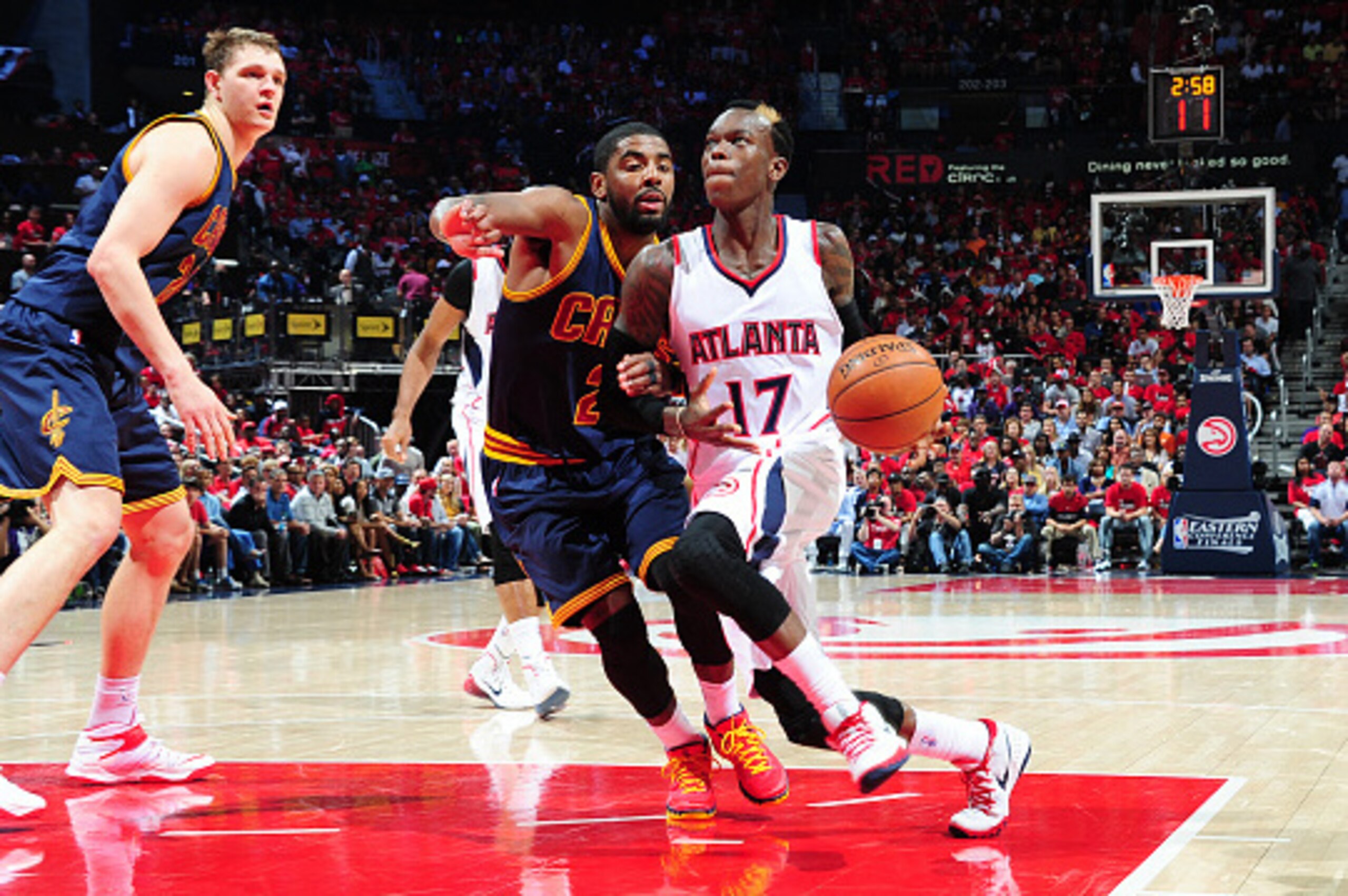
Maybe, if the tests show nothing has gotten worse, Irving rests tonight and sees if that helps, though it didn't appear to do the trick after eliminating Chicago. And if he returns for Game 3, or 4, or whatever, it's just up to Blatt and Irving's teammates to continue to hide him and to help him. That could be somewhat challenging in this series, though, specifically on defense. If the Hawks are whole, there's no clear choice for Irving to cover. Jeff Teague blew by him at will, and the combination of Kyle Korver's size and the string of screens the Hawks set for him makes the sharpshooter a tough assignment. And when the Hawks go with Dennis Schroder next to Teague, there are two guards who are too quick for someone who can't currently get to top speed.
If Carroll can't participate Friday night or on future nights, and even if he can participate but can't contribute, Budenholzer may choose to play Teague and Schroder together more often than he did in Game 1, when they were a minus-three in nine minutes. The NBA Coach of the Year may feel compelled to do so since, without Carroll and with Thabo Sefolosha sidelined for the season with a broken ankle, his only natural small forward is Kent Bazemore. And since Budenholzer stated that the Carroll injury wouldn't necessarily "trickle down" to Mike Scott, whom he views as more of a power forward, it's more likely that Budenholzer would go small, sliding Korver to small forward and clearing more time for Schroder or perhaps Shelvin Mack with Teague.
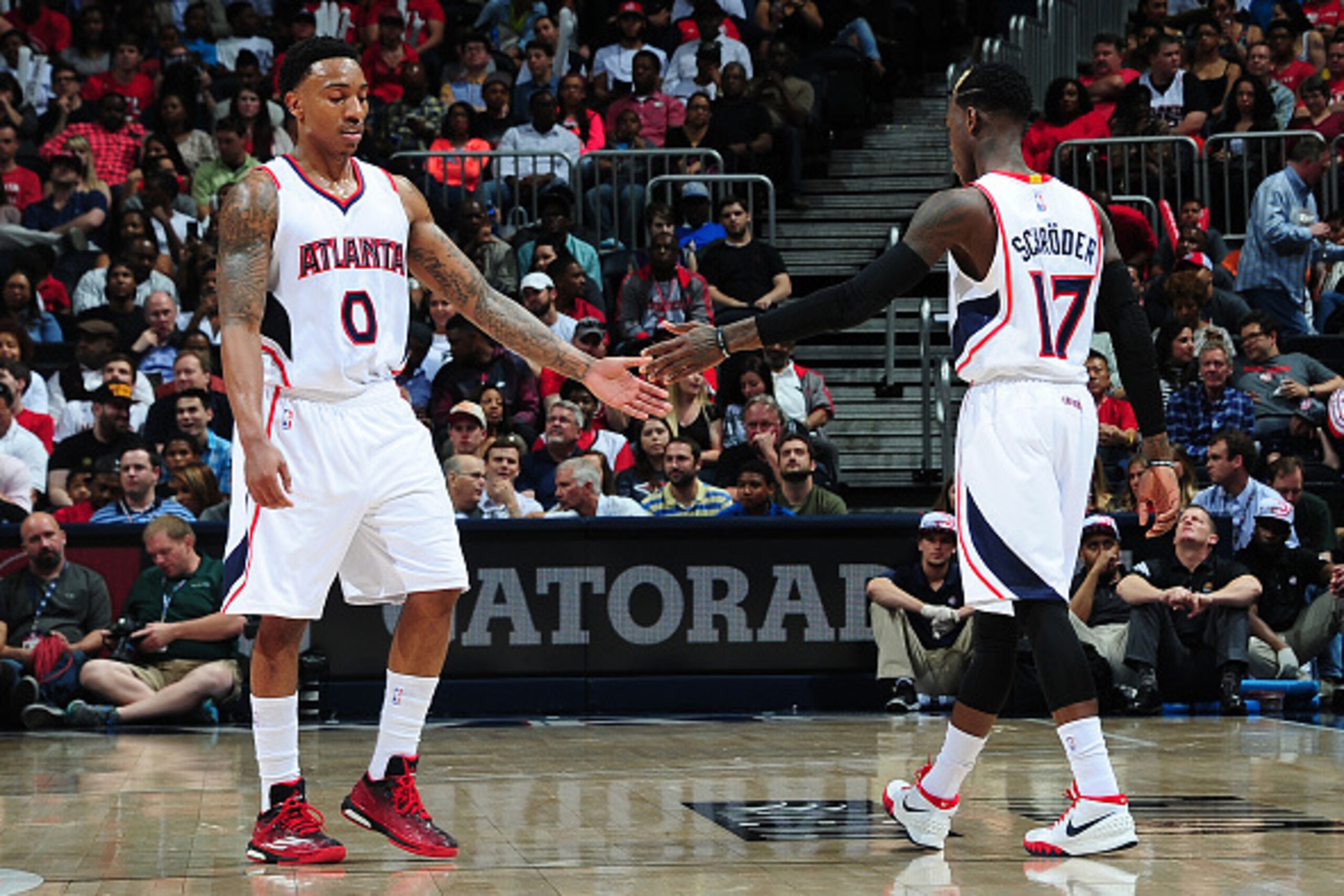
Still, the Teague and Schroder pairing sounds better in theory than statistical reality. Budenholzer pointed to some good moments together, especially in the Washington series, but the numbers argue otherwise; they are now minus-13.6 per 100 possessions in the playoffs, as Schroder's shot selection has often sidetracked the offense.
Even with some unattractive options, Budenholzer must take great care with Carroll, focusing primarily on his readiness, and secondarily on how he's helping or hurting the team—not on anything else. He espoused that approach Thursday, saying, "We'll see how things go in the next 24 hours, and we'll make a decision what's in DeMarre's short-term and long-term best interests. Listen to the doctors and listen to DeMarre, and make decisions."
Carroll must be smart, too. He's not signed to a cornerstone contract, as Irving is with Cleveland. It's the playoffs, yes. But in the midst of a breakout season, and with free agency approaching, he would be wise to look out for himself as well as his team. It's fine to try to push through some pain, but not to push away any signs that something is seriously wrong. Nor is it fair for fans to blame a player for stepping aside, even if the examinations, like the one James took in 2010, and the ones Irving and Carroll have taken this spring, don't show anything structurally serious.
James was not much worse for the wear of his 2010 experience; he took a brief hit to his reputation, because he didn't play up to his typical standards, and some Cavaliers fans viewed his struggles as some sort of conspiracy, as if he'd checked out on the organization. But he's repaired that relationship by returning, and the elbow has been only an occasional nuisance since.
Perhaps Irving and Carroll won't do any permanent damage to themselves, either, if they keep playing.
And yet, at a time when pride and passion and pressure can become overwhelming, it's up to the coaches to sometimes overrule—to step in and tell someone to step aside, even if it may mean taking a step back in a series.
All stats courtesy of NBA.com/Stats unless otherwise noted.
Ethan Skolnick covers the NBA for Bleacher Report and is a co-host of NBA Sunday Tip, 9-11 a.m. ET on SiriusXM Bleacher Report Radio. Follow him on Twitter, @EthanJSkolnick.

.jpg?w=2560 "Rodgers Iced Out on Plane 💎")
.jpg?w=2560 "Raiders Could Start Mendoza")
.jpg?w=2560 "🚨 Week 8 AP Top 25 Poll")
.jpg?w=2560 "Mahomes Told Teammate to Leave Meeting")
.jpg?w=2560 "Lamar Being Out Shocked Ravens")

.jpg?w=2560 "Packers Safety Slams Refs 🤬")