

Best- and Worst-Case Scenarios for Each Philadelphia Eagles Rookie
Leading up to the 2015 NFL draft, much of the talk within the Philadelphia Eagles fanbase centered around how much head coach Chip Kelly would give up in his pursuit for Oregon quarterback Marcus Mariota.
The Tennessee Titans never wavered in giving up the No. 2 overall pick despite a reported whopping offer by Kelly, per NFL.com's Ian Rapoport, and Tampa Bay Buccaneers general manager Jason Licht even admitted to USA Today Sports' Jim Corbett that the Eagles reached out to him about his team's No. 1 overall pick.
Kelly ended up staying put at the 20th spot, grabbing USC wide receiver Nelson Agholor and then moving up five slots in the second round to land Utah cornerback Eric Rowe.
It was an under-the-radar draft compared to what Eagles fans expected, but that doesn’t mean it won’t be productive. Many see Agholor as one of the most NFL-ready players at any position, and Rowe is a top talent who can play cornerback and safety. Kelly spent his third-round pick, both sixth-rounders and his seventh-rounder on defensive players in an attempt to shore up a unit that ranked 28th in yards allowed last year.
Kelly will be counting on his rookies, notably the top two picks, to play big roles in 2015. The Dallas Cowboys won the division last year, and despite letting go of Pro Bowl running back DeMarco Murray, their offensive line is as talented as ever. Getting through Dallas is likely Kelly’s best bet to winning a division, and he will need a better performance from his rookie draft class than what he got from the ’14 group.
Here’s a breakdown of the best- and worst-case scenarios for each Eagles rookie draft pick in 2015. A few undrafted players who may be expected to contribute are included as well.
1st-Round Pick: Nelson Agholor, WR, USC
1 of 8
Best Case
Nelson Agholor doesn’t quite have the prototypical size Chip Kelly covets in his receivers—think Jordan Matthews at 6’3”, 212 pounds or even Riley Cooper at 6’4”, 220 pounds—but Agholor is a polished, smooth and reliable presence who drew draft-day comparisons to Jeremy Maclin.
Agholor is 6’0”, 198 pounds and ran a 4.45 40-yard dash. Factor in his arm length (32 ¼") and hand size (9 ¼"), and it’s easy to see why he’s comparable to Maclin.
"Per @SBNation the #Eagles are bringing in WR Nelson Agholor for a workout-USC alum is a mirror image of Jeremy Maclin pic.twitter.com/YsT7mONbzY
— Michael (PJ) Quinn (@PJbleedsgreen) March 15, 2015
"
It’s unreasonable to expect that he duplicates Maclin’s 2014 numbers—especially considering the Philadelphia Eagles may spread the ball around more—but Agholor has a very low bust rate. He is likely to contribute both in the slot and out wide, and he has a chance to approach 1,000 yards as a rookie in the right scenario.
Agholor will likely start training camp and even the regular season behind Cooper and Josh Huff on the depth chart, but it wouldn’t be a surprise to see him pass those two relatively early.
Matthews is likely to be the go-to receiver in this offense, but Agholor could exceed Sammy Watkins’ 2014 numbers (65 receptions, 982 yards and six touchdowns) with ease, especially considering the rookie will be in a better offensive system than what Watkins had last year.
Agholor was also a dynamic return man in college, and he will be given every opportunity to win the job in preseason.
Worst Case
Wide receivers in Chip Kelly’s offense just seem to flourish. Ask DeSean Jackson (2013), Maclin (2013) or even Cooper (2014). It’s doubtful that Agholor struggles in this system. He plays fast and catches the ball well.
The realistic worst-case scenario for Agholor would be either a season-ending injury that shelves him all year or a nagging one in the preseason that saps his explosiveness and forces him to play catch-up for the majority of 2015. That would keep Cooper in a prominent role as an outside receiver, and he was exposed as an everyday player a year ago.
2nd-Round Pick: Eric Rowe, CB, Utah
2 of 8
Best Case
Playing cornerback as a rookie is a notoriously difficult job, and even recent high draft picks have experienced major growing pains in their debut seasons. Morris Claiborne (sixth overall pick in 2012), Justin Gilbert (eighth in 2014) and Dee Milliner (ninth) were huge liabilities as rookies and were repeatedly benched or relegated to reduced roles in the defense.
But Eric Rowe has NFL size for a cornerback (6'1", 205 lbs), and he’s perfect for what both head coach Chip Kelly and defensive coordinator Billy Davis want to do with their defense—and that’s play press man-to-man coverage with their cornerbacks and win the outside matchups. After all, Rowe estimates he did this on 95 percent of passing plays in college, per Birds 24/7's Sheil Kapadia.
In a best-case scenario, new $63 million corner Byron Maxwell excels in his new role as a No. 1 cornerback, and Rowe locks down the starting job opposite him with an impressive showing in training camp. Rowe handily beats out Brandon Boykin and Walter Thurmond on the outside, matching up well with Jordan Matthews and Nelson Agholor in training camp practices.
Rowe finishes the season with four interceptions and 15 passes defensed. He’s targeted more than the average corner because the Philadelphia Eagles spend so much time on defense and will likely always rank near the bottom of the league in passing attempts allowed as long as Kelly is head coach.
Still, Rowe’s physicality and penchant for forcing key turnovers at opportune times more than make up for the plays when he’s beat or out of position, and all signs point to his having a bright future as an NFL starting cornerback.
Worst Case
In his worst-case scenario, Rowe shows why playing cornerback in the NFL is arguably the toughest job in sports outside of quarterback. Rowe’s struggles are not uncommon for a rookie, but they don’t help an Eagles secondary that rated 31st in passing yards allowed a year ago and spent a high draft pick in the hopes of stabilizing that unit.
Division wideouts Odell Beckham Jr., DeSean Jackson and Dez Bryant torch Rowe repeatedly, and he even struggles against slower possession receivers like Pierre Garcon. An attempt to move Rowe to safety in midseason backfires, and the Eagles end up sitting Rowe for lesser talents such as Boykin and Thurmond, neither of whom is fit for an everyday role on the outside.
3rd-Round Pick: Jordan Hicks, ILB, Texas
3 of 8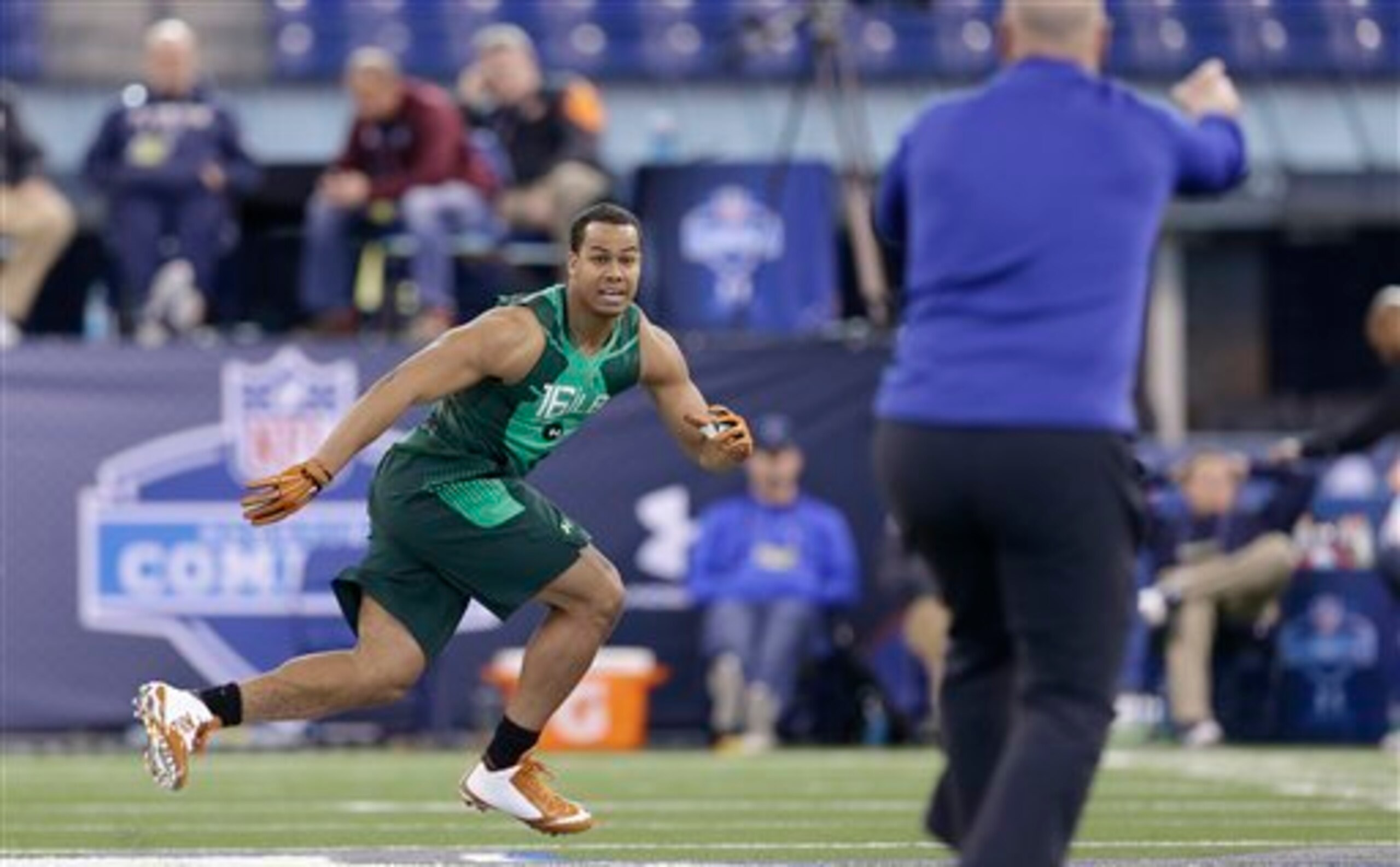
Best Case
For those who thought the draft selection of Jordan Hicks signaled the end of the Mychal Kendricks era, they’re correct. In Hicks' best-case scenario, when a contender loses a starting inside linebacker early in the season, Chip Kelly is able to send Kendricks for a third-round draft pick in 2016 and a sixth-rounder in 2017.
That thrusts Hicks into a more prominent role as a situational player, and he holds his own. While many thought Hicks may have been over-drafted in the third round—he has a lengthy list of injury issues—he justifies the Philadelphia Eagles’ faith in him.
Hicks is an athlete—4.68 40-yard dash at 6'1", 236 pounds, 38-inch vertical leap and an excellent showing in the three-cone drill with 6.78 seconds—and he even plays well as a starter when Kiko Alonso briefly misses time.
The Eagles use enough four-man fronts and both nickel and dime defenses that Hicks doesn’t see more than 20-25 snaps per game, but he’s effective when he plays. He tackles well, forces a few key turnovers and contributes on special teams.
Worst Case
In a worst-case scenario, Kelly sends Kendricks packing in training camp, acquiring just a fourth-rounder for the Pro Bowl talent. It’s a head-scratching move, and experts figure Kendricks was the latest example of an Andy Reid player who inexplicably didn’t fit Kelly’s system.
The problem is that Hicks is then forced into a starting role when Kiko Alonso’s ACL rehab stalls, and DeMeco Ryans is plagued with another bout of injuries. Hicks becomes the target of opposing quarterbacks, as he’s slightly undersized to match up with tight ends and lacks ideal instincts.
The Eagles eventually bench Hicks, but Brad Jones and Travis Long are no better. It gets to the point that even Marcus Smith works his way into the rotation, and a constant shuffling of inside linebackers is ironic after the Eagles seemed to have quite a plethora of talent at the position just months prior.
.jpg?w=2560 "Rams Raiders Football")

.jpg?w=2560 "Steelers Saints Football")
6th-Round Pick: JaCorey Shepherd, CB, Kansas
4 of 8
Best Case
In a best-case scenario, JaCorey Shepherd becomes this year’s E.J. Gaines—a late-round draft pick who holds his own as a rookie starter and outplays his draft selection.
Shepherd, a sixth-rounder who likely saw his draft stock fall as the result of a sore hamstring that led to a disappointing 4.65 40 time at his pro day, per Birds 24/7, is a much better player than his workout numbers.
He becomes one of the rookie steals of the draft, surprising the coaching staff in training camp by challenging for a starting role on the outside. Ultimately, second-rounder Eric Rowe wins the job. But Shepherd takes the nickel role when Walter Thurmond and Nolan Carroll struggle, and the team deals Brandon Boykin for a midround draft pick.
Shepherd sees action in over a third of all defensive snaps and starts two games when Rowe is injured. He’s not flashy, but he’s reliable. He becomes a key cog in an improved Philadelphia Eagles secondary.
Worst Case
It’s asking a lot to expect a sixth-round cornerback to contribute as a rookie, and so, in a worst-case scenario, it’s no surprise that Shepherd flat-out isn’t ready when the coaching staff calls on him. He’s slow in coverage and too often out of position, and that 4.65 speed doesn’t help unless he’s covering a running back or tight end.
The Philadelphia Eagles release him at the end of training camp and re-sign him to the practice squad, but it becomes pretty evident that Shepherd may never be more than a fringe NFL cornerback.
6th-Round Pick: Randall Evans, CB, Kansas State
5 of 8
Best Case
The Philadelphia Eagles have a full roster of defensive backs. At the cornerback position, it’s likely that Byron Maxwell, Eric Rowe, Brandon Boykin (if he’s not traded) and either Nolan Carroll or Walter Thurmond all make the 53-man roster.
That means Randall Evans may be competing with Carroll, Thurmond and JaCorey Shepherd for one spot. For what it’s worth, 2014 fourth-round draft pick Jaylen Watkins is no guarantee to make the team either, but he’s expected to contribute at strong safety despite being selected as a cornerback.
In a best-case scenario, Evans has a strong camp and beats out Shepherd. Carroll is a surprise veteran cut, and when Thurmond is injured, Evans becomes the dime defensive back behind Boykin. He plays well in limited snaps and contributes as a standout special teams player.
Worst Case
Evans doesn’t seem to fit the bill the Eagles coaches are looking for in their cornerbacks. Despite having good size for the position (6'0", 190 lbs), in a worst-case scenario Evans is exposed in press coverage and too often beaten by savvy veterans. He spends the season rotating between the practice squad and the active roster and will have to prove heading into 2016 that he’s worthy of a spot on the team.
7th-Round Pick: Brian Mihalik, DE, Boston College
6 of 8
Best Case
Brian Mihalik is an incredibly raw player with sheer size (6'9", 295 lbs) that makes him well worth the seventh-round gamble. In a best-case scenario, his play, though inconsistent, has occasional glimpses of Calais Campbell, and he’s able to earn a spot on the 53-man roster over former Oregon Duck Taylor Hart.
Mihalik sees action in five to 10 snaps per game for the season, mainly contributing on special teams, where his height and long arms help him block two field goals.
Worst Case
Mihalik is just too much of a project player to warrant a spot on the active game-day roster in his worst-case scenario. He spends the 2015 season on the practice squad and doesn’t get called up once.
Undrafted Free Agent: Devante Davis, WR, UNLV
7 of 8
Best Case
In a best-case scenario, Devante Davis is a camp sensation, winning one-on-one battles against cornerbacks and playing well on special teams. He manages to beat out aging veteran Miles Austin for the fifth receiver spot and even works his way into a rotation when Riley Cooper continues to be ineffective.
Davis’ final 2015 numbers (31 receptions, 427 yards, two touchdowns) are pretty remarkable, considering he managed to go undrafted. He looks to have a more promising role in the offense going forward.
Worst Case
Davis gets some buzz heading into training camp as a should-have-been mid-rounder who fell due to a 2014 injury. He does nothing to stand out in camp and gets released in the second wave of cuts.
Undrafted Free Agent: Travis Raciti, DE/OLB, San Jose State
8 of 8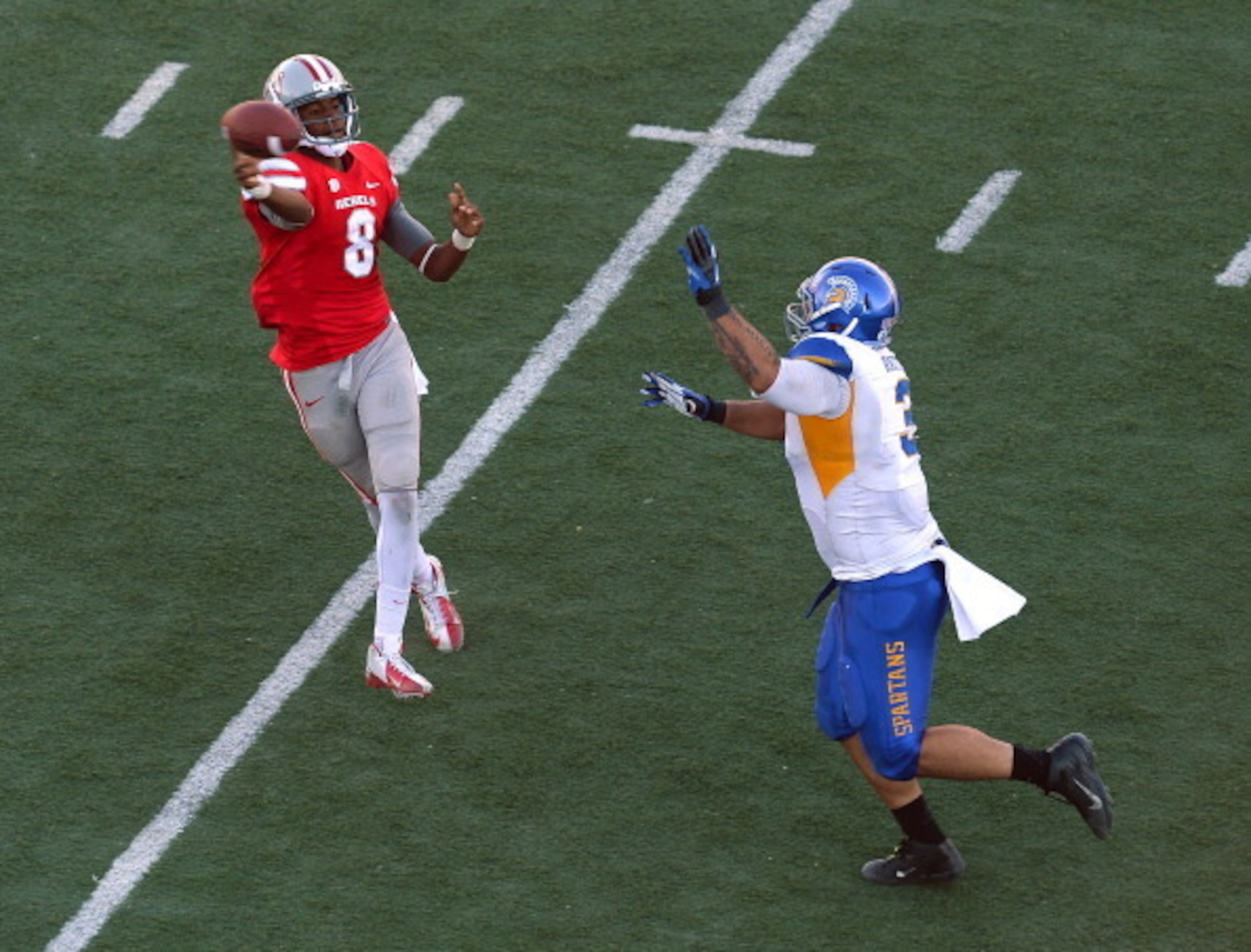
Best Case
Like Devante Davis, Travis Raciti probably should have at least gotten drafted. Fortunately, in this best-case scenario, Raciti is able to parlay limited snaps in the preseason into a roster spot as he proves to be a standout special teams player, high-character teammate and situational role player on defense.
Worst Case
Raciti never sheds his label as an undrafted rookie and doesn’t make it out of camp.
All scouting combine numbers are from NFL.com.
.jpg?w=2560 "Cowboys Packers Football")




.jpg?w=2560 "🚨 Week 8 AP Top 25 Poll")