Final 2014-15 Grades for Every Dallas Mavericks Player
The Dallas Mavericks' season concluded in dismay. With an injury-riddled roster, the Mavs fell to the Houston Rockets in the first round of the playoffs in just five games.
The postseason might have ended early for Dallas, but several players stepped up when it counted the most. Everything that happens during the regular season cannot be ignored, but huge individual playoff performances linger in fans' memories for years to come.
In a lot of ways, the playoffs truly show what a player is capable of. Some key cogs fold under the pressure, which opens the door for gutsy reserves to step up. That was certainly the case in the Mavericks' brief postseason showing.
A shorthanded Dallas fell 3-0 down to Houston after a heartbreaking 130-128 defeat in Game 3. But the team's collective Game 4 performance, in which every starter scored in double figures, was a glimpse at what the Mavericks offense is capable of at its best.
When grading the individuals on this roster, several key factors were considered. The playoff performances count for a lot, although they don't outweigh the whole of the regular season. Every player on the team had a specific role entering the 2014-15 campaign, and those who managed to make the most out of it received a favorable grade.
Greg Smith, Dwight Powell, Bernard James
1 of 13
These three players didn't really manage to crack the rotation this season. Without solid minutes outside of garbage time, they all get a default F grade.
Greg Smith
The Mavs signed Smith as their third center behind Tyson Chandler and Brandan Wright. He had a couple of opportunities to earn playing time when Wright was traded but never impressed when he was on the court. Dallas then brought in several additional big men, all of whom jumped ahead of Smith in the rotation.
Dwight Powell
Powell's little surge in mid-January was fun, especially considering Dallas head coach Rick Carlisle's reluctance to playing rookies. He logged double-digit minutes in seven straight games but soon returned to the bench and only played in 24 regular-season games total. He showed some offensive potential but is still too raw for Carlisle's liking.
Bernard James
The Mavs had an open roster spot and a lack of bodies up front after moving Wright, and they decided to bring in James after releasing him last year. He had a couple of good games and was just ahead of Powell and Smith in the rotation, but he played very few significant minutes overall.
Collective grade: F
Al-Farouq Aminu
2 of 13
Al-Farouq Aminu's season was a roller-coaster ride. He was in and out of the rotation throughout the year but eventually found his way to Carlisle's favorable side.
Aminu was very raw offensively entering this season but made strides on that end. He remains a shaky shooter but has shown an ability to push the ball in transition and even attack off the dribble a little. But his biggest impact is on the defensive end.
A highlight reel could be made consisting solely of Aminu's perfectly timed weak-side rotations with a ferocious block. He has always had the length and the physical tools to be a lockdown defender but hadn't truly blossomed until this season.
There is no doubt that Aminu was Dallas' best perimeter defender this year, and his impact is all over the advanced statistics as well. The Mavs outscored opponents by 5.7 points per 100 possessions with him on the court, the highest mark of any player on the roster, per NBA.com.
Even though it took Aminu time to settle into his role, he surpassed all expectations during the playoffs and the regular season, and that earns him a top grade.
Final grade: A
J.J. Barea
3 of 13
Performing in the playoffs is second nature to J.J. Barea at this point. The Mavericks brought him back for some additional backcourt depth after he was bought out by the Minnesota Timberwolves, but they probably didn't anticipate how crucial he would be in the most important moments of the season.
With Rajon Rondo out, Barea stepped right into his role and did a significantly better job of running the offense against Houston. His synergy with Dirk Nowitzki was spot-on as always, and Barea was terrific at probing the Rockets' helpless defense. He averaged 30.8 minutes in the series, while putting up 11.8 points and 7.4 assists per game.
Barea's minutes throughout the year varied from game to game, but he never complained and mostly stepped up when his number was called. He wasn't spectacular, but he filled an important role, remained healthy and was a steady crutch for Carlisle.
Barea gets a boost in his grade thanks to a terrific postseason and for staying consistent.
Final grade: B+



Tyson Chandler
4 of 13
Chandler has arguably been the Mavericks' most important player this season.
Before the Rondo trade, Chandler was seemingly catching every ball Dallas guards threw anywhere near the rim, dunking with perpetual ferocity. Unfortunately, the half-court offense slowed down following the move, giving Chandler fewer opportunities to dive to the basket.
His expert pick-and-roll play and screen-setting are exactly what Dallas needs in its starting center, and Chandler has delivered in that regard.
He has hardly ever been better defensively. Although he isn't as springy outside the paint, Chandler is still one of the better rim protectors in the league.
With Chandler on the floor, the Mavericks were sniffing the top 10 in defensive efficiency, surrendering 102.1 points per 100 possessions, according to NBA.com. Dallas gave up a defensive rating of 105.8 with Chandler resting, which would have ranked 26th this season.
Chandler had a couple of nagging injuries, but he managed to stay relatively healthy and was a huge difference-maker.
Final grade: A
Monta Ellis
5 of 13
Ellis led the Mavericks in scoring this season with 18.9 points per game, as he continued to be the engine that ignites the offense.
Few players are as good as Ellis at breaking down a defense, and he hasn't lost much of his pace even as he approaches 30.
It's hard not to admire Ellis' toughness, as he gutted through injuries and missed just two games this year. But it was frustrating to watch him force the issue while playing hurt, as he was missing shots and couldn't get his offense going.
Ellis still managed to get healthy enough for the playoffs, but his performances against Houston left conflicting impressions to say the least. He shot below 35 percent in the first two games, chucking relentlessly even though he had no rhythm. He proceeded to drop 34 points in Game 3 and followed that up with an efficient 31 points in Game 4, playing a major role in making the series at least somewhat competitive.
The biggest knock on Ellis is his play on the other end, which was beyond abysmal in the playoffs. He constantly fell asleep off the ball, allowing his man to cut backdoor, and didn't put much effort into his on-ball defense either.
Final grade: B
Raymond Felton
6 of 13
Raymond Felton is pretty much in the same boat as the three big men who received an F grade. He was hurt for most of the season and wasn't really needed once he got back.
He logged 9.7 minutes per game in his 29 regular-season appearances, most of which were spent in meaningless garbage time.
To his credit, Felton finished the season on a relatively high note. He got a couple of starts and played at an acceptable level once the Mavericks were locked in as the seventh seed.
He played pretty well in Game 2 against Houston and even earned the starting job for Game 3 once Rondo was out. Unfortunately, Felton wasn't really impactful in that game and faded out of the rotation quickly.
Final grade: D-
Devin Harris
7 of 13
Devin Harris struggled to stay healthy last season but was solid off the bench this year.
He played in 76 games and shot 35.7 percent from deep, the second-best figure of his career. Harris was more reliable spotting up beyond the arc, which made him a seamless fit in Carlisle's offense.
His numbers are not worthy of Sixth Man of the Year consideration, but he still fit that role admirably for Dallas. He and Aminu were the only consistent perimeter defenders the Mavs had.
Dallas lacked two-way threats on the wing and at the point, with Harris being practically the only player who was consistent on both ends of the court. He doesn't get a ton of steals but is generally reliable and stays in front of his matchup.
Unfortunately, Harris missed Game 2 due to turf toe and was bothered by the injury for the rest of the playoffs. Still, he was a key cog off the bench all year long and deserves credit.
Final grade: B
Richard Jefferson
8 of 13
Richard Jefferson was a consistent feature in Carlisle's rotation, although the coach probably gave him a little more burn than he should have.
Jefferson was the Mavericks' most reliable three-point shooter this year, knocking down 42.6 percent of his long-range attempts. But he didn't do much else at an above-average level.
Whenever Jefferson went to the rim, the result was unpredictable. He had a couple of exceptional dunks that made him appear 10 years younger, but more often than not, he struggled to finish through contact once he met resistance at the basket.
He is 34 and couldn't guard quicker wings. He was still doing an acceptable job tracking his man off the ball, but he struggled to recover on shooters after helping.
Carlisle's infatuation with Jefferson was a little bizarre. Even though Jefferson wasn't terrible, he still shouldn't have been starting ahead of Aminu in Chandler Parsons' absence.
Jefferson had an overall average season and gets an average grade.
Final grade: C
Dirk Nowitzki
9 of 13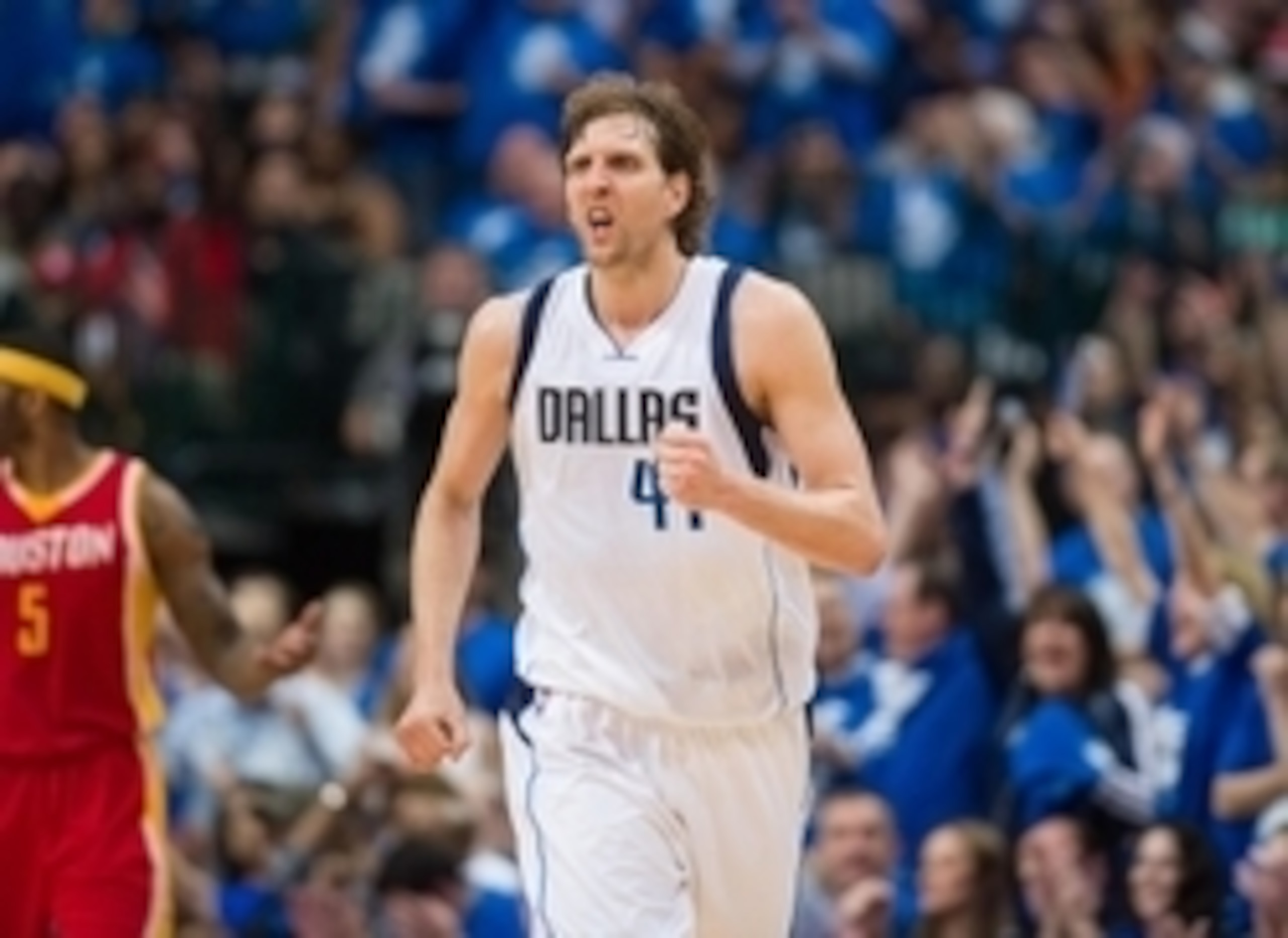
Good ol' Dirk Nowitzki. At the age of 36, he still put up 17.3 points per game and brought his three-point percentage back to a respectable 38 percent after starting the season cold.
His ability to draw double-teams and space the floor takes the offense to the next level, even though scoring in the post doesn't come as easily to Nowitzki as it once did.
However, Nowitzki's defense has become a huge problem. Carlisle tried to hide him on several different players in the playoffs, but Houston constantly had whoever Dirk was guarding screening the ball and taking advantage of his slow feet. It was sad to watch.
His performance on the offensive end was anything but sad, though. He almost single-handedly willed the Mavs to a Game 3 victory, dropping 34 points and grabbing eight rebounds in the close loss. His 22 points and 15 rebounds in Game 5 were also impressive.
Dirk is a warrior, and it's a joy to watch his intensity elevate in the postseason. He still has a lot of gas left in the tank offensively and will continue to roll next year.
Season grade: B
Chandler Parsons
10 of 13
Parsons caught some flak after signing Dallas' $45 million offer sheet last summer and underperforming in the early parts of the season. It took him a while, but he eventually broke out of his shooting slump and had an overall positive influence on the Mavericks' season.
Parsons still has ways to go defensively, but his offensive versatility is exceptional. His ability to drive, shoot and pass at a high level enabled Dallas to start the season as the hottest team in the league offensively, and that should continue to be the case next year.
His raw numbers might not be up to par with his paycheck, but Parsons certainly passed the eye test, and the advanced statistics reflect his importance to the offense.
He ranked fifth in the league in points per possession as the pick-and-roll ball-handler, per NBA.com. The four players ahead of him (James Harden, Louis Williams, Stephen Curry and Chris Paul) are all pick-and-roll wizards who can score in just about every way imaginable. The fact that Parsons, a 6'9" wing, is even sniffing that territory is a testament to his skill.
The Mavericks missed the injured Parsons in the playoffs, and the first-round series could have looked different if he hadn't been in street clothes.
Final Grade: B+
Rajon Rondo
11 of 13
The Mavericks had a lot of issues toward the end of the season, but Rondo is most certainly the scapegoat for the failure this year turned out to be.
His mere presence turned Dallas' mercurial offense into something barely functional. Without a reliable jumper, he cramped the floor and forced his teammates to face previously nonexistent double-teams and packed driving lanes.
Rondo and Dallas were never a good fit, but that's not even the worst part of the saga.
Rondo straight-up quit on the Mavs in Game 2. He played just 10 minutes, recorded a seemingly intentional eight-second violation and didn't seem to be trying on defense other than pushing and swiping at James Harden. Carlisle promptly benched him, and that was it for Rondo in the series. The saddest part of that night was how indifferent and tuned out a once-fearless competitor appeared.
Rondo did have some enthralling moments in the regular season, but they were few and far between.
Final grade: D-
Amar'e Stoudemire
12 of 13
As Carlisle struggled to find an efficient way to distribute Wright's minutes among his reserve big men, Stoudemire became available after being bought out by the New York Knicks. The Mavs brought him in for the stretch run, and he performed relatively well.
His pick-and-pop game has declined somewhat, and he almost exclusively spent his minutes dominating possessions in the low post for Dallas. Stoudemire feasted on opposing reserves, bullying his way into easy shots at the basket.
His defense has always been shaky, and it hasn't gotten any better with his mobility being on a downswing following a long list of injuries. But he was brought in to provide some scoring punch off the bench, and he did just that.
Carlisle generally ran the offense through Stoudemire when he was on the floor, and that trend continued in the playoffs. He wasn't particularly consistent, but he played a big part in the Game 4 win with an efficient 12 points.
Dallas knew what it was getting in Stoudemire, and he pretty much met expectations.
Final grade: B-
Charlie Villanueva
13 of 13
Charlie Villanueva only just made the roster back in October but rose from the bench trenches and carved out a specialist role for himself. He didn't play in every single game, and Carlisle carefully picked spots to utilize Villanueva. But he managed to make an impact nonetheless.
He gradually improved from being horrendous defensively to being just bad, but he was still outmatched against bigger forwards in the post. He has slow feet and isn't great at keeping players in front of him, but he made up for some of those flaws with sheer effort.
Either way, Villanueva's shooting touch opened up a lot of doors offensively. He has a lightning quick release, which is a nightmare to deal with, even when the opposition goes small with a wing. If the defender is a step slow, Villanueva let's it fly with no hesitation.
He became the Mavericks' ultimate heat-check guy, coming into games for short stints and either bombarding opponents with threes or missing a couple of shots and going right back to the bench.
When Villanueva heated up, it was fun to watch. But he didn't do it quite often enough in meaningful games, which knocks his grade down a bit.
Final grade: C+

.jpg?w=2560 "Raiders Could Start Mendoza")

.jpg?w=2560 "Rodgers Iced Out on Plane 💎")
.jpg?w=2560 "Packers Safety Slams Refs 🤬")
.jpg?w=2560 "🚨 Week 8 AP Top 25 Poll")