
Redrafting the First Round of 2014 NBA Draft, End-of-Season Edition
You don't often get mulligans in sports, but now that each rookie has played the final regular-season game of his first run-through in the Association, let's pretend the league gets to redo the 2014 NBA draft.
Heading into the initial selection process, franchises are essentially engaging in a glorified guessing game. We don't really have all that much information at our disposal, even with access to footage of every college basketball game and plenty of measurements. No one knows how to quantify upside, or even how each young man will respond to the rigors of a professional basketball season.
Now, we have more info at our disposal. It's still quite limited, especially when dealing with the players who spent much of the year either injured or keeping a bench warm, but there's at least a bit more to work with.
When attempting to redraft the rookie class—which, against conventional wisdom from a year ago, turned out to be an exceedingly weak one—we're taking a lot into consideration. Upside still does matter, as does performance during the first go-round. But team fit has to come into play as well, and don't forget that we're working with rosters and situations as they were this past offseason.
Let's see if you're happier with your team's hypothetical decision here than you were with the actual one in the summer.
1. Cleveland Cavaliers: Andrew Wiggins (Previously Went No. 1)
1 of 30
Age: 20
Position: SG/SF
Per-Game Stats: 16.9 points, 4.6 rebounds, 2.1 assists, 1.0 steals, 0.6 blocks, 13.9 PER (for Minnesota Timberwolves)
Previously Taken Here: Andrew Wiggins
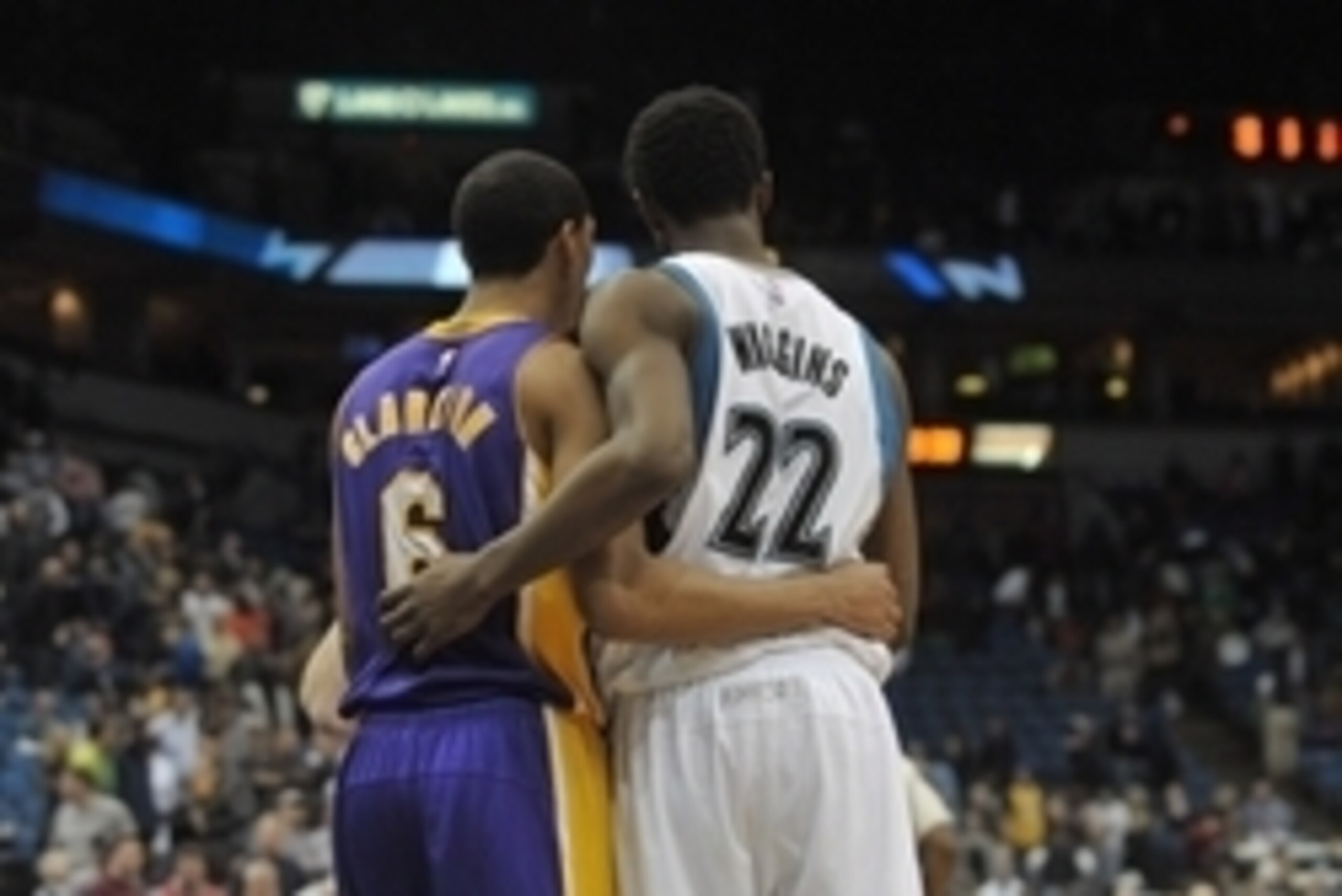
The Cleveland Cavaliers are going to take Andrew Wiggins again. And just as they did the first time, they're going to ship him off to the Minnesota Timberwolves to get their hands on Kevin Love.
Wiggins is the presumptive Rookie of the Year, especially after he elevated his scoring down the stretch of his first professional season rather than running into the wall. With the Wolves plagued by injuries, he began churning out 20- and 30-point performances, thriving as he attacked the basket with controlled aggression and spending plenty of time knocking down shots at the charity stripe.
Of course, this 20-year-old is by no means a perfect player.
Flip Saunders didn't allow him to shoot many threes, he's a lackluster passer and his rebounding needs some work. But no rookie is ever perfect, and Wiggins certainly doesn't need to be in order to remain at the top of this class.
2. Milwaukee Bucks: Jabari Parker (Previously Went No. 2)
2 of 30
Age: 20
Position: SF/PF
Per-Game Stats: 12.3 points, 5.5 rebounds, 1.7 assists, 1.2 steals, 0.2 blocks, 14.5 PER (for Milwaukee Bucks)
Previously Taken Here: Jabari Parker
Remember, Jabari Parker was the heavy favorite for Rookie of the Year before he tore his ACL halfway through a Dec. 15 game against the Phoenix Suns. It was a fluke injury, not necessarily one that should have the Milwaukee Bucks thinking about long-term concerns, and that makes this choice an easy one.
Parker is still only 20 years old, and he's a tremendously talented scorer, one who can put the ball through the twine from all parts of the half-court set. That's the exact type of production that's needed in Milwaukee, as the team is quite obviously better suited for defensive play and needs that singular go-to option.
Is it boring to have the top two picks functioning as repeats?
Sure, but it's also the correct decision.
3. Philadelphia 76ers: Joel Embiid (Previously Went No. 3)
3 of 30
Age: 21
Position: C
Per-Game Stats: N/A
Previously Taken Here: Joel Embiid
If we're going to make it two repeat choices in a row, we may as well go with three.
The Philadelphia 76ers still wouldn't have any interest in adding quality players from the present, and Joel Embiid has as much upside as anyone in this draft class. He's the best bet for their future, especially with Nerlens Noel showing improvement on his mid-range jumper and looking as if he can consistently line up at the 4 down the road.
Plus, it still seems like the organization is in love with Embiid's potential. Here are some recent comments from head coach Brett Brown, per Bob Cooney of Philly.com:
"We've watched him play one-on-one a lot and now [yesterday] he got into doing some two-on-two stuff. He's still a long way away, but it's a lot more revealing what he can do when you can start seeing him play basketball.
Physically, it's important that none of us get ahead of ourselves or expect something too quick, too soon, because that's not going to happen. But when you see glimpses of his skill package, you can't help but say, 'Wow.' Just like we saw when we saw him play at Kansas. It's a two-way player and you're just seeing hints of some of the great players and all wrapped up into somebody that hasn't played basketball in a really long time.
What I will say is when Joel got injured in the workouts [during predraft workouts] and I thought there was a chance that he could fall to us, I just get really excited. I think that his upside is what everyone else thinks it is - it's big.
"
So...yeah.
Embiid is definitely sticking at No. 3 for this rebuilding franchise.

4. Orlando Magic: Elfrid Payton (Previously Went No. 10)
4 of 30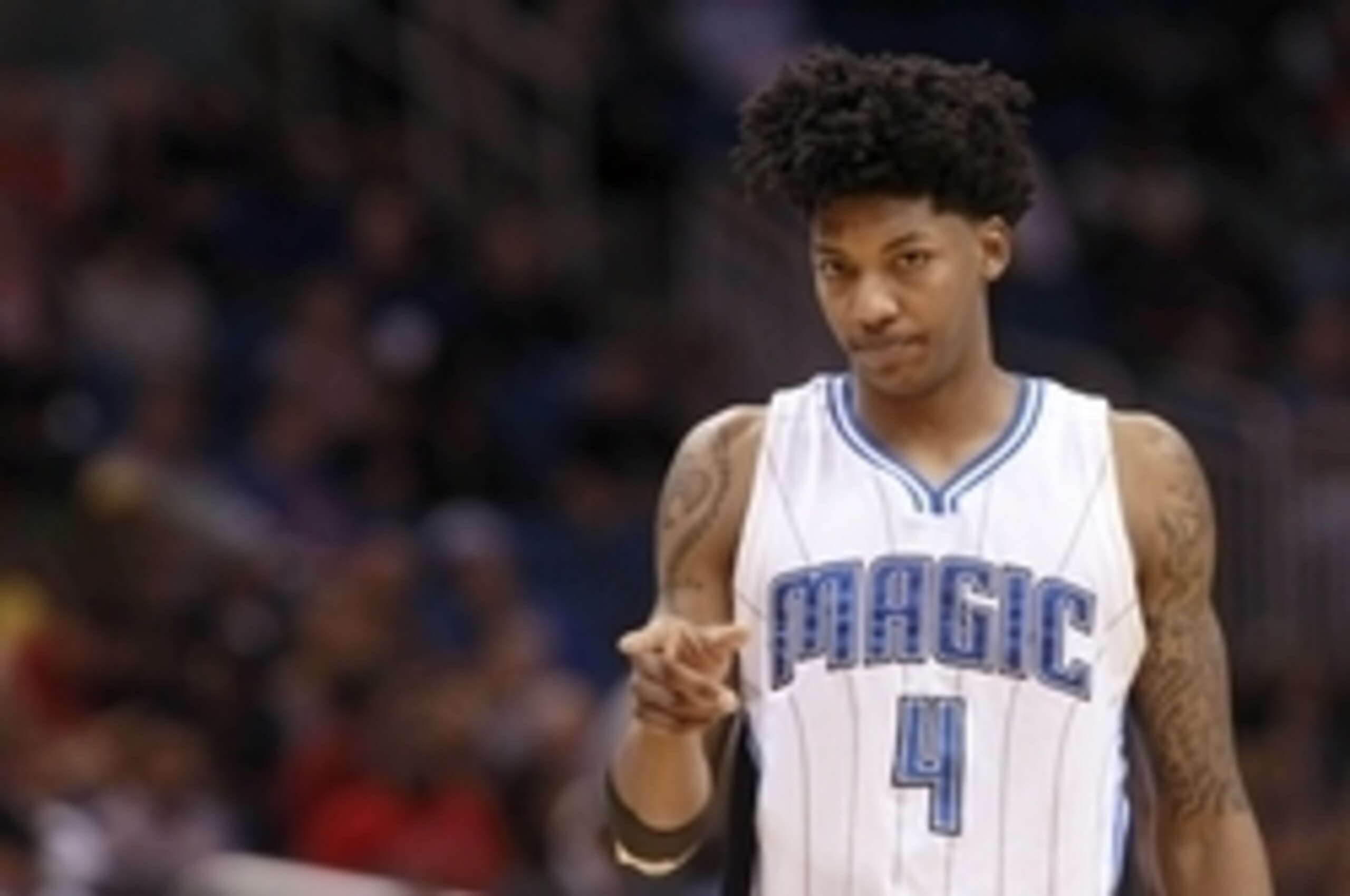
Age: 21
Position: PG
Per-Game Stats: 8.9 points, 4.3 rebounds, 6.5 assists, 1.7 steals, 0.2 blocks, 13.8 PER (for Orlando Magic)
Previously Taken Here: Aaron Gordon
Technically, this is different.
The Orlando Magic originally took Aaron Gordon with the No. 4 pick, then traded for Elfrid Payton later on in the proceedings. But now, they can't risk waiting for the floppy-haired point guard, so they're springing for him six selections earlier than he went this summer.
And why not? Payton was quite impressive during his rookie season, even if he struggled to adjust to NBA defense and was often out of position. That will come around, and his offensive arsenal was already ahead of schedule, thanks to his penchant for finding open teammates and relentlessly bursting past perimeter defenders before finishing plays around the rim.
Payton's future will ultimately be determined by his jumper's progress, but even if he never figures out how to connect from outside the paint, he's already looking like he'll be a valuable 1-guard for years to come.
5. Utah Jazz: Marcus Smart (Previously Went No. 6)
5 of 30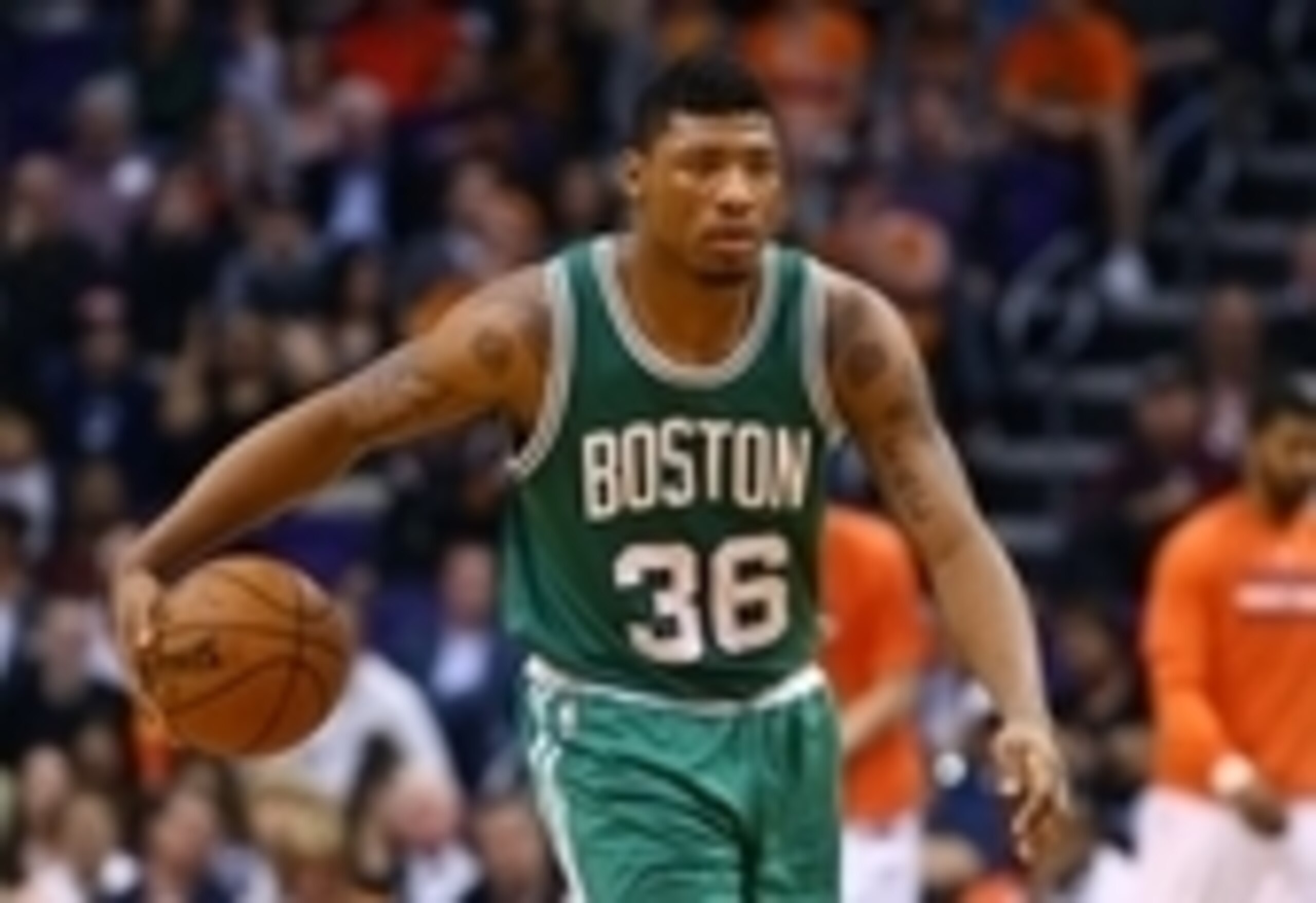
Age: 21
Position: PG
Per-Game Stats: 7.8 points, 3.3 rebounds, 3.1 assists, 1.5 steals, 0.3 blocks, 11.0 PER (for Boston Celtics)
Previously Taken Here: Dante Exum
This 21-year-old point guard enjoyed quite a strange rookie season with the Boston Celtics, but the overall product is enough for him to move slightly up the board and become the Utah Jazz's new selection.
At Oklahoma State, Smart would put his head down and use his size to his advantage, bullying his way through defenders en route to the paint. He didn't possess a particularly strong jumper, but he didn't exactly need one in order to find success.
Contrary to the widespread expectations, Smart morphed into an off-ball commodity who thrived in catch-and-shoot situations once he called Beantown home. According to NBA.com's Synergy data, the first-year guard scored 1.11 points per possession when spotting up, and that was solid enough for him to finish in the 84th percentile.
With that type of unexpected production and the rest of his tools waiting to emerge, Smart is a fairly simple choice for the Jazz, especially since they're already relying so heavily on internal improvements.
6. Boston Celtics: Julius Randle (Previously Went No. 7)
6 of 30
Age: 20
Position: PF
Per-Game Stats: 2.0 points, minus-7.5 PER (for Los Angeles Lakers)
Previously Taken Here: Marcus Smart
We don't really have much data to work with, as Julius Randle broke his leg just minutes into his NBA debut against the Houston Rockets. Of course, he looked quite promising in preseason, displaying a nice ability to attack off the bounce and dazzle with his back to the basket, but that came, well, in the preseason.
And we know how much that means. Hint: Not much.
Still, there shouldn't be any doubt that Randle is a high-upside commodity at power forward, a player who could potentially emerge as an All-Star for years to come. Much like Jabari Parker, he suffered a fluke injury, and the Boston Celtics shouldn't have any long-term concerns about his ability to bounce back.
Power forward isn't a huge need for the C's, as they already boast the services of an improving Jared Sullinger and Kelly Olynyk in the frontcourt. Plus, Brandon Bass could stick around in this organization for longer than expected.
But not a single member of that incumbent trio can touch the upside possessed by Randle, and that's too much to pass up at the No. 6 spot, especially given the disappointing nature of the rookies in this class who actually got to spend more than 14 minutes on the court.
7. Los Angeles Lakers: Zach LaVine (Previously Went No. 13)
7 of 30
Age: 20
Position: PG
Per-Game Stats: 10.1 points, 2.8 rebounds, 3.6 assists, 0.7 steals, 0.1 blocks, 11.3 PER (for Minnesota Timberwolves)
Previously Taken Here: Julius Randle
This isn't just about drafting the man who put on a show during All-Star Weekend, revitalizing the Slam Dunk Contest with arguably the best set of dunks since Vince Carter put on a legendary performance in 2000. It's about drafting a point guard with inordinate levels of upside, especially after he used the injury-riddled nature of the Minnesota Timberwolves lineup to show off down the stretch.
On March 15, LaVine moved into the starting five and responded with 18 points, six rebounds and six assists against the San Antonio Spurs. From that point through the end of the season, he averaged 18.7 points, 4.9 boards and 5.3 dimes while shooting 43.6 percent from the field, 39 percent from downtown and 85.9 percent at the free-throw line.
The highlight? Exploding for a 37-spot in a loss to the Golden State Warriors on April 11, especially since he went 13-of-21 from the field and 6-of-10 from beyond the arc.
That's the type of upside the Lakers so desperately need, even if it might be painful to pass over a draft-day gem like Jordan Clarkson in the process.
8. Sacramento Kings: Aaron Gordon (Previously Went No. 4)
8 of 30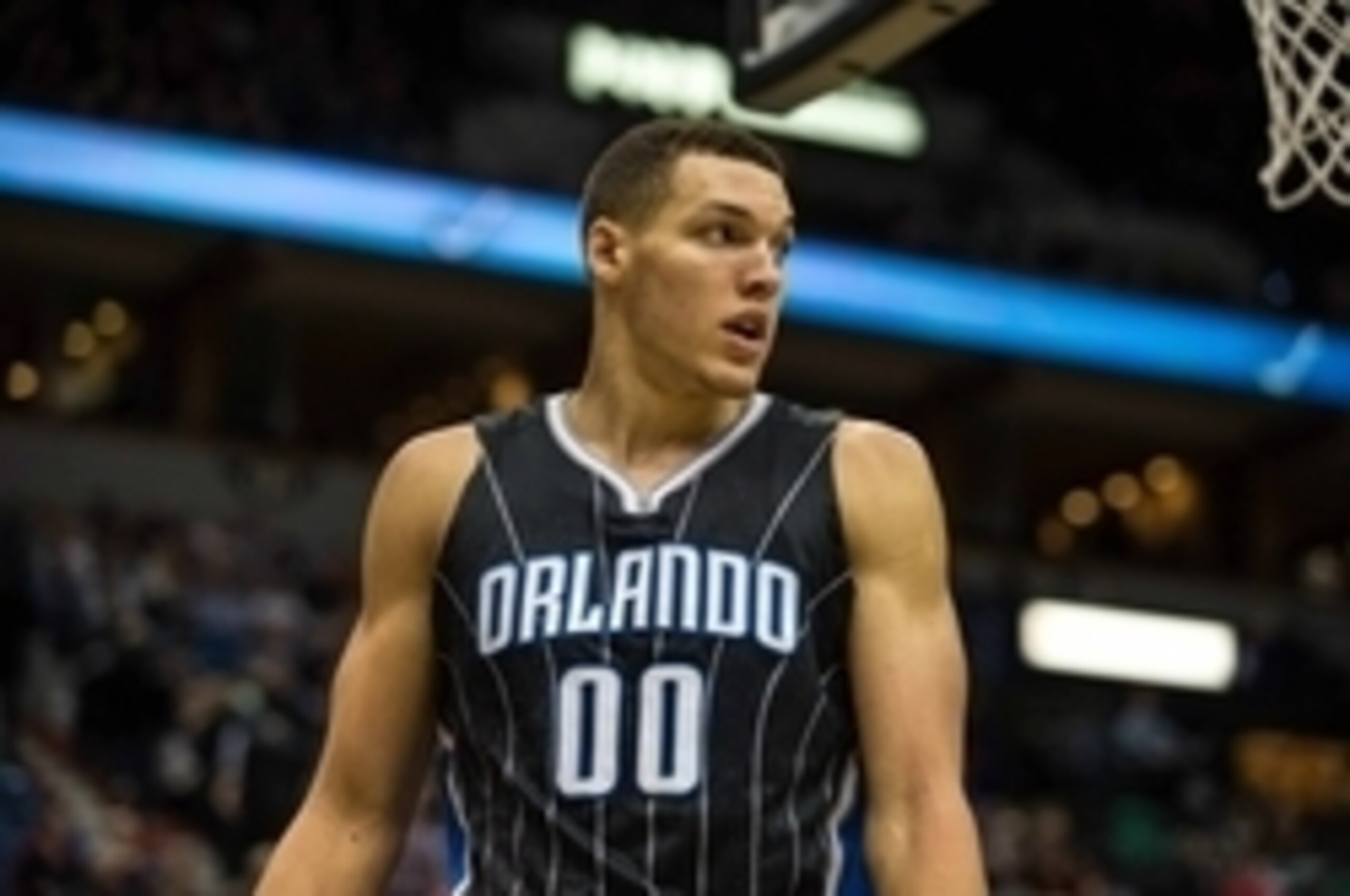
Age: 19
Position: PF
Per-Game Stats: 5.2 points, 3.6 rebounds, 0.7 assists, 0.4 steals, 0.5 blocks, 11.4 PER (for Orlando Magic)
Previously Taken Here: Nik Stauskas
Aaron Gordon, plagued by injuries for much of his first professional season, underwhelmed mightily with the Orlando Magic, but there were still signs of what made him such an intriguing commodity in the first place. He held his own on the defensive end of the floor, even if his steal and block numbers might not show it, and he displayed a nice finishing touch around the basket.
Was Gordon one of the eight best rookies in 2014-15? Absolutely not.
But he doesn't need to be here, as the combination of upside and positional need is too much for the Sacramento Kings to overlook, especially now that Ben McLemore's improvement makes picking another 2-guard fairly silly.
Per 82games.com, Sacramento's power forwards produced a player efficiency rating of just 13.3 while allowing the opposing 4s to earn a 16.6 PER. Obviously, that's not a good combination, but it should make the need for an upgrade here readily apparent.
9. Charlotte Hornets: Jordan Clarkson (Previously Went No. 46)
9 of 30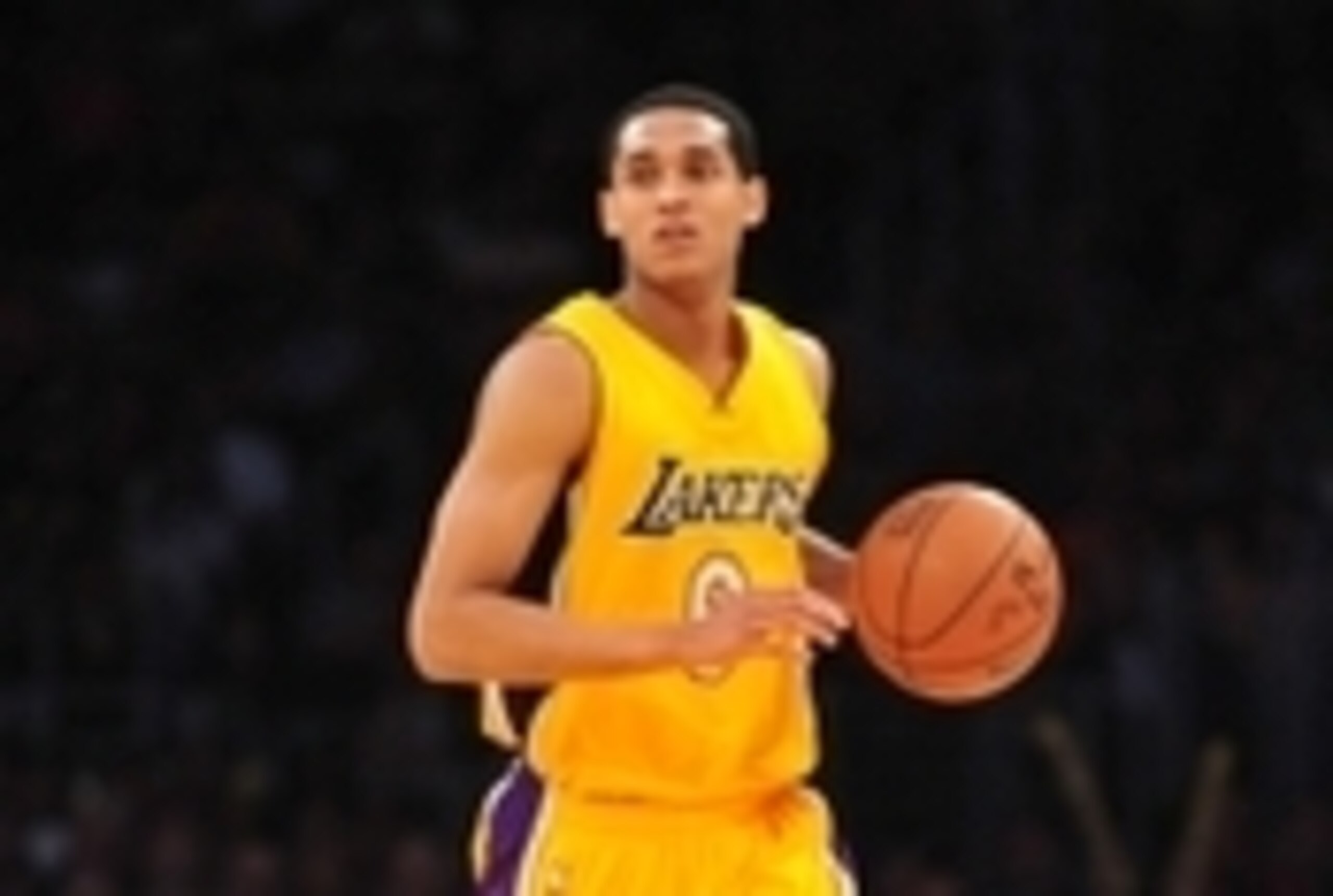
Age: 22
Position: PG
Per-Game Stats: 11.9 points, 3.2 rebounds, 3.5 assists, 0.9 steals, 0.2 blocks, 16.9 PER (for Los Angeles Lakers)
Previously Taken Here: Noah Vonleh
Talk about a massive rise.
Jordan Clarkson fell deep into the second round, but he proved himself quite substantially for the Los Angeles Lakers, thriving during the second half of the season. After moving into the starting lineup on Jan. 23, he averaged 15.8 points, 4.2 rebounds and 5.0 assists while shooting 45.8 percent from the field.
In his last 13 appearances, he was even better—20.2 points, 4.8 boards and 6.5 dimes per game.
Plus, as Mike Trudell wrote for NBA.com, "Clarkson has played some of his best basketball late in games. He twice made game-winning plays at Minnesota (an offensive rebound and two free throws) and Philadelphia (buzzer-beating layup) last week."
Now, he's going from No. 46 to No. 9, pulling an anti-Kobe Bryant by taking his talents from Los Angeles to Charlotte.
10. Philadelphia 76ers: Dante Exum (Previously Went No. 5)
10 of 30
Age: 19
Position: PG
Per-Game Stats: 4.8 points, 1.6 rebounds, 2.4 assists, 0.5 steals, 0.2 blocks, 5.7 PER (for Utah Jazz)
Previously Taken Here: Elfrid Payton
Dante Exum was not very good during his rookie season, though he showed flashes of upside throughout the year, particularly on the defensive end. He finished with minus-0.1 win shares, a 5.7 PER that's nearly a third of the league average and plenty of other advanced metrics that foretell doom and gloom when viewed in a context-free vacuum.
But that shouldn't be particularly surprising.
Exum entered the league as a teenager without much high-level experience, and he was always viewed as a high-upside project who would take a long while to realize his lofty amounts of potential. Expecting greatness right off the bat would have been foolish.
Sound like a player any team we know about could use? Sam Hinkie is drooling right now.
11. Denver Nuggets: Jusuf Nurkic (Previously Went No. 16)
11 of 30
Age: 20
Position: C
Per-Game Stats: 6.9 points, 6.2 rebounds, 0.8 assists, 0.8 steals, 1.1 blocks, 14.8 PER (for Denver Nuggets)
Previously Taken Here: Doug McDermott
The Denver Nuggets ended up with Jusuf Nurkic after completing a draft-day trade with the Chicago Bulls. Now they're going to take him for themselves right off the bat, doing so five spots earlier than he was actually selected in the real draft.
Though this 20-year-old center is quite raw on both ends of the court, you can already see superstar potential. Not only does he position himself well around the hoop on defense and throw in some nice touch shots when the ball ends up in his hands, but he has the attitude of a marquee player.
We saw that when he wasn't afraid to trash talk Marc Gasol, who's quite obviously much more established in the NBA than Nurkic was halfway through his rookie year.
On a roster that features one expendable player after another, it sure seems like Nurkic is just about untouchable. Of course Denver is going to want to bring him back outside of the top 10 in what became a pretty weak crop of first-year players.
12. Orlando Magic: K.J. McDaniels (Previously Went No. 32)
12 of 30
Age: 22
Position: SG/SF
Per-Game Stats: 7.9 points, 3.2 rebounds, 1.2 assists, 0.7 steals, 1.1 blocks, 10.6 PER (for Philadelphia 76ers and Houston Rockets)
Previously Taken Here: Dario Saric
Don't look at K.J. McDaniels' time with the Houston Rockets and treat it as gospel. He was immediately buried on the bench after a midseason trade, struggling to get much action because the team was already experiencing success and likely didn't want to jeopardize that by introducing a first-year player attempting to learn a new system.
For that matter, don't look at McDaniels' time with the Philadelphia 76ers and treat it as gospel, either. Though it's a more accurate reflection of what this 22-year-old swingman can bring to the table, he was receiving more playing time than he would in most locations.
His value lies somewhere in between, and that's still enough for him to move up from the second round to the lottery, as he was a havoc-wreaking defender who provides nontraditional production by protecting the rim quite adeptly.
The Magic have already added Elfrid Payton in this redraft, and McDaniels is yet another way for them to continue improving their point-preventing prowess.
13. Minnesota Timberwolves: Dario Saric (Previously Went No. 12)
13 of 30
Age: 21
Position: SF/PF
Per-Game Stats: N/A
Previously Taken Here: Zach LaVine
The Minnesota Timberwolves already have so much upside at every position (assuming they trade for Andrew Wiggins again), and they're clearly playing for the future.
At this point in the draft, there are two options.
Behind door No. 1, you have a mediocre prospect who's ready to compete right away during a season that's going to feature nothing but another finish near the bottom of the Western Conference standings. There's no longer anyone like Zach LaVine available at this spot in the proceedings.
However, behind door No. 2 is the top draft-and-stash commodity, a player who could very well become a star once he eventually makes his way across the pond and joins the franchise that drafted him.
It shouldn't be a tough choice.
14. Phoenix Suns: Langston Galloway (Prevoiusly Went Undrafted)
14 of 30
Age: 23
Position: PG/SG
Per-Game Stats: 11.8 points, 4.2 rebounds, 3.3 assists, 1.2 steals, 0.3 blocks, 12.3 PER (for New York Knicks)
Previously Taken Here: T.J. Warren
During his senior season at Saint Joseph's, Langston Galloway averaged 17.7 points, 4.3 rebounds, 1.6 assists, 1.1 steals and 0.5 blocks. It wasn't enough for the NBA to call out his name as one of 60 selections on draft day, and he instead became an undrafted free agent.
Then he signed a contract with the New York Knicks in September.
Then he was waived.
Then he turned a January 10-day deal into a second 10-day opportunity, which turned into a long-term contract with the Madison Square Garden residents, finally completing his deferred NBA dream instead of seeing it dry up like a raisin in the sun.
Now, he's played well enough to go in the lottery portion of this redraft, providing more depth in the Phoenix Suns backcourt that will inevitably be broken up once more. Galloway has been the trademark good player on a bad team, but he has the scoring skills necessary to be more when he's surrounded by adequate levels of offensive talent.
15. Atlanta Hawks: Doug McDermott (Previously Went No. 11)
15 of 30
Age: 23
Position: SF
Per-Game Stats: 3.0 points, 1.2 rebounds, 0.2 assists, 0.1 steals, 6.1 PER (for Chicago Bulls)
Previously Taken Here: Adreian Payne
Playing for a head coach who traditionally hates throwing first-year players out onto the court for extended stretches unless he absolutely has to, Doug McDermott didn't get an adequate chance to strut his stuff. He appeared in only 36 contests, spending just 8.9 minutes on the floor during his average outing.
But that hasn't changed what we know.
McDermott is a born scorer, as he proved time and time again at Creighton. He's not the prototypical college standout who can't get his shot off against NBA competition, either. The forward showed that during summer league and the preseason, displaying his quick release and gravitational pull on a defense.
Now, just imagine him being thrown into the Atlanta Hawks' ball-sharing system, free to learn off-ball nuances from Kyle Korver while finding himself open all the time. The Hawks were more than capable of covering up for his defensive inadequacies, and Mike Budenholzer loves himself some potent shooters.
16. Chicago Bulls: Nik Stauskas (Previously Went No. 8)
16 of 30
Age: 21
Position: SG
Per-Game Stats: 4.4 points, 1.2 rebounds, 0.9 assists, 0.3 steals, 0.2 blocks, 7.5 PER (for Sacramento Kings)
Previously Taken Here: Jusuf Nurkic
Even with Jimmy Butler breaking out and Tony Snell doing the same, albeit on a much smaller scale, the Chicago Bulls could use a bit more depth at the 2. That's where Nik Stauskas comes into play, despite his horrid rookie season for the Sacramento Kings.
At some point, potential has to matter, and we've reached that spot in the selection process.
Stauskas was a strange choice at No. 8 in the original draft, but not because of his talent and upside. After all, while he didn't show it during his rookie year, he's a great shooter with above-average athleticism and the ability to hold his own on the defensive end once he gains comfort in the NBA. It was weird simply because the Kings already rostered Ben McLemore, who was selected in the lottery only one year earlier.
Plenty of rookies still available in this redraft had better seasons. None have brighter futures if they're placed in the right situation.
17. Boston Celtics: Rodney Hood (Previously Went No. 23)
17 of 30
Age: 22
Position: SG
Per-Game Stats: 8.7 points, 2.3 rebounds, 1.7 assists, 0.6 steals, 0.2 blocks, 12.3 PER (for Utah Jazz)
Previously Taken Here: James Young
Injuries were problematic for Rodney Hood throughout his first professional season, but he flashed plenty of talent when he was healthy enough to play.
"I really just want him to keep doing what he's doing," Utah Jazz head coach Quin Snyder told KSL.com's Jon Oglesby near the end of the season. "For him, I think getting better means physically taking care of his body, getting stronger. You don't have as much of a chance to do that before your rookie season, so he's really going to have his first full summer and I think he'll be able to take advantage of that really well."
In our redraft, the Boston Celtics certainly hope he'll do exactly that, since they're a match made in heaven this deep in the first round.
Hood took 5.8 three-point attempts per 36 minutes and made 36.5 percent of his attempts from deep as a rookie—strong numbers for a first-year player making the transition from the college arc to the professional one. Meanwhile, the C's finished 14th in triples made, but hit them at a 32.7 percent clip, which was a mark that beat out only the Charlotte Hornets, Philadelphia 76ers and Denver Nuggets.
18. Phoenix Suns: Mitch McGary (Previously Went No. 21)
18 of 30
Age: 22
Position: C
Per-Game Stats: 6.3 points, 5.2 rebounds, 0.4 assists, 0.5 steals, 0.5 blocks, 16.6 PER (for Oklahoma City Thunder)
Previously Taken Here: Tyler Ennis
A fractured left foot kept Mitch McGary off the basketball court until Nov. 30, and he'd spend the next few months bouncing between the NBA and the D-League. Furthermore, that's when he wasn't dealing with a shin injury.
The big man made his Oklahoma City Thunder debut on Dec. 14, but it wasn't until February that he found a consistent home in the rotation. All the while, he showed all of the tools that made him so interesting during his up-and-down collegiate career.
There were no triple-doubles to speak of, but the same can't be said about A) 20-point outings, B) double-doubles, C) strong rejections and D) occasionally flashy passes.
McGary, already 22 years old, doesn't have as much upside as some of the players left on the board, but he seems like more of a safe bet. That's all the Phoenix Suns need to hear as they seek some depth behind Alex Len at the center position.
19. Chicago Bulls: Spencer Dinwiddie (Previously Went No. 38)
19 of 30
Age: 22
Position: PG
Per-Game Stats: 4.3 points, 1.4 rebounds, 3.1 assists, 0.6 steals, 0.2 blocks, 10.2 PER (for Detroit Pistons)
Previously Taken Here: Gary Harris
Spencer Dinwiddie was recovering from a torn ACL at the start of his rookie season, and that's usually a death knell for enjoying a sparkling first venture into the NBA. He lost out on so many chances to develop chemistry with his fellow Detroit Pistons over the offseason, and he had to work himself into ideal playing shape during the season itself.
Unsurprisingly, it wasn't until the second half of the campaign that the Colorado product rounded into form. Even then, he still struggled with his shot while receiving only sparse playing time.
Dinwiddie likely would've been a first-round pick if he were healthy while coming out of school, and it's often easy to see why. This big point guard has a smooth stroke from the outside, he can find teammates through traffic and he's going to be at least average on the defensive end of the floor.
At this point, he's the best point guard prospect on the board, and that's the position of need for the Chicago Bulls, who have less reason than ever to believe Derrick Rose can stay healthy for a substantial stretch of the season.
20. Toronto Raptors: Noah Vonleh (Previously Went No. 9)
20 of 30
Age: 19
Position: PF
Per-Game Stats: 3.3 points, 3.4 rebounds, 0.2 assists, 0.2 steals, 0.4 blocks, 13.2 PER (for Charlotte Hornets)
Previously Taken Here: Bruno Caboclo
The end of Noah Vonleh's rookie adventure saved him from falling out of the first round.
Through April 7, the former Indiana Hoosier had appeared in just 20 games, averaging seven minutes on the court during those outings. He'd done virtually nothing to remove memories of his miserable showings during summer league, as well as his lackluster performances in preseason action.
But then the injury-ravaged Charlotte Hornets started giving him more playing time. He didn't do much in his first two consecutive games receiving 20 minutes of run, but the final three were far more special. Vonleh averaged 9.7 points and 10.3 rebounds while expanding the range of his jumper, reminding everyone of the inside-outside combination that initially made him so intriguing.
It's that upside that makes him appealing to the Toronto Raptors here, even if their frontcourt depth is already solid.
21. Oklahoma City Thunder: James Young (Previously Went No. 17)
21 of 30
Age: 19
Position: SG/SF
Per-Game Stats: 3.4 points, 1.4 rebounds, 0.4 assists, 0.3 steals, 0.1 blocks, 8.5 PER (for Boston Celtics)
Previously Taken Here: Mitch McGary
"It was definitely a lot of ups and downs, injuries and stuff like that, but hopefully I can take two weeks off and then get myself ready for summer league," James Young told Gary Washburn of The Boston Globe after his first NBA regular season drew to a conclusion. "It's definitely not what I thought it was going to be but it was my rookie season. You just move on and try to get better."
Injuries and stints with the D-League's Maine Red Claws kept Young from enjoying any sort of rhythm for the Boston Celtics, but he still has a tantalizing two-way package that would look rather nice providing sorely needed depth for the Oklahoma City Thunder.
His shot didn't fall often in Boston, but he at least has a promising stroke and displayed some shooting upside back at Kentucky. He also has plenty of athletic tools, ones that will help him thrive both as a cutter and—later on—as a defender.
22. Memphis Grizzlies: Tarik Black (Previously Went Undrafted)
22 of 30
Age: 23
Position: PF/C
Per-Game Stats: 6.0 points, 5.8 rebounds, 0.7 assists, 0.3 steals, 0.4 blocks, 14.7 PER (for Houston Rockets and Los Angeles Lakers)
Previously Taken Here: Jordan Adams
Make it two undrafted players who are moving into the first round of our redraft.
Tarik Black was completely overlooked after his final season of college basketball, and that was perfectly understandable. Though he displayed plenty of potential while at Memphis, he was a no-show after transferring to Kansas for his senior campaign, averaging only 5.5 points and 3.9 rebounds.
His energy and defensive intensity got him a look with the Houston Rockets early in the season, and the Los Angeles Lakers picked him up after he was waived in December. While wearing purple and gold, Black averaged 7.2 points and 6.3 boards while throwing up a 16.3 PER, thereby all but guaranteeing that he'll receive minutes down the road as well.
Best of all? His attitude, and that's what makes him particularly intriguing to a Memphis Grizzlies organization that will never say no to a tough, gritty big man who fits the defensive mentality.
"Every article was the same—'Tarik Black is a keeper, a surprise because nobody drafted him,'" the undrafted rookie told the Los Angeles Times' Mike Bresnahan, explaining why he refuses to take his future for granted. "Then a situation popped up where a star free agent [Josh Smith] came up and I ended up getting waived. It's why I tend not to think about tomorrow."
Thinking about only today is working out rather nicely for him.
23. Utah Jazz: Jerami Grant (Previously Went No. 39)
23 of 30
Age: 21
Position: SF
Per-Game Stats: 6.3 points, 3.0 rebounds, 1.2 assists, 0.6 steals, 1.0 blocks, 8.7 PER (for Philadelphia 76ers)
Previously Taken Here: Rodney Hood
What exactly do the Utah Jazz need at this point?
We know now that Rudy Gobert and Derrick Favors are entrenched as the starters at power forward and center. Gordon Hayward is obviously a huge part of the future at small forward, even if it's no longer a guarantee that he'll serve as the team's best player. Alec Burks will be back eventually, and this redraft has already allowed Marcus Smart and Trey Burke to form a rotation at point guard.
Depth is key, and it can come at virtually any position, though the wings are the shallowest part of the squad in this hypothetical situation. That's where Jerami Grant comes in, as his size and athleticism will allow him to fit in rather nicely with the defensive mentality in Salt Lake City.
24. Charlotte Hornets: Clint Capela (Previously Went No. 25)
24 of 30
Age: 20
Position: C
Per-Game Stats: 2.7 points, 3.0 rebounds, 0.2 assists, 0.1 steals, 0.8 blocks, 12.1 PER (for Houston Rockets)
Previously Taken Here: Shabazz Napier
Clint Capela didn't receive too much NBA playing time during his rookie season, suiting up in only a dozen games and playing a total of 90 minutes. For perspective, Andrew Wiggins surpasses that total even if we only look at his back-to-back contests against the Utah Jazz and Los Angeles Lakes in late March.
But when this 20-year-old center wasn't helping out the Houston Rockets, he was thriving in the D-League. in 38 appearances. There he averaged a rock-solid 16.0 points, 9.7 rebounds, 0.8 assists, 0.8 steals and 3.0 blocks, displaying all the tools that made him such a high-upside commodity on the original draft day.
If the Charlotte Hornets are ready to move on from Bismack Biyombo, who has made virtually no offensive progress since entering the league four years ago, they could replace his defensive upside and add a stronger offensive package right away.
25. Houston Rockets: Tyler Ennis (Previously Went No. 18)
25 of 30
Age: 20
Position: PG
Per-Game Stats: 3.7 points, 1.1 rebounds, 2.2 assists, 0.5 steals, 0.2 blocks, 7.3 PER (for Phoenix Suns and Milwaukee Bucks)
Previously Taken Here: Clint Capela
The pickings are slim at point guard, but that's what the Houston Rockets need. Maybe Patrick Beverley stays healthier during our hypothetical season, and even still, some depth at the smallest spot in the lineup would be a rather nice luxury.
At this point in the proceedings, the Rockets have to make a choice between Tyler Ennis and Shabazz Napier, neither of whom enjoyed a particularly strong rookie season with the Phoenix Suns/Milwaukee Bucks and Miami Heat, respectively.
Ennis is the right call, if only because his well-rounded strengths and youth give him more upside.
26. Miami Heat: Jarnell Stokes (Previously Went No. 35)
26 of 30
Age: 21
Position: PF
Per-Game Stats: 3.0 points, 1.8 rebounds, 0.2 assists, 0.3 steals, 0.3 blocks, 18.6 PER (for Memphis Grizzlies)
Previously Taken Here: P.J. Hairston
The Miami Heat couldn't possibly have known that Josh McRoberts would be lost for the season with a torn meniscus, or that Chris Bosh would be hospitalized with blood clots in his lungs. But even with those two veteran bigs healthy, this was a team with a rather shallow frontcourt.
Enter Jarnell Stokes, a gritty, tough-nosed big man who was actually a perfect fit with the similarly minded team that originally drafted him in the second round. Admittedly, that fit—as well as the following numbers—came in very limited action.
Not only was Stokes quite efficient during his first professional season, but he was also a strong offensive rebounder, which would certainly help shore up a South Beach weakness. Though a larger sample size might have changed this, the 21-year-old posted an offensive rebounding percentage of 14.6.
The only rookies to top that this season were Jerrelle Benimon (38.7 percent in three total minutes), David Wear (33.6 in seven) and Furkan Aldemir (14.9 in 540). In fact, during the last decade, just 15 first-year players have posted a higher mark while spending more than 120 minutes on the floor.
27. Phoenix Suns: Gary Harris (Previously Went No. 19)
27 of 30
Age: 20
Position: SG
Per-Game Stats: 3.4 points, 1.2 rebounds, 0.5 assists, 0.7 steals, 0.1 blocks, 4.9 PER (for Denver Nuggets)
Previously Taken Here: Bogdan Bogdanovic
Gary Harris was admittedly terrible during his rookie season.
No player drafted this summer earned fewer win shares than his minus-0.7 for the Denver Nuggets. Only Julius Randle, Bruno Caboclo, Russ Smith, Johnny O'Bryant and Cameron Bairstow lost them at a quicker rate. You could triple his PER and still come up short of the league-wide average (15).
It was just ugly, even with some occasional highlights—the monstrous dunk his mother missed and four double-digit scoring outputs—working in his favor.
That's not going to dissuade the Phoenix Suns from taking him here. They can afford to gamble on a player with so much two-way upside that he was originally taken in the teens, especially since that was already lower than expected.
After all, the Suns already have talent across the board, and that's even more true since they've added Langston Galloway (No. 14) and Mitch McGary (No. 18) in this redraft.
28. Los Angeles Clippers: Shabazz Napier (Previously Went No. 24)
28 of 30
Age: 23
Position: PG
Per-Game Stats: 5.1 points, 2.2 rebounds, 2.5 assists, 0.8 steals, 0.1 blocks, 9.3 PER (for Miami Heat)
Previously Taken Here: C.J. Wilcox
The Los Angeles Clippers desperately need more depth at point guard.
Jordan Farmar couldn't get the job done as Chris Paul's backup and was waived in January. His replacement, Austin Rivers, was so bad that my FATS projections (based on historical similarities and explained in full here) have LAC becoming 21.7 wins worse with him on the floor, dropping from a 59.4-victory squad to a sub-.500 entity. For that matter, the Clippers also declined by eight wins when Jamal Crawford played, thanks to some horrific defense.
Someone capable of handling a ball and not getting in the way was sorely needed, and Shabazz Napier can fill that role.
Maybe.
His work for the Miami Heat didn't inspire much confidence, but no remaining point guard offers up a better pedigree.
29. Oklahoma City Thunder: T.J. Warren (Previously Went No. 14)
29 of 30
Age: 21
Position: SF/PF
Per-Game Stats: 6.1 points, 2.1 rebounds, 0.6 assists, 0.5 steals, 0.2 blocks, 14.0 PER (for Phoenix Suns)
Previously Taken Here: Josh Huestis
We're adding even more depth to the Oklahoma City Thunder, this time in the form of a player who can score from just about any situation within the three-point arc.
Expanding his range to include some triples would do wonders for T.J. Warren's development and overall offensive ability, but he's already crafty enough to get by. He thrived during offseason play, and though he couldn't live up to those expectations for the Phoenix Suns, that was largely because of his horrid defense.
After all, he averaged 6.1 points on 52.8 percent shooting from the field.
There's no one else left with nearly this much offensive upside, and OKC could use another weapon in case everyone gets hurt again.
30. San Antonio Spurs: Bryce Cotton (Previously Went Undrafted)
30 of 30
Age: 22
Position: PG
Per-Game Stats: 5.3 points, 1.2 rebounds, 1.0 assists, 0.3 steals, 14.5 PER (for Utah Jazz)
Previously Taken Here: Kyle Anderson
Do the San Antonio Spurs actually need anyone?
They rarely used Kyle Anderson during his rookie season, and there's a significant amount of talent at virtually every position. The defending champions and current No. 6 seed in the Western Conference can afford to take a flier.
You know, kind of like the flier Bryce Cotton took before he completed this sensational one-handed alley-oop flush against the Dallas Mavericks. The Providence product took advantage of his opportunity with the Utah Jazz and proved that he belongs in this league, to the point that he's the last pick of this first round instead of someone like Bruno Caboclo, Jordan Adams, P.J. Hairston and so many other reasonable choices.
Interestingly enough, Cotton was actually picked up by the Spurs over the summer on a multiyear deal, but he was waived before playing a single game for the organization. Now that they're more confident he belongs and has done some developing outside the Lone Star State, it'll be easier to take that second chance.
Note: All stats, unless otherwise indicated, come from Basketball-Reference.com.

.jpg?w=2560 "Mahomes Told Teammate to Leave Meeting")
.jpg?w=2560 "5 Teams Eyeing Jonathan Taylor")



.jpg?w=2560 "NFL investigating Eagles")
.jpg?w=2560 "Jonathan Taylor Landing Spots 📍")