

Re-Thinking 'Star' Labels for Some of the NBA's Biggest Names
Superstar labels are tossed around too often in the NBA.
We're here to take a few of them back.
Some of these players have already seen their star designations start slipping away. For them, this label purge comes not as a surprise but as an official reminder or ruling of how far they've fallen.
Those giving back their star licenses for good must have at least one All-Star selection to their names. They must also have been somewhat recently linked to such status. Players like Kevin Garnett and Paul Pierce are years removed from being held to superstar standards, so they are not here.
Judgment is solely based on performance and expectations. These players are here because their reputations now belie their current statuses for whatever reason—age, injuries, surprise regression or just the fact that they are overrated.
We'll present our fallen luminaries in order of descending age, and they hail from all walks of NBA careerdom. For now, though, they all have at least one thing in common: We're revoking their star cards.
Kobe Bryant, Los Angeles Lakers
1 of 6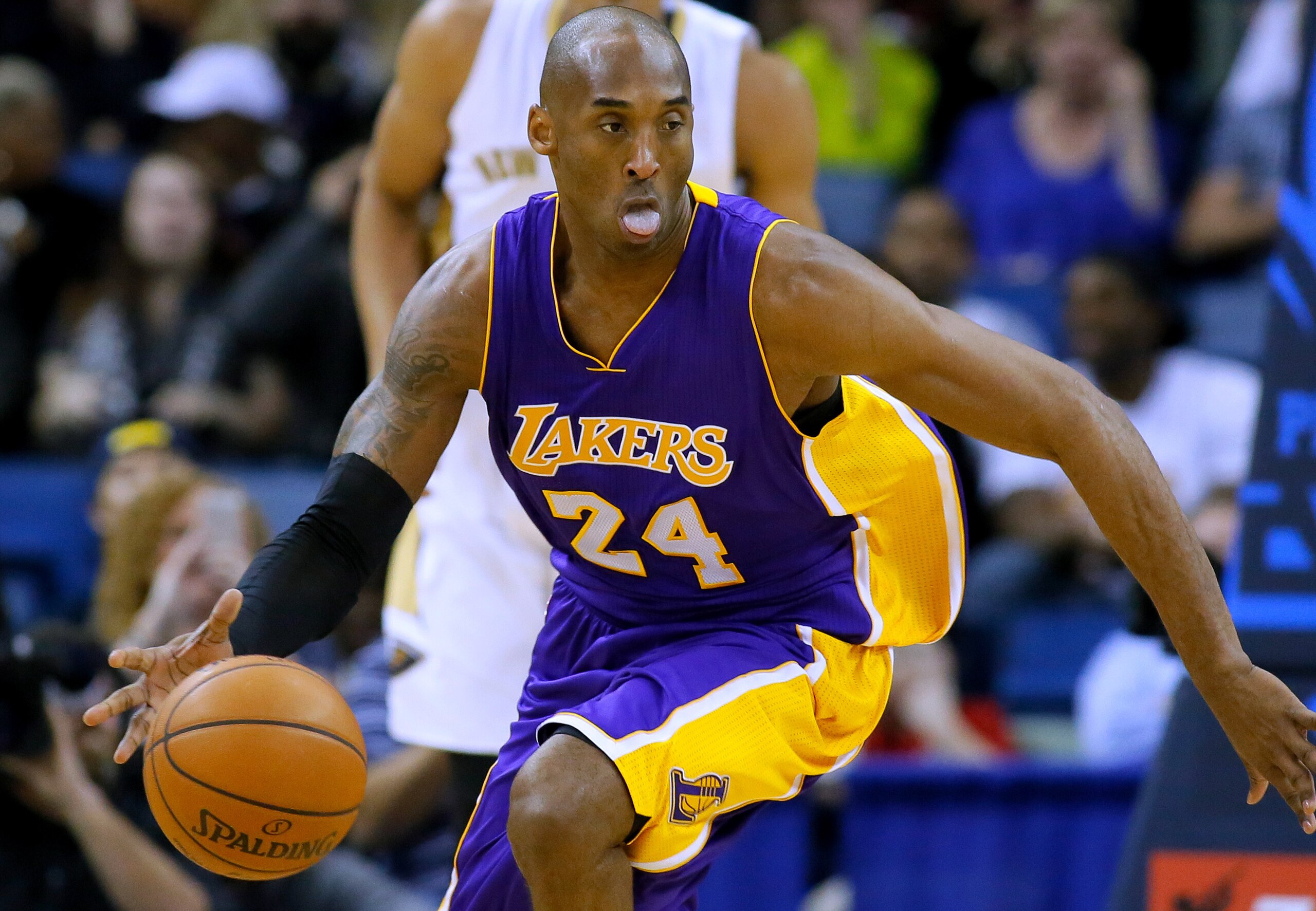
Kobe Bryant is human.
Hope to the contrary is ebbing into the great abyss, and those still stubbornly clinging to it will receive their agonizing awakenings soon enough: The days of Bryant being a star, of defying time and mortal limits, are over.
This isn't solely about the 36-year-old's lack of availability over the past two seasons. Sure, that's part of it. By season's end, he'll have missed 123 contests since 2013-14, which is 16 more than he missed through his first 17 campaigns combined (107). But this has more to do with his performance since suffering a ruptured Achilles tendon in 2013.
Thirty-five games' worth of Bryant this season is nothing if not proof that he'll never return to his 2012-13 form. Though he's now the second-oldest player—behind only at 38-year-old Michael Jordan—to average at least 20 points, five rebounds and five assists per game, he has done so for an irrelevant Lakers team and with unsightly efficiency.
It's been 50 years since someone (Elgin Baylor) last cleared 22 points per game while notching an effective field-goal percentage—cumulative measurement of two- and three-point accuracy—as low as Bryant's 41.1. His marks now are even worse when accounting for the difference in eras.
The average effective field-goal percentage was 42.6 during the 1964-65 season. Bryant's rate would be just a hair below the norm five decades ago. Shooting percentages were lower then, and the absence of a three-point line impacted the metric in question. But this season's average is 49.5 percent.
You do the math.
Put simply, Bryant has devolved into a dinosaur—not in spirit, work ethic or resume, but in health, numbers and—most importantly—play style. He hasn't played since Jan. 21, but as of Wednesday he had still attempted two more mid-range jumpers (311) this season than LeBron James (309) and 68 more than modern-day shooting guard James Harden (243).
Painful though it is to admit, Bryant is not built for a league in which teams run, pass the ball and space the floor. He is now that moth-eaten, hero-ball-embracing, mid-range chucker trying to exist and excel in an NBA that is no longer for players like him.
Joe Johnson, Brooklyn Nets
2 of 6
Joe Johnson's fall from stardom is still in progress and more graceful than most, but he's slipping nonetheless. His point totals have fluctuated since joining the Brooklyn Nets, and now his efficiency is following suit.
Of the 70 players who have logged at least 2,000 minutes this season, Johnson ranks 58th in player efficiency rating. Fifty-eighth.
A lot of this is beyond his control. Johnson is 33, doesn't move like he used to and hasn't played within an offense as uninventive as Brooklyn's since he called Mike Woodson his head coach.
Still, he earned an All-Star selection only last season, somewhat validating his ridiculous salary. Now he seems more overpaid than ever with his scoring and shooting numbers down.
Despite leading the Nets in total minutes, he ranks third in win shares, trailing Brook Lopez and Mason Plumlee by a wide margin. Yes, Brooklyn is paying him nearly $23.2 million to represent fewer wins than a sophomore who has played 830 minutes fewer and is earning roughly one-seventeenth of what he's bringing home.
Look, pretty much everyone knew Johnson's six-year, $119 million contract would end up being a horrible buy from the moment he signed it in 2010 with the Hawks. But because of his isolation-heavy, spot-up-friendly scoring style, remaining productive well into his 30s was always in play.
To an extent, that's what he has done. It's what he's doing.
Almost 15 points per game is nothing to scoff at from a player who ranks sixth in usage rate on his own team. It's just that he's officially—and undeniably—on the decline, with no star label to speak of.
Deron Williams, Brooklyn Nets
3 of 6
If it seems like the Nets are brimming with non-stars being paid like actual stars, that's because they are.
An appearance here is actually a compliment for the 30-year-old Deron Williams. It implies that he could, even by the most flimsy of arguments, be mentioned in the same breath as other stars.
Really, he can't. Not anymore. The last two seasons have made that perfectly clear.
Although his statistical demise started immediately upon being traded to the then-New Jersey Nets in 2011, the first eight years of his career, while riddled with injuries at times, can be considered successful—star level, even.
Especially when one compares them against his most recent two:
| 17.8 | 45.3 | 50.3 | 9.0 | 42.0 | 3.2 | 1.1 | 19.3 | .143 | |
| 13.6 | 41.8 | 48.0 | 6.2 | 32.8 | 2.9 | 1.2 | 16.5 | .102 |
Williams was battling Chris Paul for the rights to the NBA's best point guard crown not too long ago. Even now, on the wrong side of 30, he should still be in the prime of his career, adding to his three All-Star selections, staking his claim as a foremost authority at the league's deepest position.
Instead, he's overpaid and over the hill, playing on paper ankles, wasting away on a lottery-bound Nets squad the Williams of old could have saved.


Rajon Rondo, Dallas Mavericks
4 of 6
Rajon Rondo wants a max contract, as he told ESPN.com's Baxter Holmes. This is to say the 29-year-old wants a miracle.
Four years ago, when he was healthy and playing like the league's best point guard, Rondo would have a case. Right now, there are only cases to the contrary.
Crafty as ever, he still has no offensive range. He cannot score off the catch and has yet to shoot even 32 percent from behind the rainbow for an entire season.
There has been talk of him improving his jumper for years now, but it's never translated into on-court success. He has shot better than 40 percent between three and 10 feet once, between 10 and 16 feet twice and between 16 feet and the three-point line five times.
That's about as uneven as it gets.
Complicated still, his free-throw percentage has plunged to new depths of awfulness. He's putting in just 35.3 percent of his freebies on the season. That ranks as the worst single-campaign charity-stripe rate of any guard in league history to attempt at least 35 free throws.
“I don’t have a clue, really—still trying to figure it out,” he said in February of his foul-line struggles, per The New York Times' Benjamin Hoffman. “I continue to work on my game, and especially get some more free throws up.”
Slumps are occupational perils in the NBA. But Rondo isn't in a slump.
With the exception of his 22-game showing on the Boston Celtics this season, he hasn't been an offensive plus since the 2011-12 crusade. While that's incriminating for any player who fancies himself a superstar, it's doubly damning for a point guard, whose main job consists of, you know, making the offense better.
This is a years-long rut Rondo is attempting to claw his way back from. And until he succeeds, he'll be a star only by reputation.
Derrick Rose, Chicago Bulls
5 of 6
We have to go here.
Derrick Rose expects to return this season after having arthroscopic surgery on his right knee, per the Chicago Tribune's K.C. Johnson, but the damage to his game, to his status, is already done. He has appeared in just 95 tilts since winning MVP honors in 2010-11. And with three major injuries to his name since, he is a cautionary tale for explosive talent.
At only 26, he has time to recapture former glory. But he's devoted a majority of his would-be prime to rehabilitation and, more harrowingly, reinvention.
Rose isn't the same player anymore. Not only do his 18.4 points and 5.0 assists per game on 40.7 percent shooting hardly stand out, but his play style also barely resembles that of the megastar from years past. Gone are the volume forays into the paint; he ranks outside the top 30 in drives per game, per NBA.com.
Jumpers have replaced those attacks. More than 58 percent of Rose's shot attempts are coming outside of 10 feet away. Of those jumpers, he's hitting just 31.2 percent. And while he's never taken a larger portion of his shots from downtown, he's shooting just 28.7 percent from deep, a mark that falls below his already unflattering career average of 30.6 percent.
To top it all off, Rose isn't even the Chicago Bulls' most important player anymore. The role of franchise cornerstone now belongs to Jimmy Butler because, well, the Bulls have no other choice. As Bleacher Report's Zach Buckley previously wrote:
"Rose's injury, in a lot of ways, should signal the end of one Bulls era and the beginning of another. With $41.4 million headed his way over the next two seasons, he'll still play a role in Chicago's next chapter.
But no player on this roster is more important to the franchise's present and future than Butler.
"
Optimism can still prevail. Rose isn't a lost cause and could return to form one day. But given all that's happened, and looking at the player he is now, it's only fair that the equally, if not more, viable alternative be considered—that which acknowledges Rose may never be a superstar again.
DeMar DeRozan, Toronto Raptors
6 of 6
DeMar DeRozan is Kobe Bryant's spirit animal—a shooting guard with an archaic shot selection and no three-point range who relies on mid-range jumpers and foul-line excursions to generate points.
Few players reach the charity stripe as well as the 25-year-old does. The Raptors guard has a knack for drawing contact as he drives to the rim, often stopping on a dime to attempt a pull-up jumper. Not surprisingly, he ranks sixth in free-throw attempts per game on the season.
Most of his shots come from between 10 feet away and just inside the arc—more than 58 percent of them, in fact. That would be fine if he were drilling them with especially high frequency, but he's not. He's finding nylon just 35.5 percent of the time on those bad boys.
Couple that with his complete lack of three-point marksmanship (26.7 percent for his career), and a disturbing trend emerges.
Since he entered the league in 2009, 59 players, including DeRozan, are averaging at least 15 points per game. Of those 59, DeRozan has the third-worst effective field-goal percentage. For context, his 45.2 percent clip pales in comparison to James Harden—who is frequently viewed as an inefficient gunner himself—and his 51.9 percent mark.
Nabbing an All-Star selection last season did wonders for DeRozan's reputation. That he's the focal point of the league's fourth-most-efficient offense only further bolsters his resume. To call him a star, though, is disingenuous to the term.
Toronto's offense is statistically worse with DeRozan on the floor, he's the second-most important player (Kyle Lowry) on a good-not-great playoff outfit and his brand of basketball is ripped straight from the distant, powerless past. And though he he's been able to produce, that doesn't make him a star.
It makes him a good-not-great player.
Stats courtesy of Basketball-Reference.com and NBA.com and are accurate heading into games on March 28.

.jpg?w=2560 "Love's Body Already 'Tired'")

.jpg?w=2560 "Tyreek Deal May Come Soon")
.jpg?w=2560 "Ward Nearly Walks Out of Presser ▶️")

.jpg?w=2560 "NFL investigating 2 referees for separate viral exchanges")
