
Five 2014 Stats the New England Patriots Must Improve Upon in 2015
By most accounts, the New England Patriots have regressed from the team that last took the field in Glendale, Arizona, on Feb. 1. The Patriots' decline has probably been overstated, but depending on how the draft plays out, New England may need to retool its fundamental weekly approach, particularly on defense.
In thinking about how the 2015 Patriots might be different from their Super Bowl-winning predecessors, examining stats is one way to go about things. We've dissected New England's personnel and potential schematic alterations ad nauseam (and will continue to do so), but how will these changes actually manifest in terms of numbers?
What the Pats lost with Darrelle Revis and Brandon Browner won't be replaced, so it's likely a better approach to hone in on New England's weaknesses from last season and attempt to rectify those. Bill Belichick has seemingly adopted this mentality, strengthening areas like edge-rusher and tight end to reformulate how the Patriots will attack opponents next season, rather than plugging in inferior replacements to play the same brand.
Using both conventional and advanced metrics, let's take a look at a few areas where the 2014 Patriots struggled and identify how well-equipped they are (or could be, following the draft) to patch these issues in 2015.
Minus-0.6 Points Added from Punting Game
1 of 5
New England has traditionally boasted one of the league's best special teams units, which is hardly a surprise considering Belichick's background in the third phase. But the punting game has been a blind spot for the Pats in recent years, and in 2014, the unit was actually a slight net-negative based on Football Outsiders' measurements.
By no means was the unit disastrous, as that number placed the Patriots 19th in the league. However, Ryan Allen, whose season started inauspiciously when Miami blocked his first kick, didn't really appear to improve his directional punting much. Allen landed 38 percent of his punts inside the 20, the exact same mark from his rookie campaign. Moreover, of his 12 punts in plus territory in 2014, three went for touchbacks; conversely, in 2013, just two of Allen's 13 plus-territory punts bounced into the end zone.
Under a cost-controlled rookie contract, Allen's spot is likely safe on the roster. The Pats are fortunate to have an All-Pro gunner in Matthew Slater, as Allen is also roughly league average in terms of forcing fair catches (15 out of 66 in 2014). This isn't necessarily the most pressing spot on New England's roster, but if Allen doesn't take a step forward in 2015, expect Belichick to bring in more competition down the road.
Rushing 1st Down Rate: 27.27 Percent
2 of 5This stat probably sounds a bit confusing, so to clarify, it means that 27.27 percent of Patriots rushing attempts last year resulted in first downs. That mark ranked 22nd in the league, placing an immense amount of pressure on Tom Brady and the receiving corps to bail the offense out of unfavorable down-and-distance situations.
For now, the Patriots running back corps is a consistent but relatively uninspiring combination of plodders and callow youngsters. The Belichick-era Patriots have never employed a true three-down back, preferring to divvy up the workload between pure passing backs and sturdy between-the-tackles runners. But while the likes of Kevin Faulk and Shane Vereen have thrived on third downs, the Pats haven't enjoyed a true early-down asset since Corey Dillon.
The current solution probably doesn't exist on the roster. LeGarrette Blount has been a nice program fit the past two years but is likely more of a placeholder, while Jonas Gray and Tyler Gaffney have no meaningful track record for us to evaluate. Stevan Ridley may still return after exploring free agency, though that scenario doesn't appear particularly likely at the moment.
Fortunately, this year's draft class is particularly deep with scheme-versatile backs. The Pats are a hybrid run team that uses both power- and zone-blocking concepts, though the latter tends to vary based on no-huddle usage. New England may not be able to afford spending a premium pick on a back like Tevin Coleman, Ameer Abdullah or Jay Ajayi, but given their strength in the passing game, jump-starting the running game could make the Patriots the league's most well-rounded offense.
38.4 Percent Opponent 3rd-Down Conversion Rate
3 of 5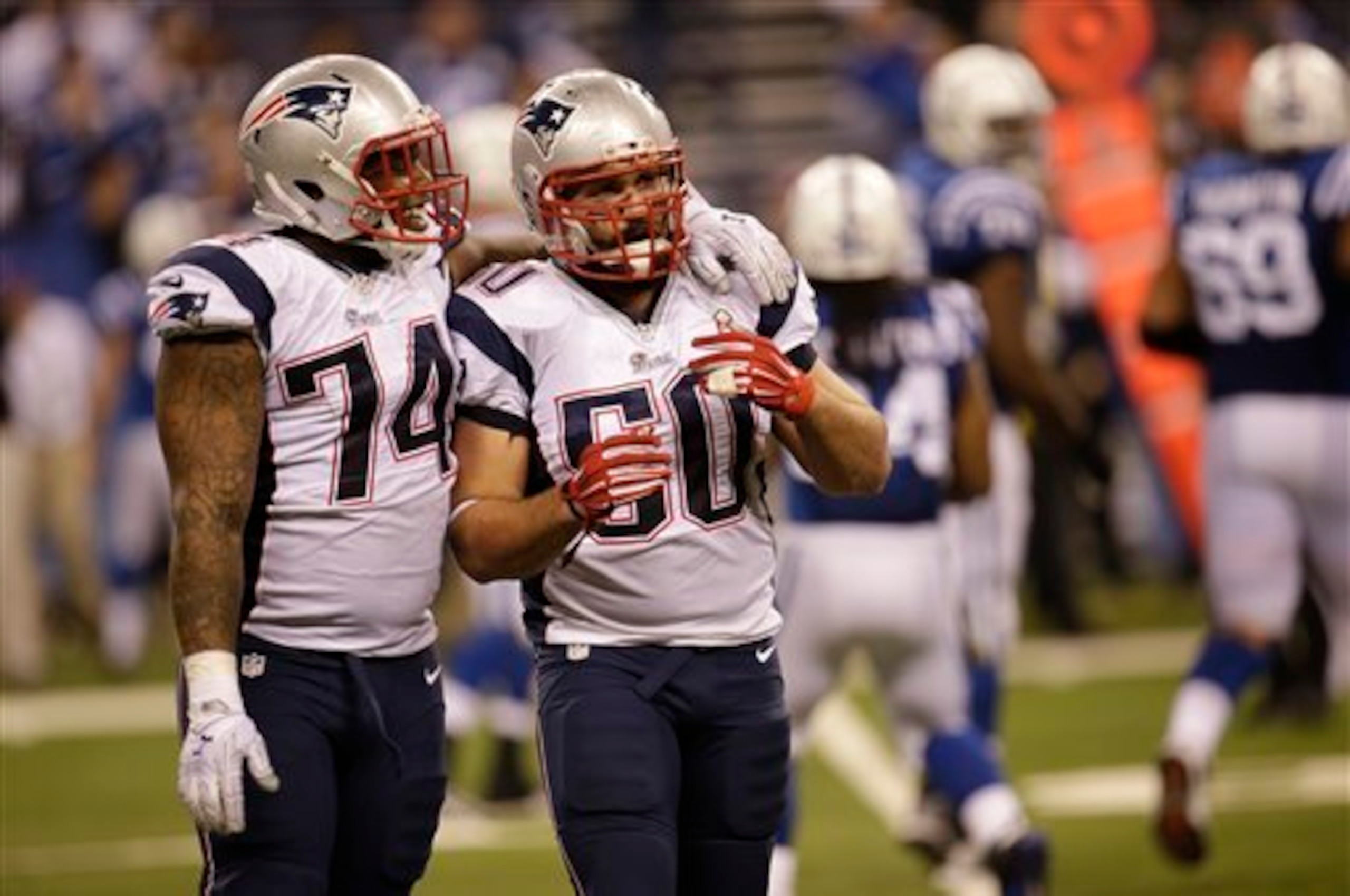
Third-down defense has been a sore spot in Foxborough for years, as the Patriots' 2014 success rate actually represented a huge leap from recent woeful performances in this category. New England still only ranked 14th in the league, though, so there's undeniably room for improvement here.
According to Pro-Football-Reference, the Patriots were excellent on 3rd-and-long (10 or more yards), allowing opponents to convert a meager 15.6 percent of such situations. But New England's issues came on 3rd-and-short (one to four yards), as their 62.2 percent concession rate ranked ninth-worst in the league.
Much of that stemmed from poor short-yardage run defense, something we'll touch on shortly. However, the Patriots' sub-package defense will be back in the spotlight, as New England's ability to force teams off the field on clear passing downs last year was the biggest change from previous leaky renditions. Before last season, New England had not fielded a third-down defense that finished in the top half of the league since 2007.
Clearly, losing Revis and Browner won't help sustain the Patriots' improvement. But investing resources in the pass rush could neutralize much of the drop-off in the secondary, a truth that figures to influence how the Pats will construct their defense the rest of this offseason.
New England now has a viable edge-rushing rotation in the trio of Chandler Jones, Rob Ninkovich and Jabaal Sheard, but this area is where first-rounder Dominique Easley will need to shine. If Easley can stay healthy and emerge as a consistent 3-technique, that kind of sophomore-year leap would represent a crucial development which could keep the defense afloat.

.jpg?w=2560 "Commanders Eagles Football")
.jpg?w=2560 "Texans-Mixon Released Football")
Short-Yardage Run Defense: 32nd in DVOA
4 of 5
New England's most glaring statistical weakness was never tested on the biggest play of its season, a fact that infuriated many analysts. Although the Seattle Seahawks bailed them out at the end of Super Bowl XLIX, the Pats nevertheless compiled the worst success rate in "power running" situations, which Football Outsiders defines as third or fourth down with two yards or less to go.
Vince Wilfork's departure would only seemingly exacerbate this issue, but that assumption isn't entirely true. Sealver Siliga has emerged as a capable nose tackle over the past two seasons, providing a layer of insurance for the post-Wilfork era. According to PFF, Siliga ranked second among defensive tackles in run-stop percentage last year, behind only Damon Harrison.
Still, depth is an issue behind Siliga and Alan Branch, as Easley, Chris Jones and Joe Vellano are all undersized linemen who are better equipped to play the 3-technique. The free-agent market is mostly barren at this point, though someone like Pat Sims or Ryan Pickett could be an underrated one-year stopgap.
Clearly, though, the draft will be the primary avenue for the Patriots to add a defensive tackle. New England is fortunate that the late first- and early second-round projects hold plenty of value for the position, with the likes of Carl Davis, Eddie Goldman and Jordan Phillips all looming in that area.
However, given the premium Belichick has always placed on employing a front-seven anchor, it wouldn't be entirely shocking to see the Patriots trade up for a surer difference-maker like Arik Armstead or Malcom Brown if the value is right. New England has enough needs where sacrificing draft capital probably isn't the wisest move, but if the front office falls for an Armstead or Brown type, don't be surprised if the Patriots make an uncharacteristically aggressive upward move.
78.5 Percent Pass-Blocking Efficiency
5 of 5
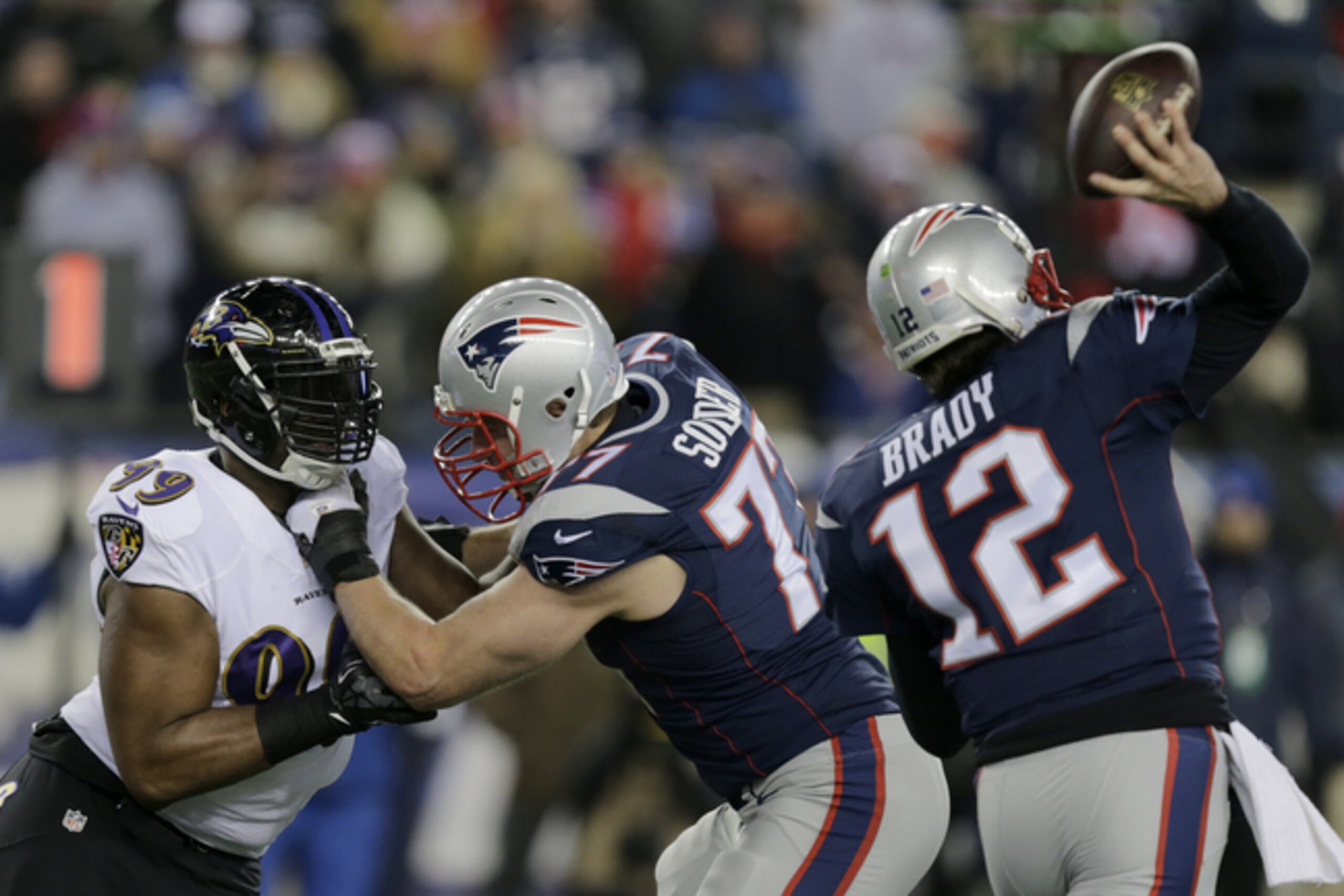
New England's wretched pass protection raised a national frenzy as the team slogged through September last year, and although the Pats settled on a starting five, their pass-protection rate still ranked just 20th based on PFF's metrics. The Patriots weren't bad with their preferred line of Nate Solder, Dan Connolly, Bryan Stork, Ryan Wendell and Sebastian Vollmer, but the total lack of depth meant that even a single injury would submarine the entire unit.
The O-line might not even retain its starting five, as Connolly has reportedly garnered interest from Seattle, Tampa Bay, Chicago and Miami, according to NFL.com's Ian Rapoport. Though Connolly is an over-30 injury-prone guard with limited athleticism, his veteran leadership probably made a tangible impact in the wake of Logan Mankins' stunning late-August trade.
More problematically, most of New England's pass-protection woes came in the interior, and Connolly's departure would only deplete an already paper-thin area of the roster. With Ndamukong Suh, Muhammad Wilkerson and Marcell Dareus all in the division, it's not a stretch to suggest that improving the interior line is the Patriots' most important remaining priority.
If Connolly leaves, developmental prospects Josh Kline and Jordan Devey wouldn't represent viable Day 1 solutions, as both were miserable during brief stints as starters last year. Natural tackles Marcus Cannon and Cameron Fleming also weren't particularly effective when the Pats attempted to kick them inside. Evan Mathis would be an exciting addition via trade, but the Patriots appeared to drop out of the Mathis sweepstakes weeks ago.
So once again, this need will likely defer to the draft for a solution. The uber-versatile Cameron Erving would likely be the top target, but Erving's rising stock could push him out of New England's range. In that instance, a trade out of the 32nd pick could allow the Pats to spend a mid-second rounder on someone like A.J. Cann or Laken Tomlinson. Ultimately, the Patriots need someone they can rely on for 16 games to ensure that Tom Brady does not take a beating in AFC East competition.

.jpg?w=2560 "Chiefs Dolphins Football")