

Jae Crowder Quickly Showing Why He Should Be Integral Part of Celtics' Future
The Boston Celtics would not be surging toward the playoffs if Jae Crowder played for a different team.
Acquired from the Dallas Mavericks as a throw-in contract to make money match in the Rajon Rondo trade, Crowder has thrived as a critical role-player in head coach Brad Stevens’ hyperactive system.
He brings toughness. He embodies energy. Crowder can shoot three-pointers, guard multiple positions and isn't afraid to detonate his muscular frame in the paint when soaring for a rebound.
TOP NEWS

Buzz: Knicks' KAT Offer $77M Below Max

Surprise Dubs Trade Idea 💡

Projecting New-Look Lakers Rotation 🧐
He's also a restricted free agent after this season. Depending on just how high his price tag rises, matching any offer sheet the 24-year-old receives is now on Boston's summer to-do list.

How expensive that offer sheet gets is anybody's guess at this point.
Crowder's individual statistics don’t pop off the page. In about 23 minutes per game, he's only averaging 8.8 points and 4.5 rebounds, with a .516 True Shooting percentage (since joining the Celtics) that would rank about 220th in the league, according to ESPN's NBA player stats. But this isn't the best way to measure Crowder's impact or value.
Courtesy of MassLive's Jay King, here's what Stevens and Danny Ainge think about Crowder so far:
"When the Celtics initially acquired Crowder, president of basketball operations Danny Ainge called the forward "undervalued." That might have continued to be the case if he had stayed at starting small forward. Instead, a role change led to a more prosperous fit.
"I think he's added to what we want to be," Stevens said recently. "He's a skilled guy on offense. He's fearless. And he's a guy that can guard multiple positions, and does so with tenacity. So you love guys like that. He's been a good pickup for us."
"
The Celtics know what they have and don’t misuse Crowder's skill set. They don't run him off screens or isolate him in the post. Crowder stays in his lane, understands what's needed on both ends and delivers as best he can.
But at the same time, he's simultaneously willing to go above and beyond what most players his size are asked, or able, to do. Crowder is a rangy weapon. He can handle the ball and score after setting a sturdy screen. (According to Synergy, he ranks in the 87th percentile as a roll man, averaging 1.17 points per possession in a limited sample size.)
It's a perfect match for what the Celtics do: utilize positionless lineups that highlight the roster's overall versatility. It makes their offense so difficult to scout and defend and allows them to wreak havoc on the other side of the ball.
He's a nightmare off the bench, tenaciously guarding four positions, giving Boston the option to switch pick-and-rolls and spread the floor when they have the ball—Crowder makes nearly 40 percent of his threes when no defender is nearby. He can't be left open, which really hurts defenses when Crowder drags opposing bigs out to the perimeter as a power forward.
Here's his shot chart in a Celtics uniform.
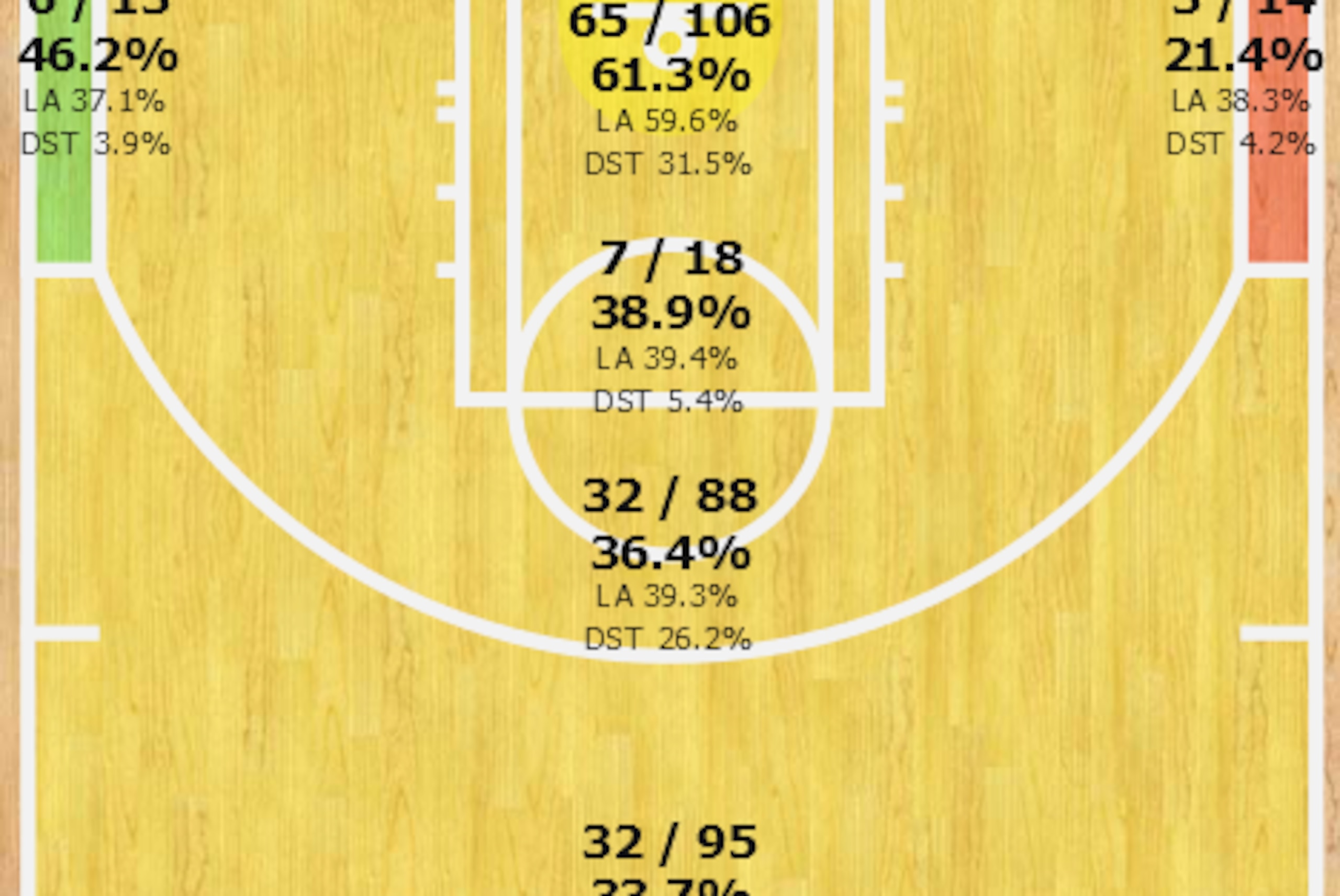
For the entire season, when Crowder isn't on the court, Boston gets outscored by 4.9 points per 100 possessions—the largest disparity from any Celtic this season. Much of his impact comes on the glass. Crowder bum rushes the paint when teammates take outside shots; Boston's offensive rebound percentage is 28.0 when he plays and 22.1 when he doesn't.
Sometimes, you can’t describe Crowder's impact with words, you just need to see him banging people around.

This play doesn't show up on a stat sheet, and it had virtually no impact on this particular game's outcome.
But who cares about all that?
Basketball is still played by really large dudes who take pride carving out on-court real estate and claiming it as their own. Crowder doesn't carve his own space so much as invade someone else's.
He never stops going in.
The Oklahoma City Thunder's Steven Adams, one of the larger, most physical players in the league, is a witness.
The Celtics want to push the pace, force turnovers and attack the paint in transition. In March, 26.7 percent of Crowder's points have come via the fast break, which ranks 12th in the league among bench players who average at least 15 minutes per game. (Additionally, he isn't the most efficient transition scorer in basketball, ranking in the 35th percentile, according to Synergy.)
On the other end, Boston prides itself as one of the best transition defenses in basketball, and Crowder is a major reason why. He's always hustling back, stopping the ball-handler himself or appearing out of nowhere to swat a layup. He understands how to balance the floor.
In the half court, Crowder tends to prematurely jump passing lanes and help off his man when a smaller teammate is about to get bullied in the post, but all this stuff is what the Celtics—a team that has zero rim protection—need.

With the shot clock winding down, Orlando Magic center Nikola Vucevic passes it to Channing Frye, who has a mismatch in the post. Crowder recognizes the situation, drops down to trap and helps force a turnover.
He gambled, sure.
But the person he's guarding rarely has fun once they receive the ball. On field-goal attempts when Crowder defends beyond 15 feet from the basket, opponents shoot 3.3 percent below their average, according to SportVU.
He isn't a perfect defender—particularly when his man is the screener on a pick-and-roll, and the scheme doesn't call for a switch—but Crowder is aggressive, quick and physical.
Some of his success is surely due to the pair of meat hooks attached to both wrists. Only two players in his draft class measured longer hands than Crowder's 9.5 inches—Anthony Davis and Andre Drummond were in that class, and these aren't the players in question.
Crowder's so great at forcing turnovers, lunging at opposing ball-handlers and poking the ball away before they're home free.
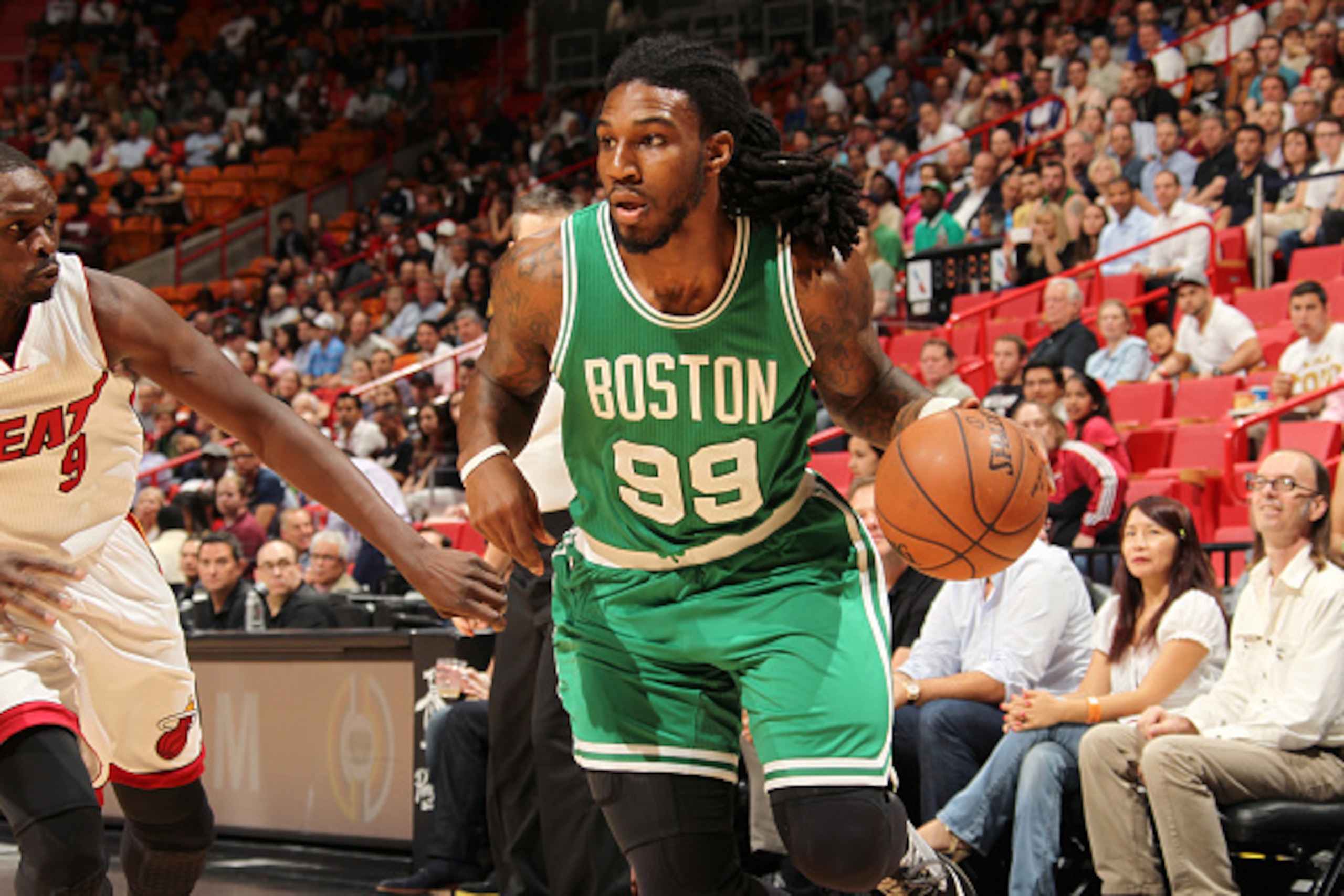
His absolute ceiling as an NBA player is something like the wing version of the Golden State Warriors' Draymond Green: a gritty demon who isn't afraid to guard anyone and can knock down wide open threes when the ball is swung his way. (Crowder also can attack off the dribble, pass and play multiple positions, when necessary.)
He noticeably affects games upon entering them, and since Feb. 2—when the Celtics began to go on a bit of a roll—Boston offense averages 107.5 points per 100 possessions when he's on the floor and a grotesque 96.5 when he's not.
Other teams around the NBA are noticing the Celtics, which means they're noticing Crowder. How expensive an offer sheet gets is anyone's guess right now, but it'd be tough for Ainge not to match whatever he sees.
All statistics are courtesy of Basketball-Reference.com or NBA.com, unless otherwise noted.
Michael Pina is an NBA writer who lives in Los Angeles. Follow him on Twitter @MichaelVPina.


.jpg?w=2560 "Love's Body Already 'Tired'")
.jpg?w=2560 "Tyreek Deal May Come Soon")
.jpg?w=2560 "Ward Nearly Walks Out of Presser ▶️")

.jpg?w=2560 "NFL investigating 2 referees for separate viral exchanges")



