

Breaking Down Why Goran Dragic Is a Good Fit Alongside Dwyane Wade
The acquisition of Goran Dragic has kept the Miami Heat afloat in the Eastern Conference playoff race. The Heat currently lead the Charlotte Hornets by just a half-game for the eighth and final spot, and Miami is only going to get better as Dragic continues to mesh with the team.
Especially in light of the blood clots in Chris Bosh's lungs that ended his season, Dragic provides a secondary on-ball creator for an offense that relies on quick decision-making.
The effects have already been visible on a statistical level. His net rating in two-man lineups with almost all of Miami's key contributors is plus-4.0 or greater, according to NBA.com; he's a plus-3.7 in his personal net rating despite Miami's overall minus-1.8; he's dishing out assists on almost a quarter of his used possessions, an impressive rate for a player who's relied upon to both score and distribute.
TOP NEWS

Buzz: Knicks' KAT Offer Revealed

Buzz: Bron Chopper Part of Deal 🚁

MJ Makes Record-Setting Donation 🙌
Although Dragic has always been more of a scoring point guard, it's his natural passing instincts that have relieved stress for all of Miami's players. The pace-and-space concept that head coach Erik Spoelstra employs masks a lot of shot-creation issues that most teams face, but sometimes an offense needs a decision-maker that can create in other ways.
An unfortunate reality of professional basketball is that much of it devolves into isolation or pick-and-roll play. With such a short shot clock, there often isn't enough time to cycle through multiple ball swings. Someone has to make something happen.
With better players, however, a more team-centric style is almost impossible to defend. What made Miami so difficult to guard over the past few seasons—besides the obvious individual greatness of LeBron James, Dwyane Wade and Bosh—was their willingness to continually change sides of the floor with the ball.
It's already hard enough to guard some of the best isolation players in the world. Trying to do that while constantly rotating from side-to-side is nearly impossible. James, Wade and Bosh are so skilled that they were able to attack these shifting defenses with ease.
Here's an example from last season in which Miami shares the ball beautifully without ever trying to break someone down in isolation or truly using a ball screen.
After Wade kicks the ball back out to Mario Chalmers on the perimeter, he whips it immediately across the floor to James:
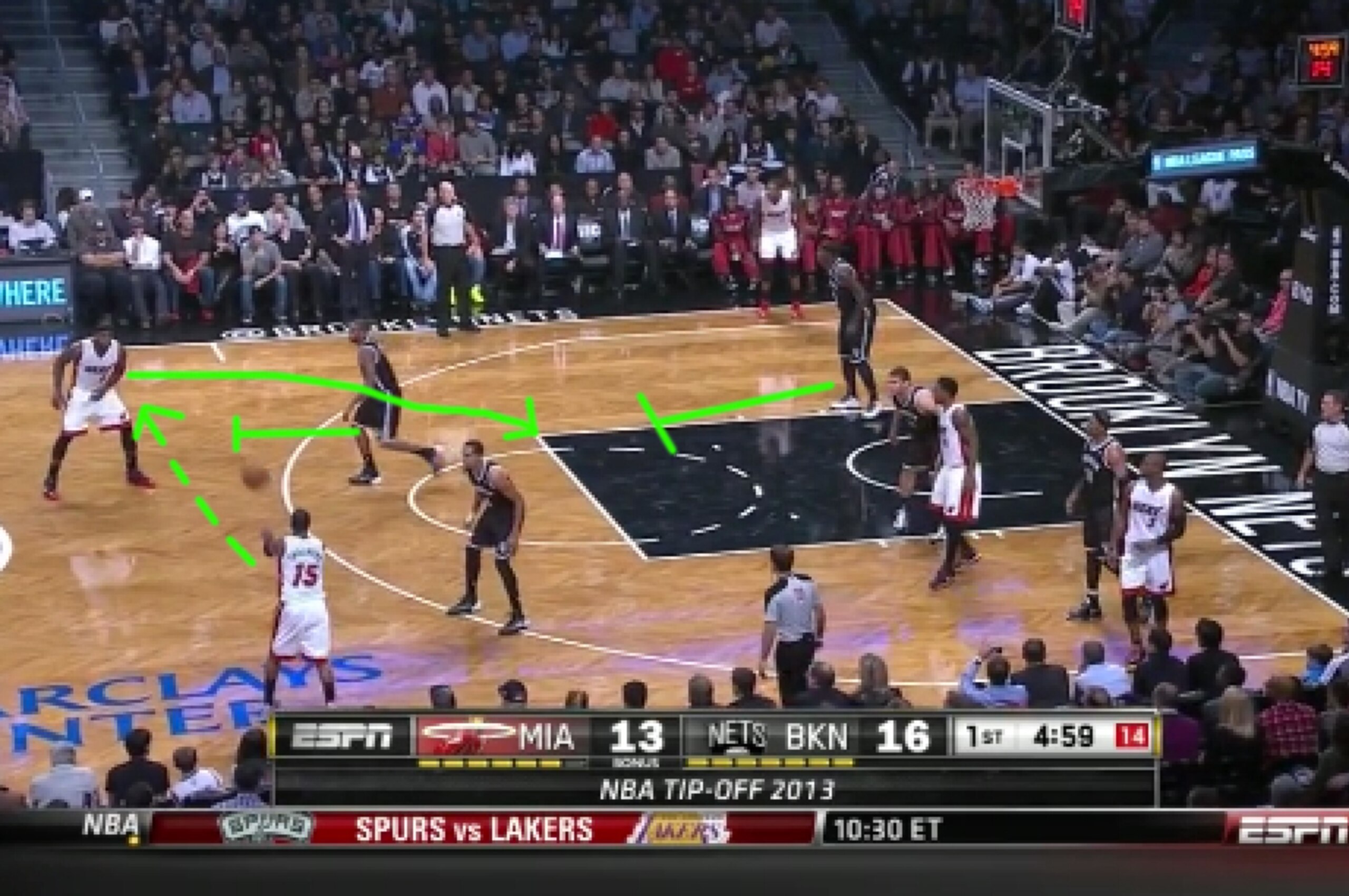
LeBron does not hesitate and attacks off the bounce. This draws Bosh's defender, Andray Blatche, into the paint. James hits Bosh, Bosh hits Blatche with a simple pump fake and rises up for the open jumper:
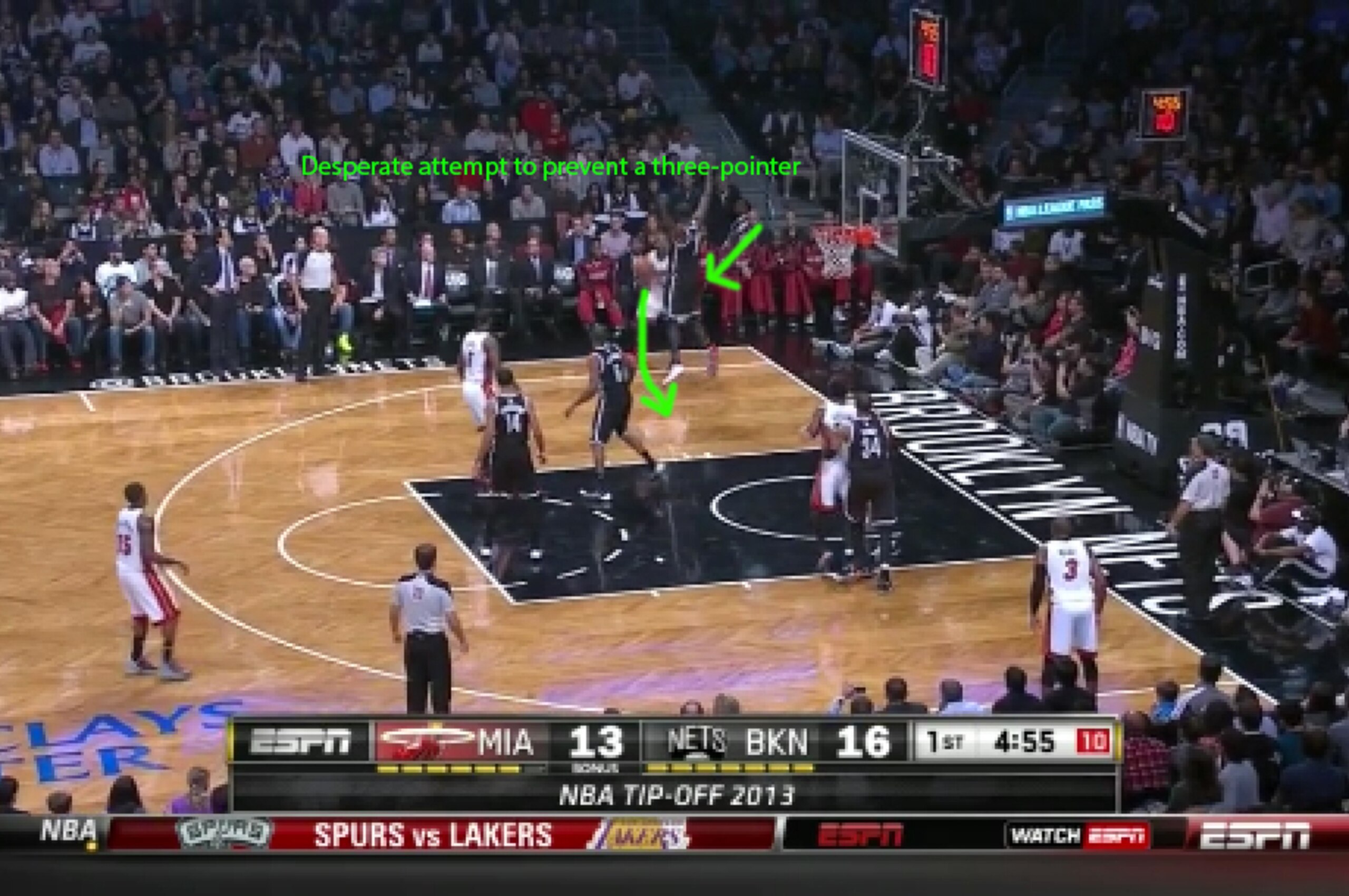
There's nothing particularly special going on here. Wade drags out a pick-and-roll, Chalmers keeps the ball moving and LeBron is able to penetrate despite only the slightest of crevices. It's not like his defender, Alan Anderson, has to close out all that much.
But for a player of James' caliber, even that half-step of momentum carrying Anderson out toward the three-point line is enough to leave him vulnerable. Miami had three players last year with this capability:
Miami's team this year doesn't have quite the same firepower. Passing for the sake of passing has less of its desired effect because there aren't as many players on the floor that can take advantage of small creases in the defense.
What looks like a great possession of ball movement might only result in a so-so shot. At some point the onus is on an individual to command additional defensive attention with a decisive move to the rim. Penetrate and pitch. Draw and kick. There are lots of terms for this concept, but it takes a certain level of skill to draw multiple defenders in the first place.
Miami is still generating those same small holes in the defense, but their team without Dragic is not good enough to consistently capitalize on them.
In the play below, Miami runs a "turn 5" or "thru 5" action for Hassan Whiteside—a post-up isolation play which is preceded by a guard looping around the big to brush his defender back.
Whiteside kicks the ball out to a moving Wade, who is able to penetrate baseline and collapse the entire Boston Celtics defense. Five players are effectively in the paint, and two Miami players are wide-open along the three-point line:
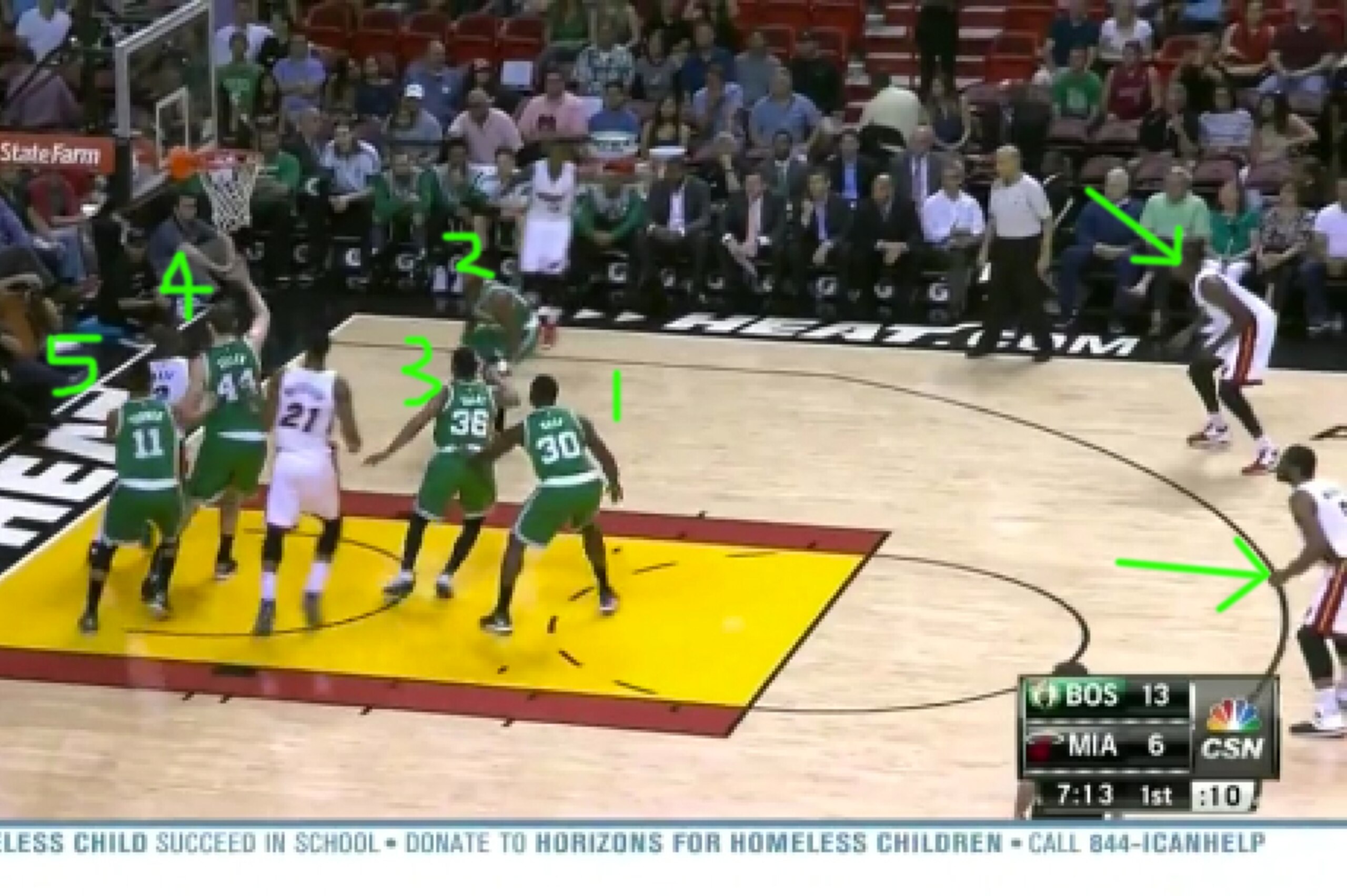
Wade hits one of them, Luol Deng, who has an ample amount of space to fire a three-pointer. He chooses to pump fake instead, which is a perfectly reasonable decision because it's an attempt to generate further rim pressure.
It's also an easy move considering Marcus Smart's closeout to Deng. Because he's running at full speed, it will be nearly impossible for him to throw on the brakes and contain dribble penetration. His only hope is to run Deng off the three-point line, which he does:

You would think Miami would be in a favorable position at this point. They're attacking downhill at the rim in a four-on-five situation.
Except the play ends in a tough Deng floater and a miss:
This is the limitation of Miami's roster. Deng is a solid player, but he's not able to rumble down to the rim like in years past. He's also not much of a touch finisher, as he's only attempted 29 runners on the whole season, according to Synergy Sports.
But he's forced into the shot because he gets scared off by Evan Turner stepping up into a rim-protecting position. If this is a player of a higher offensive caliber, the play almost certainly results in a dunk or layup. It's these few possessions each game when Miami can't capitalize on great scoring opportunities that are coming back to haunt them.
Part of the problem is that the Heat are relying too much on Wade as a creator. At heart, he's a scoring 2-guard, but the lack of a solid, distributing point guard means the duties have fallen to him.
The domino effect of this shift means that Wade is no longer focusing on the strongest part of his game. His effectiveness, therefore, is mitigated by his team's roster holes.
With Dragic initiating, Wade can slide back into his more comfortable role as an off-ball scorer. This doesn't mean that he can't or won't take certain possessions for himself—he can still back someone down in the post or isolate—but the relief of having another creator increases efficiency by decreasing volume.
Dragic's passing ability is also making Miami's bigs more effective in the pick-and-roll. Whiteside's elite athleticism is a huge asset, but he needs someone to get him the ball. And with Wade now on the outside instead of running pick-and-rolls, there's a three-headed monster that defenses must contend with.
If it doesn't shrink the floor and suck in on Dragic-Whiteside pick-and-rolls, a dunk is coming:
If it sucks in too far, a kickout to Wade for secondary penetration is in play. And the bonus of having Wade circling on the perimeter versus another player is that he doesn't need much of a defensive rotation to attack. Even if the defense bottles up the pick-and-roll well without completely abandoning the three-point line, Wade can still get in deep:
A healthy Bosh would give Miami a truly complementary offensive roster: A pick-and-roll threat in Whiteside, a pick-and-pop threat in Bosh, three isolation creators in Dragic, Bosh and Wade and two post-up threats in Wade and Bosh. Every area of the floor would need to be defended.
Though that's not quite the case, the addition of Dragic is still very crucial. No matter how great Wade has proved he can still be, he's not built to withstand upper-echelon usage rates or be a pick-and-roll passer.
He's a scorer, and the presence of Dragic allows him to do just that.




.jpg?w=2560 "Love's Body Already 'Tired'")

.jpg?w=2560 "Tyreek Deal May Come Soon")

.jpg?w=2560 "Ward Nearly Walks Out of Presser ▶️")