

Rockets Return to Portland Stronger, with 'Scar Tissue' from 2014 Playoff Loss
PORTLAND, Ore. — The reminders were everywhere, around every turn as the Houston Rockets holed up for four days in Portland for the first time since they were sent into the offseason with the most disheartening of defeats.
So much was familiar that even the unseasonably warm March weather felt like early May, when the Rockets played the Portland Trail Blazers for six incredibly tight playoff games in a series ended with Damian Lillard’s dagger three-pointer.
TOP NEWS

Jokic says booing fans not welcome in Denver

Brown with an all-time summary of relationship with Tatum
Worst NBA Predictions 🫣
Through those six games, the Rockets had outscored the Blazers by two points. But they left the Blazers nine-tenths of a second to win the series before it would head back to Houston for a Game 7.
The Rockets knew that night that they would never be together in an NBA locker room again. They were right. The sights and sounds on Wednesday and even memories might be familiar, but the Rockets have moved on because most of the roster has.
“It’s last year,” James Harden said. “It’s long gone.”
Of the players on the active list for the Rockets’ return to Portland, only three—Harden, Terrence Jones and Pat Beverley—actually played against the Trail Blazers in last season’s playoffs. (Dwight Howard is out while rehabbing his right knee, and Donatas Motiejunas, who starts at center, did not play in last season’s series.)
"For the guys that are still here, it was such a disappointing end to that series, but you have to move on," Rockets coach Kevin McHale said. "I think we learned some valuable lessons. I think as a team, you have to build up a little scar tissue so you can keep advancing."
For Harden, too much has happened since, from his summer with the 2014 USA FIBA Basketball World Cup championship team to his own rise as an MVP contender, to feel the pain of last season’s wounds.
To Jones, Portland will always be simply home—not the opponent in a playoff series in which he had been replaced in the starting lineup by Omer Asik.
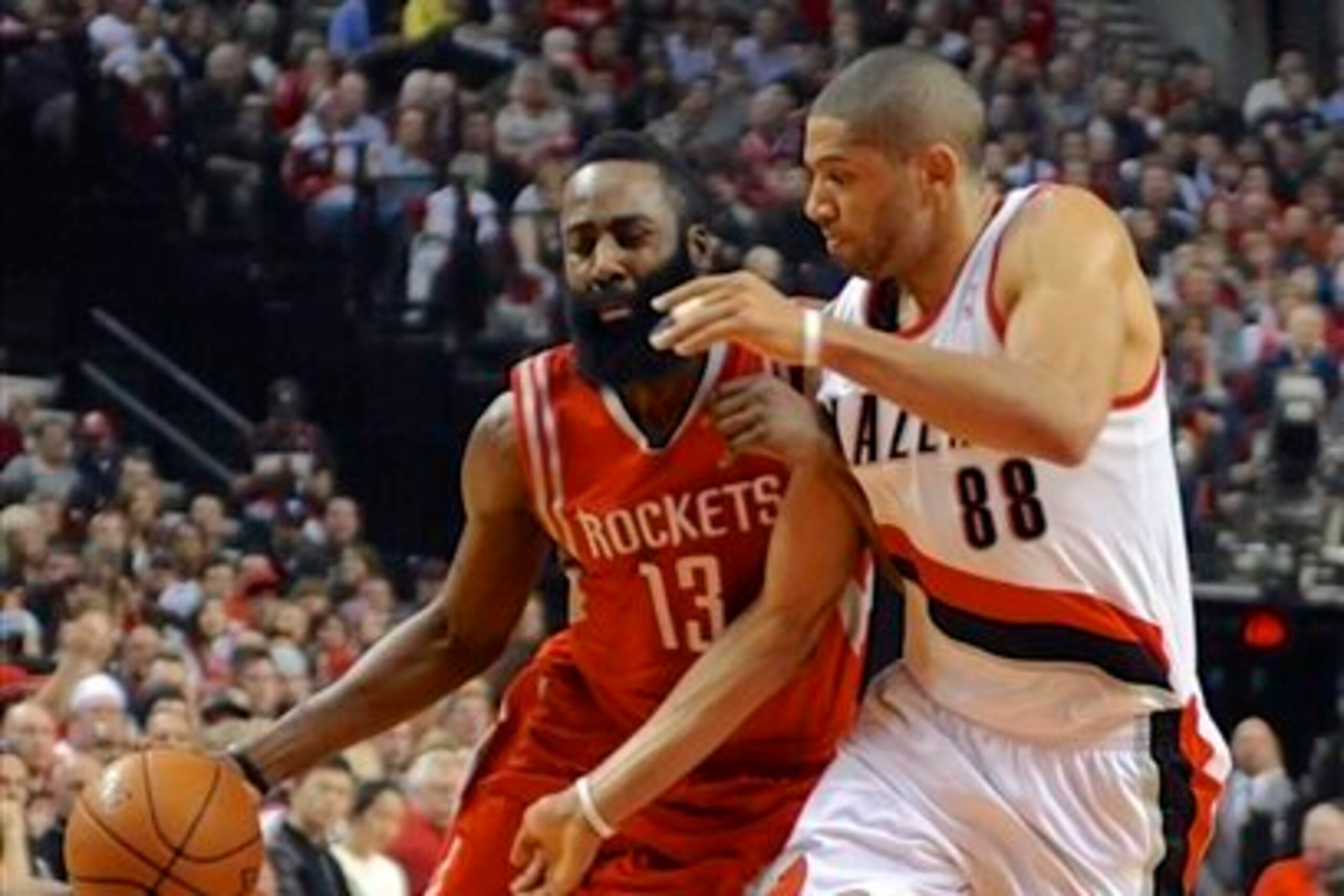
Beverley might have been able to view a return to Portland as special, but he treats every opponent as if it were a rival, making it difficult for even the Trail Blazers to stand out.
The Rockets have felt like a new team because in so many ways, that is what they are.
They are heavily influenced by veterans Jason Terry and Trevor Ariza.
They have completely rebuilt the bench around Josh Smith and Corey Brewer.
The style of those who are back has changed since Howard excelled in that series, with Howard missing nearly as many games (31) as he had in the rest of his career combined (36) and Harden taking the next step as one of the league’s top players.
Even the change to a more aggressive defensive system with players well-suited to run it was not the result of the postseason defense. The loss to the Blazers could have inspired those adjustments, but the Rockets already had those improvements in mind.
“It was such a disappointing finish, but no matter what happened, we were going to try to change the team up a little bit,” Rockets coach Kevin McHale said. “I’m not sure the outcome has as much to do with it as the growth of our team, trying to get better."
Even the improvements defensively do not seem to have been driven by the playoff loss.
The Rockets were 12th in the NBA in defensive rating at the end of the 2013-14 regular season. They return to Portland with the third-rated defense, allowing 99.7 points per 100 possessions according to NBA.com, even with Howard, their best defensive player, out for almost half the season.
McHale, however, said some of the ideas that led to changes in the Rockets’ defensive system were planned before the loss to the Blazers. Harden has said that his defensive improvement was part “of being a superstar,” an ambition he had long before the Rockets left Portland last spring.
Still, as McHale cites the benefits of “scar tissue” his players insist does not exist, the growth of the Rockets since they left the Moda Center seems apparent whether it comes from that loss or not.
The Rockets are considerably older than the team that was the youngest in last season’s postseason, a change McHale wanted throughout last season. They also seem more mature, more grounded.
That would seem to be the sort of growth that can come from defeat. There was a time that the Rockets cited another shocking playoff defeat in the Pacific Northwest—to the Seattle SuperSonics in overtime of Game 7 in 1993—for helping to inspire the championship runs that followed.
More than two decades later, the Rockets would not credit a loss for influencing them so greatly, in large part because while so much looks the same, they do not.
“It’s an entirely different team with a different chemistry,” Jones said.
For the Rockets, the return to Portland was not a reminder of what had been built out of the disappointment but proof that they left it behind.
“Every time that we lost in the playoffs I’ve been very disappointed,” Harden said, “but you can’t let that affect the new year and a new beginning and a new mindset to accomplish more.”

.jpg?w=2560 "Mahomes Told Teammate to Leave Meeting")
.jpg?w=2560 "5 Teams Eyeing Jonathan Taylor")
.jpg?w=2560 "Jonathan Taylor Landing Spots 📍")
.jpg?w=2560 "Baker Gets Glove From Rays 🧤")

.jpg?w=2560 "NFL investigating Eagles")
